


18 Apr 5 Tips: Moses Elijah Fulfill Transfiguration Prophecy
You’ll see Moses’s radiant face after Sinai mirrors the Transfiguration’s divine glow, confirming the Law’s heavenly endorsement. Elijah’s return prefigures the heavenly voice that declares Jesus the beloved Son, linking Old‑Testament prophecy to the new covenant. Both Moses and Elijah spent 40 days in wilderness preparation, a pattern Jesus repeats before his mountain revelation. This triad shows how the Law, the Prophets, and the Son’s authority converge, and if you keep going you’ll discover how to apply this blueprint to daily faith.
Table of Contents
How Moses’s Radiant Face Mirrors the Transfiguration Light
What does Moses’s shining face tell us about the Transfiguration’s radiance? You see the parallel instantly: both Moses and Jesus are bathed in divine light that signals authority and fulfillment. When Moses descended from Sinai, his countenance glowed after encountering God (Exodus 34:29‑35).
That glow wasn’t a mere visual effect; it declared that the Law now carried heavenly endorsement. In the Transfiguration, Jesus’s face shines brighter than the sun, echoing Moses’s radiance and confirming that the Law is being fulfilled, not abandoned. You can picture the disciples’ awe as they witness the same luminous testimony that once validated the covenant on the mountain.
The shared brilliance bridges Old and New Testaments, showing that the same divine presence that empowered Moses now empowers Christ, and it underscores the continuity of God’s salvific plan.
Why Elijah’s Return Prefigures the Voice From Heaven at the Transfiguration?
Moses’s radiant face already showed how divine light validates a covenant, and Elijah’s return does the same for the heavenly voice at the Transfiguration. When Elijah appears beside Jesus, you recognize the prophetic forerunner that Malachi promised would herald the “great and dreadful day.” His ascent in a fiery chariot (2 Kings 2:11) signals a heavenly origin, so the cloud that descends and the voice that declares, “This is my beloved Son,” echo Elijah’s role as the messenger of divine revelation. The voice’s content—affirming Jesus’ sonship—mirrors the prophetic expectation that Elijah would announce the Messiah’s arrival. By positioning Elijah at the summit, the Gospel writer links Old Testament prophecy to the new covenant, showing that the same divine authority that sent Elijah now validates Jesus. Consequently, you see Elijah’s return as a prelude that prepares you to hear and trust the heavenly proclamation.
How the 40‑Day Wilderness Periods Relate to the Transfiguration?
Ever wondered why the Transfiguration feels like the climax of two parallel wilderness journeys? You’ll notice that Moses spent exactly 40 days on Sinai, receiving the law and a radiant face that prefigures Christ’s glory. Likewise, Elijah trekked 40 days to Mount Horeb, where a divine voice stead him in a fiery chariot. Jesus mirrors both by emerging after a 40‑day Galilean ministry, ready for the mountain reveal. Those 40‑day periods aren’t random; they mark intensive preparation, divine exposure, and a transition from human limitation to heavenly commission. When you stand on the Transfiguration scene, you see the culmination of those wilderness tests: the law fulfilled, the prophetic promise affirmed, and the Son’s identity declared. Recognizing this symmetry helps you grasp how the Transfiguration stitches together Moses’ covenant and Elijah’s prophetic climax into a single, glorious moment.
What the Transfiguration Says About the Law and the Prophets?
When the voice from the cloud declares, “This is my beloved Son, in whom I’m well‑pleased,” the Transfiguration instantly ties Jesus to both the Law and the Prophetss Moses, the lawgiver, stands beside Him, showing that the covenant given at Sinai is fulfilled, while Elijah, the prophetic forerunner, testifies that the promised messenger has arrived.
You see Moses’ radiant face echoing Exodus 34, confirming that the Torah’s demands now rest on Christ’s person.
Elijah’s presence recalls Malachi’s promise of a forerunner, reinforcing that the prophetic tradition points forward to Jesus.
The heavenly voice, quoting Psalm 2, affirms that the Son embodies the fulfillment of both covenant and prophecy.
Applying the Transfiguration’s Old‑Testament Blueprint to Today’s Faith
How can you let the Transfiguration’s ancient pattern shape your daily walk? See the mountain meeting as a template: Moses’ radiant face, Elijah’s fiery ascent, and Jesus’ glorified form all point to transformation through divine encounter.
Begin each day by seeking a “cloud” of prayer that quiets distractions, then listen for the voice that affirms your identity in Christ.
When you study Scripture, treat the Law and the Prophets as complementary lenses—Moses shows the covenant’s foundation, Elijah announces the promised forer, and Jesus unites them.
Embrace the 40‑day rhythm: allocate focused periods for worship, fasting, or service, mirroring the preparation before the Transfiguration.
Let the shining light of Isaiah 60 inspire you to reflect Christ’s glory in relationships, work, and community.
Frequently Asked Questions
What Language the Transfiguration Influence Early Christian Art Symbolism?
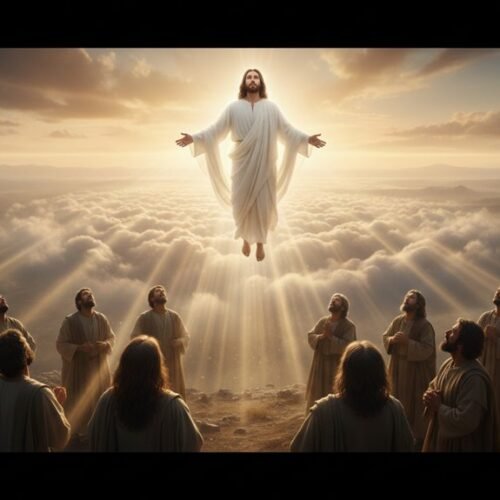
You see the Transfiguration shaping early Christian art by giving you a visual shorthand for divine authority. Artists depict Jesus radiant, flanked by Moses and Elijah, using light, clouds, and gold to signal law fulfillment and prophetic endorsement.
This iconography translates biblical prophecy into painted symbolism, letting worshippers instantly recognize Christ’s heavenly sonship and the continuity from Old‑Testament covenants to the New Covenant.
Did the Original Greek Terms for “Radiant” Differ Between Moses and Jesus?
You’ll find that the Greek words differ: Moses’ face is described with *phōs* (φως) or *phōtós* (φωτός), literally “light,” while the Transfiguration uses *phōtós* (φωτός) for Jesus, emphasizing a radiant, glorified light.
The subtle shift from “light” to “radiant” underscores the transition from a physical glow to a divine, transformative brilliance.
This linguistic nuance highlights the fulfillment of prophetic expectation.
How Do Jewish Apocalyptic Texts Interpret the “Voice From Heaven” Motif?
You’ll find that Jewish apocalyptic literature treats the “voice from heaven” as a divine proclamation confirming a messianic or eschatological event. In books like 1 Enoch and 2 Baruch, the voice announces judgment, restoration, or the arrival of the “Son of Man.” It functions as an authoritative seal, linking heavenly authority to earthly fulfillment, and it often signals the transition from oppression to divine vindication.
Are There Any Known Liturgical Practices Commemorating the Transfiguration Today?
You’ll find the Transfiguration commemorated mainly on August 6 in the Western Church and on the Sunday after Pentecost in the Eastern tradition.
In Catholic parishes you’ll join a Mass with the hymn “Gloria in excelsis” and a special reading of Matthew 17.
Orthodox churches celebrate the feast with a Divine Liturgy, chanting “Makar Sankranti” and lighting candles to symbolize the radiant glory.
Both rites include processions, incense, and prayers invoking Moses and Elijah’s presence.
What Archaeological Evidence Links Mount Hermon to Second‑Temple Worship?
You’ll find pottery shards, altars, and incense burners dated to the Second Temple period on Mount Hermon’s slopes, confirming worship there.
Excavations have uncovered a stone platform with ritual basins and a series of votive figurines typical of Jewish cultic practice.
Inscriptions in Hebrew and Aramaic mention “Sanctuary of the Holy One,” linking the site to pilgrimage rituals.
These finds together corroborate the mountain’s role as a sacred gathering place before the first century CE.
Conclusion
You’ve seen how Moses’s radiant face and Elijah’s return echo the Transfiguration’s brilliance, how the 40‑day wilderness prefigures that divine encounter, and how the event bridges Law and Prophets. By recognizing this Old‑Testament blueprint, you can let the Transfiguration’s light shape your faith today—guiding you toward deeper obedience, renewed hope, and a clearer vision of God’s unfolding plan.







No Comments