

16 Apr Ezra-Nehemiah: Temple Rebuilding Historical Context Explained
You’ll see that the Babylonian exile ripped away the Israelites’ sacred space, leaving a ruined foundation that demanded restoration to revive their covenant and political standing. Cyrus’s 539 BCE decree and Darius’s follow‑up secured the altar, returned treasures, and protected workers, while Ezra’s law‑centered reforms forged a distinct identity through public Torah readings and covenant rites. Nehemiah organized labor, sourced materials, and built the city walls, all under tight economic pressures. Keep exploring to discover how these layers shaped post‑exilic worship and national renewal.
Table of Contents
How the Babylonian Exile Prompted Post‑Exilic Temple Reconstruction
Why did the Babylonian exile ignite the drive to rebuild the temple? You felt the loss of a sacred space as a wound to communal identity. The exile stripped you of the altar, the priesthood, and the rituals that anchored daily life. When you returned, the ruined foundation became a tangible reminder of divine abandonment and a rallying point for restoration. You recognized that rebuilding the temple would re‑establish covenantal legitimacy, signal continuity with ancestral worship, and restore the city’s political standing under foreign rulers. The prophets’ warnings and promises reinforced urgency, urging you to act before the memory of destruction faded. You gathered resources, organized labor, and invoked divine favor through prayer. The project unified disparate groups—returnees, locals, and priests—around a common purpose, turning a shattered past into a hopeful future for the community.
Cyrus and Darius: Persian Policies That Enabled the Return
The urgency you felt after the exile found a practical outlet in the policies of the Persian kings. Cyrus’s decree in 539 BCE restored the altar, returned temple treasures, and granted Judeans permission to rebuild. You recognize his strategy: a broad “policy of restoration” that aimed to stabilize conquered peoples by honoring their religious sites.
Darius I continued this approach, issuing a second decree that confirmed Cyrus’s orders, appointed governors to oversee fund collection, and protected the construction workers from local opposition. He required regular tax reports, ensuring the project stayed financially viable while reinforcing Persian authority.
Both monarchs used edicts, not coercion, to mobilize diaspora communities, allowing you to coordinate labor, secure materials, and re‑establish worship. Their pragmatic tolerance turned a distant imperial edict into a concrete, actionable plan that revived the temple and reshaped Judean identity under Persian rule.
Ezra’s Reform: Law and Identity in Post‑Exilic Temple Reconstruction
How did Ezra’s reforms reshape the community’s sense of identity while the temple rose again? You see the law become the glue that bound a scattered people to a renewed worship center. Ezra gathered the returned exiles, read the Torah aloud, and demanded obedience to its statutes. By insisting on circumcision, Sabbath observance, and dietary purity, he forged a distinct covenantal identity that set the Jews apart from surrounding cultures. The public covenant ceremony at the rebuilt temple turned abstract commandments into lived reality, reinforcing communal solidarity. You notice that Ezra’s emphasis on public reading and instruction created a shared narrative of redemption, turning the temple into both a sacred space and a cultural beacon. In this way, the law didn’t just regulate behavior; it reshaped collective memory, ensuring that the rebuilt sanctuary symbolized a unified, law‑centered people.
Nehemiah’s Wall‑Building Project and Civic Organization
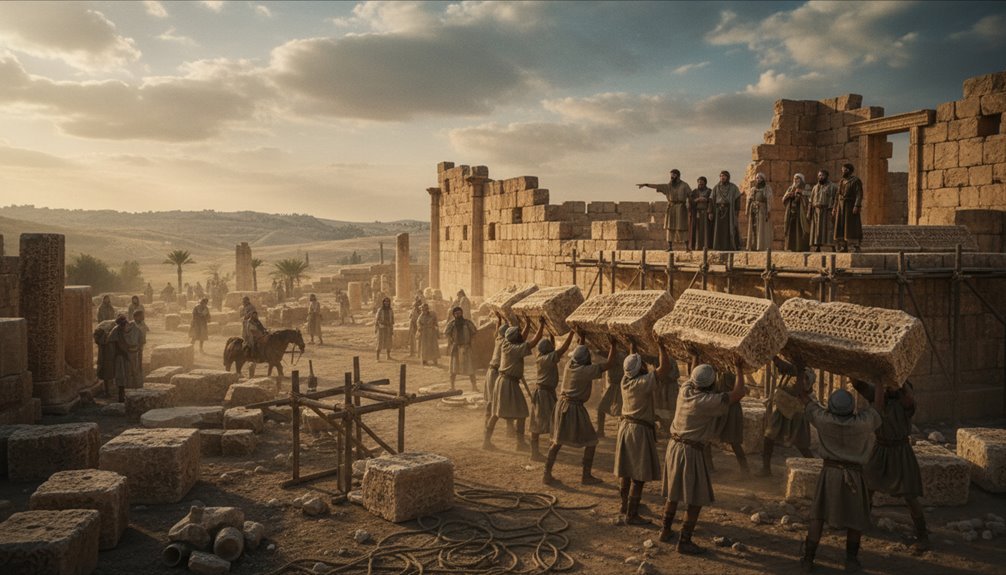
You’ll see how Nehemiah mobilized labor forces, secured material supplies, and coordinated civic leadership to rebuild Jerusalem’s walls. He organized workers by family and skill, ensuring everyone contributed while protecting the stockpile of timber and stone.
The result was a unified community that completed the fortifications quickly and efficiently.
Mobilizing Labor Forces
What drove Jerusalem’s residents to rally around Nehemiah’s wall‑building effort? You see, Nehemiah framed the project as a collective defense mission, reminding everyone that a fortified city meant safety for families and worship.
You feel his urgency when he gathers the people at the gate, assigning each family a specific stretch of wall to repair.
You notice how he leverages existing social ties—brothers, fathers, and neighbors work side by side, turning personal pride into public duty.
You observe that he uses a rotating schedule, allowing farmers and merchants to tend their trades while still contributing labor.
You recognize his strategic use of incentives, offering praise and communal feasts to those who finish their sections quickly, which fuels momentum and keeps morale high.
Securing Material Supplies
Where did the stones, timber, and tools come from? You’ll find that Nehemiah tapped local quarries, forested hills, and nearby workshops to supply his wall‑building crew. He sent envoys to the surrounding Persian provinces, negotiating with officials who granted access to limestone blocks and cedar logs. Skilled blacksmiths forged axes, chisels, and nails on the spot, while caravan drivers hauled materials along the Via Maris to Jerusalem’s gates. You notice that Nehemiah’s record mentions “the people of the surrounding nations” contributing resources, indicating a mix of tribute and voluntary donation. By coordinating these supply lines, you ensure a steady flow of building materials, preventing shortages that could stall the reconstruction effort.
Coordinating Civic Leadership
How did Nehemiah rally Jerusalem’s leaders to rebuild the wall without chaos? You see him summon the priests, nobles, and officials to a single meeting, then assign each family a specific section of the wall. He pairs skilled workers with those who can guard, rotating duties so labor never stops. You notice his insistence on prayer before each shift, reinforcing unity through shared faith. He establishes watch‑towers staffed by volunteers, creating a rapid response network against attacks. By delegating authority to trusted sub‑leaders, he prevents bottlenecks and keeps morale high. You observe that his transparent reporting—daily tallies of stones laid—keeps everyone accountable, turning a fragmented community into a coordinated, purpose‑driven workforce.
Economic and Social Issues That Affected Temple Reconstruction
You’ll notice that funding shortages and heavy taxation strained the community’s ability to gather resources for the temple. At the same time, labor scarcity—exacerbated by population shifts—made it hard to find enough hands for the work.
These economic and social pressures shaped every decision the leaders made about reconstruction.
Funding Shortages and Taxation
Why did the rebuilding of the temple stall despite the community’s zeal? You’ll find that dwindling funds and heavy taxes crippled progress. The Persian treasury, once generous, cut subsidies after political unrest, leaving local leaders scrambling for contributions.
Levies imposed on agricultural produce and trade goods strained households already recovering from exile, so many could barely afford the modest tithes required for construction.
Moreover, the temple’s tax‑exempt status was ambiguous, prompting officials to demand additional levies that diverted resources to military and administrative costs. As you watch the work slow, you realize that without reliable financing and a clear tax framework, even the most devoted volunteers couldn’t sustain the massive stone‑laying effort.
Labor Scarcity and Population Shifts
Where did the workers go when the temple’s foundations needed hands? You’ll find that many laborers had already fled to the surrounding countryside, seeking safety after the Babylonian exile. The remaining population was thin, and the few who stayed were often older or infirm, unable to lift heavy stones. Additionally, the Persian administration recruited Jews for military service and tax‑collection duties, pulling them away from construction sites. Seasonal migrations for harvests further thinned the workforce, as families moved to fertile lands to secure food. These demographic shifts left a chronic labor shortage, forcing Ezra and Nehemiah to negotiate with governors for temporary labor levies and to rely on volunteer crews, which slowed progress and increased costs.
Post‑Exilic Worship: Theological Shifts After Temple Reconstruction
How did the return from exile reshape the community’s worship? You see a people who once prayed in hidden synagogues now gathered before a restored altar, insisting on public sacrifice and liturgical order. The temple’s reconstruction re‑centralized worship, shifting emphasis from spontaneous, prophetic utterances to formalized rites. You notice the priesthood’s renewed authority, as the high priest mediated covenant renewal through burnt offerings, incense, and the Day of Atonement. The Torah’s public reading, instituted by Ezra, turned Scripture into a communal liturgy, reinforcing identity through the “Shema” and “Deuteronomy” passages. You also observe a theological pivot: the exile experience taught that divine favor hinges on fidelity, so covenant renewal linked obedience with national restoration. Consequently, you find worship becoming both a reminder of past transgression and a forward‑looking promise, binding the community to a restored, covenant‑faithful future.
Frequently Asked Questions
What Archaeological Evidence Supports the Temple’s Original Layout?
You’ll find the temple’s layout in the Jerusalem excavations: the massive stone foundation known as the “Temple Mount” platform, the basalt paving of the courtyards, and the preserved altar base with its distinctive rectangular shape. Pottery shards and seal impressions match the 6th‑century BCE chronology, while the discovered “gate of the priests” aligns with biblical descriptions. Together, these finds confirm the original plan described in Ezra-Nehemiah.
How Did the Local Non‑Jewish Population React to the Reconstruction?
You’ll find that the surrounding peoples—primarily Samaritans, Ammonites, and Phoenicians—were hostile. They mocked the work, shouted curses, and even tried to sabotage the foundations. Their leaders appealed to Persian officials, claiming the Jews were overstepping. Yet you also see occasional cooperation: some local laborers were hired, and a few officials tolerated the project for political stability. Overall, the reaction was a mix of overt opposition and pragmatic acquiescence.
What Role Did Women Play in the Post‑Exilic Religious Community?
You’ll find that women helped essential in maintaining the post‑exilic religious community. They organized and led household worship, taught children the Torah, and kept the Sabbath observances alive.
Their participation in the temple’s peripheral activities—like preparing offerings and supporting the priestly staff—ensured continuity. By preserving oral traditions and fostering communal solidarity, women sustained the community’s identity and faith throughout the rebuilding era.
Did the Persian Empire Tax the Temple’s Construction Labor?
You’ll find that the Persian Empire didn’t levy a direct tax on the temple’s construction labor; instead, it granted the Jews a tax‑exempt status for that work. The king’s decree allowed them to collect donations and use local resources without imperial tribute.
While they still paid ordinary provincial taxes, the building project itself was financially protected, letting the community focus on rebuilding without extra fiscal burdens.
How Did the Temple’s Restoration Influence Neighboring Cultures’ Architecture?
You’ll see that the temple’s restoration sparked a wave of architectural borrowing across the region. You notice Persian officials adopting its massive stone columns and vaulted roofs, while Hellenistic cities start echoing its stepped terraces and decorative friezes.
You also spot Jewish diaspora communities replicating its layout in synagogues, influencing local worship spaces.
In short, the rebuilt sanctuary became a visual template that reshaped neighboring building traditions.
Conclusion
You’ve seen how the exile forced Jews to re‑imagine their identity, how Persian rulers cleared the way, and how Ezra and Nehemiah turned those opportunities into a rebuilt temple and fortified city. Their reforms reshaped worship, law, and community life, leaving a lasting legacy that still shapes Jewish thought and practice today.









No Comments