

16 Apr Why Did Jesus Ascend Into Heaven?
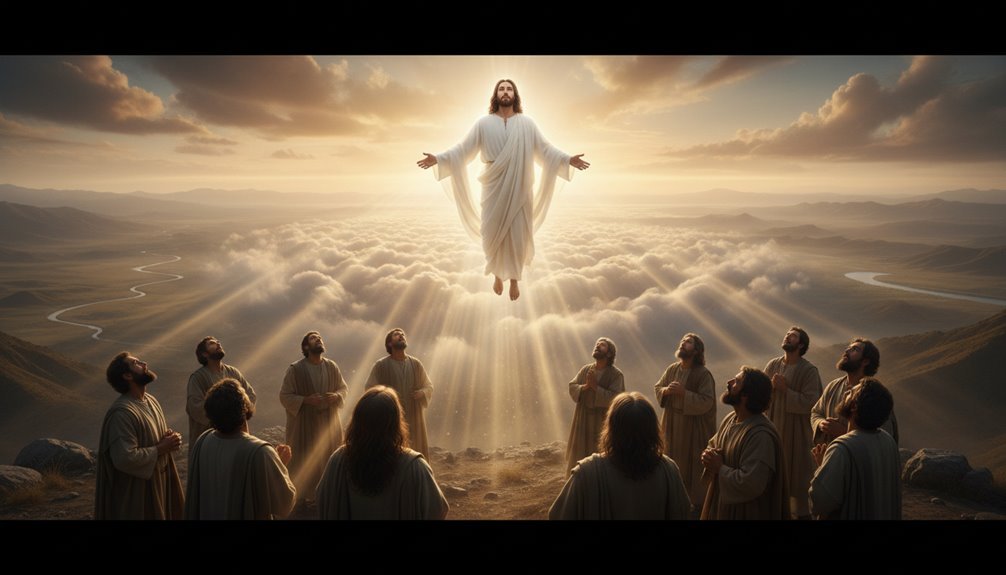
You’ll find that Jesus ascended to fulfill Scripture, to take the exalted seat at God’s right hand, and to open the way for the Holy Spirit’s work on earth. The Gospels show Him being lifted up after appearing to the disciples, confirming His kingship and completing His earthly mission. This act also guarantees His ongoing intercession and promises His return, so you can see how the Ascension links past prophecy with present hope and future glory.
What the Gospels Say About the Jesus Ascension
Why does the ascension matter? You’ll see that each Gospel frames it uniquely, yet all agree it marks the climax of Jesus’s earthly mission.
In Mark 16:19, you read that after appearing to the disciples, He “was taken up into heaven and sat at the right hand of God.”
Luke adds detail in 24:50‑53, describing how He led the disciples to Bethany, lifted His hands, blessed them, and then was carried up while a cloud hid Him.
Matthew’s account (28:18‑20) is brief, focusing on the Great Commission before noting that “the Father… will send… the Holy Spirit.”
John offers the most theological spin in 20:17‑19, where Jesus tells Mary Magdalene that He’ll go “to the Father” and that He’ll appear again.
Together, these passages give you a clear, multi‑angle picture of the ascension’s narrative role and its immediate impact on the early followers.
Why the Jesus Ascension Matters Theologically
The Gospel accounts show the ascension as the moment Jesus completes His earthly work and moves into a new role that reshapes Christian belief. You see that his return to heaven isn’t a departure but an exaltation that validates his divinity and authority. By ascending, he takes his seat at the right hand of God, confirming that the kingdom isn’t just a future hope but a present reality governed by his sovereign rule. This act opens the way for the Holy Spirit’s indwelling, because the Father sends the Spirit from the place where Jesus now reigns. You also recognize that the ascension guarantees his ongoing intercession for you, as he petitions on your behalf before the Father. It signals the fulfillment of prophecy, linking Old Testament promises to New Testament fulfillment, and it anchors your hope in a Christ who remains actively involved in history.
How Churches Observe the Jesus Ascension Day
Ever wondered how churches actually mark Ascension Day? You’ll find that most congregations schedule a special service on the fortieth day after Easter, often combining a sunrise worship with a solemn liturgy. You’ll hear hymns like “The Ascension” and read passages from Acts 1, while the pastor emphasizes Christ’s exaltation and promised return. Many churches decorate the sanctuary with white drapes and banners symbolizing heaven’s glory, and some release balloons or doves to represent the Spirit’s ascent. You might join a procession that moves from the altar to an outdoor cross, echoing the disciples’ journey to the mount. In Catholic parishes, the day includes a Mass with a specific “Ascension” feast, while Protestant communities may opt for a shorter gathering and a sermon focused on mission. You’ll also notice charitable outreach events, reminding you that the Ascension calls believers to serve the world.
Frequently Asked Questions
What Historical Evidence Exists for the Ascension?
You’ll find that the ascension isn’t documented in contemporary secular records, but early Christian writings give it prominence. The New Testament’s Acts (1:9‑11) and Luke’s Gospel (24:50‑53) describe it, and Paul’s letters (1 Cor 15:3‑7) reference it as a witnessed event. Later, non‑Christian sources like the Roman historian Tacitus and Jewish historian Josephus mention early Christian belief in Jesus’ divine exaltation, though they don’t detail the ascent itself.
Did Jesus Physically Rise or Was It Symbolic?
You’ll find that most scholars treat the ascension as a symbolic event rather than a literal, physical rise. Early Christian writers describe it in theological terms, emphasizing Jesus’ transition to divine authority and his ongoing spiritual presence.
While the New Testament narratives portray a bodily departure, historical analysis interprets those accounts as metaphorical expressions of belief, not verifiable physical phenomena.
How Do Non‑Christian Traditions View the Ascension?
You’ll find that many non‑Christian traditions treat the ascension as a mythic motif rather than a historical event. In Hinduism, it mirrors divine avatars returning to the celestial realm. Buddhist stories speak of enlightened beings transcending the material world. Islamic texts acknowledge Jesus’s unique status but describe his return to God without a physical ascent. Generally, these perspectives see the narrative symbolically, emphasizing spiritual elevation over literal departure.
What Linguistic Nuances Affect the Greek Term “ἀνάληψις”?
You’ll notice that “ἀνάληψις” carries a range of nuances. In classical Greek it often means “a lifting up” or “an ascent,” but in the Septuagint and New Testament it can imply “translation” or “exaltation.” The term’s gender and case affect whether it describes a physical rise, a spiritual glorification, or a doctrinal event.
Pay attention to surrounding verbs—like “ἀναβαίνω” versus “ἀναλαμβάνω”—because they shift the focus from literal movement to theological elevation.
Is the Ascension Mentioned in Any Apocryphal Writings?
You’ll find the ascension referenced in several apocryphal texts, though they differ from the canonical account. The Proto‑Evangelium of James mentions Jesus’ return to heaven after his resurrection, and the Acts of Peter and Acts of John describe him being taken up in a glorious vision.
The Apocalypse of Peter and the Gospel of Thomas also allude to a heavenly ascent, but these writings lack the doctrinal detail and authority of the New Testament.
Conclusion
You now see why the Ascension isn’t just a dramatic exit but the cornerstone of Christian hope. It confirms Jesus’ divine authority, seals the promise of the Holy Spirit, and guarantees that He’s still actively leading the Church from heaven. By remembering this event, you’re reminded that Christ’s reign is ongoing, that His presence transcends earthly limits, and that your faith rests on a living, exalted Savior.












No Comments