

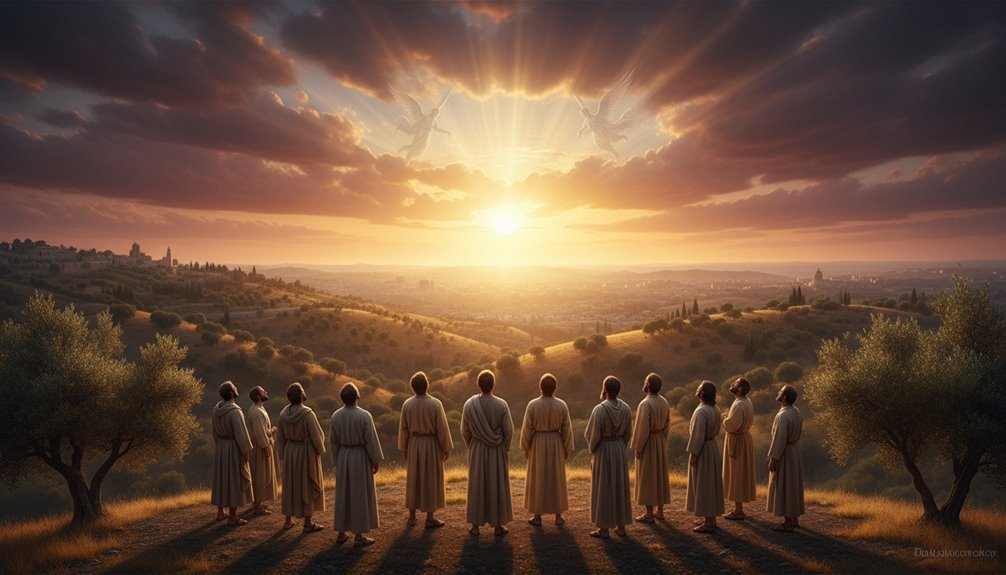
16 Apr 5 Biblical Significances of Ascension Day on Mount of Olives
You’ll see why the Mount of Olives—overlooking Jerusalem at 800 feet—was chosen: its height gave every disciple a clear view, and its historic ties to Jesus’ ministry made the Ascension a dramatic, prophetic climax. The site fulfills Psalm 24 and Zechariah 14, showing the Lord’s universal ownership and future return. Olive trees, eastward sunrise, clouds and wind all symbolize the coming Kingdom. Gospel accounts place post‑resurrection appearances there, and centuries of liturgy keep the connection alive, so the next section will reveal even deeper insights.
Why Was the Mount of Olives Chosen for the Ascension?
Why was the Mount of Olives selected for the Ascension? You’ll find it’s not a random hill; its geography and history make it ideal. The Mount sits east of Jerusalem, overlooking the city and the Temple, so every witness could see the event clearly. Its elevation—about 800 feet above sea level—offers a natural platform for a dramatic departure without needing a constructed stage. The Olives had already hosted pivotal moments: Jesus entered Jerusalem on Palm Sunday, taught on its slopes, and prayed there before his crucifixion. Those precedents gave the site symbolic weight, linking the Ascension to his earthly ministry.
Moreover, Jewish tradition held that the Messiah would return from this mountain, so choosing it underscored continuity with prophetic expectation. The location also provided a safe, open space for the disciples to gather, ensuring the ascension could be observed without obstruction. All these factors combined to make the Mount of Olives the logical, powerful setting.
How Does the Ascension Fulfill Old‑Testament Prophecy on This Mountain?
How does the Ascension fulfill Old‑Testament prophecy on the Mount of Olives? You see the mountain’s prophetic weight in Psalm 24:1‑2, where the earth and everything in it belong to the Lord, and in Zechariah 14:4, which says the Lord will stand on the Mount of Olives on the day of his return. When Jesus rose from the tomb and ascended from that very hill, he embodied the Lord’s claim to universal ownership and inaugurated the eschatological “standing” promised by Zechariah. The ascent also mirrors the “lifting up” language of Isaiah 52:12, where the servant is raised high to be seen by the nations. By leaving the earth from the Mount of Olives, he demonstrates that the promised reign begins now, not merely in a distant future. Thus the event satisfies the Old‑Testament expectation that the Messiah would be exalted on that specific mountain, confirming the scriptures’ forward‑looking vision.
What Symbols Connect the Mount of Olives Ascension to the Coming Kingdom of God?
The Mount of Olives serves as a vivid tableau where several biblical symbols converge to illustrate the future Kingdom of God. You’ll notice the olive trees, representing peace and the anointed one, standing beside the Ascension site—an emblem of divine authority preparing to reign.
The eastward view toward Jerusalem evokes the sunrise of the Messianic age, while the hill’s elevation mirrors the throne’s exalted position.
The cloud that enveloped Jesus at Ascension recalls the Shekhinah, signaling God’s imminent kingdom.
The stone that marked the burial place of the prophet becomes a foundation stone for the new,, hinting at the solid, unshakable reign to come.
The wind that lifted Christ points to the Spirit’s future outpouring, which will empower the kingdom’s expansion.
Together, these symbols weave a coherent picture: the Mount of Olives isn’t merely a backdrop but a prophetic stage linking Christ’s heavenly ascent to the establishment of God’s everlasting kingdom.
Which Post‑Resurrection Appearances on the Mount of Olives Are Recorded in the Gospels?
Where do the Gospels place the risen Christ on the Mount of Olives? You’ll find that Matthew, Mark, Luke, and John each record a distinct post‑resurrection appearance there. Matthew 28:16‑20 tells you the disciples went to a hill in Galilee—often identified with the Mount of Olives—where Jesus met them, gave the Great Commission, and promised his continual presence.
Mark 16:12‑14 describes Jesus appearing to the disciples while they were eating, a scene traditionally linked to the olive grove outside Jerusalem.
Luke 24:33‑36 recounts the disciples gathering in a house on the Mount of Olives, where Jesus entered, showed them his hands and feet, and ate fish with them.
Finally, John 20:19‑20 notes that on the evening of the first day of the week, Jesus appeared to the disciples in a locked room at the Mount of Olives, greeting them with “Peace.”
These four accounts together highlight the Mount of Olives as a focal point for Jesus’ post‑resurrection encounters.
How Do Liturgical Traditions Link the Ascension to the Mount of Olives?
When you trace the liturgical calendar, you’ll see that the Ascension feast consistently recalls the Mount of Olives, because early Christian worship linked Jesus’ final earthly appearance to the place where he promised his return. In the Roman Rite, the Mass of the Ascension includes a procession toward the altar, symbolically reenacting the journey up the hill.
Eastern Orthodoxy celebrates the feast with the “Great Doxology,” chanting “He ascended on the Mount of Olives” while the choir rises, echoing the ascent.
Anglican and Lutheran traditions often read the Ascension narrative alongside Psalm 24, emphasizing the “mount” motif.
In many medieval liturgies, the incense is lifted high, representing the clouds that received Christ above the olives.
Even contemporary worship songs reference the hill, reinforcing the spatial memory that the Mount of Olives is the geographic anchor for the Ascension’s theological significance.
Frequently Asked Questions
Did Early Christians Ever Celebrate Ascension on the Mount of Olives?
You’ll find that early Christians didn’t fix a universal feast on the Mount of Olives for the Ascension. By the second century, the celebration had spread throughout the Roman world, usually held on a Sunday fifty days after Easter, but the specific location varied. Some liturgical texts mention the mount as the place of Christ’s ascent, yet the observance itself remained a communal worship day, not a localized pilgrimage.
Are There Any Archaeological Findings on the Mount of Olives Linked to the Ascension?
You won’t find any definitive archaeological evidence linking the Mount of Olives to the Ascension.
Excavations have uncovered burial caves, early‑Christian chapels, and a 4th‑century church, but none contain inscriptions or artifacts that explicitly commemorate the event.
Scholars rely on literary sources, not material finds, to locate the tradition there.
How Do Different Christian Denominations Interpret the Mount of Olives’ Role in the Ascension?
You’ll find that Catholics view the Mount of Olives as the literal launch point of Christ’s ascension, emphasizing its historicity in liturgy.
Protestants often treat it symbolically, focusing on the theological significance of Christ’s return to heaven.
Eastern Orthodox churches stress the connection to the “Eastertide” narrative, linking the site to the Spirit’s descent.
Each tradition thus interprets the mount’s role through its own doctrinal lens.
What Language Variations Exist for “Mount of Olives” in Biblical Texts?
You’ll find “Mount of Olives” rendered in several ways across biblical languages. In Hebrew it’s “הַר הַזַיִת” (Har HaZayit), literally “the mountain of olives.”
The Greek Septuagint calls it “ὄρος τῶν ἐλαιῶν” (oros ton elaiōn).
In Latin Vulgate you see “Mons Olivarum.”
Early Syriac translations use “ܛܘܪܐ ܕܐܪܙܐ” (turā d‑ārzā).
Modern English translations often prefer “Mount of Olives,” but some opt for “Olive Mountain” for stylistic variation.
Do Any Non‑Biblical Historical Sources Mention the Ascension at the Mount of Olives?
You’ll find that non‑biblical sources barely mention the Ascension at the Mount of Olives. Josephus briefly notes Jesus’ burial nearby but never records a heavenly ascent. Early Christian writers like Eusebius and later apocryphal texts reference the site, yet they rely on biblical tradition. Outside Christian literature, only a few late‑antique pilgrim accounts all the hill, and none describe an ascension event.
Conclusion
So, when you stand on the Mount of Olives, you’re not just looking at a hill—you’re witnessing the climax of God’s redemptive story. The Ascension ties ancient prophecy to present hope, crowns Christ’s kingdom, and echoes the post‑Resurrection appearances that cement faith. Liturgical rites keep this connection alive, reminding you that every step toward heaven began right here, on this sacred mount.










No Comments