

16 Apr Why Did Pentecost Bring a Mighty Rushing Wind?
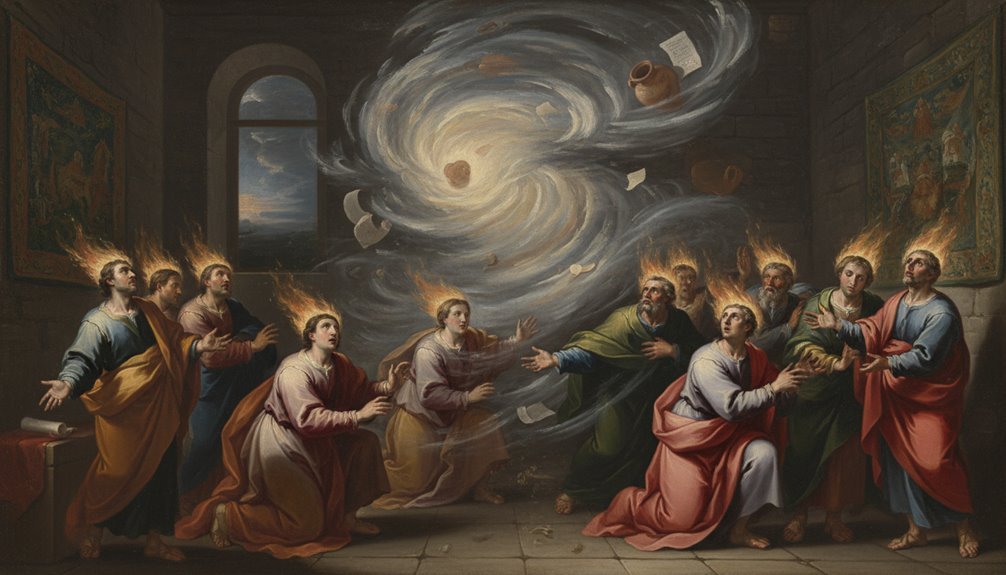
You feel the rush because Acts 2:2‑4 describes the Holy Spirit arriving as a violent, “mighty rushing wind” (Greek boreios anemos), echoing Joel’s prophecy of God’s outpouring. The wind signals a divine, direction‑less power that animates believers, links to the Spirit‑breath motif in Genesis, and fulfills the promised new era of mission. It’s more than weather—it’s a tangible sign of God’s presence and empowerment, and the next sections will show how early Christians, Jewish tradition, and modern theology interpret this striking phenomenon.
What the Biblical Text Says About the Pentecost Wind
Why does the biblical account emphasize a “mighty rushing wind” on Pentecost? You read Acts 2:2‑4, where a sound like a violent wind swept over the gathered disciples, filling the room with tongues of fire. The Greek term *pneuma* (spirit) is paired with *boreios* (violent) and *anemos* (wind), stressing both power and divine agency. You notice the narrative links this wind to the fulfillment of Joel’s prophecy (Joel 2:28‑32), which promises the Spirit’s outpouring on all people. The wind’s suddenness mirrors the abrupt transition from a fearful, imprisoned community to an empowered, bold witness. You also see that the wind’s direction isn’t specified, implying it comes from God, not human effort. This imagery underscores that the Holy Spirit arrives dramatically, overturning expectations and inaugurating a new era of mission.
Early Christian Interpretations of the Pentecost Wind
You’ll see early Christians reading the wind as a divine fulfillment of prophecy, a tangible sign that Scripture was being enacted. They understood the rushing breath as the Holy Spirit’s symbolic life‑giving force, animating believers in a single moment.
Patristic writers then unpacked the wind’s meaning, linking its unseen power to the Spirit’s work in the church.
Divine Fulfillment of Prophecy
How did early Christians read the sudden, mighty wind at Pentecost as a fulfillment of prophecy? You’ll find that they linked the event to Joel 2:28‑32, where God promises to pour out his Spirit “on all people.” The wind’s sudden force echoed the “breath” imagery of Ezekiel 37, suggesting the Spirit’s life‑giving power. You also saw the writers of Acts cite Psalm 104:30, “When you send forth your spirit, they’re created,” framing the wind as divine agency that fulfills the promised outpouring. By interpreting the gust as a tangible sign, you recognized that the early church saw history’s climax in a single, dramatic moment, confirming that the prophetic timeline had arrived and that God’s covenant was actively being realized.
Symbolic Breath of the Holy Spirit
What does the sudden rush of wind at Pentecost symbolize for early Christians? You see it as the divine breath that animates the new covenant. Early believers linked the gust to the “spiritus” that God sent to fill the world, echoing Genesis where God’s breath gave life to Adam. They interpreted the wind as a tangible sign that the Holy Spirit was no longer hidden but actively moving among them, empowering speech and mission. This breath carried the promise of renewal, turning ordinary disciples into bold witnesses. By feeling the wind, you recognize that the Spirit’s presence is both invisible and palpable, a life‑giving force that ignites faith and unites the church across cultures.
Patristic Exegesis on Wind
The breath that animated the new covenant now finds its echo in the writings of the Fathers, who read the Pentecostal wind as a living symbol of the Holy Spirit’s power. You’ll see that Iatius likens the wind to the “breath of God” that fills the church, while Gregory of Nyssa calls it a “divine gust” that awakens the soul. Augustine interprets the rushing air as the Spirit’s swift movement into human hearts, echoing the biblical “breath of life.” You notice how each father ties the wind to baptism, liturgy, and the transformative power of grace. Their exegesis treats the wind not merely as a meteorological event but as a theological metaphor that conveys the Spirit’s invisible, yet palpable, presence.
Symbolic Meanings of the Pentecost Wind in Jewish Tradition
Ever wondered why the Pentecost wind carries such rich symbolism in Jewish tradition? You’ll find that the wind embodies divine presence, echoing the biblical “spirit of God” that sweeps over the Tabernacle. In the Torah, wind signifies God’s breath (ruach), a life‑giving force that animates the nation. At Shavuot, the wind’s sudden rush reminds you of the giving of the Torah, a revelation that arrives unexpectedly yet powerfully. Midrashic sources link the gust to the “Shekhinah” descending upon Mount Sinai, suggesting that the wind is a tangible sign of holiness entering the world. The wind also mirrors the prophetic tradition of renewal, urging you to let old habits be blown away and to embrace fresh spiritual insight. Finally, the wind’s direction—often from the east—recalls the sunrise, symbolizing enlightenment and the dawning of covenantal relationship between God and Israel.
Scientific Explanations for the Pentecost Wind
Wind patterns at Pentecost often align with regional meteorological cycles, and modern science can explain why a sudden, strong gust appears each year. You’ll notice that Pentecost falls in late spring, when the jet stream shifts northward and creates a pressure gradient over the Eastern Mediterranean. This gradient fuels low‑level cyclones that pull cold, dry air from the interior of the continent toward the sea. As the cold air meets warmer, moist air over the Levant, the resulting baroclinic instability generates a rapid, localized wind surge. You can also factor in the topography of the region: valleys and coastal plains channel the airflow, amplifying its speed. Satellite data show that these gusts coincide with a trough moving eastward along the Eurasian front, producing a brief but intense wind event. Understanding these dynamics lets you see the Pentecost wind as a predictable atmospheric phenomenon, not a mystery.
Theological Implications of the Pentecost Wind as Divine Power
What does a sudden, powerful gust on Pentecost reveal about divine activity? You see the wind as a tangible sign that God’s power isn’t abstract but can manifest physically. It signals that the Holy Spirit moves beyond words, shaking the status quo and inaugurating a new era of mission. When you feel that rush, you recognize God’s authority breaking through human limitation, empowering believers to speak in tongues and prophesy. This divine dynamism validates the claim that God intervenes directly in history, not merely through metaphor. The wind’s directionless force illustrates that God’s power transcends human control, yet it precisely targets the gathered disciples. Consequently, you understand that divine power can be both chaotic and purposeful, reshaping identity, community, and purpose in a single, awe‑inspiring moment.
How Modern Christians View the Pentecost Wind Today?
The vivid image of a sudden, powerful gust on Pentecost still resonates with believers today, shaping how they interpret the Holy Spirit’s work. You’ll notice that contemporary Christians often describe the wind as a metaphor for divine empowerment, linking it to personal renewal and social transformation.
Sermons frequently tie the gust to moments of spiritual awakening—whether in worship, prayer, or mission—suggesting that the Spirit moves in unexpected, dynamic ways.
Many believers see the wind as a reminder that God’s presence can break through routine, urging them to embrace boldness and compassion.
In charismatic circles, the wind is sometimes associated with tangible experiences like speaking in tongues or prophetic utterances, while mainline denominations may emphasize its symbolic call to justice and community service.
Across traditions, the Pentecost wind challenges you to recognize that the Spirit’s activity is both intimate and communal, inviting active participation in God’s ongoing story.
Frequently Asked Questions
Did the Pentecost Wind Affect the Physical Environment in Jerusalem?
You’ll find that the Pentecost wind didn’t dramatically reshape Jerusalem’s streets or buildings. It was a sudden, strong gust that rattled doors and lifted dust, but the city’s stone structures stayed intact. The wind’s main impact was sensory—people felt the rush, heard the howling, and saw debris swirl. So, while it created a vivid, unsettling atmosphere, it left the physical environment essentially unchanged.
How Do Different Bible Translations Describe the Pentecost Wind?
You’ll see that most translations label the Pentecost wind as “a sound like a rushing mighty” (KJV) or “a mighty wind” (NIV), while the ESV calls it “a sound like a violent rushing wind.”
The NASB renders it “a sound like a violent rushing wind,” and the CSB says “a sound like a violent wind.” Each version keeps the imagery of a powerful, sudden gust, though wording varies slightly.
Were There Any Recorded Miracles Linked to the Pentecost Wind?
You won’t find any specific miracles recorded that are directly attributed to the Pentecost wind itself. The biblical narrative links the wind to the Holy Spirit’s arrival, but the miracles—speaking in tongues, healing, and prophetic revelations—are described as results of the Spirit’s work, not the wind’s power.
Early church writers mention the wind as a dramatic sign, yet they don’t recount distinct supernatural events caused solely by that gust.
Did the Pentecost Wind Influence Early Church Architecture?
You’ll find that the Pentecost wind didn’t shape early church architecture directly. Builders focused on liturgical needs, acoustics, and local traditions rather than a symbolic gust.
While some churches later incorporated wind‑like motifs in frescoes or carvings, the structural plans—basilicas, domes, and vaulted ceilings—evolved from Roman models and theological considerations, not from that specific biblical event.
How Is the Pentecost Wind Referenced in Contemporary Worship Music?
You’ll hear the Pentecost wind in contemporary worship music as a metaphor for the Holy Spirit’s power and presence.
Songwriters often describe it as a “rush,” “breath,” or “gust” that ignites hearts, moves congregations, and brings fresh life to worship.
The imagery appears in lyrics, bridges, and instrumental builds, creating dynamic, soaring arrangements that echo the biblical wind’s transformative force.
Conclusion
You’ve seen how the Pentecost wind bridges scripture, tradition, and science, revealing a divine surge that ignites faith. Its roar isn’t just a meteorological event—it’s a symbol of God’s power breaking into history, empowering believers then and now. By grasping its layered meanings, you can appreciate how this mighty gust continues to inspire awe, unity, and spiritual renewal in today’s Christian life.








No Comments