

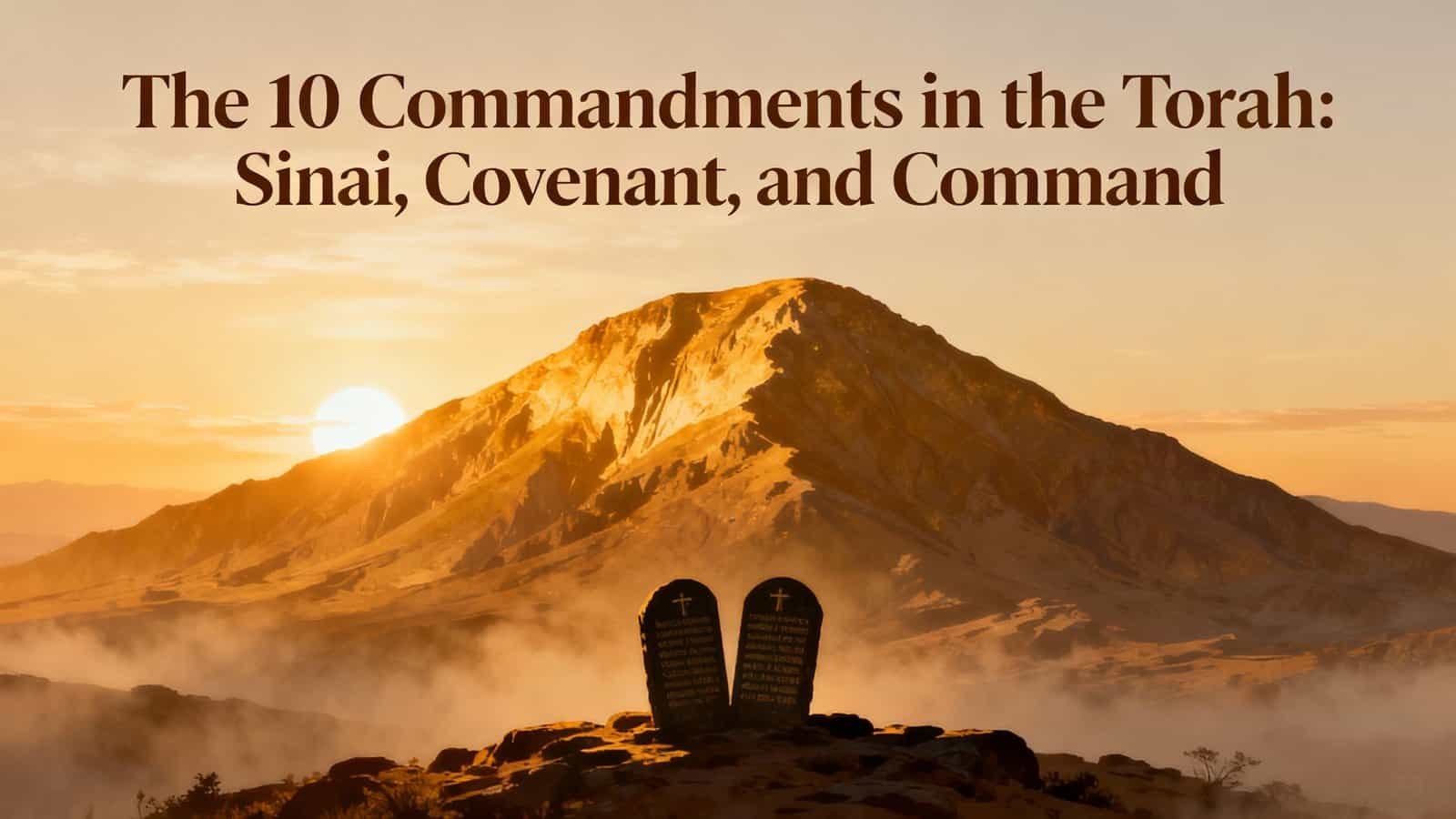
30 Nov The 10 Commandments in the Torah: Sinai, Covenant, and Command
You’ll find the Aseret HaDibrot presented twice in Torah – at Har Sinai in Parashat Yitro and Moshe’s retelling in Va’etchanan – with notable variations like “zachor” versus “shamor” for Shabbat. The Gemara (Shabbat 88a) describes the mountain suspended above B’nei Yisrael like a barrel while they declared “na’aseh v’nishma,” transforming avdut into geulah through brit. These ten utterances establish both bein adam l’Makom and bein adam l’chaveiro obligations, from “Anochi Hashem” through “lo tachmod,” creating the halakhic foundation for mamlechet kohanim v’goy kadosh that continues shaping Jewish law today.
Table of Contents
Key Takeaways
- The Ten Commandments were revealed at Mount Sinai through a terrifying theophany featuring thunder, lightning, and supernatural phenomena witnessed by the entire nation.
- Two versions exist in Torah: Exodus 20 given at Sinai and Deuteronomy 5 repeated forty years later before entering the Promised Land.
- The covenant framework transforms former slaves into a “kingdom of priests and holy nation” through voluntary acceptance (“na’aseh v’nishma”).
- The first tablet addresses divine-human relationships while the second tablet establishes core social prohibitions essential for communal order.
- Unlike ancient Near Eastern law codes, the commandments present absolute moral principles without specified punishments, forming the foundation of Jewish law.
The Theophany at Mount Sinai: Divine Revelation in Thunder and Fire

When the Jewish people stood at Har Sinai on the sixth day of Sivan, they witnessed an unprecedented divine revelation that the Torah describes as both terrifying and transformative.
You’ll find the Gemara in Shabbat 88a discussing how Hashem held the mountain above their heads like a barrel, establishing the covenant through atmospheric phenomena that defied nature’s laws.
The manifestation wasn’t merely visual—it embodied a unique auditory theology.

Rashi notes they “saw the sounds” (Shemot 20:15), experiencing synesthesia as קולות (voices) became visible.
You’re encountering here what the Ramban calls the intersection of upper and lower worlds, where physical boundaries dissolved.
The Mechilta d’Rabbi Yishmael explains that each divine utterance split into seventy languages, ensuring universal accessibility.
You can’t separate the theophany’s form from its content—the thunder, lightning, and שופר קול represented middah k’neged middah, measure for measure, preparing Am Yisrael for accepting the עול מלכות שמים.
Exodus and Deuteronomy: Two Versions of the Decalogue
When you compare the Aseret HaDibrot in Parashat Yitro (Exodus 20:2-14) with those in Parashat Va’etchanan (Deuteronomy 5:6-18), you’ll discover fascinating textual variations that have occupied the Rishonim for centuries.

The most striking difference appears in the Shabbat commandment, where Exodus uses “zachor” (remember) while Deuteronomy employs “shamor” (observe), leading the Gemara in Shevuot 20b to explain that both words were miraculously spoken b’dibbur echad.
These variations reflect distinct historical contexts—Exodus presenting the initial revelation at Har Sinai versus Moshe Rabbeinu’s retrospective account forty years later in Arvot Moav, each serving different pedagogical purposes within the Halakhic framework.
Textual Differences Examined
Have you ever wondered why the Aseret HaDibrot appear twice in the Torah with notable textual variations?
You’ll find the most striking difference in the Shabbat commandment: Exodus uses “zachor” (remember) while Deuteronomy employs “shamor” (observe).
The Gemara in Shevuot 20b explains they were miraculously spoken b’dibbur echad—simultaneously.
When you examine Qumran Fragments, you’ll discover ancient witnesses confirming both textual traditions, dismissing theories of later Scribal Emendations.
The rationale for Shabbat also differs: Exodus cites Creation while Deuteronomy invokes yetziat Mitzrayim.
You’re seeing deliberate variation, not corruption.
The Ramban notes how Moshe’s retrospective account in Deuteronomy adds “ka’asher tzivcha Hashem Elokecha”—reminding you that you’ve already received these mitzvot.
These aren’t contradictions but complementary revelations addressing different aspects of the same divine imperatives.
Historical Context Variations
These textual variations reflect the distinct historical moments in which each version was given.
You’ll notice Exodus presents the Aseret HaDibrot during the wilderness wandering, while Deuteronomy’s Mishneh Torah occurs forty years later at the Plains of Moav.
The Gemara in Bava Kamma 54b acknowledges these chronological distinctions affect halakhic interpretation.
Archaeological correlates from ancient Near Eastern covenant treaties demonstrate similar repetition patterns.
You’re seeing vassal treaties that parallel the Torah’s structure.
When examining pre-Hellenistic influence texts, you’ll find the dual presentation isn’t unusual—it’s pedagogically deliberate.
Consider how Rambam addresses this in Hilchot Yesodei HaTorah: the first giving established the brit, while Moses’s retelling reinforced commandments for entering Eretz Yisrael.
You’re witnessing divine wisdom adapting eternal law to temporal circumstances.
The Covenant Framework: From Slavery to Sacred Nationhood
Before the revelation at Har Sinai transformed b’nei Yisrael into a mamlechet kohanim v’goy kadosh (kingdom of priests and holy nation), the narrative establishes a critical theological framework through the transition from avdut (slavery) to geulah (redemption). You’ll find this metamorphosis isn’t merely historical—it’s covenantal architecture.
The Ramban explains that yetziat Mitzrayim created the necessary precondition for kabbalat haTorah. You can’t accept divine sovereignty while enslaved to human masters.
This explains why “Anochi Hashem Elokecha asher hotzeiticha” precedes the mitzvot—liberation validates legislation.
Your collective identity emerges through shared memory practices. The Pesach seder’s maggid section doesn’t just recount; it reconstitutes you as if you personally left Egypt.
This experiential framework, what the Mishnah calls “b’chol dor v’dor,” transforms historical memory into living covenant.
The brit at Sinai wasn’t imposed—you declared “na’aseh v’nishma.” This voluntary acceptance converted political freedom into spiritual purpose, establishing Am Yisrael’s unique status among nations.
The First Tablet: Commands Governing the Divine-Human Relationship

You encounter the foundational mitzvot of the first tablet through the lens of “Anochi Hashem Elokecha” and “Lo yihyeh lecha,” establishing both positive acknowledgment of divine sovereignty and the prohibition against avodah zarah.
The Rambam’s Sefer HaMitzvot counts these as distinct commandments—knowing God’s existence and rejecting false deities—while the issur of taking God’s name in vain (lo tisa) creates boundaries around kedushah through speech.
These three mitzvot form what the Mechilta calls the “avot” of all bein adam l’Makom obligations, requiring you to recognize, protect, and sanctify your relationship with the Divine through thought, rejection of falsehood, and guarded speech.
No Other Gods
What defines the essence of monotheistic faith if not the categorical rejection of all deities except HaShem? When you declare “lo yihyeh lecha elohim acherim al panai,” you’re establishing an exclusive covenantal relationship.
The Rambam identifies this mitzvah as the foundation of all commandments, while the Gemara in Sanhedrin warns against even acknowledging other gods’ existence.
You’ll find this prohibition extends beyond literal avodah zarah. Political idolatry manifests when you elevate governmental authority above divine law—a violation the Chofetz Chaim addressed regarding totalitarian regimes.
In modern interfaith dialogue, you must navigate carefully: respecting others’ humanity doesn’t mean validating their theological claims. The Meiri’s distinction between idolaters and those “bound by religious law” provides halakhic framework for such encounters while maintaining your absolute commitment to HaShem’s singularity.
Honoring God’s Name
When you utter HaShem’s name in vain, you violate “lo tisa et shem HaShem Elokecha lashav”—a transgression the Gemara in Shevuot ranks among the gravest aveiros.
The Rambam delineates four categories of shevuat shav: false oaths, unnecessary oaths, impossible vows, and oaths regarding known truths.
You’re commanded to guard the kedushah inherent in divine onomastic traditions, recognizing that each Name carries specific halakhic parameters.
Your invocation practices must reflect kavod shamayim.
The Yerushalmi teaches that even permitted uses require trepidation—you shouldn’t invoke the Shem HaMeforash casually in berachot or learning.
The issur extends beyond formal oaths; the Sefer HaChinuch explains you transgress through any frivolous utterance.
When you study Torah containing Hashem’s names, you fulfill “veyareita,” demonstrating proper yirat shamayim through careful pronunciation and reverent intent.
The Second Tablet: Laws for Human Society and Social Order
While the first tablet establishes humanity’s relationship with the Divine through mitzvot bein adam l’Makom (commandments between man and God), the second tablet delineates the foundation of civil society through mitzvot bein adam l’chaveiro (commandments between man and his fellow).
You’ll find these five commandments form the bedrock of Jewish jurisprudence, beginning with kibbud av v’em (honoring parents) and culminating in lo tachmod (prohibition against coveting).
The Gemara in Sanhedrin 56b explains how these mitzvot create mechanisms for Dispute Resolution within the kehillah.
When you transgress lo tirtzach (murder prohibition) or lo tin’af (adultery prohibition), you’re subject to Community Sanctions administered by the beit din.
The prohibition of lo tignov (theft) establishes property rights essential for economic order, while lo ta’aneh (false testimony) ensures judicial integrity.
These aren’t merely ethical guidelines—they’re enforceable laws with prescribed oneshim (penalties) that maintain societal harmony through din Torah proceedings.
Hebrew Text and Translation Challenges in the Ten Commandments
When you examine the Aseret HaDibrot in their original lashon hakodesh, you’ll encounter ancient grammatical forms like the apodictic “lo” (לא) versus “al” (אל) prohibitions that shape our understanding of permanent versus temporary mitzvot.
The Masoretic text’s variations between Shemot 20 and Devarim 5—particularly in the Shabbat commandment’s use of “zachor” versus “shamor”—have sparked centuries of Talmudic discourse about whether these represent a single divine utterance (dibbur echad) or sequential revelations.
Modern translations struggle with rendering terms like “lo tachmod” (you shan’t covet) and “lo titaveh” (you shan’t desire), where Rishonim like Rambam and Ibn Ezra debate whether these reflect distinct halakhic categories of thought versus action.
Ancient Hebrew Linguistic Features
How does the Torah’s original Hebrew text reveal nuances that translations can’t fully capture?
You’ll find the ancient consonantal system lacks vowel points (nikud), creating interpretive possibilities the Talmud explores extensively.
When you examine “lo tirtzach” (לא תרצח), the verb morphology distinguishes between “murder” and “kill” through contextual usage patterns, as the Sanhedrin tractate clarifies.
You’re encountering biblical Hebrew’s unique verb forms—the vav-consecutive transforms tenses, making “v’ahavta” future-turned-command.
The Torah’s apodictic law structure (“thou shalt not”) differs from casuistic forms found in Mishpatim.
You’ll notice the divine speech alternates between first and third person, prompting Rashi’s commentary on revelation’s dual nature.
The term “d’varim” itself means both “words” and “things,” suggesting commandments aren’t merely linguistic but ontological realities shaping creation.
Word Choice Variations
Beyond the grammatical structures lies another layer of complexity: the Torah’s deliberate lexical choices that resist uniform translation.
You’ll notice the term “lo tirtzach” employs the rare verb r-tz-ch rather than the common h-r-g for killing.
The Talmud (Sanhedrin 52b) distinguishes between retzichah (murder) and harigah (lawful execution), establishing precise halakhic boundaries through stylistic branding.
Consider how “lo tignov” uses g-n-v specifically for theft by stealth, while g-z-l denotes robbery by force.
The Mechilta d’Rabbi Yishmael notes this distinction shapes reader reception differently than generic prohibitions would.
You’re encountering calculated terminology that defines legal categories.
Each verb selection carries halachic weight—”tachmod” (covet) versus “titaveh” (desire) in the two versions creates distinct prohibitions according to the Rambam’s count of mitzvot.
Modern Translation Debates
Where should translators draw the line between fidelity to ancient Hebrew and contemporary accessibility? You’ll find this tension exemplified in the debate over “lo tirtzach” – whether it’s “don’t murder” or “don’t kill.”
The Talmud (Sandarhin 52b) distinguishes between retzichah (unlawful killing) and harigah (judicial execution), yet modern translations can’t capture this halakhic nuance.
Consider how Liturgical Impact shapes translation choices. When you recite the Aseret HaDibrot during Shavuot, you’re encountering versions filtered through centuries of interpretation.
Publishers face Copyright Conflicts when updating classical translations – Artscroll can’t simply adopt JPS renderings without legal ramifications.
The mitzvah of “zachor” versus “shamor” in Shabbat commandments reveals another challenge. Mechilta notes both were spoken b’dibur echad (simultaneously), but you can’t translate divine simultaneity into linear English text.
The Sabbath Commandment: Creation, Liberation, and Sacred Time
When you examine the Sabbath commandment’s dual presentation in the Torah, you’ll discover a profound halakhic paradox: Exodus 20:8 commands “זָכוֹר” (zachor – remember) while Deuteronomy 5:12 demands “שָׁמוֹר” (shamor – observe/guard).
The Talmud (Shevuot 20b) resolves this through divine simultaneity—both words were uttered b’dibbur echad, in one divine utterance.
You’ll find Exodus grounds Shabbat in creation theology, establishing sanctified leisure as imitatio Dei.
Deuteronomy’s rationale shifts to liberation from Egypt, transforming rest into zecher l’yetziat Mitzrayim.
This dual causation creates overlapping halakhic frameworks: cosmic order meets social justice.
The commandment’s scope extends beyond human cessation.
You’re obligated to provide ecological rest for animals and land—your ox, donkey, and even ger (stranger) must experience menucha.
The Mishnah (Shabbat 7:2) codifies thirty-nine melachot, prohibited labors mirroring the Mishkan’s construction, revealing how sacred time supersedes sacred space in Jewish consciousness.
Honor Your Parents: The Bridge Between Divine and Human Authority
The fifth commandment’s placement marks a striking structural pivot—you’re moving from bein adam l’Makom (between human and God) to bein adam l’chavero (between humans), yet “כַּבֵּד אֶת־אָבִיךָ וְאֶת־אִמֶּךָ” (honor your father and mother) occupies the first tablet alongside divine obligations. This positioning reveals parents as conduits of divine authority—they’re partners with HaShem in creation (Kiddushin 30b).
You’ll notice the verb כַּבֵּד shares its root with כָּבוֹד (honor/glory), typically reserved for God. The Talmud equates honoring parents with honoring the Divine Presence itself.
Your parents embody familial authority that bridges heavenly and earthly realms, serving as primary agents of moral transmission across generations.
The promise “לְמַעַן יַאֲרִכוּן יָמֶיךָ” (that your days may be lengthened) isn’t merely individual reward—it’s societal continuity. When you honor those who transmitted Torah values, you’re preserving the covenantal chain.
The Gemara distinguishes between כִּבּוּד (honor through positive action) and מוֹרָא (reverence through restraint), creating a comprehensive framework for maintaining hierarchical respect while acknowledging human dignity.
Prohibitions Against Murder, Adultery, and Theft: Foundations of Social Ethics

As you transition to the sixth, seventh, and eighth commandments—”לֹא תִּרְצָח” (you shan’t murder), “לֹא תִּנְאָף” (you shan’t commit adultery), and “לֹא תִּגְנֹב” (you shan’t steal)—you’re encountering the Torah’s most concise articulation of social ethics.
The Talmud (Sanhedrin 86a) emphasizes these mitzvot establish society’s foundational boundaries: life’s sanctity, marital fidelity, and property rights.
You’ll notice the Torah’s brevity here contrasts with comparative jurisprudence of ancient Near Eastern codes.
While Hammurabi details penalties, these commandments present absolute prohibitions without specified punishments.
The Mishnah (Makkot 1:10) reveals how seriously you must treat capital cases—a court executing once in seventy years was considered bloodthirsty.
Halakhically, you’re bound by restorative justice principles.
Theft requires double restitution (Exodus 22:3), while adultery disrupts kedushat ha-mishpachah (family sanctity).
Murder’s prohibition extends through pikuach nefesh—you must violate nearly any commandment to preserve life, demonstrating how these three mitzvot form civilization’s ethical bedrock.
The Tenth Commandment and the Inner Life: Desire, Coveting, and Moral Psychology
From external actions governing society’s order, “לֹא תַחְמֹד” (you shan’t covet) penetrates the human heart’s recesses, addressing thought itself as a moral category. You’re commanded to master your inner world—the Gemara in Bava Metzia 5b recognizes that חמדה (coveting) precedes גזל (theft), establishing desire regulation as preventive halakha.
You’re commanded to master your inner world—desire regulation as preventive halakha against theft’s eventual manifestation.
The Rambam distinguishes between תאוה (desire) and חמדה (coveting) in Hilchot Gezelah 1:9—you violate this commandment when covetous impulses crystallize into schemes.
Ibn Ezra challenges this interpretation, arguing you can’t legislate feelings. Yet the Sefer HaChinuch (416) reconciles: you’re training your נפש to recognize boundaries even in thought.
This mitzvah transforms you into a ben Torah who guards his מחשבה (thought). When you see your neighbor’s possessions, you must arrest the progression from הסתכלות (looking) to חשק (longing) to מעשה (action). You’re cultivating שלמות הנפש—perfection of soul through cognitive discipline.
Frequently Asked Questions
How Many Commandments Are There in Total Throughout the Entire Torah?
You’ll find 613 mitzvot in the Torah according to Rabbinic Counts, as codified in the Talmud (Makkot 23b).
These divine imperatives divide into Commandment Categories: 248 positive mitzvot (mitzvot aseh) corresponding to human body parts, and 365 negative prohibitions (mitzvot lo ta’aseh) matching solar days.
You’re obligated to observe these whether they’re d’oraita commandments from Sinai or subsequent revelations, each carrying distinct halakhic weight in your observance.
Are the Ten Commandments Legally Binding in Modern Secular Law?
You won’t find the Aseret HaDibrot directly enforceable in secular courts, though their Legal Influence shaped Western jurisprudence profoundly.
While the Talmud discusses din malchuta dina (the law of the land is law), modern states don’t derive authority from Sinai’s revelation.
You’ll see Secular Precedent in prohibitions against murder and theft, but these exist independently of their Torah origins.
The mitzvot remain binding b’shamayim, not through governmental enforcement mechanisms.
What Happens if Someone Breaks One of the Ten Commandments?
If you break one of the Aseret HaDibrot, you’ll face both divine and communal consequences.
The Talmud Bavli discusses how transgressions require teshuvah – specific repentance rituals including vidui and potentially korbanot.
You’ll encounter social sanctions from your kehillah, ranging from nezifah to niddui depending on the aveirah’s severity.
Halakhically, you must perform complete teshuvah: charatah, kabbalah al ha’atid, and when applicable, seek mechilah from wronged parties before achieving kapparah.
Do Christians and Muslims Follow the Same Ten Commandments?
You’ll find Christians and Muslims honor the Aseret HaDibrot differently than Jews.
While doctrinal differences shape each tradition’s interpretation – Christians emphasize grace over mitzvot, Muslims follow Qur’anic versions – the core prohibitions remain.
Your liturgical practices reveal these distinctions: where we recite them during Shavuot Torah reading, they’re embedded in church catechisms and Islamic fiqh.
The Gemara’s discussion of universality through Noahide laws suggests shared ethical foundations despite theological divergence.
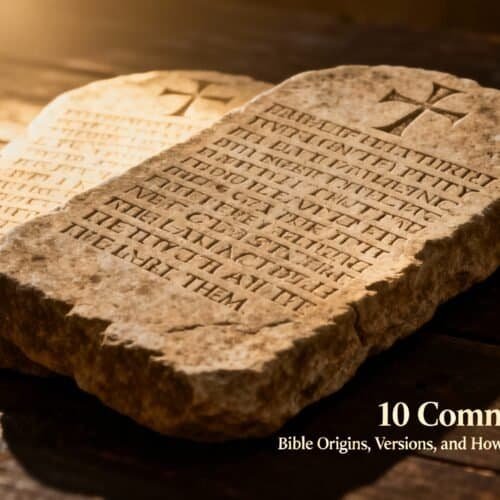
Were There Physical Tablets and Where Are They Now?
You’ll find the Torah describes physical tablets (לוחות הברית) given at Sinai, but archaeological evidence hasn’t confirmed their existence.
According to religious tradition, they were placed in the Aron HaKodesh within the Kodesh Kodashim.
The Talmud (Bava Batra 14a) states both broken and whole tablets resided there.
After the Temple’s destruction, their location remains unknown – some suggest hidden by Yoshiyahu, others believe they’re concealed until Mashiach’s arrival.
Conclusion
You’ve journeyed through the Aseret HaDibrot, from the ma’amad Har Sinai to the depths of “lo tachmod.” These mitzvot aren’t merely ancient prohibitions—they’re living halakhah shaping your neshamah daily. The Gemara teaches that when you observe Shabbat, you’re testifying to creation itself. Whether following Rashi’s interpretation of kibud av v’em or the Rambam’s analysis of lo tirtzach, you’re binding yourself to the brit established between thunderclaps, transforming divine tzivui into human kedushah.








No Comments