

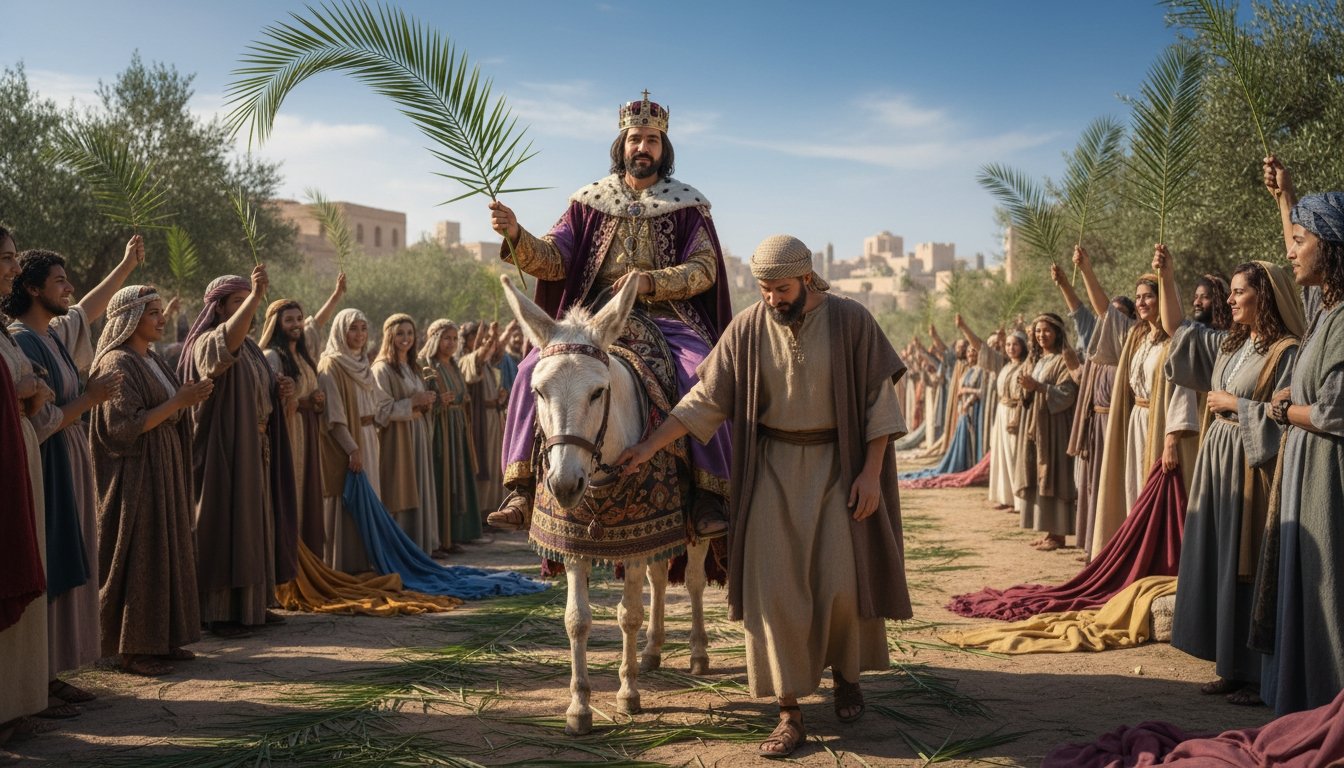
07 Mar Kingly Power and Humble Servant on Palm Sunday
On Palm Sunday, you see Jesus Christ demonstrate both His kingly power and His humble servant nature as He rides into Jerusalem on a donkey, foreshadowing the events of His sacrificial death and glorious resurrection. Though the crowds expect a powerful, conquering king, Jesus’ entry communicates divine authority and the nature of His spiritual kingdom. If you’d like to learn more about this pivotal moment, keep exploring the significance of Jesus’ Triumphal Entry.
Table of Contents
Key Takeaways
- The Triumphal Entry on Palm Sunday demonstrated Jesus’ kingly authority, yet his choice to ride a humble donkey foreshadowed his sacrificial death as the Suffering Servant.
- The crowds’ welcoming Jesus with palm branches and shouts of “Hosanna” recognized his Messianic identity but also revealed their misunderstanding of his true purpose.
- Jesus’ entry into Jerusalem on a donkey, rather than a majestic stallion, clashed with the crowds’ earthly expectations of a powerful, conquering king.
- The Triumphal Entry set the stage for the events surrounding Jesus’ crucifixion and resurrection, where his divine authority and humble servanthood would be fully revealed.
- The contrasting portrayals of Jesus as both a kingly figure and a humble servant on Palm Sunday crystallized the tension between power and humiliation central to his mission.
The Triumphal Entry Into Jerusalem
Why did Jesus’ triumphal entry into Jerusalem on Palm Sunday mark a pivotal moment in His ministry? As the crowds welcomed Him with palm branches and shouts of “Hosanna!”, Jesus demonstrated His kingly authority. Yet, riding humbly on a donkey, He also revealed Himself as the Suffering Servant prophesied to bring salvation. This dramatic contrast foreshadowed Jesus’ approaching death and resurrection. The people celebrated Him as their long-awaited Messiah, unaware their shouts of praise would soon turn to cries for His crucifixion. This moment crystallized the tension between Jesus’ divine power and His voluntary humiliation, a tension that would reach its climax in the events of Good Friday and Easter.
The Humble Servant Riding a Donkey
As Jesus rode into Jerusalem on a humble donkey, He presented Himself not as a conquering king, but as the Suffering Servant. You see, Jesus could’ve ridden a magnificent stallion, but He chose a docile, lowly animal – a symbol of His meekness and gentleness.
This was no ordinary entry into the Holy City. The crowds waved palm branches and shouted “Hosanna!”, hailing Him as the long-awaited Messiah. Yet, Jesus knew His true purpose – to suffer and die for the sins of the world. His kingdom wasn’t of this world, but a spiritual one. By riding a donkey, the humble Savior foreshadowed His sacrificial death on the cross, where He’d become the ultimate Servant-King.
The Clash of Expectations
How did the crowds’ expectations clash with Jesus’ true purpose as He entered Jerusalem? The people expected a powerful, conquering king who’d overthrow the Roman occupiers and establish His kingdom. But Jesus rode humbly on a donkey, defying their vision of a majestic ruler. His triumphal entry into Jerusalem wasn’t about military might or political revolution – it was a statement of His divine authority and the nature of His kingdom.
Though the crowds acclaimed Him as the Messiah, their shallow understanding of His mission would soon give way to bitter disappointment. Jesus didn’t come to be an earthly king, but to be the suffering servant who’d die for the sins of the world. The clash between the people’s expectations and Jesus’ true purpose would culminate in His crucifixion just days later.
Frequently Asked Questions
Why Was Jesus Riding a Donkey on Palm Sunday?
Jesus rode a donkey on Palm Sunday to fulfill the prophecy that the Messiah would enter Jerusalem in this manner. It was a deliberate choice to present himself as a humble servant, in contrast to the powerful rulers who rode horses. This act demonstrated Jesus’ kingship and his willingness to suffer and die for the people.
What Did the Crowds Expect From Jesus on Palm Sunday?
The crowds expected Jesus to be the long-awaited Messiah who’d overthrow the Roman occupation and restore Israel’s political independence.
They anticipated a powerful, conquering king who’d lead them in battle and establish a new earthly kingdom.
However, Jesus’ humble, peaceful entry on a donkey defied their expectations, revealing a different kind of Messiah and kingdom.
How Did Jesus’ Actions on Palm Sunday Challenge the People’s Expectations?
Jesus’ actions on Palm Sunday challenged the people’s expectations by not riding in on a majestic white horse as a conquering king, but instead humbly entering Jerusalem on a lowly donkey.
This unexpected display of humility and servant leadership contrasted with the people’s anticipation of a powerful political deliverer who’d overthrow Roman rule.
Jesus’ actions revealed His true identity as the Messiah who’d come to serve, not be served.
What Was the Significance of Jesus Entering Jerusalem on a Donkey?
By riding a donkey instead of a war horse, Jesus demonstrated His humble and peaceful nature, challenging the people’s expectations of a conquering military Messiah.
This symbolic act revealed His true purpose – to serve as a suffering servant who’d ultimately sacrifice Himself for the salvation of humanity, rather than establish an earthly kingdom by force.
Why Did the Crowds Welcome Jesus as a King on Palm Sunday?
The crowds welcomed Jesus as a king on Palm Sunday because they recognized him as the long-awaited Messiah, the promised king who’d restore Israel’s sovereignty.
They hailed him with palm branches, a symbol of victory, and shouted “Hosanna!” – a cry of praise and celebration for the one who’d come in God’s name to save them.
Conclusion
You see the kingly power and the humble servant. The crowds hail Jesus as the Messiah, yet He rides humbly on a donkey. Their expectations clash, but Jesus fulfills His purpose – to be the Suffering Servant who gives His life to save the world. His humble obedience leads to the triumph of the cross.






No Comments