

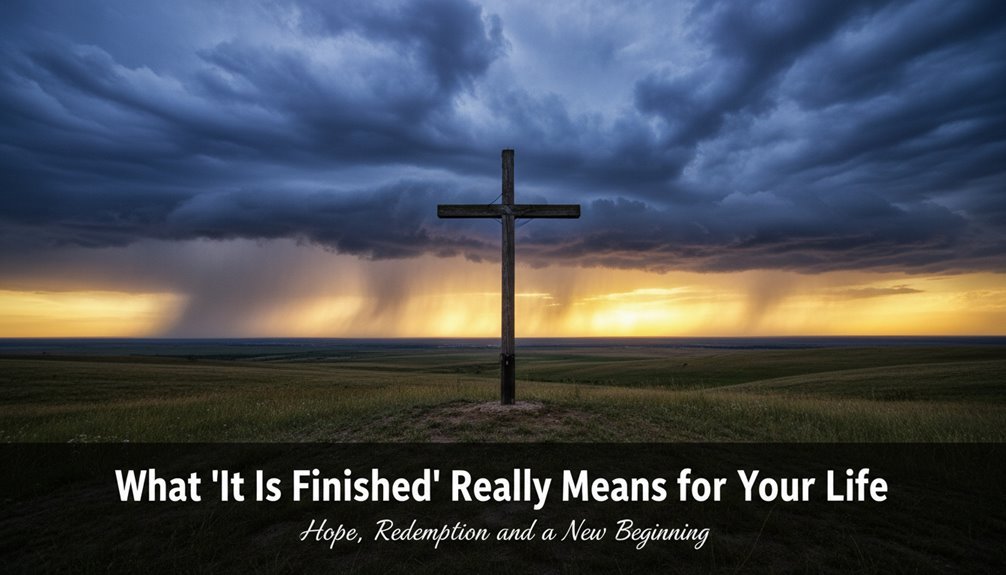
27 Feb What “It Is Finished” Really Means for Your Life
When Jesus declared “tetelestai” on the cross, He used the Greek perfect tense—indicating a completed action with permanent effects. This means your acceptance with God isn’t based on your performance but on His finished work. You’re freed from earning divine favor through perfect compliance, allowing you to approach God through grace rather than fear. Your identity rests securely on this completed redemption, transforming daily struggles into opportunities for grateful response rather than anxious striving for approval. Understanding this declaration’s fuller implications reveals how profoundly it reshapes every aspect of spiritual growth.
Key Takeaways
- The Greek word “tetelestai” means “paid in full” – your spiritual debt is completely satisfied, not partially covered.
- You don’t need to earn God’s acceptance through perfect performance; it’s based on finished work, not ongoing effort.
- Live from already-secured acceptance rather than trying to achieve it, shifting motivation from fear to gratitude.
- Your identity rests on completed divine work, providing security when facing life’s challenges and uncertainties.
- Growth becomes a grateful response to grace rather than anxious striving to prove your worth or secure salvation.
Why do three simple words spoken two millennia ago continue to reverberate through human consciousness with such profound force? When Jesus uttered “It is finished” from the cross, recorded in John 19:30 as “tetelestai,” He wasn’t merely announcing His impending death. This Greek perfect tense verb carries profound implications that fundamentally reshape how you understand your relationship with the divine and your purpose in existence.
The term “tetelestai” appears on ancient receipts and legal documents, meaning “paid in full” or “completed.” In Jesus’s context, it represents the ultimate act of faithful surrender—not passive resignation, but deliberate completion of His redemptive mission. This declaration signals that the cosmic debt humanity owed has been satisfied entirely. You’re no longer bound by the impossible task of earning divine favor through perfect moral performance or religious ritual.
This completion births renewed purpose in your daily existence. Rather than living under the crushing weight of perpetual spiritual inadequacy, you can operate from a position of already-secured acceptance. The finished work means you’re free to pursue righteousness not as desperate attempts to earn love, but as grateful responses to love already received. Your motivations shift from fear-based compliance to joy-driven participation in divine purposes.
The perfect tense of “tetelestai” indicates an action completed in the past with continuing present effects. This grammatical structure reveals that Christ’s work isn’t something requiring your addition or completion. You can’t improve upon what’s already perfect. This reality liberates you from the exhausting cycle of spiritual performance anxiety that characterizes much religious experience.
Archaeological evidence shows “tetelestai” was also inscribed on completed artwork, indicating a masterpiece finished according to the artist’s original vision. God’s redemptive masterpiece in your life isn’t dependent on your ability to perfect yourself. The divine Artist has already declared the work complete, transforming how you view your flaws, failures, and ongoing struggles.
This completion doesn’t eliminate your responsibility to grow spiritually or pursue moral excellence. Instead, it provides the secure foundation from which genuine transformation becomes possible. When you’re no longer frantically trying to establish your worth, you’re free to develop authentic character rooted in gratitude rather than anxiety.
The three words also establish a new covenant reality where divine relationship operates on grace rather than performance metrics. You can approach life’s challenges knowing that your fundamental identity and eternal destiny rest on Christ’s finished work, not your fluctuating efforts or circumstances.
Understanding “It is finished” properly transforms how you handle guilt, pursue spiritual growth, relate to others, and face uncertainty. These ancient words offer modern souls the profound peace that comes from knowing the most important work—securing your relationship with God—has already been accomplished completely and permanently on your behalf.
Frequently Asked Questions
Did Jesus Say “It Is Finished” in Hebrew, Greek, or Aramaic?
Jesus spoke “It is finished” in Aramaic, his native tongue, though John’s Gospel records it using the Greek “tetelestai.”
You’re encountering a translation spanning multiple languages—from Aramaic utterance to Greek documentation to English rendering.
The forgiveness scope embedded within these words transcends the language of words themselves.
Each linguistic layer reveals exegetical depth: Aramaic expressing completion, Greek conveying accomplished purpose, demonstrating how divine truth communicates across cultural boundaries.
What Specific Sins Were Forgiven When Jesus Said “It Is Finished”?
Jesus wasn’t forgiving specific sins when declaring “it is finished“—He accomplished general atonement for humanity’s sin nature. You’re witnessing the completion of redemptive work, not individualized forgiveness. This once for all sacrifice (Hebrews 10:10) established the foundation for forgiveness, but you still need ongoing repentance to appropriate that finished work personally. The cross provides universal access, not automatic universal application.
Why Did Jesus Wait Until the Cross to Say “It Is Finished”?
Jesus waited until the cross because only His sacrificial death could complete the atonement required for sin’s penalty. You can’t achieve eternal security through partial obedience or incomplete sacrifice. The cross represents the culmination of God’s redemptive plan, where Christ’s substitutionary death satisfied divine justice completely. Any earlier declaration would’ve created assurance dilution, undermining the finished work’s sufficiency for your complete justification before God.
How Does “It Is Finished” Relate to Old Testament Animal Sacrifices?
“It is finished” declares the complete fulfillment of Old Testament sacrificial typology. You’re witnessing Christ’s definitive replacement of the repetitive animal sacrifice system that could never permanently remove sin.
Where countless lambs, bulls, and goats provided temporary covering, Jesus’s singular offering achieves eternal redemption.
The temple veil’s tearing confirms you no longer need mediating sacrifices—Christ’s perfect atonement supersedes the entire Levitical system permanently.
Can We Lose Our Salvation After Jesus Declared “It Is Finished”?
You can’t lose your salvation because Christ’s “it is finished” declaration established an irreversible covenant. The “it is finished implications” demonstrate God’s completed work—not humanity’s ongoing performance. Your “salvation perseverance” isn’t based on maintaining righteousness but on Christ’s accomplished redemption. The Greek “tetelestai” signifies permanent completion, indicating God’s satisfaction with Christ’s sacrifice. You’re eternally secure because salvation depends on Christ’s finished work, not your continued efforts.
Conclusion
When Christ declared “It is finished,” you’re witnessing the completion of redemptive history’s central act. This tetelestai wasn’t merely announcing death’s approach—you’re hearing the divine proclamation that atonement’s work stands complete. The sacrificial system’s typological fulfillment means you’re no longer bound by ceremonial law’s requirements. Christ’s substitutionary death satisfies divine justice completely, securing your justification through His finished work rather than ongoing religious performance. You’re recipients of accomplished salvation, not participants in its completion.












No Comments