

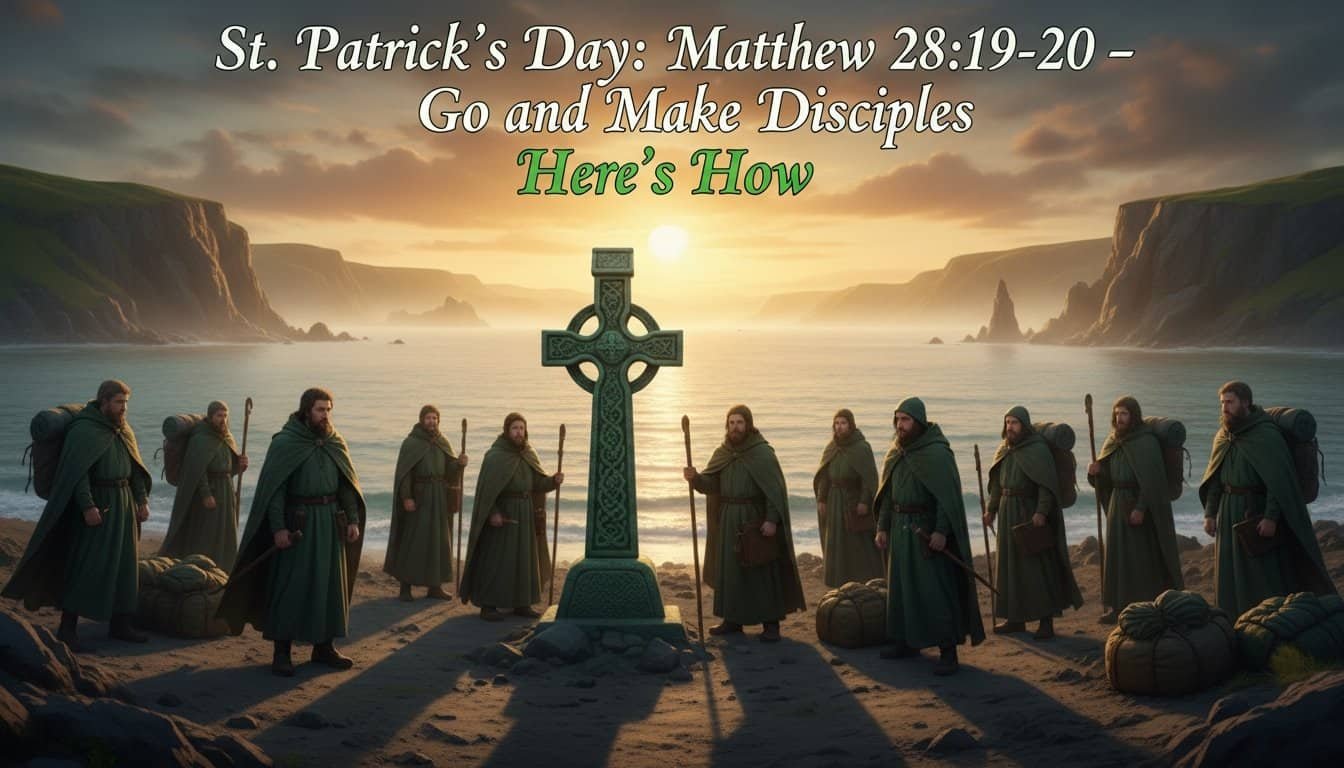
27 Feb St. Patrick’s Day and Matthew 28:19-20: Go Make Disciples, Here’s How
St. Patrick’s mission to Ireland exemplifies Matthew 28:19-20’s Great Commission in action—crossing cultural boundaries to make disciples through authentic relationships. You’re called to go beyond your comfort zone, share your personal faith story rather than pushing doctrine, baptize new believers as public declarations of transformation, and teach obedience to Christ’s commands. Like Patrick, you’ll succeed by building genuine connections, listening first, and letting your lifestyle demonstrate God’s love. Discover how these four strategic actions create lasting spiritual multiplication.
Key Takeaways
- St. Patrick exemplified the Great Commission by leaving comfort zones to evangelize Irish pagans through authentic relationships and cultural understanding.
- Making disciples requires going beyond familiar circles into diverse communities, just as Patrick crossed cultural and geographic boundaries.
- Baptism serves as public declaration of faith transformation, marking entry into God’s community as Patrick established throughout Ireland.
- Teaching obedience to Christ’s commands creates reproducible leaders who multiply the mission across generations and cultures.
- Practical discipleship emphasizes genuine curiosity, personal stories, and relationship-building over doctrinal arguments when engaging different faith backgrounds.
What the Great Commission Actually Commands Christians to Do
What does Jesus actually command you to do in the Great Commission? The answer centers on one primary imperative: make disciples. This isn’t merely about converting souls—it’s about creating followers who become like their master through learning, submission, and servant relationships.
Jesus grounds this command in His absolute authority over heaven and earth. He’s sending you into all nations, echoing the Father’s mission for Him. This cross cultural outreach fulfills God’s ancient promise to bless all peoples through His people.
Your discipleship mission involves three essential actions. First, you baptize new believers in the name of the Father, Son, and Holy Spirit, publicly declaring their position in God’s eternal family. Second, you teach them tangible obedience to everything Jesus commanded through ongoing mentorship. Finally, you go—actively engaging the world while making disciples.
This divine command continues until Christ’s return, with His promised presence empowering your efforts. The Holy Spirit empowerment enables you to witness effectively, beginning in your local community and extending progressively to distant regions and cultures.
Why Jesus Chose These Four Specific Actions for His Followers
Jesus didn’t randomly select four actions for His followers—He strategically designed a complete discipleship process that transforms both individuals and entire nations. You’re called to participate in God’s divine plan where going, making disciples, baptizing, and teaching work together as an integrated system for spiritual multiplication. Each action builds upon the others, creating a sustainable framework that’s enabled countless believers like St. Patrick to impact whole cultures for Christ. This commission continues unto the end of the world, ensuring that the discipleship process Jesus established remains constant and unchanging throughout all generations.
Divine Strategic Purpose
When examining Christ’s final commission, the divine wisdom behind His four strategic actions becomes unmistakably clear. Jesus didn’t randomly select these commands—He crafted a comprehensive discipleship blueprint. You’ll notice each action builds upon the previous one, creating an unbreakable chain of spiritual transformation. Going demonstrates your willingness to cross boundaries, while making disciples establishes the core relationship. Baptizing marks the definitive entry point into God’s family, and teaching ensures lifelong growth in obedience.
This strategic sequence transcends mere interfaith dialogue or environmental stewardship—it’s about eternal souls. Christ’s authority enables you to wield unassailable power in this mission. His presence guarantees success through every cultural barrier. You’re not just sharing information; you’re participating in God’s cosmic plan to bring all nations under His glorious reign.
Complete Discipleship Process
Because Christ designed each element to work in perfect harmony, you’ll discover that going, making disciples, baptizing, and teaching aren’t separate activities—they’re interconnected components of one complete transformation process. Unlike polytheistic ethics that fragment spiritual development, Jesus created a unified system where evangelism leads to baptism, baptism initiates discipleship, and teaching produces reproducible leaders.
You’ll notice this differs dramatically from secular mentorship programs that focus on skills transfer. Christ’s model transforms the entire person—body, mind, soul, and spirit—through intentional relationships and accountability. Each stage builds upon the previous one: going opens doors, making disciples establishes commitment, baptizing marks initiation, and teaching ensures multiplication. This interconnected process produces disciples who naturally reproduce other disciples, creating the exponential growth Jesus intended for His church.
How to Share Your Faith Without Being Pushy or Awkward
How can you share Christ’s love without making others uncomfortable or turning them away? The answer lies in embracing curiosity rather than pushing doctrine. Start by asking genuine questions about others’ beliefs and experiences—70% of Christians find this approach most effective since 1993.
Share stories from your own journey instead of quoting Scripture at strangers. When you tell how God’s worked in your life, you’re creating connection, not confrontation. Personal narratives prove far less threatening than direct challenges, yet they carry powerful witness.
Personal stories build bridges while Scripture quotes can build walls—your testimony creates connection, not confrontation.
Live your faith through daily actions. Sixty-five percent of believers demonstrate Christ through lifestyle rather than words, understanding that authentic living speaks louder than arguments. Your consistency and kindness often open hearts better than debates.
Consider gentle invitations to church events, focusing on community rather than conversion. Use social media thoughtfully to share positive faith content. Remember, disciplemaking happens through relationships, not religious lectures.
Making Disciples Through Authentic Relationships and Mentorship
Where does true discipleship flourish? In authentic relationships where mentorship becomes the bridge between faith and transformation. You’ll discover that students with mentors show significantly less depression, higher life satisfaction, and greater spiritual commitment than those without guidance.
Effective mentorship isn’t complicated—it’s relational. When you pray together, study Scripture, and engage in meaningful conversations, you’re creating the foundation for lasting spiritual growth. Having fun with your mentee moderates positive outcomes, while joint engagement in social contexts strengthens your relationship quality.
However, mentoring barriers persist in church leadership. Only 33% of Christian adults receive church recommendations for spiritual mentors, and busyness remains the primary obstacle. Despite 94% of church leaders discipling others, only 60% receive discipleship themselves.
You can break this cycle. Prioritize one-on-one relationships, embrace vulnerability, and model authentic faith. Through consistent mentorship, you’ll equip the next generation for kingdom impact.
The Biblical Purpose and Practice of Baptism Today
When Jesus commanded His followers to baptize new disciples “in the name of the Father and of the Son and of the Holy Spirit,” He established baptism as both a public declaration of faith and an essential step in spiritual growth. You’ll find that Scripture presents baptism as an outward sign of an inward transformation—a believer’s identification with Christ’s death, burial, and resurrection. Today’s churches are witnessing renewed interest in this sacred ordinance, with various denominations practicing immersion, sprinkling, or pouring while maintaining the biblical heart of obedience to Christ’s command.
Baptism’s Scriptural Foundation
Every Christian faces a pivotal moment when they must decide whether to follow Christ’s clear command regarding baptism. Jesus’ Great Commission in Matthew 28:19-20 isn’t cryptic symbolism—it’s a direct mandate to baptize new believers. You’ll find baptism isn’t about ritual purity through water itself, but represents your identification with Christ’s death and resurrection. Romans 6:3-4 reveals that when you’re baptized, you’re demonstrating your spiritual transformation—dying to sin and rising to new life. This scriptural foundation establishes baptism as essential obedience, not salvation’s cause. You’re publicly declaring your covenant relationship with Jesus while joining God’s community. Baptism follows your faith as outward evidence of inward change, fulfilling Christ’s universal command.
Modern Baptismal Methods
Understanding baptism‘s scriptural foundation naturally leads to examining how churches today practice this sacred command. Modern missions have embraced innovative approaches, from synchronized nationwide events like “Baptize America” drawing 26,657 participants across 1,080 gatherings, to ocean baptisms emphasizing authentic biblical settings. You’ll find Gen Z men leading today’s adult baptism surge, reflecting renewed spiritual hunger across demographics.
Baptism ethics demand careful preparation and genuine conversion. Churches report higher baptismal efficiency when combining traditional methods with contemporary outreach. The Church of Jesus Christ saw 20%+ increases in convert baptisms, while Southern Baptists experienced a 46% post-COVID rebound. You can participate in this Great Commission work by supporting local baptismal ministries, witnessing authentic conversions, and helping create environments where disciples naturally emerge through faithful gospel proclamation.
Teaching New Believers What Jesus Really Emphasized
Follow the leader-apprentice model Jesus demonstrated. Draw new believers closer through teaching, instruction, and personal example. Move beyond theoretical understanding to practical application of all Christ’s commandments. Remember, results belong to God while faithful instruction remains your responsibility. Train disciples who can reproduce this intentional, relationship-based approach in others.
Breaking Through Cultural and Language Barriers in Evangelism
Making disciples as Jesus commanded means reaching beyond your comfortable cultural circles into diverse communities where different languages, worldviews, and traditions shape how people receive spiritual truth. You’ll encounter significant resistance—47% of practicing Christian Millennials believe sharing beliefs with different faiths is wrong, while 61% of non-Christians reject conversations they perceive as disrespectful.
However, breaking through cultural barriers requires genuine relationship-building. With Millennials reporting four close friends from non-Christian faiths, you have unprecedented opportunities for authentic dialogue. Language barriers aren’t just about words—they’re about understanding how different cultures process spiritual concepts.
Start by listening more than speaking. Learn their cultural context before sharing yours. When 70% report increased spiritual curiosity among lapsed Christians, timing matters. Build trust first, then share Christ’s love in ways that resonate with their cultural framework while remaining faithful to biblical truth.
Simple Daily Practices That Fulfill the Great Commission
Where does fulfilling Christ’s Great Commission begin if not in the ordinary moments of your everyday life?
You don’t need formal missionary training to witness effectively. Start conversations with neighbors, coworkers, and strangers you encounter. Share your testimony naturally during daily interactions. Invite others to church events or small group studies.
Practice hospitality by opening your home for meals and fellowship. Use social media to share encouraging Scripture and personal faith experiences. Volunteer in community service projects where you’ll meet unbelievers. Support missionaries through mutual fundraising efforts with your congregation.
Participate actively in church governance decisions that prioritize evangelism and missions. Pray regularly for unreached people groups and local outreach opportunities. Mentor new believers in discipleship relationships. Lead Bible studies in your workplace or neighborhood.
Frequently Asked Questions
What Specific Connection Does St. Patrick Have to the Great Commission?
Patrick literally fulfilled Christ’s command to reach “the ends of the earth” by evangelizing Ireland’s western frontier. You can learn from his approach to overcoming barriers—he trained native clergy, targeted influential leaders, and contextualized the gospel without compromise. His strategic disciple-making methodology provides a powerful blueprint for modern evangelism, showing you how sustained mission work multiplies God’s kingdom across generations.
How Did St. Patrick Overcome Language Barriers When Evangelizing in Ireland?
Patrick overcame language barriers through his earlier captivity experience. You see how God used his six years as a slave to master Irish fluently, understanding Celtic customs from within their culture. His evangelistic methods involved speaking directly to tribes in their native dialect without interpreters. You can follow his example by immersing yourself in the language and culture of those you’re called to reach with Christ’s gospel.
What Evangelistic Methods Did St. Patrick Use That We Can Apply Today?
You can adopt Patrick’s evangelistic methods by working in teams, targeting influential leaders first, and contextualizing the gospel using local culture, stories, and symbols. Like Patrick overcame language barriers through cultural immersion, you should learn people’s customs and speak their heart language. Build relationships through conversation, address their questions directly, and establish ongoing discipleship communities that integrate new believers into ministry outreach.
Why Is St. Patrick’s Day Relevant to Modern Christian Discipleship Efforts?
St. Patrick’s Day transforms from an irrelevant topic into powerful discipleship fuel when you embrace Patrick’s Great Commission legacy.
You’ll discover two word discussion ideas like “sacrificial obedience” and “cultural transformation” that spark evangelistic conversations.
Patrick’s model shows you how personal trials become ministry tools, how individual calling overcomes obstacles, and how authentic faith-sharing creates lasting disciples rather than mere converts in resistant cultures.
How Did St. Patrick’s Missionary Work Fulfill Matthew 28:19-20 in Practice?
Patrick’s ministry exemplified Christ’s Great Commission through bold adaptability and cross cultural engagement. You see how he baptized thousands, established churches, and trained disciples across Ireland for forty years.
He didn’t impose foreign customs but wisely integrated Celtic symbols with Christian truth. You’re called to the same commitment—going, making disciples, and teaching obedience through culturally relevant witness that transforms entire communities.
Conclusion
You’re called to go beyond celebrating St. Patrick’s legacy—you’re commissioned to live it. Don’t wait for perfect circumstances or flawless theology. Start where you are, with who you know. Share Christ’s love through your authentic relationships. Baptize new believers and teach them Jesus’ heart for the lost. Like Patrick, you’ll discover that obedience to the Great Commission transforms both you and those you’re called to reach.












No Comments