

05 Dec 50 Christian Christmas Songs That Celebrate the Birth of Jesus
When you sing “O Holy Night” or “Silent Night” this Christmas, you’re joining millions of believers across centuries who’ve proclaimed Christ’s birth through sacred melodies that transform Luke’s nativity into worship. These timeless carols – from “Mary, Did You Know?” to “Hark! The Herald Angels Sing” – echo Scripture’s promise of Emmanuel. They unite your voice with heaven’s chorus, declaring “Gloria in excelsis Deo” as shepherds once did, bringing the incarnation’s wonder into your heart today.
Table of Contents
Key Takeaways
- Classic Christian Christmas songs like “O Holy Night,” “Silent Night,” and “O Come All Ye Faithful” transform Luke’s nativity account into worship experiences.
- These sacred carols celebrate Jesus’s birth through scriptural themes of incarnation, redemption, and God’s glory proclaimed by angels.
- “Silent Night” has been translated into over 300 languages, uniting global Christian communities in celebrating Christ’s birth.
- Traditional hymns incorporate direct scripture references from Luke 2, Isaiah 9:6, and John 1:14 to proclaim the Word becoming flesh.
- Songs range from contemplative pieces like “Mary, Did You Know?” to triumphant anthems like “Hark! The Herald Angels Sing” celebrating salvation.
O Holy Night

When you hear the opening notes of “O Holy Night” rise through a candlelit sanctuary, you’re experiencing one of Christianity’s most powerful musical testimonies to Christ’s birth.
Written in 1843 by Adolphe Adam, this hymn transforms Luke’s nativity account into pure worship.
You’ll find its lyrics echo Scripture’s promise: “Fall on your knees, O hear the angel voices” mirrors the shepherds’ response to heaven’s announcement.
Every vocal arrangement builds toward that climactic “O night divine,” where you’re proclaiming Christ’s redemptive mission.
The song’s bridge declares “Chains shall He break, for the slave is our brother,” reflecting Isaiah’s prophecy of liberation through the Messiah.
Modern video adaptation brings fresh power to congregational singing, allowing you to join believers worldwide in this declaration.
As you sing “His power and glory evermore proclaim,” you’re not just performing—you’re participating in the same worship that’s united generations of faithful hearts celebrating Emmanuel’s arrival.
Silent Night
You’ve likely sung “Silent Night” countless times, but this beloved carol’s journey from a small Austrian church in 1818 to becoming the world’s most recorded Christmas song reveals God’s providence in spreading His message of peace.
The lyrics beautifully echo Luke 2:11-14, proclaiming Christ as our Savior and the “dawn of redeeming grace” while calling you to fall on your knees in worship.
Today, you’ll hear this sacred song in over 300 languages across every continent, uniting believers worldwide in celebrating the holy infant who came “tender and mild” to bring salvation to all nations.
History and Origins
On a cold December evening in 1818, a young Austrian priest named Joseph Mohr walked through the snow to the home of his friend Franz Xaver Gruber, carrying a poem he’d written two years earlier.
You’d never imagine this simple meeting would create Christianity’s most beloved carol.
Unlike ancient hymns passed through centuries or songs shrouded in origin myths, “Silent Night” has a documented beginning that testifies to God’s providence.
When you sing this holy song, you’re joining millions who’ve proclaimed Christ’s birth through its gentle melody.
Mohr needed music for Christmas Eve mass after the church organ broke.
Gruber composed the tune in hours, and they performed it with guitar that very night.
God transformed their humble offering into a worldwide testament of His Son’s arrival.
Biblical Message Within
As you meditate on “Silent Night’s” sacred lyrics, you’ll discover they’re woven entirely from Scripture’s account of Christ’s nativity.
The song’s opening verse echoes Luke 2:7, where Mary wraps her firstborn in swaddling clothes.
You’re invited to witness the scriptural context of shepherds keeping watch, trembling at heaven’s glory breaking through darkness.
The hymn’s second verse proclaims prophetic fulfillment from Isaiah 9:6—”Son of God, love’s pure light.”
You’ll recognize how each phrase points to biblical promises kept in Bethlehem’s manger.
When you sing “Jesus, Lord at Thy birth,” you’re declaring with your congregation the truth of Philippians 2:11.
This beloved carol doesn’t merely tell a story; it leads you into worship through God’s Word made flesh, calling you to join heaven’s praise.
Global Impact Today
This sacred song’s cultural outreach extends beyond church walls.
You’ve heard it transform shopping centers into spaces of reflection, reminding hurried hearts of heaven’s gift.
It’s opened doors for sharing the Gospel in nations where Christianity faces restrictions.
When you sing these words, you’re participating in a worldwide testimony that declares Jesus as humanity’s hope.
Mary, Did You Know?
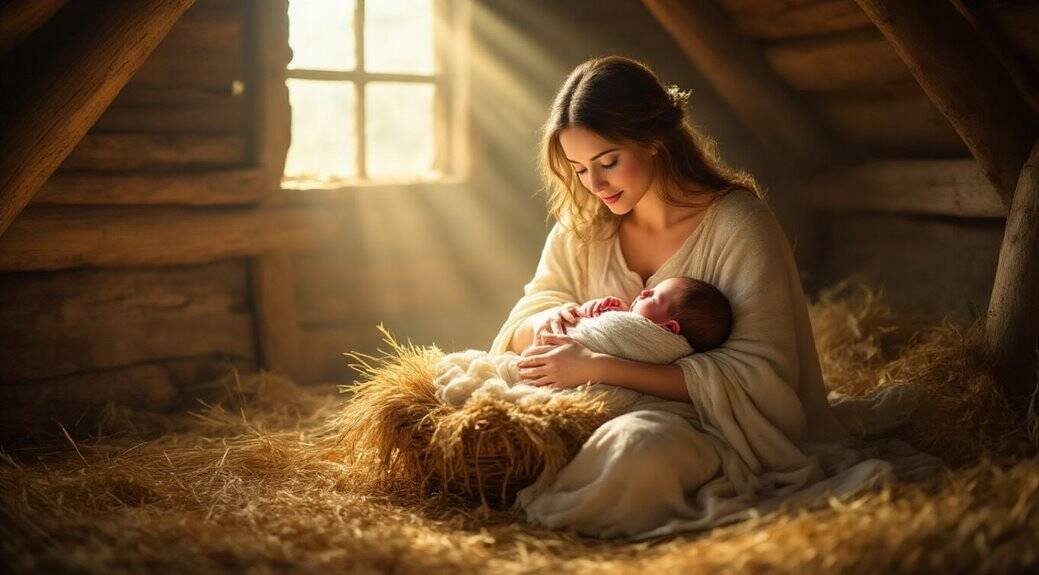
Have you ever pondered the profound questions posed to the mother of our Savior? “Mary, Did You Know?” stands as one of modern Christianity’s most contemplative Christmas songs, inviting worshippers to reflect on the divine mystery Mary carried in her womb.
You’ll find this song’s power lies in its scriptural context, drawing from Luke’s Gospel and Isaiah’s prophecies. Each verse asks Mary if she comprehended her Son would walk on water, give sight to the blind, and calm storms with His hand. The lyrics echo Mary’s biography from Scripture—a young virgin chosen by God, treasuring these things in her heart.
When you sing these words with your congregation, you’re joining millions who’ve wrestled with the incarnation’s magnitude. The song doesn’t just recount Christ’s miracles; it invites you into Mary’s awe. You’re reminded that the baby she kissed is the face of God, making this Christmas meditation both intimate and universal.
O Come, All Ye Faithful
You’ll find yourself drawn into worship when you sing “O Come, All Ye Faithful,” a triumphant hymn that calls believers to Bethlehem to adore the newborn King.
This beloved carol, originally written in Latin as “Adeste Fideles” around 1743, weaves together Scripture’s nativity accounts with powerful theological truths about Christ’s incarnation and deity.
Its majestic melody and rich harmonies have inspired countless traditional arrangements that lift congregational voices in unified praise, proclaiming “O come, let’s adore Him, Christ the Lord!”
History and Origins
When you sing “O Come, All Ye Faithful” during advent season, you’re joining voices with believers who’ve proclaimed Christ’s birth for nearly three centuries.
You’re participating in a tradition that began around 1743 when John Francis Wade, an English Catholic, penned “Adeste Fideles” in Latin.
“Through archival methodology, scholars’ve traced Wade’s original manuscript to Douai Abbey in France,”
“where he’d fled during religious persecution.”
The hymn’s linguistic roots reveal profound theological truths—”Venite adoremus” calls you to worship just as the shepherds answered heaven’s invitation in Luke 2:15.
You’ll find the English translation we know today came from Frederick Oakeley in 1841.
When you lift your voice with “O come, let’s adore Him,” you’re echoing centuries of faithful witness to the Word made flesh.
Lyrics’ Biblical Meaning
How deeply do the verses of “O Come, All Ye Faithful” reflect Scripture’s testimony about Christ’s incarnation?
You’ll discover profound exegetical insights within each stanza that mirror biblical truth.
The opening call to “come and behold Him” echoes the shepherds’ response in Luke 2:15, while “born the King of angels” proclaims His divine sovereignty from Isaiah 9:6.
Translation issues from the original Latin “Adeste Fideles” reveal even richer meaning.
“Venite adoremus” doesn’t merely invite worship—it commands urgent adoration.
When you sing “Word of the Father, now in flesh appearing,” you’re declaring John 1:14‘s truth about the Word becoming flesh.
The hymn’s theology centers on Christ’s dual nature: fully God (“Light of Light”) and fully man (“born of a virgin”), calling your congregation to worship the incarnate Lord.
Traditional Musical Arrangements
The biblical truths proclaimed in these sacred words find their perfect vessel in the hymn’s majestic musical framework.
You’ll discover that “O Come, All Ye Faithful” employs modal harmony rooted in ancient church traditions, creating a sense of timeless reverence that draws your heart toward Bethlehem’s manger.
The melody’s ascending phrases mirror the call to “come and behold Him,” lifting congregational voices in unified worship.
When you sing this carol, you’re participating in renaissance textures that layer voices like angels proclaiming Christ’s birth.
The arrangement’s stately rhythm moves with processional dignity, while the harmonic progressions build toward the triumphant “O come, let’s adore Him.”
You’ll notice how each musical element serves the text’s devotional purpose, transforming simple notes into corporate praise.
Hark! The Herald Angels Sing
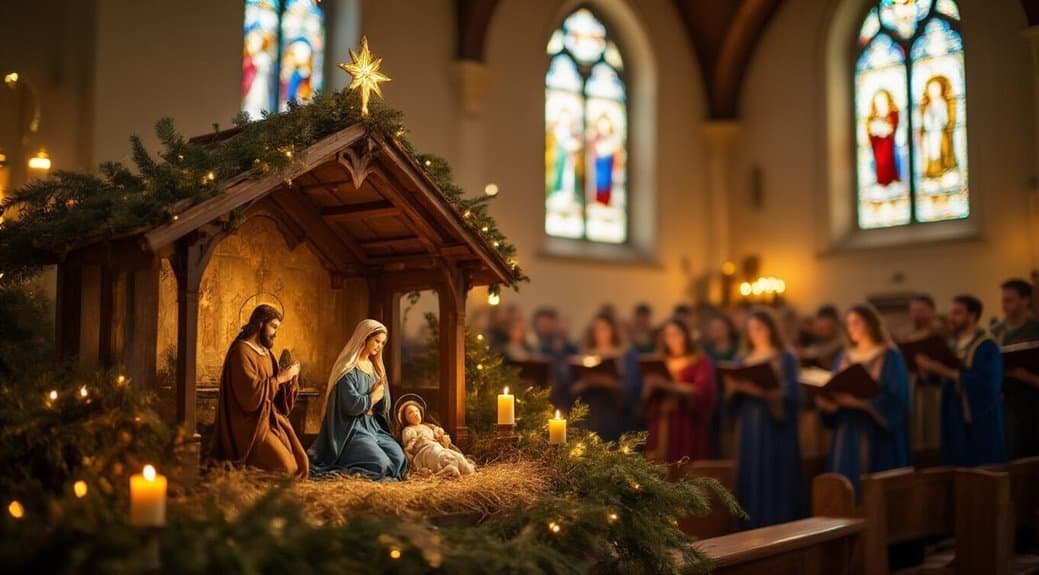
“Hark! The Herald Angels Sing” invites you to join heaven’s proclamation of Christ’s birth.
When you sing Wesley’s powerful lyrics, you’re declaring the theology themes central to salvation: “God and sinners reconciled” and “Light and life to all He brings.”
The song’s triumphant melody dynamics mirror the angels’ joyful announcement in Luke 2:14, building from reverent worship to exultant praise.
You’ll notice how each verse deepens your understanding of the Incarnation.
The text grounds you in Scripture, from “offspring of a virgin’s womb” echoing Isaiah 7:14 to “risen with healing in His wings” from Malachi 4:2.
As you raise your voice with the congregation, you’re not just singing about historical events—you’re proclaiming eternal truths.
The soaring “glory to the newborn King” becomes your personal declaration of faith, uniting your worship with believers across centuries who’ve celebrated this divine mystery of Emmanuel, God with us.
Angels We Have Heard on High
You’ll discover that “Angels We Have Heard on High” originated as a French carol from the 18th century, bringing the shepherds’ wonder at Christ’s birth directly into your worship.
The soaring “Gloria in excelsis Deo” refrain echoes the heavenly host’s proclamation in Luke 2:14, lifting your voice in the same Latin praise that believers have sung for centuries.
Traditional arrangements of this carol range from simple four-part harmonies to elaborate orchestrations, yet each invites you to join the angels’ glorious announcement of the Savior’s arrival.
Origins and History
When you sing “Angels We Have Heard on High” during worship, you’re joining centuries of believers who’ve proclaimed Christ’s birth through this majestic hymn.
The carol’s French origins trace back to “Les Anges dans nos campagnes,” first appearing in southern France during the 18th century.
You’ll find archival gaps make pinpointing its exact composer impossible, though traditional accounts link it to shepherds’ songs from Languedoc.
Dating disputes surround the hymn’s creation, with scholars placing it between 1700 and 1862.
James Chadwick translated it into English in 1862, adding the beloved “Gloria in excelsis Deo” refrain that echoes Luke 2:14.
You’re participating in worship that connects medieval Latin traditions with modern congregational praise, bridging centuries of Christmas devotion through one powerful song.
Gloria Refrain Meaning
Singing those cascading notes on “Gloria in excelsis Deo” transforms you into part of the heavenly chorus that first announced Christ’s birth to startled shepherds.
You’re proclaiming “Glory to God in the highest,” echoing Luke 2:14’s angelic declaration.
This Latin refrain carries profound theological significance—you’re acknowledging God’s supreme majesty while celebrating His humility in becoming flesh.
Within its liturgical context, you’ll recognize this phrase from the Gloria of the Mass, connecting Christmas worship to year-round praise.
As you stretch “Gloria” across sixteen notes, you’re not merely singing; you’re participating in heaven’s joy breaking into earth’s darkness.
The refrain’s repetition mirrors the angels’ continuous worship before God’s throne, inviting you to join their eternal song celebrating redemption’s dawn.
Traditional Carol Arrangements
“Traditional arrangements of “Angels We Have Heard on High” build upon that glorious refrain through carefully crafted harmonies that mirror the heavenly host’s multitude.”
“You’ll discover how modal analysis reveals the carol’s ancient church modes, creating that distinctive medieval quality that transports you to Bethlehem’s holy night.”
“When you sing with your congregation, you’re joining centuries of believers who’ve proclaimed Christ’s birth through these timeless melodies.”
“Your choir’s instrumentation choices can enhance worship profoundly.”
“You might pair organ with strings to evoke the shepherds’ wonder, or add brass to proclaim the King’s arrival.”
“Traditional arrangements often feature descants that soar above the melody during the Gloria, letting your soprano voices represent the angels’ ethereal praise while lower voices ground the earthly celebration.”
The First Noel
Through centuries of Christmas worship, “The First Noel” has proclaimed the angel’s announcement to humble shepherds keeping watch over their flocks.
You’ll find this carol’s melodic lineage traces back to medieval France or England, though its exact origins remain mysteriously veiled.
When you sing these sacred verses, you’re joining believers who’ve lifted this same testimony since the 16th century.
The carol’s textual variants reflect different traditions—some congregations sing “born is the King of Israel” while others proclaim “King of Israel born.”
Yet you’ll discover the core message never wavers: Christ’s birth brings light to darkness, hope to despair.
As you voice the refrain “Noel, Noel,” you’re echoing the French word for “birth,” declaring with the shepherds and wise men that salvation has come.
This carol invites you to witness the star’s guidance, kneel before the manger, and offer your own gold, frankincense, and myrrh—your worship, prayers, and surrendered life.
Away in a Manger
When you cradle a child or recall your own childhood memories, you’ll understand why “Away in a Manger” touches hearts with its tender portrayal of the infant Jesus.
This beloved carol transforms Luke 2:7’s account of Christ’s humble birth into gentle verse that’s become a cornerstone of congregational worship during Advent.
The song’s crib imagery paints an intimate picture of our Savior’s first moments on earth.
You’re drawn to the manger where “the little Lord Jesus laid down his sweet head,” experiencing the profound mystery of God becoming vulnerable for humanity’s redemption.
Its lullaby themes create a peaceful atmosphere that invites you to approach the Christ child with childlike faith.
You’ll find this hymn’s simplicity carries deep theological truth—Emmanuel chose poverty and humility to bring salvation.
Whether you’re singing with your congregation or teaching it to children, “Away in a Manger” reminds you that Christ’s love began in Bethlehem’s stable.
O Little Town of Bethlehem
You’ll discover that “O Little Town of Bethlehem” emerged from Phillips Brooks’ 1865 pilgrimage to the Holy Land, where he stood in the very fields where shepherds once watched their flocks.
The hymn’s lyrics draw directly from Luke 2 and Micah 5:2, proclaiming Christ’s humble birth in David’s city while celebrating the profound truth that the “hopes and fears of all the years” met in Bethlehem’s streets.
As you sing these sacred words, you’re joining generations of believers who’ve found in this carol both historical witness and prophetic fulfillment.
History and Origins
How remarkable that one of Christianity’s most cherished Christmas carols emerged from a Holy Land pilgrimage in 1865.
You’ll discover that Phillips Brooks penned these sacred words after visiting Bethlehem’s ancient roots, where Christ’s birth transformed history. He’d witnessed Christmas Eve from the hillside overlooking David’s city, experiencing the very landscape Mary and Joseph traversed.
Brooks shared his inspired verses with church organist Lewis Redner, who composed the melody “St. Louis” through what he called divine intervention.
The chronology development reveals they first presented it to Sunday school children at Philadelphia’s Church of the Holy Trinity in 1868.
You’re singing words birthed from genuine spiritual encounter—Brooks captured Bethlehem’s timeless peace while standing where shepherds once heard angels proclaim salvation’s dawn.
Biblical Message
As you sing Brooks’ beloved carol, you’re proclaiming Micah’s ancient prophecy fulfilled in Christ’s humble birth.
The little town becomes the stage where messianic prophecy transforms from promise to reality.
You’re declaring how the “hopes and fears of all the years” meet in Bethlehem’s manger, where God’s redemptive plan unfolds.
Through these verses, you’re embracing biblical ethics that celebrate humility over pride, peace over violence, and divine love over earthly power.
The carol invites you to witness how Christ arrives “while mortals sleep,” demonstrating God’s quiet revolution that changes hearts rather than conquering kingdoms.
You’re affirming Scripture’s truth that salvation comes through meekness, not might.
Each time you lift your voice with fellow believers, you’re testifying to God’s faithfulness in keeping His promises.
Joy to the World
When you sing “Joy to the World” during Christmas, you’re proclaiming one of Christianity’s most triumphant hymns, penned by Isaac Watts in 1719 as a poetic interpretation of Psalm 98.
You’re not just celebrating Christ’s birth—you’re declaring His lordship over all creation.
The hymn structure builds magnificently from personal joy to cosmic praise, inviting you to join heaven and nature’s song.
As you lift your choral voice with fellow believers, you’re echoing Scripture’s promise that “every valley shall be exalted” (Isaiah 40:4).
Each verse calls you deeper into worship: first announcing Christ’s arrival, then claiming His reign, and finally celebrating His righteousness and grace.
You’re proclaiming truth that transcends seasons—that Christ rules with truth and grace, making nations prove the glories of His righteousness.
When you sing “repeat the sounding joy,” you’re participating in eternal worship that began at creation and continues forever.
What Child Is This?
Why does this haunting melody grip your soul each Christmas season? “What Child Is This?” pairs William Dix’s 1865 lyrics with the ancient English tune “Greensleeves,” creating a profound meditation on Christ’s incarnation that moves you from wonder to worship.
The song’s lyrical origins emerge from Dix’s contemplation of Matthew 2:11, where wise men fall before the infant King.
You’ll notice how each verse builds theological depth—first questioning Christ’s identity, then proclaiming His purpose, finally calling for universal praise. This structure guides your congregation through the mystery of God becoming flesh.
The melodic analysis reveals why “Greensleeves” perfectly serves this text. Its minor key and lilting rhythm create an atmosphere of reverent awe that matches the song’s contemplative questions.
When you sing these words, you’re joining centuries of believers who’ve pondered this same miracle: the Creator lying helpless in Mary’s arms, salvation wrapped in swaddling clothes.
We Three Kings
When you sing “We Three Kings,” you’re joining countless believers in retelling Matthew’s account of the Magi who followed the star to worship the newborn King.
You’ll notice how each verse unveils the prophetic significance of their gifts—gold honoring Christ’s kingship, frankincense acknowledging His deity, and myrrh foreshadowing His sacrificial death.
Through this beloved carol, you’re proclaiming the Gospel message that wise men still seek Him and offer their treasures at His feet.
Biblical Magi Story
As you sing “We Three Kings” during worship, you’re joining millions who’ve celebrated the journey of the Magi following the star to Bethlehem.
Matthew’s Gospel reveals how these wise men from the East saw Christ’s star and traveled to worship the newborn King.
Their Magi journey wasn’t just physical—it was spiritual transformation, moving from darkness into God’s marvelous light.
The Star symbolism speaks powerfully to your faith today.
Just as that celestial beacon guided them through desert nights, God’s Word illuminates your path.
You’ll notice how the Magi brought gold, frankincense, and myrrh—gifts acknowledging Jesus as King, Priest, and Sacrifice.
When you lift this carol with your congregation, you’re declaring the same truth they discovered: Christ deserves your worship and most precious offerings.
Symbolic Gift Meanings
Gold represents kingship—the sovereign authority of Christ over heaven and earth that you proclaim each time you sing this treasured carol.
When you reflect on gold symbolism in “We Three Kings,” you’re acknowledging Jesus as the King of Kings, worthy of your highest honor and complete submission.
Frankincense symbolism reveals Christ’s divine nature and priestly role.
This costly incense, burned in temple worship, points to Jesus as your eternal High Priest who intercedes before the Father.
You’re declaring His deity when you sing about this sacred gift.
Myrrh foreshadows Christ’s sacrificial death—the bitter spice used for burial anointing.
Through these three gifts, you’re proclaiming the complete gospel: Jesus reigns as King, serves as Priest, and died as Savior for your redemption.
O Come, O Come Emmanuel
Among the most ancient and beloved Advent hymns, “O Come, O Come Emmanuel” carries the deep longing of God’s people awaiting their Messiah.
You’ll notice its haunting melody echoes Israel’s centuries of expectation, drawing from the “O Antiphons” – seven ancient prayers traditionally sung during Advent’s final week.
When you sing this hymn within its liturgical context, you’re joining believers across generations who’ve cried out for deliverance.
You’re joining believers across generations who’ve cried out for deliverance from darkness into light.
The textual cadence moves between lament and hope, each verse addressing Christ through Old Testament titles: Wisdom, Lord of Might, Branch of Jesse’s stem.
You’re proclaiming prophecies fulfilled in Jesus’ birth.
The refrain “Rejoice! Rejoice!” breaks through the minor key’s solemnity, declaring victory even in waiting.
As your congregation lifts these words, you’re not merely remembering Israel’s anticipation – you’re expressing your own longing for Christ’s return, when He’ll complete what His first coming began.
God Rest Ye Merry Gentlemen
The historical context reveals this carol emerged from 16th-century England, where common people sang it in streets and taverns, spreading Christ’s nativity story outside church walls.
You’ll notice the melodic analysis shows its minor key creates an unexpectedly jubilant atmosphere, building tension that resolves into the refrain’s declaration of comfort and joy.
As you lift your voice with fellow believers, you’re declaring Satan’s defeat through Christ’s birth.
The lyrics remind you that Jesus came “to save us all from Satan’s power when we were gone astray.” This isn’t merely nostalgia—it’s worship that proclaims redemption’s dawn through the manger in Bethlehem.
It Came Upon a Midnight Clear
It Came Upon a Midnight Clear emerged in 1849 from pastor Edmund Sears’s pen, making it one of the first American carols to focus on peace rather than Christ’s nativity.
When you sing its verses about angels bending near the earth, you’re proclaiming the biblical promise of peace from Luke 2:14, where heavenly hosts declared “Glory to God in the highest, and on earth peace, good will toward men.”
Today’s arrangements range from traditional organ settings that echo in your sanctuary to contemporary versions that invite your congregation to reflect on God’s enduring message of peace amidst life’s weariness.
History and Origins
When Edmund Sears penned “It Came Upon a Midnight Clear” in 1849, he crafted more than a carol—he created a prophetic call to peace during America’s tumultuous pre-Civil War era. You’ll find this hymn stands apart from pagan precursors that influenced other seasonal songs, drawing instead purely from Luke’s angelic announcement. Sears, a Unitarian minister, wove Scripture’s promise of “peace on earth” throughout five stanzas that still resonate in your congregation today.
The carol’s musical migrations began when Richard Storrs Willis composed its beloved tune “Carol” in 1850.
You’ve likely sung both this melody and the alternative British setting, “Noel,” which Arthur Sullivan adapted. Through these musical journeys, Sears’s vision of heaven touching earth continues blessing worshippers, reminding you that God’s angels still sing over humanity’s struggles.
Lyrics’ Biblical Message
How deeply does Scripture permeate every verse of Sears’s masterpiece? You’ll discover angels proclaiming peace, echoing Luke 2:14’s heavenly host.
Through careful textual exegesis, you recognize the song’s foundation rests on prophetic fulfillment and divine promise.
The biblical imagery transforms each stanza into worship. You’re witnessing heaven touching earth, as angelic messengers bend near struggling humanity.
Sears weaves Isaiah’s peace prophecies with Gospel narratives, creating verses that invite your congregation to contemplate Christ’s advent.
When you sing these words, you’re declaring scriptural truth about reconciliation and hope.
The lyrics don’t merely reference the nativity; they proclaim God’s redemptive plan.
You’ll find the golden age imagery reflects Revelation’s promise of restoration, while the call to hear heaven’s music echoes throughout Scripture’s invitation to worship the newborn King.
Musical Arrangements Today
Contemporary arrangements of this beloved carol transform its gentle melody into diverse expressions of worship that resonate across generations.
You’ll find modern arrangements breathing fresh life into Edmund Sears’ timeless lyrics, from acoustic guitar renditions to full symphonic presentations.
Digital orchestration now enables worship teams to layer rich instrumental textures beneath the familiar tune, creating immersive soundscapes that draw congregations deeper into contemplation of Christ’s birth.
Today’s arrangers skillfully balance reverence with innovation, preserving the song’s peaceful essence while adapting it for contemporary worship settings.
You can hear electronic strings supporting traditional vocals, or piano-driven versions that strip away complexity to highlight the profound simplicity of heaven’s announcement.
These varied approaches ensure this nineteenth-century hymn continues speaking God’s peace to modern hearts, whether in traditional sanctuaries or contemporary gatherings.
Good Christian Men, Rejoice
The medieval carol “Good Christian Men, Rejoice” bursts forth with unbridled celebration of Christ’s birth, calling you to join heaven’s chorus in proclaiming salvation’s arrival.
You’ll discover this 14th-century German hymn originally paired Latin and vernacular text, making God’s message accessible to all believers.
Its triple meter creates an infectious dance-like quality that moves your spirit to worship.
When you sing “Christ was born for this!” you’re declaring the incarnation’s purpose—redemption through the cross.
The vocal arrangement traditionally features unison singing, though modern liturgical practice often includes harmonized versions.
You’ll notice each verse addresses different aspects of salvation: Christ’s birth, death’s defeat, and heaven’s opening.
This carol transforms your congregation into joyful heralds, echoing the angels’ announcement to shepherds.
You’re not merely reciting historical facts; you’re participating in eternal truth.
The refrain “News! News!” compels you to share what God has accomplished through His Son.
Lo, How a Rose E’er Blooming
When you encounter “Lo, How a Rose E’er Blooming,” you’re witnessing prophecy fulfilled through Mary’s holy motherhood, as Isaiah’s ancient promise takes flesh in Bethlehem’s manger.
This German hymn from the 15th century draws its botanical symbolism from Isaiah 11:1, where Christ springs forth as a shoot from Jesse’s root.
You’ll find the rose represents both Mary’s purity and Jesus as the flowering of God’s redemptive plan.
In liturgical use, you’ll often sing this during Advent and Christmas Eve services, where its gentle melody creates sacred space for contemplation.
The hymn’s verses unfold salvation’s mystery—how God chose the darkest hour, “half spent was the night,” to bring forth His Son.
As you join your voice with countless believers across centuries, you’re proclaiming the marvel of incarnation: the eternal Word blooming in time, heaven’s glory cradled in Mary’s arms.
Come, Thou Long Expected Jesus
Charles Wesley’s advent hymn “Come, Thou Long Expected Jesus” carries forward Isaiah’s messianic hope with urgent yearning for Christ’s appearing.
You’ll find Wesley’s hymn authorship reflects deep scriptural knowledge, weaving Old Testament prophecies into every verse.
The opening plea echoes Israel’s centuries of waiting, transforming ancient thematic longing into your present worship.
When you sing “Born Thy people to deliver,” you’re proclaiming Christ’s dual mission—freeing from sin’s bondage and establishing His eternal kingdom.
Wesley draws from Haggai’s promise that the “Desire of All Nations” would come, making this truth personal for your congregation.
The hymn’s power lies in bridging expectation with fulfillment.
You’re not merely recounting history but participating in ongoing redemption.
The closing verse transforms waiting into worship: “By Thine own eternal Spirit, rule in all our hearts alone.”
You’re invited to experience advent’s tension—celebrating Christ’s first coming while anticipating His return.
The Little Drummer Boy
A humble gift becomes profound worship in “The Little Drummer Boy,” where you’ll discover how the smallest offering, given with pure devotion, transforms into acceptable praise.
You’re reminded that God doesn’t measure gifts by their monetary value but by the heart behind them, echoing the widow’s mite that Jesus praised.
The drum symbolism represents more than percussion—it’s the heartbeat of worship itself.
When you sing “I played my drum for Him,” you’re acknowledging that whatever talent God’s given you belongs at Christ’s feet.
The boy’s poverty doesn’t disqualify his worship; it amplifies its authenticity.
Cultural adaptations have carried this truth across generations and nations, proving its universal message.
You’ll find this song resonates whether sung in cathedral choirs or children’s pageants because it proclaims what Scripture confirms: God delights in sincere worship from His people, regardless of their station.
Your simplest “pa rum pum pum” becomes a symphony when offered to the King.
Do You Hear What I Hear?
As you lift your voice to sing “Do You Hear What I Hear?”, you’re joining a prophetic call for peace that emerged during the Cuban Missile Crisis in 1962, when songwriters Noël Regney and Gloria Shayne transformed their fears into a prayer for God’s intervention.
The song’s cascading questions echo Scripture’s promise that Christ’s birth brings “peace on earth, goodwill toward men,” inviting you to become a messenger who shares this divine peace with others.
You’ll find yourself in blessed company with artists like Bing Crosby, Whitney Houston, and Carrie Underwood, who’ve each proclaimed this song’s timeless message that the humble Child in the manger holds the power to bring light to our darkest nights.
Song’s Historical Origins
During the height of the Cuban Missile Crisis in October 1962, songwriters Noël Regney and Gloria Shayne Baker penned “Do You Hear What I Hear?” as a plea for peace in a world teetering on the brink of nuclear war.
You’ll find this modern carol breaks from medieval roots that shaped traditional Christmas hymns, yet it maintains the sacred storytelling tradition of Christ’s birth.
While ancient carols underwent centuries of hymn evolution through oral tradition and church liturgy, this song emerged fully formed from contemporary crisis.
Regney’s lyrics follow the biblical narrative from shepherd to king, echoing Luke’s Gospel account.
You’re singing words born from nuclear fear transformed into hope—a prayer that humanity would hear heaven’s message of peace through the Christ child, just as shepherds heard angels proclaim glory to God.
Biblical Peace Message
When you trace the song’s progression from wind to lamb to shepherd to king, you’re witnessing how God’s peace moves through creation to reach humanity’s highest powers.
You’ll discover the biblical peace themes echo Isaiah 9:6, proclaiming Christ as the Prince of Peace who brings salvation to all nations.
The lyrics transform nature’s whisper into heaven’s declaration, mirroring how God’s inner peace spreads from one heart to another.
You’re called to hear what creation knows—that Christ’s birth brings “goodness and light” to overcome darkness.
The song’s message parallels Luke 2:14, where angels announce peace on earth to the shepherds.
As you sing these words with your congregation, you’re joining the biblical pattern of peace proclamation, becoming God’s voice that declares His peace to troubled souls everywhere.
Notable Artist Versions
Countless believers have lifted this sacred message through their voices, transforming “Do You Hear What I Hear?” into a vessel for worship across generations.
You’ll find Bing Crosby’s 1963 recording established the song’s reverent foundation, while Whitney Houston’s powerful rendition brought gospel-infused majesty to Christ’s story.
Carrie Underwood’s crystalline interpretation and Pentatonix’s layered harmonies showcase diverse vocal styles that honor the Savior’s birth.
When you’re selecting versions for worship, you’ll discover each artist brings unique anointing to the lyrics.
Publishers have carefully managed copyright issues, ensuring churches can freely share this testimony of peace.
From traditional choir arrangements to contemporary worship bands, you’re witnessing how God’s message transcends musical boundaries, uniting believers in proclaiming the holy night when heaven touched earth through a child.
Angels From the Realms of Glory
The triumphant carol “Angels From the Realms of Glory” calls you to join heaven’s proclamation of Christ’s birth, echoing the angelic announcement that first broke through Bethlehem’s night sky. You’ll find this majestic hymn weaving Luke 2’s narrative throughout its verses, summoning angels, shepherds, sages, and saints to worship the newborn King.
James Montgomery’s 1816 text paired with Henry Smart’s beloved tune “Regent Square” creates powerful liturgical usage during Advent and Christmas services. You’re singing Scripture when you voice “Come and worship Christ the newborn King”—a direct call reflecting Matthew’s wise men and Luke’s shepherds.
The hymn’s arrangement challenges lie in balancing its grand, processional nature with congregational accessibility.
You’ll notice skilled music directors often modulate the final verse upward, building toward the climactic “Glory in the highest heaven” that mirrors the heavenly host’s praise.
This carol transforms you from observer to participant in salvation’s story.
Breath of Heaven (Mary’s Song)
When you listen to “Breath of Heaven,” you’re hearing Mary’s heart cry as she faced the overwhelming reality of carrying the Savior—a young woman’s honest prayer for strength to walk in God’s impossible calling.
You’ll find yourself drawn into her vulnerability as she pleads, “Help me be strong, help me be,” echoing the biblical truth that God’s power perfects itself in our weakness.
This song transforms your worship by reminding you that even Mary needed divine breath to sustain her through heaven’s miraculous plan.
Mary’s Biblical Perspective
The song captures her human vulnerability—you’ll hear her wonder if a wiser one should’ve been chosen.
She’s frightened, alone, praying for heaven’s mercy.
This perspective transforms your understanding of the Incarnation.
You’re witnessing a teenage girl’s radical obedience that changed history.
Through Mary’s eyes, you’ll grasp the weight of carrying salvation’s promise.
Song’s Spiritual Impact
Beyond Mary’s personal journey, this song creates sacred space where you’ll encounter God’s presence in profound ways.
You’ll find its personal resonance drawing you into Mary’s wonder, helping you grasp the weight of God’s redemptive plan.
As you sing these words, you’re not just observing history—you’re participating in the mystery of incarnation.
In communal worship, “Breath of Heaven” transforms congregations into unified voices crying out for divine strength.
You’ll witness hearts opening as believers connect with Mary’s vulnerability and God’s faithfulness.
The song’s bridge between ancient scripture and contemporary expression enables you to experience Christmas through heaven’s perspective.
Each verse invites you deeper into worship, where Christ’s birth becomes personal revelation rather than distant narrative, stirring your soul to magnify the Lord alongside Mary.
Welcome to Our World
As you reflect on the miracle of Christ’s birth, “Welcome to Our World” invites you into the holy wonder of God stepping into human history. You’re witnessing the Word become flesh, dwelling among us in perfect love and humility.
This powerful song captures your heart’s response to heaven’s inclusive welcome.
You’ll find yourself marveling at how the King of Kings chose our shared humanity, entering a broken world that desperately needed redemption. The lyrics echo Isaiah’s prophecy: “For unto us a child is born, unto us a son is given.”
When you sing these words with your congregation, you’re acknowledging Christ’s willingness to experience every human struggle.
He didn’t come to a palace but to a manger.
You’re celebrating that Jesus knows your tears, understands your pain, and walks beside you through every valley.
Through this song, you’re proclaiming the gospel truth that changes everything.
Labor of Love
Contemplating Mary’s journey to Bethlehem reveals the profound sacrifice woven into Christ’s arrival.
You’ll find that “Labor of Love” captures this sacred dedication through melody and verse, reminding you that God’s greatest gift came through humble, willing service.
Mary’s yes to Gabriel wasn’t just acceptance—it was complete surrender to divine purpose.
When you sing these lyrics with your congregation, you’re declaring that Christ’s birth required dedicated service from an ordinary young woman who became extraordinary through obedience.
The song transforms your understanding of Christmas from mere celebration to participation.
You’re called to mirror Mary’s volunteer effort, offering your own life as she did.
Scripture affirms this truth: “My soul magnifies the Lord” becomes your anthem.
You recognize that celebrating Jesus’s birth means embracing sacrificial love yourself.
Through this song, you join believers throughout history who’ve understood that worshiping the newborn King means following Mary’s example of costly devotion.
Noel
When you sing “Noel” this Christmas, you’re proclaiming the French word for “birth” that has echoed through centuries of worship, originating from the Latin “natalis” meaning “birthday of the Lord.”
You’ll find this sacred declaration woven throughout beloved hymns like “The First Noel” and “Sing We Now of Christmas,” each one inviting your voice to join the angelic announcement of Christ’s arrival.
These time-honored songs transform your congregation into a chorus of heralds, proclaiming with the heavenly host that unto us a Child is born, unto us a Son is given.
Origins of Noel
Have you ever wondered why we sing “Noel” during Christmas celebrations? You’re participating in an ancient tradition that spans centuries.
The word origin traces back to the Latin “natalis,” meaning “birth,” which evolved through Old French into “noël.” These linguistic roots directly connect to Christ’s nativity, making every utterance a proclamation of His arrival.
When you sing “The First Noel,” you’re echoing medieval Christians who first used this term to announce Jesus’s birth.
The word became synonymous with Christmas itself in French-speaking regions before spreading throughout Christendom.
Scripture reminds us that angels declared “good tidings of great joy” (Luke 2:10), and “Noel” carries that same jubilant message.
You’ll find this sacred word woven throughout traditional carols, each time affirming the miracle of Emmanuel—God with us.
Popular Noel Hymns
Which beloved carols featuring “Noel” fill your church sanctuary each December? You’ve likely lifted your voice to “The First Noel,” proclaiming Christ’s birth to Bethlehem’s shepherds.
This timeless hymn invites you to join heaven’s chorus in worshiping the newborn King.
“Angels We Have Heard on High” echoes through your congregation with its soaring “Gloria in excelsis Deo” refrain, while “Sing We Now of Christmas” brings joyful medieval reverence to your worship.
You’ll find modern renditions breathing fresh life into these ancient texts, helping younger generations connect with their spiritual heritage.
Many sung translations from French and Latin manuscripts preserve the original “Noël” spelling, reminding you that Christians across centuries and cultures have celebrated this holy night.
These hymns unite your voice with believers worldwide, declaring Emmanuel—God with us.
Light of the World
These songs don’t merely describe light—they invite you to experience it.
Through congregational worship, you’re proclaiming Isaiah’s prophecy: “The people walking in darkness have seen a great light.”
Each carol becomes your testimony of transformation.
Born Is the King (It’s Christmas)
When you lift your voice to sing “Born Is the King (It’s Christmas),” you’re joining heaven’s announcement that echoed over Bethlehem’s fields.
This contemporary anthem transforms Luke 2’s narrative into corporate worship, inviting you to proclaim Christ’s royal birth alongside angels and shepherds.
You’ll find the song’s power in its declaration of Jesus’s kingship from the manger.
While the world expected earthly sovereignty, you’re celebrating the paradox of divine majesty wrapped in swaddling clothes.
The lyrics strip away mythic symbolism often attached to Christmas, focusing instead on biblical truth—Emmanuel has come.
As you sing the bridge’s “Hallelujahs,” you’re not just remembering history; you’re participating in eternal worship.
The song builds from quiet wonder to explosive praise, mirroring your heart’s response to the incarnation.
Each chorus reinforces the central message: the promised King isn’t coming—He’s already here, transforming your waiting into rejoicing.
Glory (Let There Be Peace)
As angelic voices pierced the darkness above Bethlehem’s shepherds, they proclaimed both glory and peace—twin realities you’re invited to embrace through “Glory (Let There Be Peace).”
This worship anthem captures the cosmic significance of Christ’s birth, where heaven’s glory descended to establish God’s shalom on earth.
You’ll discover profound glory symbolism woven throughout Scripture’s nativity account.
The shekinah glory that once filled Solomon’s temple now rests in a manger.
God’s radiant presence breaks through humanity’s darkest hour, illuminating shepherds’ fields and wise men’s journey.
When you sing this song, you’re declaring that Christ embodies divine glory made tangible.
The peace theology embedded in these lyrics transcends mere absence of conflict.
You’re proclaiming the comprehensive wholeness Jesus brings—reconciliation between God and humanity, restoration of broken relationships, and redemption of creation itself.
This shalom isn’t fragile human diplomacy but heaven’s unshakeable kingdom breaking into time.
Emmanuel (Hallowed Manger Ground)
Though kings built palaces and priests consecrated temples, God chose a humble feeding trough to cradle His incarnate Son—transforming ordinary wood and straw into the holiest ground on earth.
When you sing “Emmanuel (Hallowed Manger Ground),” you’re declaring the breathtaking truth of Isaiah 7:14—God dwells with us.
The Emmanuel meaning, “God with us,” reveals heaven’s greatest mystery: the divine presence wrapped in swaddling clothes.
You’ll find this song draws your heart to Bethlehem’s stable where infinity touched time.
Chris Tomlin’s reverent lyrics remind you that shepherds and angels bowed before this child, recognizing what Mary treasured in her heart—this baby embodied God’s promise to never leave nor forsake His people.
As your congregation lifts these words, you’re joining centuries of believers who’ve marveled at the incarnation.
The manger becomes your altar, where you encounter the Word made flesh, dwelling among us.
How Many Kings
The manger that cradled divinity points you to an even greater mystery—the King of kings chose poverty over power. “How Many Kings” confronts you with heaven’s most stunning reversal: thrones abandoned for thorns, crowns exchanged for crosses.
You’ll find this contemporary carol weaving through Scripture’s birth narratives, from shepherds’ fields to the magi census of distant kingdoms. When you sing these lyrics, you’re proclaiming Christ’s incomparable worth—how many rulers left their thrones to die for love? Only One descended from heaven’s glory to Bethlehem’s stable.
This song transforms your worship as you consider what kingship truly means.
You’re not just recounting history; you’re declaring that Jesus surpassed every earthly sovereign who sought Him.
While Herod clung to power and Caesar counted subjects, Christ came serving.
As you lift these words together, you’re testifying that no king compares to the Servant King who traded His crown for your redemption.
While Shepherds Watched Their Flocks
When darkness blanketéd Bethlehem’s fields, ordinary shepherds became the first gospel preachers, receiving heaven’s birth announcement before princes or priests.
“While Shepherds Watched Their Flocks” invites you into that holy night when God chose society’s outcasts as His heralds.
You’ll discover profound theology in this carol’s simplicity.
These weren’t wealthy landowners but laborers in the pasture economy, maintaining their nighttime vigil over vulnerable sheep.
Yet heaven’s glory burst upon them first.
When you sing these verses, you’re proclaiming God’s upside-down kingdom where the last become first.
The hymn captures Luke 2:8-14 with remarkable faithfulness.
You’ll hear the angel’s proclamation: “Fear not!”
You’ll witness heaven’s host declaring glory to God.
Through each stanza, you’re transported to those fields where trembling shepherds received history’s greatest news.
Their response becomes yours—leaving everything to seek the Christ child, then spreading the word with joy.
Infant Holy, Infant Lowly
The carol’s manger imagery transforms rough wood and scattered straw into heaven’s throne room.
You’ll discover how Christ chose weakness as His strength, making shepherds His first evangelists.
When you sing “Swift are winging angels singing,” you’re joining heaven’s chorus that announced salvation to society’s margins.
Each verse draws you deeper into the mystery of Emmanuel—God with us in our frailty.
Through this tender melody, you’ll proclaim the gospel’s scandal: divinity nursing at Mary’s breast, infinity wrapped in swaddling clothes.
Love Came Down at Christmas
Love itself descended from heaven’s throne when Christ took flesh in Bethlehem’s stable.
You’ll discover this profound truth in Christina Rossetti’s beloved hymn “Love Came Down at Christmas,” where divine love becomes tangible through incarnation.
The song’s liturgical symbolism weaves throughout each verse—love, worship, and joy aren’t abstract concepts but God’s presence you can embrace.
When you sing these words corporately, you’re participating in worship that transcends theology critique by embodying truth rather than merely analyzing it.
The hymn doesn’t explain love; it reveals Love Himself wrapped in swaddling clothes.
You’ll notice Rossetti’s economy of language—no unnecessary theological jargon clutters the message.
Instead, she presents Christ’s birth as love’s ultimate expression, making the sacred accessible to every worshiper.
Your congregation experiences this hymn as both proclamation and prayer, declaring that Love didn’t remain distant but “came down” to dwell among us.
Through this simple yet profound text, you’re invited into Christianity’s central mystery.
Of the Father’s Love Begotten
When you sing “Of the Father’s Love Begotten,” you’re lifting your voice with centuries of believers who’ve proclaimed Christ’s eternal nature through this ancient Latin hymn.
You’ll discover profound theological themes woven throughout its verses—the Word’s existence before creation, His incarnation through Mary, and His reign over all ages.
This fourth-century text invites you to worship the Alpha and Omega, celebrating how God’s love took flesh to redeem His people.
Ancient Latin Origins
How deeply can a hymn’s roots extend into Christian history? When you sing “Of the Father’s Love Begotten,” you’re voicing words from Aurelius Prudentius’s fourth-century poem “Corde Natus.” This ancient text emerged from the Latin liturgy that shaped Western Christianity’s worship for over a millennium.
You’ll discover its melody comes from medieval Roman chants, specifically from “Divinum Mysterium,” a plainsong dating to the 12th or 13th century. These sacred sounds once echoed through stone cathedrals where monks gathered for divine offices.
The hymn’s theological depth reflects Scripture’s testimony of Christ as the eternal Word who “was in the beginning with God” (John 1:2). Today, you’re joining believers across seventeen centuries who’ve proclaimed these truths about Christ’s eternal generation from the Father.
Theological Themes Explored
The eternal nature of Christ’s divine sonship forms the theological foundation of this ancient hymn. You’ll discover profound christology implications as you sing these verses that declare Jesus as “Alpha and Omega,” existing before creation itself. The hymn’s doctrine comparison with Scripture reveals perfect alignment with John’s Gospel—Christ as the eternal Word who was with God and was God.
When you proclaim “He is Alpha and Omega, He the source, the ending He,” you’re affirming the Trinity’s mystery and Christ’s pre-existence. You’re not merely singing about a baby in Bethlehem; you’re worshiping the eternal Son who took on flesh. This hymn teaches you that Christmas celebrates not just a birth, but the incarnation of the everlasting God who stepped into time for your redemption.
Once in Royal David’s City
In Bethlehem’s humble stable, the eternal Word became flesh, and “Once in Royal David’s City” captures this profound mystery with reverent simplicity.
You’ll find this hymn beautifully weaves the nativity narrative through each verse, beginning with Christ’s lowly birth and ascending to His eternal glory.
When you sing these words, you’re proclaiming Scripture’s truth about the Incarnation.
The manger imagery throughout the hymn reminds you that Heaven’s King chose poverty and weakness.
You’re invited to marvel at how “He came down to earth from heaven, Who’s God and Lord of all.”
This congregational favorite teaches you that Christ shared your human experience—He knows your tears, your joys, your struggles.
As you lift your voice with fellow believers, you’re not merely recounting history; you’re worshiping the One who bridges heaven and earth, making you children of God through His perfect obedience.
Star of Bethlehem
When you sing about the Star of Bethlehem, you’re proclaiming the fulfillment of Numbers 24:17’s ancient prophecy: “A star shall come out of Jacob.”
This miraculous light didn’t merely mark Christ’s birthplace—it guided seeking hearts through darkness to find their Savior.
You’ll discover that every carol about this heavenly beacon reminds your congregation that God still provides direction to all who earnestly seek Him.
Biblical Star Prophecy
Throughout the ages, God’s promise of a coming Messiah shone as brightly as the star that would one day announce His arrival. You’ll find the star origins in Numbers 24:17, where Balaam prophesied, “A star shall come out of Jacob.” This ancient promise pointed to Christ’s birth centuries before the Bethlehem omen appeared to the Magi.
When you sing Christmas carols about the star, you’re celebrating God’s faithfulness to His word.
The prophecy wasn’t just about celestial light—it revealed how God would guide seekers to His Son.
You can trust that the same God who placed that star in the sky still leads you today. He’s kept every promise from Genesis to Revelation, and the star stands as your reminder that His word never fails.
Guiding Light Symbolism
The star of Bethlehem illuminates more than just the path to Christ—it reveals how God’s light breaks through your darkness.
You’ll find this lamp imagery throughout Scripture, from “Your word is a lamp to my feet” to Christ declaring “I am the light of the world.” When you sing about that guiding star, you’re proclaiming how God leads His people through wilderness seasons.
The path symbolism resonates deeply in your worship.
Just as the wise men followed heaven’s beacon through unknown territories, you’re called to trust divine direction when earthly maps fail.
Christmas hymns capture this journey—from wandering in shadows to discovering salvation’s dawn.
Every verse about that holy star reminds you that God doesn’t abandon His children in confusion but provides celestial guidance toward His Son.
The Birthday of a King
A humble manger in Bethlehem cradled the most extraordinary gift ever given to humanity—Jesus Christ, the King of Kings.
When you sing about His birth, you’re proclaiming the arrival of heaven’s royalty wrapped in swaddling clothes.
This wasn’t merely a baby’s birth—it was a royal celebration that changed history forever.
You’ll find powerful kingly symbolism throughout Christmas hymns that honor Christ’s divine authority.
Songs like “Hark! The Herald Angels Sing” declare His reign, while “Joy to the World” announces that the Lord has come to rule with truth and grace.
As you lift your voice with fellow believers, you’re joining the angelic host who first announced His arrival to shepherds in the fields.
Scripture confirms His kingship: “He will reign on David’s throne and over his kingdom” (Isaiah 9:7).
Every Christmas carol celebrating His birth acknowledges that you’re worshiping the sovereign Lord who came to save.
Who Is He in Yonder Stall?
Questions about Christ’s identity echo through this beloved hymn, inviting you to ponder the mystery of the incarnation alongside generations of worshippers.
Written by Benjamin Hanby in 1866, this carol presents Christ through a series of profound questions and answers that reveal His divine birth and earthly mission.
You’ll notice how each verse builds upon scripture, asking “Who is He in yonder stall?” before declaring “‘Tis the Lord!'”
The manger symbolism woven throughout connects Jesus’s humble beginnings to His ultimate sacrifice—from the straw-filled feeding trough to the cross at Calvary.
As you sing these words with your congregation, you’re affirming truths from Isaiah 53 and Luke 2, recognizing the suffering servant who came as a helpless infant.
The hymn’s call-and-response structure makes it perfect for congregational worship, allowing you to proclaim together that this child in Bethlehem’s stable is indeed “the Lord of glory.”
A Strange Way to Save the World
Why would God choose a teenage girl, a carpenter, and a feeding trough to accomplish humanity’s redemption?
“A Strange Way to Save the World” confronts you with heaven’s divine irony—the King of Kings entering creation through poverty and vulnerability.
You’re invited to marvel at God’s salvific paradox: infinite power wrapped in infant weakness, eternal glory cradled in straw.
When you sing this modern carol, you’re acknowledging that God’s ways aren’t your ways.
The song echoes Mary’s Magnificat, where the mighty are brought low and the humble lifted high.
You’ll find yourself pondering how the Creator of galaxies chose a stable over a palace, shepherds over nobles as first witnesses.
This isn’t just theological reflection—it’s worship.
You’re declaring that God’s upside-down kingdom confounds human wisdom.
Through weakness, He demonstrates strength.
Through humility, He reveals majesty.
You’re celebrating the scandalous beauty of a God who saves through surrender.
Joseph’s Lullaby
Stepping into Joseph’s sacred role as earthly father to the Son of God, “Joseph’s Lullaby” reveals the profound tenderness of a righteous man cradling divinity in human form.
You’ll discover how this song captures the dream sequence that changed everything—when God’s angel appeared to Joseph, calling him to embrace Mary and the miracle within her womb.
The lyrics paint Joseph’s carpenter faith, those weathered hands that shaped wood now holding the One who shaped the universe.
You’re invited into that humble Bethlehem stable where Joseph’s heart overflows with wonder, fear, and protective love.
He’s singing over Jesus, knowing this child will build something far greater than any earthly dwelling.
When you sing “Joseph’s Lullaby” in worship, you’re acknowledging the quiet obedience of a man who said yes to God’s impossible plan.
His lullaby becomes your prayer, recognizing how ordinary faithfulness serves extraordinary purposes.
One Small Child
Though kingdoms rise and empires fall, David Meece’s “One Small Child” proclaims how heaven’s greatest gift arrived through Bethlehem’s smallest miracle.
You’ll discover profound manger symbolism woven throughout this powerful anthem, where wood that held the Christ child foreshadows the cross that’d hold the Savior.
The song captures how one baby’s cry changed eternity’s course.
When you sing these lyrics with your congregation, you’re declaring the mystery Paul described—God manifested in flesh.
The melody builds from gentle verses to a triumphant chorus, mirroring heaven’s quiet invasion that’ll culminate in Christ’s glorious return.
You can’t miss the childhood wonder Meece preserves, reminding you that unless you become like little children, you won’t enter God’s kingdom.
Each verse strips away pride’s pretense, bringing you to your knees before the manger throne where divinity wore swaddling clothes.
This song transforms your worship, fixing your eyes on heaven’s humblest entrance.
Rose of Bethlehem
From Bethlehem’s smallest miracle springs forth another sacred image—the Rose that bloomed in David’s city.
You’ll discover profound flower symbolism in this tender carol that transforms Christ’s birth into a garden metaphor.
The song draws from Isaiah’s prophecy of the shoot from Jesse’s stem, connecting Jesus to David’s lineage through botanical imagery.
When you sing “Rose of Bethlehem,” you’re proclaiming how divine beauty emerged from humble surroundings.
The nativity symbolism weaves throughout each verse—the rose represents purity, love, and new life breaking through winter’s darkness.
You’ll notice how the lyrics parallel Song of Solomon’s “rose of Sharon,” identifying Christ as heaven’s perfect bloom.
Your congregation connects deeply with this imagery because gardens speak universally of God’s creative power.
The rose’s thorns foreshadow the crown at Calvary, while its fragrance suggests prayers ascending heavenward.
You’re not just singing about a flower; you’re celebrating how God planted salvation in Bethlehem’s soil.
Jesus, What a Wonderful Child
How does heaven’s glory manifest in a single child?
When you sing “Jesus, What a Wonderful Child,” you’re proclaiming the mystery of the Incarnation through powerful lyrical imagery.
This beloved spiritual captures the awe of shepherds and angels witnessing God’s redemptive plan unfold in Bethlehem’s manger.
You’ll find each verse echoes Isaiah’s prophetic symbolism: “Wonderful Counselor, Mighty God.”
Each verse resonates with Isaiah’s ancient prophecy, proclaiming the Christ child as Wonderful Counselor and Mighty God.
The song’s repetitive structure mirrors heavenly worship, where saints cry “Holy, holy, holy” before God’s throne.
As you lift your voice with the congregation, you’re joining Mary’s magnificat, declaring this child’s divine nature while celebrating His humble birth.
The spiritual’s call-and-response pattern draws you into communal praise.
You’re not just singing about Christ’s birth—you’re participating in the cosmic celebration that began when angels announced “Glory to God in the highest.”
Through this song, your worship connects earth to heaven, present to past.
Come and Worship
When shepherds heard the angelic proclamation, they responded with immediate obedience: “Let us go to Bethlehem and see this thing that has happened.” Their example echoes through “Come and Worship,” a hymn that transforms you from passive observer to active participant in Christ’s nativity.
You’re invited to join heaven’s chorus as you sing these words of adoration. The song’s contemporary worship style makes ancient truths accessible, bridging centuries between Bethlehem’s manger and today’s sanctuary. You’ll find yourself drawn into liturgical imagery—angels bowing, shepherds kneeling, wise men offering gifts—each verse positioning you among those first worshippers.
As you lift your voice with your congregation, you’re not merely recounting history; you’re declaring Christ’s lordship now. The repeated refrain “Come and worship” isn’t past tense—it’s present invitation. You’re called to bring your own gifts, your own wonder, your own surrender to the newborn King who still receives worshippers today.
He Is Born, the Divine Christ Child
You’ll hear the jubilant French carol “Il est né le divin enfant” ringing through sanctuaries each December, its melody carrying two millennia of anticipation fulfilled. This beloved hymn proclaims the divine birth that transformed history, inviting you to join heaven’s celebration of the Word made flesh.
When you sing “He is born, the divine Christ Child,” you’re declaring the messianic hope realized in Bethlehem’s manger. The carol’s refrain echoes Isaiah’s prophecy: “For unto us a child is born, unto us a son is given.” You’re not merely recounting ancient events but participating in eternal truth.
The song’s lilting rhythm captures both the wonder of shepherds and the worship of wise men. As you voice these verses with your congregation, you’re affirming that Christ’s incarnation remains Christianity’s central miracle. Each chorus becomes your testimony that God entered human history, fulfilling every promise spoken through the prophets.
Sing We Now of Christmas
Medieval voices rise across centuries in “Sing We Now of Christmas,” calling you to proclaim Christ’s nativity with ancient joy.
This French carol, known originally as “Noël Nouvelet,” transforms your worship into timeless celebration.
You’ll discover through text analysis how each verse builds upon Luke’s nativity account, weaving scripture into melody.
The song’s refrain “Noel, noel, noel” becomes your declaration of wonder.
You’re joining believers throughout history who’ve sung these words, announcing Christ’s arrival to waiting hearts.
The cadence study reveals intentional rhythm patterns that mirror your soul’s rejoicing—rising and falling like shepherds hastening to Bethlehem.
When you sing “Born is the King of Israel,” you’re echoing angelic proclamation.
Each verse invites you deeper into the mystery: God wrapped in swaddling clothes, heaven touching earth.
You’ll find this carol doesn’t merely recount history—it places you within the stable’s holy hush, where worship becomes witness.
The Holly and the Ivy
Nature’s symbols transform into gospel truth in “The Holly and the Ivy,” where creation itself proclaims Christ’s redemptive work.
You’ll discover how medieval Christians saw Christ’s passion in every detail of these winter plants. The holly’s sharp leaves remind you of His crown of thorns, while its red berries speak of His precious blood shed for your salvation.
Ancient holly folklore merged with Christian teaching as believers recognized God’s redemptive story written throughout creation.
The ivy symbolism reveals your soul’s need to cling to Christ, just as ivy depends entirely on its support for life.
You’re singing theology when you voice these verses—
The white blossoms represent Christ’s purity, the bitter bark His suffering.
Your congregation joins centuries of worshippers who’ve found profound meaning in these natural metaphors.
Through this carol, you’re declaring that all creation testifies to Christ’s glory and sacrifice for humanity’s redemption.
Coventry Carol
You’ll find the Coventry Carol stands apart from joyful Christmas hymns as it mourns the innocent children slain by King Herod in his attempt to destroy the Christ child.
This haunting medieval lullaby from 16th-century England connects you directly to Matthew’s gospel account of Rachel weeping for her children, reminding us that Christ’s birth brought both salvation and suffering.
When you sing its sorrowful “Lully, lullay,” you’re joining centuries of believers who’ve remembered that even in the shadow of Bethlehem’s star, darkness tried but failed to overcome the Light.
Medieval English Origins
Where did some of Christianity’s most haunting carols originate? You’ll find the Coventry Carol’s roots in medieval England’s mystery plays, performed by trade guilds to teach Scripture to common folk.
This lament for Bethlehem’s slain innocents emerged from Coventry’s Shearmen and Tailors’ pageant, preserving Matthew 2:16-18’s tragic witness.
You’re hearing centuries of dialect development when you sing “Lully, lullay,” words that medieval mothers used to comfort their babies.
The carol’s earliest manuscript illumination appears in sources dating to 1534, though the tradition reaches back further.
As you join your voice to this ancient song, you’re participating in worship that’s connected believers across six centuries.
The Spirit uses these medieval harmonies to remind you that Christ entered a world of real suffering—and conquered it through His resurrection.
Herod’s Massacre Theme
When Herod’s soldiers descended upon Bethlehem with drawn swords, they fulfilled Jeremiah’s prophecy of Rachel weeping for her children (Jeremiah 31:15). You’ll find this tragic episode memorialized in the haunting “Coventry Carol,” a lullaby sung by mothers to their doomed infants. The song’s minor key and sorrowful melody capture the autocratic brutality that marked Herod’s reign, reminding you that Christ’s birth occurred amid genuine political motives and murderous opposition.
As you sing this carol, you’re acknowledging Scripture’s unflinching record of evil’s attempt to destroy God’s redemptive plan. The massacre of the innocents wasn’t merely historical tragedy—it revealed Satan’s desperate warfare against the promised Messiah. Yet God’s sovereignty prevailed, preserving Jesus through Joseph’s obedient flight to Egypt.
Christ Is Born Today
The triumphant proclamation “Christ is born today” echoes through sanctuaries worldwide each December, uniting believers in celebration of the Incarnation.
You’ll find this joyful declaration woven throughout centuries of hymnody, from ancient carols to expressions of modern devotion.
When you sing these words, you’re joining an unbroken chain of worship stretching back to the shepherds who first heard heaven’s announcement.
Contemporary theology embraces this timeless truth while bringing fresh perspective to Christ’s nativity.
You’re not merely commemorating a historical event—you’re proclaiming a present reality.
The Word who became flesh dwells among His people still.
As you lift your voice with the congregation, you’re testifying that Christ’s birth transforms today, not just yesterday.
These songs invite you to experience the immediacy of God’s salvation plan.
They’re not museum pieces but living testimonies.
Through them, you declare with confidence: the Savior isn’t coming—He’s here.
Rejoice and Be Merry
You’ll find that Scripture overflows with commands to rejoice in the Lord, and Christmas music captures this divine mandate through melodies that lift congregational hearts toward heaven.
When you sing these joyful carols, you’re participating in the same worship that angels proclaimed at Christ’s birth, declaring “Glory to God in the highest” with instruments, voices, and dancing.
Your celebration isn’t merely festive tradition—it’s a biblical response to Emmanuel’s arrival, expressing through song the joy that comes from God dwelling among His people.
Biblical Joy Foundations
When you sing Christmas hymns, you’re participating in heaven’s celebration that began with shepherds hearing glory songs.
This sacred happiness transcends emotion—it’s spiritual fruit produced by Christ’s presence.
You’re joining countless believers who’ve discovered that true rejoicing comes from knowing Emmanuel, God with us, has fulfilled every promise through Jesus’s birth.
Musical Worship Elements
Songs of rejoicing carry distinct musical elements that lift your spirit toward heaven’s throne.
When you sing Christmas worship, you’re participating in layers of sound that mirror angelic praise.
The instrumental textures beneath your voice—whether organ swells, string crescendos, or brass proclamations—create a foundation that supports corporate worship.
You’ll notice how these arrangements build from quiet reflection to triumphant celebration, echoing Mary’s Magnificat and the shepherds’ glory.
Your voice joins congregational harmony that transforms individual praise into unified adoration.
As you blend with fellow believers, you’re creating something greater than solo worship—you’re embodying the body of Christ in song.
The musical dynamics guide your heart through confession, thanksgiving, and celebration, each element carefully crafted to magnify the incarnate Word.
Celebrating Christ’s Arrival
At the moment of Christ’s arrival, heaven’s joy erupted into earthly celebration that continues to echo through your worship today.
You’re joining centuries of believers who’ve proclaimed “Joy to the World” and “Hark! The Herald Angels Sing” as declarations of divine breakthrough.
These songs transform your advent rituals from mere tradition into living encounters with the incarnate Word.
When you gather for nativity feasts, you’re not simply commemorating history—you’re participating in heaven’s ongoing celebration.
Scripture’s promise fulfilled in Bethlehem becomes your present reality through song.
You’ll find that rejoicing isn’t optional but commanded: “Let the heavens be glad, and let the earth rejoice” (Psalm 96:11).
Your voice joins the angelic chorus, proclaiming Christ’s arrival with the same wonder that shook shepherds’ hearts two thousand years ago.
Frequently Asked Questions
Which Christian Christmas Songs Are Appropriate for Children’s Church Services?
You’ll find “Away in a Manger” and “Silent Night” perfect for children’s church services with their child-friendly melodies and Bible themes.
“Go Tell It on the Mountain” encourages congregational participation while celebrating Christ’s birth.
“The First Noel” and “O Come, All Ye Faithful” teach scripture-based truths through simple, worshipful lyrics.
These songs help young hearts understand Jesus’s arrival while maintaining reverence.
They’re easy to sing and memorize for little voices.
Are There Modern Christian Christmas Songs Not Included in Traditional Hymnals?
Yes, you’ll find many modern worship songs celebrating Christ’s birth that fill hymnal gaps in traditional collections.
You’re blessed with contemporary treasures like “Mary Did You Know,” “Welcome to Our World,” and “Noel” by Hillsong.
These Spirit-filled compositions bring fresh melodies to ancient truths, helping your congregation proclaim Isaiah 9:6’s promise through new expressions.
You’ll discover these modern anthems unite generations in declaring Emmanuel’s arrival with renewed joy.
What Instruments Are Typically Used When Performing Christian Christmas Songs?
You’ll hear magnificent instrument variety when performing Christian Christmas songs, from traditional organs and pianos to contemporary guitars, drums, and orchestral strings.
Your worship experience transforms through performance dynamics that range from gentle acoustic arrangements during “Silent Night” to triumphant brass sections proclaiming “Joy to the World.”
Whether you’re singing with simple piano accompaniment or full orchestra, these instruments help your congregation unite in celebrating Christ’s holy birth through sacred music.
How Can I Find Sheet Music for These Christian Christmas Songs?
You’ll find sheet music for beloved Christian Christmas songs through several trusted sources.
Church music publishers offer comprehensive resource guides with arrangements for congregations of all sizes.
Check Christian bookstores, online worship sites like PraiseCharts, and denominational publishing houses.
Many provide free downloadable sheets for classics like “O Holy Night” and “Silent Night.”
Your church’s music ministry likely has resource guides featuring arrangements that help you proclaim Christ’s miraculous birth through song.
Which Christian Christmas Songs Work Best for Congregational Singing?
You’ll find “O Come All Ye Faithful” and “Silent Night” work beautifully for congregational singing with their steady congregational rhythm that everyone can follow.
“Hark! The Herald Angels Sing” offers perfect harmonization tips through its simple chord progressions.
Choose songs like “Angels We Have Heard on High” that reflect Scripture’s nativity account.
These timeless hymns invite worshipful participation as you celebrate Christ’s birth together, lifting unified voices in praise.
Conclusion
You’ve discovered timeless treasures that proclaim Christ’s birth through sacred song. Let these melodies fill your heart and home, drawing you closer to the manger where Love was born. As Scripture declares, “Let everything that has breath praise the Lord!” These songs aren’t just music—they’re worship, they’re witness, they’re wonder. Gather with fellow believers, lift your voices high, and celebrate the greatest gift ever given: Jesus, our Emmanuel, God with us.






No Comments