

01 Dec 50 Best Christmas Songs Lyrics to Sing Along This Holiday Season
You’re encountering songs that’ve defined December’s emotional temperature since 1818, when “Silent Night” transformed Austrian church music with its intimate restraint. From Berlin’s poolside-penned “White Christmas” evoking wartime nostalgia to “Jingle Bells'” secular winter revelry, these lyrics span sacred declarations like “O Holy Night” to corporate myths like “Rudolph.” They’ve established modern carol DNA—accessible harmonies, sensory details, and that delicate balance between melancholy and comfort that makes seasonal singing irresistible.
Table of Contents
Key Takeaways
- Classic carols like “Silent Night” and “O Holy Night” feature simple, memorable melodies with repetitive choruses ideal for group singing.
- “Jingle Bells” and “Rudolph the Red-Nosed Reindeer” offer upbeat, playful lyrics that encourage audience participation and call-and-response moments.
- “White Christmas” and “The Christmas Song” use vivid seasonal imagery that evokes nostalgia through familiar winter scenes and sensory details.
- Public domain songs allow flexible key changes and tempo adjustments to accommodate different vocal ranges and singing contexts.
- Popular recordings by Crosby, Cole, and Sinatra established definitive interpretations that audiences recognize and can easily follow along with.
Silent Night
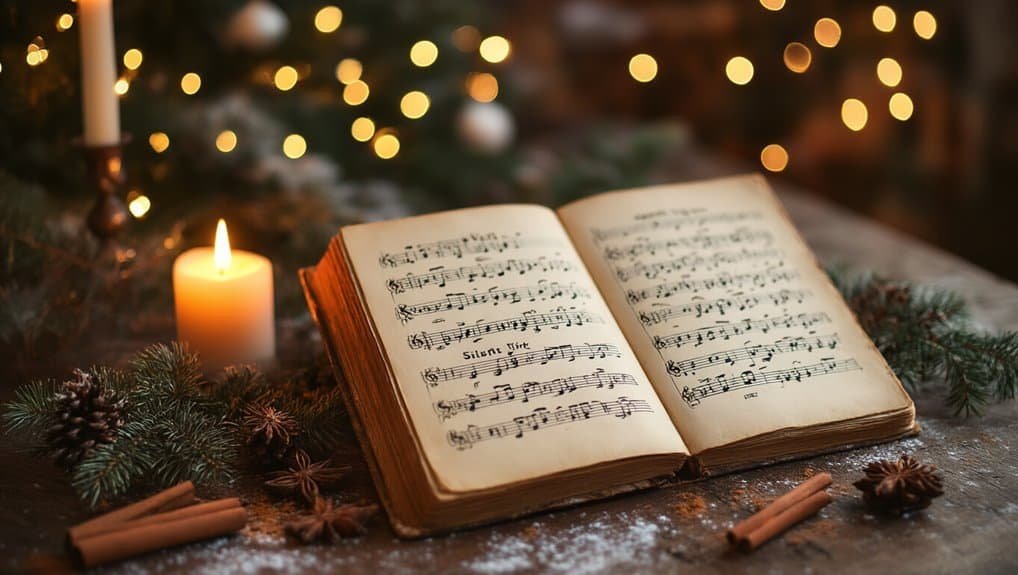
The 1818 composition “Silent Night” emerged from an Austrian church’s broken organ, forcing assistant priest Joseph Mohr and organist Franz Xaver Gruber to create something revolutionary—a Christmas carol written for guitar accompaniment.
You’ll recognize its distinctive melody analysis reveals a 6/8 waltz-like meter that creates the song’s gentle, rocking quality, mimicking a lullaby’s soothing rhythm.
The simple harmonic progression stays primarily within three chords, making it accessible for amateur musicians while maintaining sophisticated emotional depth.
What makes “Silent Night” endure isn’t complexity but restraint.
Musical restraint trumps complexity—sparse arrangements and deliberate simplicity create the enduring power that defines truly timeless composition.
The harmony texture remains deliberately sparse, allowing each voice to breathe within the arrangement.
You’re hearing compositional choices that prioritize intimacy over grandeur—a radical departure from baroque church music’s ornate style.
Gruber’s melodic line spans just over an octave, ensuring singability across age groups and vocal ranges.
This democratic approach to sacred music transformed how communities experience Christmas worship, establishing the template for modern carol composition.
Jingle Bells
You’ll find “Jingle Bells” fascinating once you discover James Lord Pierpont composed it in 1857 as “The One Horse Open Sleigh” for Thanksgiving, not Christmas, making it one of America’s most misunderstood seasonal songs.
The tune’s simple, repetitive structure has spawned countless reinterpretations from Sinatra’s swinging brass arrangement to Bassey’s soul-infused rendition, each exploiting the song’s malleable melodic framework.
When you’re leading a sing-along, emphasize the contrasting dynamics between the gentle verses and the boisterous chorus—it’s this structural tension that’s kept audiences belting out the refrain for over 165 years.
History and Origins
Although you’ve likely sung “Jingle Bells” countless times during the holiday season, you’re probably unaware that James Lord Pierpont composed this iconic tune in 1857 as “One Horse Open Sleigh” — and it wasn’t originally intended for Christmas at all.
The song’s structure actually draws from earlier folk melodies and secular winter celebration traditions, representing a departure from Christmas music’s medieval origins rooted in religious liturgy.
You’d find it fascinating that Pierpont wrote this supposedly wholesome holiday standard about Massachusetts sleigh races, where young men would compete to impress women.
The song’s initial performance occurred during a Thanksgiving service, not Christmas. Its secular nature and catchy rhythm made it accessible to broader audiences, eventually transforming it into America’s most recognizable winter song despite containing zero religious references or Christmas imagery.
Fun Sing-Along Tips
When leading “Jingle Bells” at gatherings, you’re tapping into participatory musical traditions that predate recorded music, where communal singing served as both entertainment and social bonding. You’ll maximize audience participation by establishing a clear tempo through hand claps or foot stomps before starting. Practice rhythmic breathing between verses—inhale during instrumental breaks and exhale steadily through phrases to maintain vocal strength.
Don’t rush the chorus; it’s where everyone joins in confidently.
You can divide the room for call-and-response sections, creating dynamic energy shifts.
Point to different groups for alternating lines, building competitive enthusiasm.
Lower the key if you notice strain—accessibility trumps authenticity.
Consider adding simple percussion instruments like bells or shakers, transforming passive listeners into active performers.
This tactile engagement particularly helps children and self-conscious adults overcome inhibitions.
Popular Cover Versions
The recording history of “Jingle Bells” spans nearly a century of American popular music, with each era’s interpretations reflecting contemporary musical trends and production techniques.
You’ll find Bing Crosby’s 1943 swing-influenced version established the template for countless artist collaborations, while Frank Sinatra’s 1957 recording with Gordon Jenkins demonstrated how orchestral arrangements could transform the simple sleigh-ride tune into sophisticated entertainment.
The song’s public domain status eliminates traditional royalty structures, allowing artists to reimagine it freely.
You can trace jazz evolution through Duke Ellington’s 1962 interpretation versus Diana Krall’s 2001 approach.
Modern versions showcase genre-hopping versatility: Gwen Stefani’s ska-pop treatment, Michael Bublé’s retro-crooner style, and Pentatonix’s a cappella complexity each target different demographics while maintaining the composition’s fundamental appeal.
White Christmas

You’re encountering Irving Berlin’s “White Christmas,” the best-selling single of all time that emerged from the composer’s homesickness while writing it in sunny California during 1940.
Bing Crosby’s 1942 recording transformed the song into cultural shorthand for wartime nostalgia, establishing a melancholic template that still defines how popular music constructs idealized holiday memories.
The song’s genius lies in its sparse lyrics that evoke seasonal longing through imagery rather than narrative, creating emotional space you fill with your own memories of Christmases past.
Song History Origins
Irving Berlin penned “White Christmas” in 1940 while poolside at Beverly Hills Hotel, crafting what would become the best-selling single of all time with over 50 million copies sold worldwide.
You’ll find the origins debate fascinating—Berlin initially wrote it for a never-produced Broadway revue before it found its home in the 1942 film “Holiday Inn.”
Despite authorship myths suggesting collaborative input, Berlin’s sole creative ownership remains undisputed.
He’d reportedly called it his best song ever, though he couldn’t read music and composed entirely by ear.
The Jewish immigrant’s nostalgic vision of an idealized American Christmas struck a profound chord during World War II, when servicemembers overseas yearned for home.
You’re witnessing how one man’s outsider perspective captured the holiday’s emotional essence perfectly.
Bing Crosby Legacy
Bing Crosby’s October 1942 recording session transformed Berlin’s composition into America’s definitive Christmas soundtrack, establishing vocal techniques and interpretive choices that would define holiday recordings for generations.
You can’t understand modern Christmas music without recognizing Crosby’s revolutionary approach—his warm baritone delivery stripped away operatic pretense, introducing conversational intimacy that made listeners feel he was singing directly to them.
As radio star and pioneering crooner influence, Crosby’s interpretation became the blueprint every subsequent artist would reference or deliberately subvert.
He’d already mastered microphone technique through his broadcasting career, allowing subtle emotional shadings impossible in pre-electric recording.
His version’s commercial dominance—best-selling single until Elton John’s “Candle in the Wind 1997″—reflects how perfectly he captured wartime America’s longing for idealized home-front comfort.
Holiday Mood Setting
When snow falls in classic Hollywood films, you’re hearing Berlin’s masterpiece transform physical weather into emotional architecture—the song doesn’t describe Christmas activities but constructs pure atmospheric yearning through its spare, almost haiku-like imagery.
You’re experiencing how four simple lines about tree-tops, children, and sleigh bells create an entire sensory world without mentioning gifts, gatherings, or celebrations.
The genius lies in what’s absent: no warm lighting descriptions, yet you feel the glow; no cozy ambiance details, yet you’re transported to that idealized hearth-side moment.
Berlin understood that mood-setting works through suggestion rather than inventory.
By focusing on whiteness—both literal snow and metaphorical blankness—he lets you project your own holiday memories onto his canvas.
It’s why this 1940s composition still defines December’s emotional temperature for millions worldwide.
The Christmas Song (Chestnuts Roasting on an Open Fire)
Evoking wintertime nostalgia through its opening image of roasting chestnuts, “The Christmas Song” stands as perhaps the most successful seasonal standard written entirely outside the Tin Pan Alley era.
You’ll recognize Mel Tormé and Bob Wells’s 1945 composition as the blueprint for modern holiday songwriting—it catalogs seasonal pleasures without relying on religious themes or Victorian sentimentality.
When you examine its structure, you’re witnessing masterful economy.
Each verse builds nostalgic imagery through specific sensory details: the tactile warmth of fires, children’s anticipation, Jack Frost’s presence.
Nat King Cole’s 1946 recording established the song’s definitive interpretation, his soulful harmony transforming what could’ve been mere seasonal inventory into profound emotional architecture.
You can’t overlook how the song’s genius lies in its universality.
It doesn’t demand specific beliefs or cultural knowledge—just shared memory of winter’s particular magic.
That’s why you’ll hear it everywhere from jazz clubs to shopping malls, its appeal transcending generational and stylistic boundaries.
O Holy Night

Sacred majesty defines “O Holy Night,” a carol that’s survived translation, revolution, and theological controversy to become Christmas Eve’s unofficial anthem.
You’re hearing Adolphe Adam’s 1847 composition transform Placide Cappeau’s French poem into something transcendent—a piece once banned by French clergy for its Jewish composer and wine merchant lyricist.
The song’s tone analysis reveals why it endures: it builds from hushed reverence to triumphant declaration, demanding vocal athleticism that’s humbled countless singers.
You’ll notice the melody motifs mirror this emotional arc—those ascending phrases on “divine” push skyward before plunging into contemplative valleys.
The bridge’s rallying cry for liberation wasn’t accidental; Cappeau’s text champions abolition, making this a radical document disguised as devotional music.
When you tackle that climactic “O night divine,” you’re participating in musical theater disguised as worship.
It’s opera infiltrating midnight mass, requiring technique that separates amateur carolers from professionals.
That’s precisely why congregations fall silent when someone truly nails it.
Rudolph the Red-Nosed Reindeer
Commercial genius masquerading as children’s entertainment, “Rudolph the Red-Nosed Reindeer” represents Montgomery Ward’s most successful corporate creation—a marketing gimmick that hijacked Christmas mythology.
You’re singing along to what started as a 1939 promotional booklet, written by copywriter Robert L. May to drive department store traffic.
The character analysis reveals calculated emotional manipulation: Rudolph’s narrative weaponizes childhood insecurities about difference and belonging.
You’ve internalized a corporate-crafted underdog story where acceptance hinges on utility—Rudolph’s worth isn’t recognized until his “defect” serves Santa’s agenda.
It’s capitalism’s perfect metaphor: you’re only valuable when you’re productive.
The cultural impact proves staggering.
Gene Autry’s 1949 recording sold 50 million copies, embedding corporate fiction into seasonal tradition.
You can’t escape Rudolph’s commodified message across merchandise, television specials, and endless covers.
What began as retail strategy now dominates Christmas imagery, proving that with enough repetition, commercial invention becomes sacred tradition.
Have Yourself a Merry Little Christmas
You’ll find “Have Yourself a Merry Little Christmas” carries a bittersweet legacy that began with Hugh Martin and Ralph Blane’s 1944 composition for Judy Garland in *Meet Me in St. Louis*,
where its original melancholic lyrics were deemed too depressing and required softening.
The song’s transformation accelerated when Frank Sinatra requested even more optimistic revisions in 1957, establishing the version you’re most familiar with,
though artists from Ella Fitzgerald to Sam Smith have since navigated between its wistful origins and cheerier rewrite.
Its placement in films ranging from the original MGM musical to modern features like *The Family Stone* demonstrates how directors weaponize the song’s dual nature—choosing specific lyrical versions to either comfort audiences or underscore seasonal melancholy.
Song’s Original History
During the golden age of MGM musicals, Hugh Martin and Ralph Blane penned “Have Yourself a Merry Little Christmas” for the 1944 film *Meet Me in St. Louis*.
You’ll find the song’s publication chronology reveals it wasn’t an immediate holiday standard.
Judy Garland’s melancholic delivery transformed what could’ve been another forgettable movie tune into a wartime anthem of hope.
The original lyrics were considerably darker—Martin’s first draft proved too depressing even for a scene meant to console a crying child.
While copyright disputes haven’t plagued this particular classic like other holiday standards, you should know that Frank Sinatra’s 1957 request for cheerier lyrics fundamentally altered the song’s DNA.
Martin obliged, changing “Until then we’ll have to muddle through somehow” to “Hang a shining star upon the highest bough,” shifting the song’s entire emotional register from bittersweet longing to optimistic celebration.
Famous Artist Versions
Sinatra’s revised version opened the floodgates for countless reinterpretations that would define how each generation experiences this standard.
You’ll find each decade’s sonic fingerprint through distinctive artist interpretations—from Judy Garland’s vulnerable 1963 recording to Christina Aguilera’s melismatic 2000 approach.
The song’s malleable structure invites radical reimagining: James Taylor strips it to folk essentials, while Michael Bublé’s swing arrangement recalls pre-rock sophistication.
Cover collaborations have expanded the song’s emotional range.
Tony Bennett and John Legend’s duet bridges generational divides, while She & Him’s indie-folk treatment proves the melody transcends genre boundaries.
You can’t ignore how each artist navigates the lyrical variations—some choosing Martin’s original melancholy, others embracing Sinatra’s optimistic rewrite.
These versions collectively demonstrate why this composition remains America’s most versatile holiday standard.
Holiday Movie Features
Invariably, Hollywood’s deployment of “Have Yourself a Merry Little Christmas” transforms the song into a narrative device that crystallizes characters’ emotional turning points.
You’ll recognize this pattern across decades of cinema—from its origin in “Meet Me in St. Louis” (1944) where Judy Garland’s melancholic delivery underscored wartime anxieties, to contemporary interpretations that punctuate seasonal releases.
Directors consistently position the song during pivotal third-act moments, exploiting its bittersweet undertones to bridge narrative conflict and resolution.
Casting trivia reveals studios often select this particular number when actors can’t carry traditional uptempo holiday tunes.
Modern productions enhance these sequences through subtle visual effects—softened lighting, digitally enhanced snowfall, and color grading that shifts from cold blues to warm ambers as characters achieve emotional catharsis.
You’re witnessing calculated emotional manipulation at its finest.
Winter Wonderland
Sleigh bells and snow-covered lanes frame “Winter Wonderland,” a 1934 composition that’s transcended its Tin Pan Alley origins to become a secular Christmas standard. Felix Bernard’s melody and Richard B. Smith’s lyrics captured Depression-era escapism through romantic imagery of snowy landscapes transformed into playgrounds for lovers. You’ll notice the song cleverly sidesteps religious themes, instead celebrating winter’s sensory pleasures—a strategic choice that broadened its commercial appeal.
The composition’s genius lies in its cinematic quality. You’re transported through crystalline scenes where couples build snowmen and conspire by the fire. Smith wrote the lyrics while recovering from tuberculosis, gazing at Pennsylvania’s Honesdale Central Park, transforming his view into universal winter romanticism. Over 200 artists have recorded it, from Guy Lombardi’s 1934 original to contemporary interpretations. The song’s endurance stems from its ability to evoke childhood wonder while maintaining sophisticated wordplay about ice sculptures and pastoral winter scenes that resonate across generations.
Let It Snow! Let It Snow! Let It Snow
You’ll notice that Sammy Cahn and Jule Styne’s 1945 composition strategically avoids any mention of Christmas, instead constructing a secular winter romance through meteorological metaphors and domestic warmth.
The song’s persistent refrain transforms inclement weather into an excuse for intimacy, while its lyrical architecture—moving from the storm outside to the fire inside—established a template for countless holiday standards that followed.
Winter Weather Imagery
Swirling snowflakes and howling winds transform the mundane into the magical in “Let It Snow! The song’s winter weather imagery doesn’t merely describe meteorological conditions—it constructs an emotional sanctuary.
You’ll notice how the lyrics juxtapose harsh external elements with interior warmth, a narrative device that’s defined holiday music since Victorian times.
The snow imagery operates on multiple levels: it’s both barrier and blessing, isolating lovers while creating intimacy. When you examine the frost patterns metaphorically etched throughout, they’re not decorative flourishes but psychological boundaries. The storm becomes permission to pause, to disconnect from obligation. This wasn’t accidental—Sammy Cahn wrote these lyrics in July 1945’s California heat, deliberately crafting winter as imaginative escape. You’re experiencing calculated nostalgia, where weather functions as emotional architecture rather than simple seasonal setting.
Romantic Holiday Themes
While the storm rages outside, “Let It Snow!” constructs one of popular music’s most enduring romantic frameworks—the weather-imposed intimacy that became a template for countless holiday songs.
You’ll recognize this blueprint everywhere: bad weather becomes the perfect excuse for lovers to stay close, transforming potential inconvenience into romantic opportunity.
The song’s genius lies in how it weaponizes romantic nostalgia without mentioning Christmas directly.
You’re hearing a secular love song that hijacked the holiday playlist through sheer repetition and couple traditions. Its cozy domesticity—the dying fire, the reluctant goodbye—established the sonic architecture for modern holiday romance. Dean Martin’s 1959 version particularly crystallized this formula, teaching generations that winter storms aren’t obstacles but invitations. You’ve inherited this perspective whether you realize it or not, expecting your December soundtracks to merge meteorological drama with intimate yearning.
O Come, All Ye Faithful
Triumphant brass and soaring voices have carried “O Come, All Ye Faithful” through nearly three centuries of Christmas celebrations, yet its origins remain surprisingly murky. You’ll find scholars debating whether John Francis Wade composed it around 1743 or merely transcribed an existing melody.
What’s certain is its transformation from Latin hymn “Adeste Fideles” into the English powerhouse you know today.
The hymn’s nativity context places you directly in Bethlehem’s stable, commanding your participation in worship alongside shepherds and angels. You’re not just singing about Christmas; you’re transported to that first Christmas morning.
Modern choral arrangements exploit this dramatic potential, building from intimate verses to that explosive “O come, let’s adore Him” refrain that practically demands you stand.
Churches worldwide recognize its liturgical weight—it’s often reserved for midnight mass processionals, where its martial rhythm and ascending melody lines create an atmosphere of sacred anticipation you won’t find in secular carols.
The First Noel
You’ll find “The First Noel” emerged from the English carol tradition sometime before 1823, though its exact origins remain disputed—scholars debate whether it’s Cornish or originated in France as “Les anges dans nos campagnes.”
The melody’s distinctive rising sixth interval on “noel” creates an instantly recognizable hook, while its verse-refrain structure allows congregations to join confidently on the repeated chorus.
You’re hearing centuries of oral tradition crystallized into AABA form, where the simple melodic line masks sophisticated harmonic possibilities that arrangers from Stainer to Rutter have exploited.
History and Origins
Dating from at least the 16th century, “The First Noel” emerged from the Cornwall region of England, though its precise origins remain contested among musicologists.
You’ll find competing theories about its ancient origins—some scholars trace its melody to medieval troubadour songs, while others link it to earlier folk traditions.
The carol’s ritual origins connect to wassailing ceremonies and winter solstice celebrations that predate Christianity’s arrival in Britain.
When you examine the musical structure, you’re looking at a tune that wasn’t formally transcribed until William Sandys’ 1833 collection.
The lyrics underwent numerous revisions across centuries, with each generation adapting verses to reflect contemporary theological understanding.
You can’t ignore how oral tradition shaped its evolution—village singers transmitted variations that musicologists still debate today.
Melody and Structure
The melody moves through a distinctive 3/4 waltz time that sets it apart from most English carols of its era.
You’ll notice the melodic contour creates a gentle, ascending arc in each verse, peaking at “born is the King of Israel” before gracefully descending.
This wave-like pattern mirrors the narrative’s emotional journey from wonder to proclamation.
The harmonic progression relies heavily on I-IV-V relationships, though you’ll find unexpected modal inflections that hint at the tune’s folk origins.
The refrain’s repetitive “noel, noel” serves as both a structural anchor and emotional release, allowing singers to emphasize the celebratory nature through dynamic variation.
When you sing it, you’re participating in a musical architecture that’s deceptively simple yet sophisticated enough to have sustained congregational singing for centuries.
Deck the Halls
Welsh carolers first brought “Deck the Halls” to English-speaking audiences in the 1860s, though its melody traces back to a 16th-century Welsh winter song called “Nos Galan.” You’re hearing centuries of evolution when this carol fills shopping malls and living rooms each December.
Its famous “Fa la la la la” refrain actually replaced the original Welsh “nonsense syllables” that medieval singers used for vocal ornamentation.
The song’s enduring appeal lies in its celebration of pre-Christian winter traditions. You’ll notice it never mentions religious themes, instead focusing on yuletide decor ideas like holly, ivy, and blazing hearths.
These festive motifs reflect Victorian England’s secular approach to Christmas decoration, when middle-class families embraced elaborate seasonal displays.
The lyrics’ emphasis on “donning gay apparel” and “singing together” captures the communal spirit that’s made this carol a party favorite for over 150 years.
Silver Bells

City sidewalks became the unexpected muse for “Silver Bells” when Jay Livingston and Ray Evans penned this urban Christmas anthem in 1950 for the Paramount picture “The Lemon Drop Kid.
You won’t find any sleigh rides through snow-covered woods here—instead, the songwriters deliberately crafted America’s first major Christmas song to celebrate metropolitan holiday traditions.
Jay Livingston and Ray Evans deliberately crafted America’s first major Christmas song celebrating metropolitan holiday traditions over rural nostalgia.
The lyrical meaning revolutionized Christmas music by spotlighting department store windows, street corners, and bustling shoppers rather than rural nostalgia.
You’re hearing the city’s soundtrack: ringing bells from Salvation Army volunteers mixed with traffic lights blinking red and green.
The instrumental arrangement typically features gentle strings and bells that mirror the urban soundscape, creating what became the definitive “city Christmas” sound.
Bing Crosby’s recording with Carol Richards established the template, but you’ll recognize Bob Hope’s film version as equally influential.
The song’s genius lies in acknowledging that millions celebrate Christmas in concrete jungles, validating their holiday experience through sophisticated metropolitan imagery.
I’ll Be Home for Christmas
You can’t separate this song from its historical context.
Written when millions of families faced wartime separation, it captured emotional nostalgia that transcended its era.
The melody’s gentle swing rhythm cushions the heartbreak, while the bridge’s rising notes on “Christmas Eve will find me” create momentary hope before reality returns.
Today, you’ll hear it differently—not just as wartime yearning but as the universal ache of anyone spending the holidays apart from loved ones.
Hark! The Herald Angels Sing
You’ll find “Hark! The Herald Angels Sing” emerged from Charles Wesley’s 1739 poem “Hark How All the Welkin Rings,” though Felix Mendelssohn’s 1840 cantata melody wasn’t paired with Wesley’s text until William H. Cummings’s 1855 arrangement. The song’s musical architecture builds on Mendelssohn’s secular celebration piece, transforming it into a majestic four-part harmony that emphasizes ascending melodic phrases during the chorus’s “Glory to the newborn King” proclamation. You’re hearing centuries of revision when modern performances blend Wesley’s theological urgency with Mendelssohn’s triumphant orchestral sensibility, creating that distinctive balance between congregational accessibility and classical grandeur.
History and Origins
When Charles Wesley penned the original verses in 1739, he couldn’t have predicted his Methodist hymn would undergo such dramatic transformation before becoming the Christmas standard you know today.
Originally titled “Hymn for Christmas Day,” Wesley’s text bore little resemblance to what you’re singing now.
Felix Mendelssohn’s 1840 cantata provided the melody—though he’d explicitly stated it shouldn’t accompany religious lyrics.
You’ll find the song’s folk origins trace through multiple revisions.
William H. Cummings married Wesley’s adapted text to Mendelssohn’s secular tune in 1855, creating the version that conquered Victorian England.
Unlike carols with ancient regional roots in European countryside traditions, this hymn emerged from deliberate nineteenth-century craftsmanship.
It’s a manufactured classic that somehow feels timeless, proving that authenticity in Christmas music isn’t always about antiquity.
Musical Arrangement Style
How does Mendelssohn’s secular cantata melody transform into sacred grandeur? You’ll notice the arrangement elevates a festive cantata into church-worthy majesty through strategic musical choices.
The harmony textures shift from Mendelssohn’s original compound duple meter to Common Time, creating a more processional feel that suits congregational singing.
The typical instrumentation palette features organ as the foundation, with brass fanfares punctuating key moments—particularly on “Glory to the newborn King!”
You’re hearing four-part vocal harmony that builds vertically, with sopranos carrying the melody while lower voices provide rich harmonic support. The arrangement often employs block chords rather than complex polyphony, ensuring accessibility for amateur choirs. Modern performances might add timpani and strings, but the core arrangement maintains its 19th-century Anglican cathedral aesthetic: stately, triumphant, and deliberately paced for maximum congregational participation.
It’s the Most Wonderful Time of the Year
Andy Williams transformed “It’s the Most Wonderful Time of the Year” into a holiday standard when he recorded it in 1963, though the song’s compositional origins reveal the calculated artistry of the early 1960s Christmas music boom.
Songwriters Edward Pola and George Wyle crafted this piece during an era when record labels actively commissioned new holiday material to capitalize on seasonal nostalgia.
You’ll notice the song’s lyrical meaning centers on communal celebration rather than religious themes.
The lyrics catalog winter social rituals—parties, caroling, marshmallow toasting—that evoke mid-century American domesticity.
This secular approach broadened the song’s commercial appeal while tapping into postwar prosperity’s idealized vision of holiday gatherings.
The composition’s waltz-time signature distinguishes it from typical 4/4 Christmas pop, creating a sweeping, theatrical quality that enhances its celebratory mood.
When you analyze Williams’s delivery, you’ll hear how his smooth crooning style perfectly matched the song’s optimistic messaging, establishing a template that countless performers still follow today.
Frosty the Snowman
The postwar Christmas music boom that produced Williams’s waltz-time hit also generated “Frosty the Snowman,” though this 1950 composition emerged from distinctly different commercial pressures.
You’ll recognize how songwriters Jack Nelson and Steve Rollins crafted their tune specifically to capitalize on Gene Autry’s “Rudolph” success, creating another anthropomorphic winter character for children’s entertainment.
The frosty origins reveal calculated commercialism—Nelson and Rollins weren’t drawing from ancient snowman folklore but manufacturing instant tradition.
Nelson and Rollins weren’t drawing from folklore but manufacturing instant tradition through calculated commercialism.
They understood you’d embrace a magical narrative about temporary life, transforming winter’s ephemeral sculpture into a poignant metaphor.
The song’s genius lies in how it weaponizes childhood’s bittersweet reality: everything you love will eventually melt away.
Unlike traditional carols rooted in religious celebration, “Frosty” represents secular Christmas music’s commercial zenith.
You’re singing along to a corporate creation that succeeded through repetition and media saturation, particularly after the 1969 Rankin/Bass television special cemented its cultural position.
Joy to the World
You’ll discover that “Joy to the World” isn’t actually a Christmas carol but Isaac Watts’ 1719 psalm adaptation that churches later repurposed for the holiday season.
The song’s distinctive descending major scale in its opening phrase creates an architectural symmetry that composers have reimagined across centuries, from Lowell Mason’s 1839 arrangement borrowing from Handel to contemporary gospel and jazz interpretations.
You’re hearing theological universalism wrapped in accessible melodic patterns whenever modern artists like Mariah Carey or Pentatonix transform this accidental Christmas standard into chart-topping seasonal releases.
Historical Origins
Paragraph 1:
Long before Isaac Watts penned “Joy to the World” in 1719, he’d already established himself as a radical reformer of English church music, challenging the strict psalm-only tradition that dominated Protestant worship.
Paragraph 2:
You’ll find the etymology roots trace to Psalm 98, though Watts brilliantly transformed the Hebrew text into a Christological celebration.
Paragraph 3:
The song’s origins myths often misattribute the melody to Handel, but you’re actually hearing Lowell Mason’s 1839 arrangement borrowing fragments from Messiah.
Paragraph 4:
Mason’s genius lay in marrying Watts’s verses with this pseudo-Handelian tune, creating what you now recognize as a Christmas standard.
Paragraph 5:
Ironically, Watts never intended this as a Christmas hymn; it celebrated Christ’s second coming, not his birth.
Musical Structure
Descending through its iconic opening phrase, “Joy to the World” employs a complete octave scale that mirrors baroque compositional techniques while maintaining folk-song accessibility.
You’ll notice the melody’s stepwise descent creates immediate momentum, establishing tonal center through its predictable yet satisfying resolution.
The phrase structure follows classical AABA form, where each eight-bar section builds symmetrically.
You’re hearing Handel’s influence in the repeated note patterns that punctuate “heaven and nature sing,” though Watts never intended musical accompaniment for his text.
The cadence analysis reveals predominant authentic cadences closing each verse, providing harmonic satisfaction you’ve internalized through countless repetitions.
Mason’s arrangement strategically places half cadences at mid-points, creating anticipation that propels you forward.
This architectural precision explains why you can’t resist joining in—the structure practically demands participation.
Popular Versions Today
How did “Joy to the World” transform from sacred hymn to pop culture phenomenon? You’ll find the answer in its digital evolution.
Today’s most-played versions reflect strategic licensing deals that’ve positioned the carol across streaming platforms.
Mariah Carey’s 1994 R&B-gospel fusion remains dominant, while Pentatonix’s a cappella arrangement captures Gen Z listeners.
Whitney Houston’s gospel-powered rendition still commands holiday playlists, demonstrating the hymn’s adaptability to contemporary vocal styles.
You’re witnessing how streaming platforms have democratized access while consolidating specific interpretations.
The Three Dog Night confusion persists—their unrelated 1970 hit still appears in misguided holiday searches.
Modern artists navigate complex licensing deals to reimagine Watts’s verses, though most preserve the traditional melodic structure.
These commercial versions haven’t displaced church performances but exist parallel to them.
Little Drummer Boy
The steady rhythm of “pa rum pum pum pum” echoes through decades of Christmas celebrations, marking “The Little Drummer Boy” as one of the season’s most distinctive carols. You’ll recognize this 1958 composition’s genius lies in its percussive vocalization—a drum technique that transforms singers into instruments themselves. The onomatopoeia creates an immediate, visceral connection that transcends language barriers.
The carol’s lyrical meaning centers on profound simplicity: a poor child offers the only gift he possesses—his musical talent. You’re witnessing theological sophistication wrapped in accessible narrative.
The drummer boy’s predicament mirrors your own seasonal anxieties about gift-giving adequacy. His resolution—that sincere personal expression outweighs material wealth—critiques commercialization while affirming authentic devotion.
Katherine K. Davis’s original composition underwent multiple transformations before achieving its current cultural status. You’ll find the song’s enduring appeal stems from its democratic message: everyone possesses something worthy of offering, regardless of economic circumstances.
Angels We Have Heard on High
You’ll recognize “Angels We Have Heard on High” by its soaring “Gloria in excelsis Deo” refrain, a Latin phrase meaning “Glory to God in the highest” that transforms the carol into a miniature cantata through its elaborate melismatic runs.
The song’s French origins trace back to at least 1862’s “Les Anges dans nos Campagnes,” though James Chadwick’s 1860 English translation popularized it throughout the Anglican world.
From Nat King Cole’s velvet crooning to Andrea Bocelli’s operatic interpretation, modern artists have leveraged the carol’s theatrical potential, treating those extended “Gloria” passages as showcases for vocal virtuosity.
History and Origins
While scholars can’t pinpoint the exact origins of “Angels We Have Heard on High,” most trace its roots to 18th-century France, where it likely emerged as a traditional folk carol sung in the Languedoc region.
You’ll find its folk origins reflected in the pastoral narrative—shepherds watching their flocks encounter divine messengers, a scene that resonated with rural communities who passed down these origin stories through generations.
The carol’s journey from French countryside to global phenomenon reveals how religious music transcends boundaries.
You’re hearing centuries of oral tradition when you sing this hymn today.
James Chadwick’s 1862 English translation transformed “Les Anges dans nos Campagnes” into the version you know, though he preserved the Latin refrain “Gloria in Excelsis Deo” that connects modern singers to medieval worship traditions.
Gloria Refrain Meaning
When you sing those cascading “Gloria” melodies that define this carol, you’re participating in a musical technique called melisma—stretching a single syllable across multiple notes to create an effect of jubilant praise.
The gloria meaning extends beyond mere translation of “glory”—it’s the Latin proclamation angels supposedly sang at Christ’s birth, “Gloria in excelsis Deo” (Glory to God in the highest).
You’ll notice the refrain significance lies in its departure from the verses’ narrative structure.
While verses tell the shepherds’ story in straightforward melody, the ornate Gloria breaks through as pure worship.
This contrast mirrors the theological shift from earthly events to heavenly celebration.
The extended melismatic passage demands breath control and vocal agility, transforming you from storyteller to participant in angelic chorus.
It’s deliberately excessive—that’s the point.
Heaven’s joy can’t be contained in simple syllables.
Popular Recording Versions
Your grandmother might’ve owned Nat King Cole’s 1960 recording, where his velvet baritone transformed the French carol into sophisticated supper-club reverence, stripping away medieval austerity for orchestral lushness that defined mid-century American sacred pop.
You’ll find Josh Groban’s 2007 operatic treatment pushing theatrical boundaries, while Pentatonix’s a cappella arrangement demonstrates how alternative takes can reimagine centuries-old material through contemporary vocal percussion and harmonic stacking.
Celtic Woman’s live versions showcase the carol’s adaptability to arena spectacle, their synchronized choreography and Celtic instrumentation creating devotional entertainment.
Bad Religion’s punk interpretation proves you can’t pigeonhole this hymn—they’ve weaponized the Gloria refrain as anarchic celebration.
From Andrea Bocelli’s classical crossover to Relient K’s pop-punk energy, you’re witnessing how each generation recontextualizes sacred tradition through their sonic lens.
We Wish You a Merry Christmas
You’ve probably sung “We Wish You a Merry Christmas” countless times without realizing you’re performing a centuries-old English wassailing song that predates most of the holiday canon.
Dating to the 16th century, this West Country carol emerged from the choral tradition of door-to-door caroling, where singers demanded figgy pudding and “good cheer” from wealthy homeowners—essentially musical extortion wrapped in seasonal greetings.
What’s fascinating is how the song’s structure mirrors social negotiations of Tudor England.
You’re not just wishing merriment; you’re establishing a transactional relationship through repetitive verses that escalate from polite greeting to stubborn refusal to leave.
The “we won’t go until we get some” refrain transforms caroling into peaceful protest, making it surprisingly subversive for its era.
Modern performances sanitize this context, but you can’t ignore how the original wassailers used communal singing to temporarily invert class hierarchies during Christmas festivities, demanding hospitality from their social superiors.
O Little Town of Bethlehem
You’ll find “O Little Town of Bethlehem” carries a distinctly different heritage from its British and American versions, with Phillips Brooks penning the lyrics in 1868 after visiting Bethlehem three years earlier during the Christmas season.
The text’s contemplative theology has inspired two primary musical settings: Lewis Redner’s gentle, lilting melody favored in America and Ralph Vaughan Williams’s adaptation of the English folk tune “Forest Green” that dominates British hymnody.
These contrasting arrangements reflect each culture’s approach to sacred music—America’s preference for accessible sentiment versus Britain’s embrace of modal folk traditions—while both maintain the song’s core meditation on Christ’s humble birthplace.
Historical Background
When Philadelphia rector Phillips Brooks penned “O Little Town of Bethlehem” in 1865, he’d just returned from a transformative horseback journey through the Holy Land, where he’d spent Christmas Eve in Bethlehem itself.
You’ll find his text departs from medieval origins of Christmas hymnody, which typically emphasized theological abstractions over personal witness.
Brooks’s organist, Lewis Redner, composed the melody three years later, claiming it came to him in a dream on Christmas Eve.
Unlike carols rooted in ancient folk customs, this hymn emerged from American Protestantism’s educational mission.
You can trace its rapid adoption through Sunday schools, where it served dual purposes: teaching children biblical geography while fostering emotional connection to Christ’s birthplace.
The song’s contemplative tone reflects Brooks’s Episcopal background, yet its accessibility transcended denominational boundaries, establishing it as America’s first indigenous Christmas classic.
Musical Arrangements
Arranging “O Little Town of Bethlehem” presents unique challenges because two distinct melodies compete for primacy: Redner’s original “St. Louis” and Vaughan Williams’s “Forest Green.”
You’ll find each demands different harmony textures—Redner’s calls for traditional four-part voicing while Forest Green’s modal character invites open fifths and suspended fourths.
Your orchestration choices should reflect these melodic personalities: Redner’s version suits brass quartets and full orchestral treatment, whereas Forest Green responds better to woodwinds and strings.
When you’re crafting contemporary arrangements, don’t overlook the carol’s introspective nature.
You can emphasize contemplative moments through sparse instrumentation before building to fuller textures.
Consider how twentieth-century arrangers like Ralph Carmichael incorporated jazz harmonies without sacrificing the hymn’s reverent character.
The most effective arrangements honor the text’s intimate narrative while creating sonic landscapes that support congregational participation.
God Rest Ye Merry Gentlemen

This ancient carol stands as one of the oldest surviving Christmas songs in the English tradition, with roots stretching back to at least the 16th century.
You’ll discover its carol origins trace to London’s streets where watchmen sang it door-to-door, though its composer remains unknown.
The melody you hear today differs from earlier versions—it evolved through centuries of oral tradition before Victorian arrangers standardized it.
You’re encountering profound biblical references throughout its verses, particularly the nativity story from Luke’s Gospel.
The archaic language creates interpretive challenges—”rest ye merry” doesn’t mean “rest happily” but rather “remain mighty” or “stay blessed.”
You’ll notice how it inverts typical carol structure, beginning with reassurance before revealing Christ’s birth.
Its minor key distinguishes it from cheerier contemporaries, lending gravitas to its theological message.
The song’s endurance speaks to its adaptability; you’ve heard versions from folk to metal, each generation finding fresh meaning in its timeless comfort.
Away in a Manger
You’ll find “Away in a Manger” carries a complicated authorial history, with its attribution to Martin Luther proving entirely spurious—a myth perpetuated by nineteenth-century American Lutherans seeking denominational prestige.
The carol’s textual tradition splits between two distinct versions: the original two-stanza form first published in Philadelphia in 1885, and the expanded three-stanza variant that emerged when various poets added their own concluding verses.
You’re encountering a prime example of how Victorian sentimentality shaped Christmas hymnody, transforming an anonymous American composition into a vehicle for idealized childhood piety that still dominates nativity services today.
History and Origins
When you’re exploring the backstory of “Away in a Manger,” you’ll discover one of Christmas music’s most persistent myths: its false attribution to Martin Luther.
The carol’s actual origins chronology reveals it first appeared in an 1885 Lutheran publication in Philadelphia, nearly four centuries after Luther’s death.
You’ll find its folk roots embedded in nineteenth-century American Protestantism, where anonymous composers crafted what became a devotional standard.
The melody you’re familiar with depends on geography.
James R. Murray’s 1887 tune dominates American performances, while William J. Kirkpatrick’s 1895 version prevails in Britain.
This dual-melody tradition demonstrates how carol transmission patterns reflect denominational and regional preferences.
When you examine the text’s evolution, you’ll notice later verses were added incrementally, transforming a simple lullaby into a theological meditation on childhood innocence and divine protection.
Popular Verse Variations
Beyond the compositional history lies a fascinating textual landscape where “Away in a Manger” exists in multiple incarnations across denominational lines.
You’ll discover that regional variations have shaped this carol’s evolution significantly, with American congregations often singing different second and third verses than their British counterparts.
The Lutheran tradition preserves one set of lyrics while Methodist hymnals feature another, creating distinct worship experiences across communities.
When you examine translation differences, you’re witnessing how cultural contexts transform meaning.
German versions emphasize Christ’s poverty differently than English texts, while Scandinavian translations introduce unique theological nuances.
You’ll notice that some variations add verses about Jesus blessing children, while others focus on prayers for protection.
These textual divergences aren’t mere accidents—they’re deliberate adaptations reflecting each community’s spiritual priorities and linguistic traditions.
What Child Is This?
Why does this particular carol resonate across centuries when countless other Victorian hymns have faded into obscurity?
“What Child Is This?” exemplifies the nineteenth-century tradition of setting new religious texts to existing secular melodies—in this case, the English folk tune “Greensleeves.” William Chatterton Dix penned the lyrics in 1865 while recovering from a near-fatal illness, crafting verses that transform a Renaissance-era melody about unrequited love into a theological meditation on Christ’s incarnation and sacrifice.
You’ll find the carol’s endurance stems from its musical accessibility.
The minor mode creates an unusual melancholy for a Christmas song, while the familiar melody makes it perfect for street performance without accompaniment.
Any harmonic analysis reveals why it works: the modal inflections and simple chord progressions allow for diverse arrangements, from baroque interpretations to contemporary jazz renditions.
This adaptability ensures you’re hearing “What Child Is This?” whether you’re attending midnight mass or browsing department stores in December.
Good King Wenceslas

The Victorian carol “Good King Wenceslas” presents a curious paradox: it’s neither about Christmas nor technically accurate about its protagonist.
You’re singing about a 10th-century Bohemian legend set on St. Stephen’s Day (December 26th), where Wenceslaus wasn’t even a king but a duke.
Yet you’ll find this tale of charitable winter wandering in every Christmas collection.
The carol’s enduring appeal lies in its moral simplicity: a saintly king spots a peasant gathering winter fuel and trudges through harsh snow to deliver food, wine, and pine logs.
You’re essentially experiencing a medieval morality play set to the 13th-century tune “Tempus Adest Floridum.”
John Mason Neale’s 1853 lyrics transformed Wenceslaus from historical duke to archetypal Christian monarch, embodying the Victorian obsession with benevolent authority.
When you sing about the page following his master’s footsteps through the snow, you’re participating in a distinctly British interpretation of Continental hagiography.
The Holly and the Ivy
You’ll find “The Holly and the Ivy” represents one of England’s oldest winter carols, with roots stretching back to medieval times when these evergreen plants symbolized Christ’s crown of thorns and Mary’s purity.
The carol’s pagan-Christian duality reflects Britain’s syncretic religious history, where pre-Christian nature worship merged with ecclesiastical tradition through metaphors of masculine holly and feminine ivy.
Modern interpreters from Natalie Cole to Annie Lennox have reimagined its modal melodies, though they can’t entirely secularize the theological weight embedded in its botanical imagery.
Traditional Carol Origins
Medieval England frequently witnessed the blending of Christian and pagan traditions during winter celebrations, and “The Holly and the Ivy” exemplifies this syncretic evolution in carol literature.
You’ll discover the carol’s medieval roots stretch back to broadside ballads, where holly represented masculinity and ivy symbolized femininity in pre-Christian winter rituals.
The song’s transformation from secular drinking song to sacred carol demonstrates Christianity’s strategic appropriation of pagan symbols.
Regional variations emerged as the carol traveled through England’s counties.
You’re encountering different melodic structures in Gloucestershire versus Sharp’s collected versions from Somerset.
The text itself underwent significant revision—earlier manuscripts reveal verses about brewing ale and competitive singing between men and women.
Modern performances typically omit these earthier stanzas, presenting a sanitized Victorian interpretation that obscures the carol’s complex cultural negotiations between sacred and secular spheres.
Symbolic Plant Meanings
Holly’s prickly leaves and blood-red berries carried potent Christian symbolism that medieval audiences immediately recognized—the sharp points representing Christ’s crown of thorns, the berries his drops of blood.
You’ll find ivy symbolism intertwined with holly’s masculine energy, representing Mary’s feminine protection and eternal life through its evergreen nature.
While fern symbolism doesn’t appear in this carol, Victorian botanists documented how medieval Christians associated ferns with humility and sincerity in other seasonal songs.
The carol’s genius lies in how it layers pagan and Christian meanings.
You’re witnessing centuries of religious syncretism when you sing these verses—ancient winter solstice traditions absorbed into Christmas worship.
The plants weren’t randomly chosen; they’re deliberate theological statements wrapped in accessible imagery that medieval congregations could decode instantly.
Popular Recording Artists
Dozens of acclaimed artists have recorded “The Holly and the Ivy,” transforming this medieval carol into a cross-genre phenomenon that spans classical, folk, pop, and experimental interpretations.
You’ll find the artist lineage particularly fascinating—from early recordings by King’s College Choir establishing its Anglican tradition to folk revival pioneers like Jean Ritchie reimagining its pastoral roots.
Contemporary artists haven’t ignored its potential either.
Annie Lennox’s haunting arrangement and Sting’s contemplative version demonstrate how modern performers extract new emotional depths from ancient verses.
While chart dynamics for traditional carols differ from commercial releases, you can’t overlook how certain recordings achieve cultural permanence.
Nat King Cole’s warm interpretation and Judy Collins’s crystalline rendition became holiday standards, proving that artistic authenticity trumps seasonal novelty when establishing enduring Christmas recordings.
I Saw Three Ships

When you encounter “I Saw Three Ships,” you’re witnessing one of English carol tradition’s most puzzling texts—a landlocked Bethlehem receiving ships on Christmas morning defies both geography and logic.
Yet this geographic impossibility hasn’t diminished the carol’s endurance since its first printed appearance in 1666.
You’ll notice the melody’s naval origins immediately—its rollicking 6/8 time signature echoes the rhythmic pull of sea shanty work songs that synchronized sailors’ labor.
The tune’s swaying motion mimics ocean waves, creating kinetic energy that’s made it irresistible for centuries of carolers.
Various theories attempt explaining the ships’ symbolism: they’re the Magi’s camels, the three virtues of faith, hope, and charity, or simply narrative vessels carrying joy itself.
What you’re really singing is a riddle wrapped in maritime imagery, demonstrating how folk traditions cheerfully disregard literal sense when communal celebration’s at stake.
The carol’s persistence proves that sometimes inexplicable joy trumps geographic accuracy.
It Came Upon the Midnight Clear
From maritime mysteries to celestial proclamations, “It Came Upon the Midnight Clear” grounds itself in earthly suffering while yearning skyward.
Maritime mysteries yield to celestial proclamations as earthly suffering reaches skyward through revolutionary Christmas verse.
You’ll recognize Edmund Sears’s 1849 poem as revolutionary for its time—a Christmas carol that confronts war’s brutality rather than celebrating seasonal cheer.
The text emerged during America’s Mexican-American War, and you can’t miss its pacifist undertones questioning humanity’s endless conflicts.
Richard Storrs Willis’s 1850 melody creates a descending melodic motif that mirrors angels bending toward earth, while the hymn’s lyrical harmony between divine message and human anguish remains startlingly modern.
You’re hearing social commentary disguised as devotional verse when Sears writes about mankind’s inability to hear peaceful tidings over “Babel sounds.”
The carol’s third stanza, often omitted today, explicitly condemns warfare’s toll on the suffering poor.
This isn’t your typical Victorian sentimentality—it’s protest music wearing angel wings, challenging you to consider why heaven’s peace proclamation still falls on deaf ears.
Do You Hear What I Hear?
Do You Hear What I Hear? carries unexpected Cold War origins—written in 1962 by Noël Regney and Gloria Shayne as a plea for peace during the Cuban Missile Crisis, transforming Biblical imagery into nuclear-age prophecy.
When you’re performing this deceptively simple melody, you’ll need to master its dramatic dynamic shifts from the whispered “little lamb” verses to the commanding “mighty king” climax, requiring careful breath control through its ascending vocal line.
Bing Crosby’s 1963 recording established the song’s interpretive template, though Whitney Houston’s 1987 gospel-inflected version and Carrie Underwood’s 2020 country arrangement demonstrate how genre-specific vocal techniques can reimagine its message of cascading revelation.
Song’s Historical Background
The song’s structure mirrors medieval roots of oral transmission, with each verse building upon the previous one—from shepherd to lamb, king to people—echoing how traditional carols spread through communities.
You’ll notice this cascading narrative technique wasn’t decorative; it served their anti-war message by demonstrating how one voice of reason could ripple outward, reaching those in power.
Vocal Performance Tips
How does a vocalist approach a song that demands both intimate storytelling and soaring proclamation?
“Do You Hear What I Hear?” challenges singers with its unique vocal architecture—a deceptively simple melody that climbs through nearly two octaves while requiring you to embody four distinct narrative voices.
You’ll need exceptional breath control to navigate the ascending phrases that mirror the song’s cumulative structure.
Each verse builds dynamically, demanding pitch accuracy as you transition from the night wind’s whisper to the shepherd boy’s wonder, then to the mighty king’s decree.
The song’s genius lies in how it tests your technical precision while maintaining conversational naturalness.
Master the controlled crescendo through each repetition, and you’ll transform this 1962 Cold War plea into a compelling vocal journey that resonates with contemporary audiences.
Popular Cover Versions
Artists who’ve mastered these vocal demands have transformed “Do You Hear What I Hear?” into one of Christmas music’s most frequently reimagined standards, with over 200 recorded versions spanning six decades.
You’ll find Whitney Houston’s 1987 gospel-inflected rendition showcasing melismatic runs that session musicians later studied as a masterclass in holiday R&B.
Bing Crosby’s 1963 original recording established the template, but you can trace how each generation’s interpreters—from Johnny Mathis to Carrie Underwood—have negotiated cover rights while adding distinctive stylistic stamps.
When you compare versions, you’ll notice how arrangements evolve: folk artists strip it to acoustic essentials, while contemporary pop producers layer synthesizers over traditional orchestration.
The song’s adaptability across genres demonstrates why publishers continue granting licenses, recognizing its structural versatility accommodates jazz improvisation, country storytelling, and electronic experimentation equally well.
Mary, Did You Know?
Contemplation defines the heart of “Mary, Did You Know?”, a modern Christmas song that’s sparked both devotion and debate since Mark Lowry penned its lyrics in 1984.
You’ll find this theological meditation poses rhetorical questions about whether Mary understood her son’s divine nature and future miracles.
The song’s become a cultural phenomenon, generating both earnest covers and internet mary trivia about its redundancy—critics note that scripturally, Mary did know, having received Gabriel’s announcement.
Yet you can’t deny its emotional impact when Buddy Greene’s melody paired with Lowry’s words in 1991.
Unlike traditional nativity myths that simplify Mary’s experience, this song invites you into complex theological territory.
It’s been recorded by everyone from Kenny Rogers to Pentatonix, each artist emphasizing different emotional textures.
You’ll hear it everywhere during December, its questions hanging in church sanctuaries and shopping malls alike, transforming a mother’s wonder into contemporary worship that transcends denominational boundaries.
O Come, O Come Emmanuel
While modern songs question Mary’s awareness, the ancient plea of “O Come, O Come Emmanuel” reaches back through twelve centuries of Advent longing, making it Christianity’s oldest surviving Christmas hymn still in regular use. You’re hearing echoes of medieval monasteries when you sing this haunting melody, originally chanted in Latin as “Veni, Veni Emmanuel” during the week before Christmas.
The hymn’s Latin origins trace to the 12th-century “O Antiphons,” seven verses each beginning with “O” that monks sang at vespers.
John Mason Neale’s 1851 English translation notes reveal his struggle to preserve the original’s theological depth while crafting singable verses.
You’ll notice how he maintained the acrostic pattern spelling “ero cras” (I shall be tomorrow) in Latin—Christ’s promise of imminent arrival.
The refrain “Rejoice! Rejoice!” wasn’t mere translation choice but Neale’s amplification of the subdued Latin “gaude,” transforming monastic restraint into congregational celebration.
We Three Kings
You might assume “We Three Kings” emerged from ancient tradition, but John Henry Hopkins Jr. composed this Oriental-flavored carol in 1857 for a Christmas pageant at New York’s General Theological Seminary, making it America’s first widely popular homegrown Christmas Hymn.
Hopkins crafted America’s first homegrown Christmas hymn in 1857, not from ancient tradition but theatrical innovation.
Hopkins’s genius lies in crafting a narrative journey that transforms the magi symbolism from static nativity figures into dynamic travelers.
You’ll notice the star motif doesn’t merely guide—it becomes a character itself, “westward leading, still proceeding,” creating movement through repetition.
The carol’s structure mirrors the pilgrimage: verses alternate between collective travel and individual kings presenting gifts, each with distinct theological significance.
What sets this apart from European carols is Hopkins’s conscious orientalism—the minor key, the processional rhythm mimicking camel gait.
You’re hearing America’s 19th-century fascination with the exotic East filtered through Protestant sensibilities.
The refrain’s ascending “Alleluia” provides the emotional lift, transforming what could’ve been a somber journey into celebration.
Carol of the Bells
The haunting four-note ostinato you recognize as “Carol of the Bells” began life as “Shchedryk,” a Ukrainian New Year’s chant about a swallow announcing prosperity, composed by Mykola Leontovych in 1914.
You’re hearing centuries of Eastern European folk tradition filtered through modern Western harmonization when Peter Wilhousky adapted it in 1936.
The song’s hypnotic power lies in its bell structure—that relentless descending pattern mimics actual church bells’ overtones.
You’ll notice how the ringing motif never stops; it’s architecturally brilliant, building tension through repetition while voices layer increasingly urgent warnings about Christmas coming.
The melody spans just four notes, yet Leontovych crafted infinite variation through rhythm and dynamics.
What you’re experiencing isn’t just holiday nostalgia—it’s musical minimalism before minimalism existed.
The composition’s genius transforms a simple Ukrainian folk blessing into something darker, more urgent.
That’s why modern arrangements lean into the song’s inherent drama, emphasizing its almost threatening energy beneath the festive surface.
I Want a Hippopotamus for Christmas

You’ll recognize Gayla Peevey’s 1953 novelty hit as a masterclass in child-voiced commercial appeal, recorded when she was just ten years old to promote a local zoo’s fundraising campaign for an actual hippopotamus.
The song’s deliberately absurd premise—rejecting conventional gifts for a two-ton African mammal—tapped into postwar America’s appetite for whimsical holiday entertainment while creating countless childhood memories of gleefully shouting its infectious chorus.
Its endurance proves that calculated silliness, when expertly crafted by songwriter John Rox, can outlast more earnest seasonal offerings by transforming holiday gift-giving anxiety into pure nonsensical joy.
Song History Origins
When ten-year-old Gayla Peevey walked into Columbia Records’ Oklahoma City studio in 1953, she couldn’t have predicted that her novelty recording would become a permanent fixture in America’s holiday canon. You’re witnessing how mid-century pop culture transformed children’s entertainment into commercial gold. Unlike traditional carols rooted in ancient chant or folk roots, “I Want a Hippopotamus for Christmas” represented postwar America’s embrace of manufactured whimsy.
John Rox composed the song specifically for Peevey’s childlike voice, crafting lyrics that balanced absurdist humor with genuine yearning.
The recording’s success wasn’t accidental—it capitalized on television’s growing influence and suburban families’ appetite for lighthearted seasonal entertainment. You can trace how this calculated innocence paved the way for countless novelty Christmas songs, establishing a template that still dominates holiday playlists today.
Fun Holiday Memories
Beyond its commercial origins, “I Want a Hippopotamus for Christmas” embedded itself in American consciousness through its peculiar ability to trigger visceral childhood memories.
You can’t hear Peevey’s earnest plea without recalling department store displays, scratchy AM radio broadcasts, or grandparents’ bemused reactions to such nonsensical requests.
You’ve likely encountered this song during those formative moments when holiday absurdity felt perfectly logical.
The tune resurfaces in family stories about kids’ impossible wish lists, becoming shorthand for childhood’s unfiltered imagination.
It’s woven into snowy traditions where parents playfully threaten to fulfill the request, knowing full well they won’t be housing a two-ton mammal.
The song’s endurance stems from its capacity to crystallize that specific brand of holiday chaos—when children’s desires collide with adult pragmatism, creating the friction that defines December’s domestic theater.
All I Want for Christmas Is You
How did a 1994 holiday single become the undisputed monarch of modern Christmas music? You’re witnessing pop architecture at its finest.
Mariah Carey’s masterpiece deploys Phil Spector’s Wall of Sound template while injecting contemporary R&B sensibilities that hadn’t previously existed in holiday repertoire.
Those ascending vocal hooks in the chorus aren’t accidental—they’re engineered earworms that trigger dopamine responses you can’t resist.
The song’s streaming metrics tell an unprecedented story: it’s charted every December since 2012, hitting number one decades after release.
You’re looking at over one billion streams annually, making it Spotify’s most-played holiday track worldwide.
While Bing Crosby’s “White Christmas” dominated the analog era through sheet music and radio play, Carey conquered the digital age by understanding how nostalgia intersects with modern production values.
She didn’t just write a Christmas song; she created a cultural requirement that activates your holiday memories while generating new ones.
Last Christmas
George Michael crafted the ultimate heartbreak-disguised-as-holiday-cheer anthem in 1984, proving you could weaponize sleigh bells against romantic betrayal.
“Last Christmas” operates on a deceptive premise—its shimmering synth-pop production and festive instrumentation mask lyrics about rejection and regret that’d fit better on a breakup album than a holiday compilation.
You’ll find the song’s lyrical analysis reveals Michael’s genius in juxtaposing seasonal warmth with emotional coldness.
He transforms gift-giving into a metaphor for vulnerability, turning Christmas tradition against itself.
The track’s chart history proves its enduring appeal—it’s haunted December airwaves for four decades, finally hitting UK number one in 2021, thirty-seven years after release.
You can’t escape its cultural omnipresence because it perfectly captures post-relationship melancholy during forced holiday cheer.
The song’s production choices—those synthetic strings, that drum machine precision—create an ’80s time capsule that somehow remains timeless, making heartbreak danceable every December.
The Christmas Waltz
When Frank Sinatra recorded “The Christmas Waltz” in 1954, he transformed Sammy Cahn and Jule Styne’s composition into the quintessential sophisticated holiday standard, proving that Christmas music didn’t need jingling bells or reindeer references to capture seasonal magic.
You’ll notice the song’s waltz structure immediately – that elegant 3/4 time signature creates a gentle sway that distinguishes it from typical four-beat holiday fare.
The lyrical interpretation depends entirely on the vocalist’s approach; while Sinatra delivered it with cosmopolitan ease, subsequent artists have emphasized either its romantic undertones or nostalgic warmth.
The song’s genius lies in its simplicity: it paints Christmas through adult eyes, focusing on wishes, dreams, and quiet anticipation rather than childlike wonder.
You’re hearing jazz-influenced sophistication that elevated holiday music beyond novelty territory.
Its enduring appeal demonstrates how restraint and musical craftsmanship can create something more lasting than bombastic seasonal productions ever could.
Blue Christmas
While Sinatra brought cosmopolitan sophistication to holiday music, Elvis Presley’s 1957 recording of “Blue Christmas” injected raw emotional vulnerability into the Christmas canon, forever linking heartache with holly wreaths.
You’ll recognize how the song’s color symbolism transforms traditional Christmas imagery—turning red and green celebrations into monochromatic grief. The lyrics’ melancholic imagery doesn’t just acknowledge seasonal loneliness; it validates your experience if you’re struggling through December’s forced cheer.
Presley’s delivery stripped away the genre’s typical optimism, creating space for authentic sadness within holiday music. The song’s genius lies in its refusal to resolve—there’s no last-verse reunion, no Christmas miracle. Instead, you’re left with the honest acknowledgment that decorations and snow can’t mask genuine loss. This emotional truthfulness explains why “Blue Christmas” resonates across generations. It’s become essential programming for those who need permission to feel something other than joy, proving that Christmas music can hold complexity beyond simple celebration.
Rockin’ Around the Christmas Tree
Thirteen-year-old Brenda Lee’s precocious vocal delivery transformed “Rockin’ Around the Christmas Tree” into something far more subversive than its surface cheerfulness suggests—a teenage rebellion wrapped in tinsel.
You’re hearing rock and roll infiltrate Christmas tradition when Lee’s voice cuts through those jangling guitars and saxophone bursts.
Producer Owen Bradley understood that mixing Nashville session musicians with rockabilly energy would create something unprecedented in 1958.
The song’s dance rhythms mirror early rock’s challenge to conservative values—you can’t miss how those “boppin'” and “hoppin'” references signal youth culture’s arrival at grandma’s holiday table.
Rock and roll crashes the family Christmas party through strategic boppin’ and hoppin’ at grandma’s traditional holiday table.
Johnny Marks crafted lyrics that smuggle teenage party vibes into family gatherings, turning mistletoe from innocent decoration into romantic opportunity.
When you listen closely, you’ll notice how Lee’s knowing delivery transforms seemingly wholesome phrases into double entendres.
The track flopped initially but became inescapable after 1960, proving that Christmas music needed rock’s rebellious spirit to stay culturally relevant.
Jingle Bell Rock
Bobby Helms’s country-western background collided with rock and roll’s nascent energy to create “Jingle Bell Rock” in 1957, a hybrid that you’ll recognize as both revolutionary and deeply conservative.
The song’s rhythmic tempo borrowed directly from Bill Haley’s “Rock Around the Clock,” yet Helms’s vocal delivery retained Nashville’s polish, creating a crossover phenomenon that wouldn’t fully mature until the 1960s.
You’re hearing calculated rebellion in those guitar licks—electric but restrained, suggestive rather than explicit.
Producer Paul Cohen understood that rock needed domestication for holiday playlists, and session guitarist Hank Garland’s picking style bridged honky-tonk and teenage dance halls.
The arrangement’s genius lies in its contradictions: it’s simultaneously nostalgic and modern, sacred and secular, adult and adolescent.
When you sing along today, you’re participating in a cultural compromise that helped legitimize rock music for mainstream America while preserving Christmas tradition’s commercial viability.
Holly Jolly Christmas
A Burl Ives recording session in 1964 transformed Johnny Marks’s composition into something more complex than its surface cheerfulness suggests—you’re listening to calculated nostalgia engineered for the emerging shopping mall culture. The song’s lyrics interpretation reveals a deliberate construction of mandatory joy, where you’re instructed to “have a holly jolly Christmas” as if happiness were a consumer obligation rather than genuine emotion.
You’re noticing the cultural significance extends beyond seasonal entertainment.
Marks, who’d previously written “Rudolph the Red-Nosed Reindeer,” understood how to package sentimentality for mass consumption.
The song’s release coincided with America’s postwar suburban expansion, when Christmas became increasingly commercialized.
You’re hearing the soundtrack to retail therapy, where mistletoe encounters and greeting strangers become performative acts of seasonal conformity.
The song’s endurance demonstrates how effectively it captured—and helped create—the modern Christmas industrial complex.
You can’t escape its programming: every December, you’ll perform the rituals it prescribes, mistaking commercial messaging for tradition.
It’s Beginning to Look a Lot Like Christmas

You’re encountering Meredith Willson’s 1951 masterwork of manufactured anticipation, where the composer of “The Music Man” deploys his theatrical expertise to transform seasonal observation into consumer programming.
The song’s nostalgic themes function as emotional architecture, constructing an idealized American Christmas through strategic placement of toys, candy canes, and department store imagery.
You’ll notice how Willson’s composition manipulates seasonal mood through its accelerating tempo and ascending melodic lines, mimicking the mounting excitement of holiday preparation.
The lyrics catalog material desires alongside domestic scenes, effectively coding consumption as tradition.
Perry Como’s 1951 recording established the template, though Bing Crosby’s version achieved greater commercial penetration.
What you’re experiencing isn’t mere holiday sentiment but calculated nostalgia engineering.
The song’s enduring appeal stems from its ability to package mid-century suburban aspirations as timeless Christmas magic, transforming shopping lists into poetry and retail environments into wonderlands.
Sleigh Ride
Jingling bells mask the sophisticated orchestration behind Leroy Anderson’s 1948 instrumental composition, later transformed into a lyrical showcase through Mitchell Parish’s 1950 additions.
You’ll recognize Anderson’s masterful sleigh tempo immediately—that galloping rhythm mimics horses’ hooves while woodblocks create the clip-clop effect that’s become synonymous with winter transportation.
What’s remarkable is how Parish’s lyrics avoid clichéd snow imagery, instead painting vivid scenes of “a birthday party” and “pumpkin pie” alongside winter activities.
You’re hearing jazz-influenced harmonies beneath the seemingly simple melody, particularly in the bridge where chromatic progressions challenge vocalists.
The song’s genius lies in its versatility—you’ve heard everyone from Arthur Fiedler to TLC interpret it, each finding new rhythmic possibilities within Anderson’s framework.
Consider how the piece functions without traditional Christmas references.
It’s technically a winter song that’s been absorbed into holiday canon through sheer repetition and association.
You’re experiencing American midcentury optimism crystallized in three minutes of orchestrated joy.
Here Comes Santa Claus
Gene Autry’s cowboy boots clicked down Hollywood Boulevard during the 1946 Christmas parade when inspiration struck for what would become his second holiday standard.
Watching children’s faces light up as Santa’s float passed, you’d understand why Autry penned a democratic vision where Santa visits every child regardless of economic status.
Autry’s Santa brought gifts to every child, rich or poor—a radical departure from Victorian Christmas morality.
The lyrical theme breaks from Victorian sentimentality, embracing post-war American optimism.
You’ll notice how Autry’s Western swing background shapes the bouncing rhythm, making it irresistibly singable.
The vocal arrangement typically features call-and-response patterns that invite participation—you’re not just listening; you’re joining a communal celebration.
What’s remarkable is how the song democratizes Christmas mythology.
While earlier carols emphasized moral worthiness, Autry’s Santa doesn’t discriminate.
The egalitarian message resonated with audiences rebuilding after World War II.
You’ll hear this reflected in countless cover versions, from Elvis’s rockabilly take to Bob Dylan’s polka-influenced interpretation, each artist recognizing the song’s fundamental accessibility and joy.
Santa Claus Is Coming to Town
The song’s origins debate centers on composer Haven Gillespie’s claim he penned it during subway poverty versus J. Fred Coots’s account of calculated commercial creation.
What’s undeniable is its immediate Depression-era success, offering escapist fantasy when material scarcity defined reality.
Artist interpretations have ranged from Bing Crosby’s avuncular warmth to Bruce Springsteen’s rock-infused urgency, each generation reimagining Santa’s surveillance state.
You’ll notice how Jackson 5’s funk version transformed threat into celebration, while Mariah Carey’s melismatic approach emphasizes anticipation over anxiety.
The song’s endurance reveals America’s comfort with benevolent authoritarianism wrapped in tinsel.
Up on the Housetop
Benjamin Hanby’s 1864 composition predates the surveillance anxiety of “Santa Claus Is Coming to Town” by seven decades, yet you’ll find its rooftop geography equally loaded with class implications.
You’re witnessing one of the first commercial Christmas songs to codify chimney etiquette—that Victorian obsession with domestic entry points that separated respectable households from the undeserving poor.
Hanby’s innovation wasn’t just musical; he engineered the sleigh physics that’d dominate Christmas mythology for generations. You’ll notice how the song transforms Santa’s vehicle into a gravity-defying machine, establishing the aeronautical impossibility that later composers would desperately try to rationalize through reindeer magic.
The song’s architecture mirrors industrial America’s vertical aspirations—rooftops become landing strips, chimneys transform into service entrances. You’re hearing capitalism’s first attempt to domesticate the supernatural, turning folk traditions into suburban delivery logistics.
It’s no accident that Hanby wrote this during the Civil War’s consumer boom, when Northern prosperity needed new mythologies to justify its abundance.
Grandma Got Run Over by a Reindeer
Elmo & Patsy’s 1979 novelty hit weaponized Christmas trauma into comedy gold, transforming vehicular homicide into the holiday season’s most successful black comedy franchise.
You’ve heard it countless times—that darkly comic tale of holiday tragedy involving Santa’s sleigh and an unfortunate grandmother.
The song’s genius lies in its deadpan delivery of absurdist horror, treating familial loss with the same casual indifference you’d give a broken ornament.
What makes this tune endure isn’t just its shock value—it’s how perfectly it captures pop culture’s tendency to transform genuine darkness into consumable entertainment.
You’re singing along to lyrics about death, insurance fraud, and family dysfunction while decorating cookies.
The song’s stayed relevant for over four decades because it offers cathartic release from enforced holiday cheer.
It acknowledges what you already know: Christmas can be complicated, families are messy, and sometimes the best response to seasonal pressure is laughing at the absolute worst-case scenario.
Feliz Navidad
José Feliciano’s 1970 masterpiece achieved what countless crossover attempts failed to accomplish—it became the most-played holiday song by a Latino artist in American history while requiring zero translation.
You don’t need a pronunciation guide to master its bilingual simplicity, though non-Spanish speakers often stumble over the rolled ‘r’ in “próspero.”
The genius lies in Feliciano’s strategic repetition: he crafted a tune where the Spanish verses function as percussive instruments while the English chorus translation (“I wanna wish you a Merry Christmas”) provides universal access.
You’re witnessing pop architecture at its finest—twenty-one words total, engineered for maximum cultural penetration.
The song’s three-chord progression mirrors its linguistic economy, proving that complexity isn’t necessary for longevity.
Its success demolished industry assumptions about language barriers in American markets, paving the way for future Latin crossovers.
When you sing along, you’re participating in a radical act disguised as holiday cheer.
Happy Xmas (War Is Over)
The Plastic Ono Band’s 1971 anti-war anthem arrived wrapped in Christmas paper but armed with Vietnam-era fury, transforming seasonal sentiment into political confrontation.
You’ll recognize John Lennon and Yoko Ono’s subversive masterpiece as both holiday standard and protest song, its dual nature reflecting the era’s fractured consciousness.
When you examine the song’s structure, you’re witnessing calculated provocation.
The childlike melody disarms while delivering its peace message through repetitive questioning that indicts complacency.
Lennon weaponized Christmas’s universal reach, ensuring his antiwar anthem would resurface annually in shopping malls and radio rotations.
You can’t separate the track from its historical moment—recorded during Vietnam’s bloodiest years, promoted through billboards declaring “War Is Over! If You Want It.”
The Harlem Community Choir‘s inclusion wasn’t decorative but political, amplifying marginalized voices within the season’s commercial machinery.
Today, you’ll hear it sanitized in retail spaces, though its radical DNA remains intact beneath the sleigh bells.
Frequently Asked Questions
How Can I Find Karaoke Versions of These Christmas Songs?
You’ll find karaoke versions through YouTube’s extensive catalog, Spotify’s sing-along features, and specialized apps like Karaoke Mugen or Singa.
Platform availability varies by region, with some services requiring subscriptions.
Check license requirements carefully—commercial venues need proper performance licenses through ASCAP or BMI.
Traditional carols are public domain, but modern hits aren’t.
Consider CDG downloads for professional setups, or streaming services that’ve negotiated the complex holiday music rights landscape.
What Are Good Warm-Up Exercises Before Singing Christmas Carols?
You’ll want to start with gentle humming scales for breath control, then progress to lip trills across your comfortable range.
Practice range stretches by sliding between octaves on “ng” sounds, mimicking the intervallic leaps found in traditional carols like “O Holy Night.”
Don’t rush your diaphragmatic breathing exercises—they’re crucial for sustaining those long phrases in Victorian-era hymns.
Finally, try five-note ascending patterns on “mah-meh-mee-moh-moo” to prepare your resonance chambers.
Which Christmas Songs Work Best for Group Caroling Outdoors?
You’ll find traditional carols like “Silent Night” and “O Come All Ye Faithful” excel outdoors because their familiar melodies carry despite weather considerations affecting vocal projection.
Choose songs with repetitive choruses and strong rhythmic patterns—”Jingle Bells” and “Deck the Halls” work brilliantly.
Outdoor acoustics demand simpler harmonies than Victorian parlor arrangements originally intended.
Avoid contemporary pop covers; they’re engineered for studio acoustics and won’t translate effectively in open-air caroling situations.
Are There Sign Language Versions Available for These Holiday Songs?
You’ll find extensive ASL availability for most beloved holiday classics, though translation concerns arise when interpreting culturally-specific metaphors and religious terminology.
Deaf performers have brilliantly adapted “Silent Night,” “Jingle Bells,” and “White Christmas” into visually expressive pieces that capture melodic rhythm through movement.
However, you should recognize that ASL versions aren’t mere word-for-word translations—they’re cultural reinterpretations that transform auditory experiences into spatial-temporal art, often requiring creative solutions for rhyme schemes and musical phrasing.
What Key Signatures Are Easiest for Amateur Singers?
You’ll find C, F, and G major offer optimal key suitability for untrained voices, historically dominating amateur songbooks since the 19th century.
These keys naturally accommodate most singers’ range awareness, typically spanning an octave and a fourth comfortably.
D and A major work well too, though they’re slightly higher.
Avoid keys with many sharps or flats – they’ll push you beyond your tessitura and compromise your vocal control during group singing.
Conclusion
You’ve explored the holiday canon that’s shaped American Christmas culture since the 19th century, from German immigrant traditions (“Silent Night”) to Tin Pan Alley commercialization (“White Christmas”) to Latin crossover hits (“Feliz Navidad”). These songs aren’t just nostalgic artifacts—they’re cultural documents reflecting changing demographics, wartime anxieties, and consumer capitalism. Whether you’re embracing their sentimentality or critiquing their commodification, you’re participating in a musical tradition that’s constantly negotiating between sacred origins and secular celebration.








No Comments