

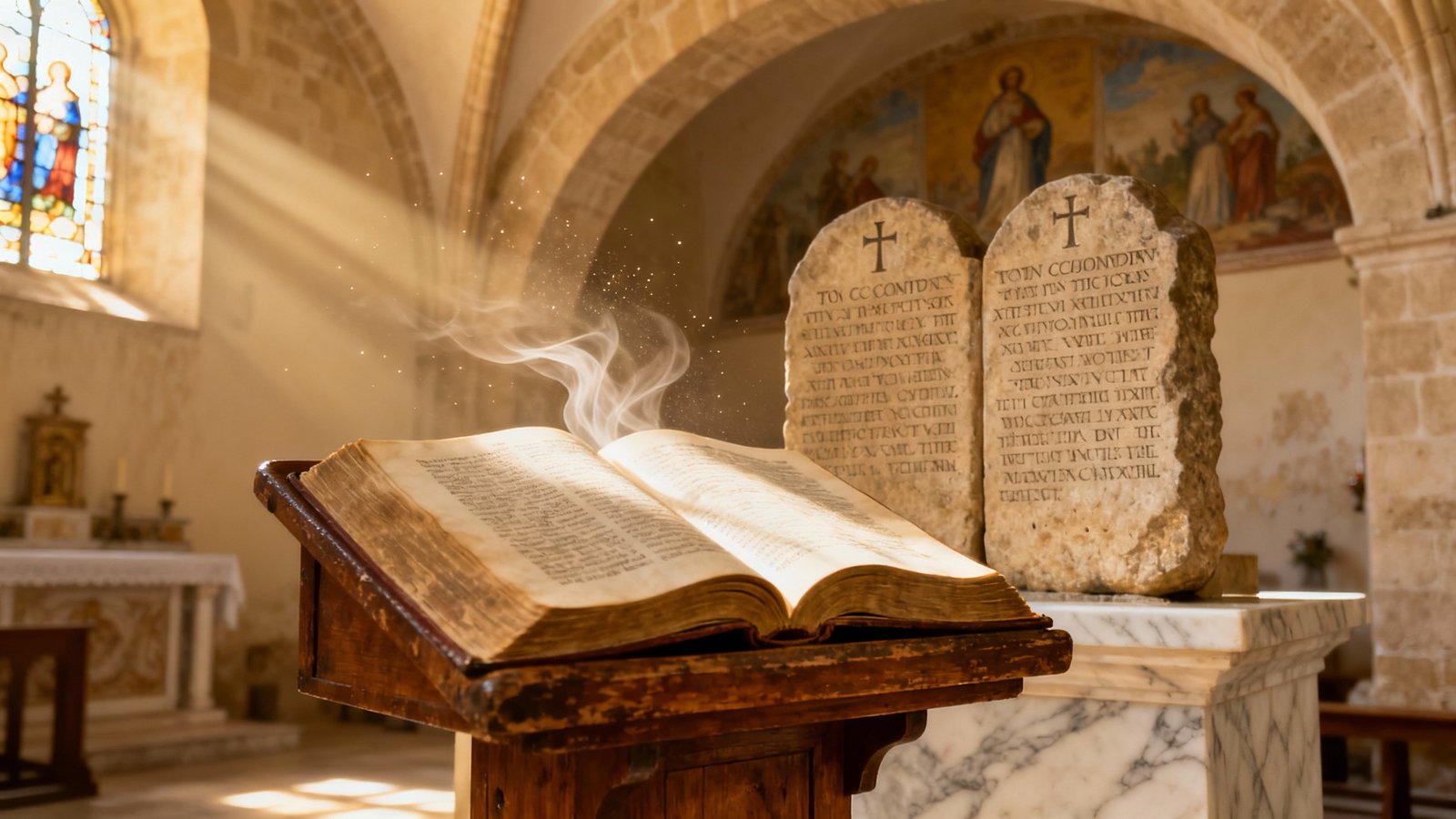
01 Dec The 10 Commandments in the New Testament: Where They’re Quoted and Applied
You’ll find the Ten Commandments transformed throughout the New Testament’s teachings. Jesus intensifies them in Matthew 5:21-48, expanding murder to include anger and adultery to encompass lustful thoughts. Paul directly quotes several in Romans 13:9 and Ephesians 6:2-3, while reframing Sabbath observance as spiritual rest in Hebrews 4:1-11. The apostles apply these ancient laws to Christian community life—from Acts 15:20’s prohibition of idolatry to James 5:4’s expansion of theft to include wage exploitation. Each commandment becomes a gateway to deeper spiritual transformation.
Table of Contents
Key Takeaways
- Jesus directly quotes and expands several commandments in Matthew 5, intensifying their meaning to include internal thoughts and attitudes, not just actions.
- Paul explicitly cites the fifth commandment about honoring parents in Ephesians 6:2-3, calling it the “first commandment with a promise.”
- The Sabbath commandment undergoes radical reinterpretation, with Jesus declaring himself “Lord of the Sabbath” and Paul treating it as optional (Romans 14:5-6).
- First and second commandments are reframed Christologically, with Jesus receiving worship (John 20:28) and described as God’s perfect image (Colossians 1:15).
- The Jerusalem Council in Acts 15:20 maintains prohibition against idolatry while Paul addresses its practical implications for Corinthian Christians (1 Corinthians 8-10).
No Other Gods Before Me: Christ as Supreme Lord in New Testament Teaching

When you examine the New Testament’s treatment of the first commandment, you’ll discover that the prohibition against other gods undergoes a radical christological transformation rather than simple repetition. Paul’s declaration in 1 Corinthians 8:5-6 exemplifies this shift: while acknowledging “many gods,” he affirms one God and “one Lord, Jesus Christ.”
The first commandment undergoes radical christological transformation in the New Testament, expanding monotheism to encompass Christ’s divine Lordship.
This reformulation doesn’t abolish monotheism but expands it to encompass Christ’s Lordship.
You’ll find Jesus himself claiming divine sovereignty in Matthew 28:18, asserting “all authority in heaven and on earth.” The epistle writers consistently apply Old Testament YHWH texts to Christ—Philippians 2:10-11 transfers Isaiah 45:23’s exclusive worship of God to Jesus.
Thomas’s confession “My Lord and my God” (John 20:28) isn’t corrected but affirmed. Early Christians weren’t abandoning the first commandment; they’re recognizing that exclusive devotion to Israel’s God now requires acknowledging Christ’s divine identity and supreme authority over all competing powers.
No Graven Images: Worshiping God in Spirit and Truth
You’ll find the early church grappling with idolatry throughout Paul’s epistles, particularly in Corinth where meat sacrificed to idols created theological controversy (1 Corinthians 8-10).
The New Testament radically redefines worship from physical representations to pneumatic encounter—you’re called to worship “in spirit and truth” (John 4:24), transcending geographical and material boundaries.
Most significantly, you encounter Christ himself as the “image of the invisible God” (Colossians 1:15), making all other representations obsolete since the divine has taken human form.
Idolatry in Early Church
Although modern Christians rarely encounter temple prostitutes or meat sacrificed to Zeus, the early church’s struggle with idolatry reveals fundamental principles about worshiping God that transcend cultural boundaries. You’ll find Paul addressing syncretism tensions throughout his epistles, particularly in Corinth where believers couldn’t separate their new faith from pagan patronage networks.
These social structures weren’t merely religious—they determined employment, civic participation, and economic survival.
When you examine Acts 15:20, you’ll notice the Jerusalem Council specifically prohibits food sacrificed to idols, recognizing that idol worship wasn’t abstract theology but daily reality. Paul’s nuanced approach in 1 Corinthians 8-10 demonstrates how you must navigate between Christian liberty and community witness.
He doesn’t simply forbid; he teaches discernment, showing how idolatry corrupts both vertical worship and horizontal relationships.
Spiritual Worship Redefined
How does Christ’s incarnation transform the prohibition against graven images into a call for spiritual worship?
You’ll find Jesus redefining worship in John 4:23-24, where he declares that true worshipers must worship “in spirit and truth.” This shift from physical representations to spiritual reality marks Christianity’s distinctive approach to the second commandment.
Paul’s teaching on embodied prayer in 1 Corinthians 12 demonstrates how believers themselves become living temples.
You’re no longer seeking God through carved images but experiencing divine presence through communal formation.
The early church’s worship practices, documented in Acts 2:42-47, show this transformation—gathering for prayer, breaking bread, and sharing possessions replaced temple rituals.
You’ll notice how apostolic writings consistently emphasize that Christ himself becomes the perfect image of God (Colossians 1:15), rendering all other representations obsolete.
Christ as True Image
When Paul declares Christ “the image of the invisible God” (Colossians 1:15), he’s making a radical theological claim that overturns centuries of Jewish prohibition against divine representation.
You’re encountering Christianity’s boldest paradox: the God who forbade graven images becomes visible in human flesh. Christ functions as the Incarnate Prototype, the legitimate representation that all idols falsely promised to be.
In Hebrews 1:3, you’ll find Christ described as “the exact representation of God’s being.”
He’s the Divine Mirror reflecting God’s character perfectly. Where golden calves and carved statues failed, Christ succeeds—not as a manufactured substitute but as God’s self-revelation. You’re no longer violating the second commandment by contemplating Christ; you’re fulfilling it. The invisible God makes himself known through the visible Son.
Not Taking the Lord’s Name in Vain: Reverence for God’s Holy Name

As you examine the third commandment‘s presence in the New Testament, you’ll discover that early Christian writers transformed the Hebrew prohibition against misusing YHWH’s name into a broader theological principle encompassing speech ethics and spiritual integrity.
Matthew 5:33-37 extends this commandment beyond oaths, demanding complete truthfulness in all communication. James 5:12 explicitly forbids swearing by heaven or earth, reflecting developed Name Theology that connects divine authority with human speech acts.
You’ll notice Paul’s writings establish Liturgical Etiquette for Christian assemblies, particularly in 1 Timothy 6:1 where blasphemy prevention becomes a communal responsibility.
The Lord’s Prayer’s opening petition, “hallowed be thy name,” positions reverence as foundational to Christian worship. Early believers understood that bearing Christ’s name required behavioral consistency—Acts 19:13-17 demonstrates consequences for unauthorized invocation. This commandment’s New Testament application reveals how primitive Christianity regulated sacred speech within Greco-Roman contexts where divine names held thaumaturgical power.
Remember the Sabbath: From Day of Rest to Rest in Christ
The fourth commandment undergoes radical reinterpretation in New Testament texts, where Jewish Sabbath observance encounters Christological fulfillment theology.
You’ll find Jesus deliberately healing on the Sabbath (Mark 3:1-6), declaring himself “Lord of the Sabbath” (Matthew 12:8), and asserting the Sabbath’s subordination to human need (Mark 2:27).
Paul’s epistles reveal early Christian Sabbath practice diverging from strict observance.
In Colossians 2:16-17, you encounter Sabbaths classified as “shadows” pointing to Christ.
Romans 14:5-6 presents Sabbath-keeping as optional, while Galatians 4:9-10 warns against returning to “weak and worthless elementary principles.”
Hebrews 4:1-11 transforms Rest Theology entirely.
You’re invited to enter God’s rest through faith, not through calendrical observance.
The author reinterprets Genesis 2:2 and Psalm 95:11, presenting salvation as the ultimate Sabbath rest.
This theological shift doesn’t abolish the commandment but fulfills it—you find rest not in weekly cessation from labor but in Christ’s completed work.
Honor Your Father and Mother: Family Relationships in the New Covenant
While ancient Mediterranean cultures universally emphasized filial piety, the fifth commandment receives complex treatment in New Testament texts where biological kinship confronts spiritual family dynamics.
You’ll find Paul directly quotes this command in Ephesians 6:2-3, noting it’s “the first commandment with a promise.” Yet Jesus himself seemingly challenges traditional interpretations when he declares that disciples must “hate” their parents (Luke 14:26) and prioritizes those who do God’s will as his true family (Mark 3:35).
This tension doesn’t negate parental honor but reframes it within God’s kingdom priorities. Paul condemns those who don’t provide elder care for relatives as “worse than an unbeliever” (1 Timothy 5:8), while simultaneously establishing intergenerational discipleship patterns where spiritual fathers mentor converts (1 Corinthians 4:15).
You’re called to navigate both responsibilities: honoring biological parents through practical support while recognizing that ultimate allegiance belongs to your heavenly Father and the spiritual family formed through Christ’s blood.
You Shall Not Murder: From Physical Death to Heart Attitudes
When you examine Jesus’s treatment of the sixth commandment in Matthew 5:21-26, you’ll discover He radically redefines murder to include angry thoughts and verbal contempt toward others.
Christ’s equation of anger with murder reflects rabbinic interpretation methods that sought the deeper spiritual principles within Torah commands, yet He speaks with unprecedented authority (“But I say to you”) that surpasses traditional scribal teaching.
His mandate to reconcile with offended brothers before presenting offerings at the altar demonstrates that right relationships with others constitute a prerequisite for acceptable worship in the new covenant community.
Jesus Expands Murder’s Definition
Though ancient Jewish law clearly prohibited taking another person’s life, Jesus radically reinterpreted the sixth commandment in Matthew 5:21-22, extending its scope beyond physical homicide to encompass the murderous intentions of the human heart.
Within the Sermon Context, you’ll notice Jesus doesn’t abolish the commandment but intensifies it. He equates anger with murder, declaring that whoever’s angry with their brother faces judgment.
You’re confronted with three escalating offenses: anger brings judgment, calling someone “Raca” warrants the Sanhedrin’s attention, and saying “fool” risks hellfire.
The Judicial Implications transform earthly courts into divine tribunals. Jesus isn’t establishing literal legal penalties but revealing how God’s kingdom operates.
You can’t separate external actions from internal attitudes—both violate the commandment’s essence.
Anger Equals Murder
Building on this radical reinterpretation, Jesus establishes a startling equivalence between anger and murder that would have shocked His first-century audience.
When you read “whoever is angry with his brother will be liable to judgment,” you’re encountering a revolutionary ethical framework that transcends both Rabbinic contexts and Greco Roman ethics.
While Jewish teachers debated degrees of culpability and Greek philosophers promoted emotional moderation, Jesus doesn’t merely regulate anger—He criminalizes it.
You’ll notice He equates three escalating expressions: anger itself, calling someone “Raca” (empty-headed), and saying “fool.”
Each carries increasingly severe consequences: judgment, the council, and hell’s fire.
This teaching doesn’t suggest anger literally kills, but that it shares murder’s essential nature—devaluing human dignity.
You’re confronting an ethics that judges internal states as severely as external actions.
Reconciliation Before Worship
Prioritizing reconciliation over religious ritual marks Jesus’s most practical application of the murder commandment’s heart-level demands. In Matthew 5:23-24, you’re commanded to leave your gift at the altar if you remember your brother has something against you. First reconcile, then worship. This reverses Temple confession practice, where purification preceded offering.
You can’t compartmentalize worship from relationships.
Jesus establishes peacemaking rituals that supersede ceremonial obligations. The imperative “go” (ὕπαγε) indicates immediate action—you must interrupt sacred duties to restore human bonds. This teaching assumes mutual responsibility: not just when you’ve wronged someone, but when they hold grievances against you. The altar scenario isn’t hypothetical for Matthew’s Jewish-Christian audience who still participated in Temple worship before 70 CE. You’re witnessing Christianity’s ethical revolution: horizontal reconciliation validates vertical worship.
You Shall Not Commit Adultery: Purity of Heart and Body
When Jesus addressed adultery in the Sermon on the Mount, he radically expanded the commandment’s scope beyond physical acts to encompass the intentions of the heart.
In Matthew 5:27-28, you’ll find his revolutionary teaching: “Anyone who looks at a woman lustfully has already committed adultery with her in his heart.”
This internalization of the law reflects rabbinic debates of the Second Temple period, where ethical purity extended beyond mere behavioral compliance.
Paul reinforces this expanded understanding, declaring your body a “temple of the Holy Spirit” (1 Corinthians 6:19).
This body stewardship theology frames sexual ethics within the broader covenant community’s holiness.
You’re called to honor God through physical discipline and marital fidelity, recognizing that sexual union creates a profound spiritual bond (1 Corinthians 6:16).
The New Testament’s treatment transforms the seventh commandment from prohibition into positive virtue—you’re not merely avoiding adultery but actively cultivating purity in thought and deed.
You Shall Not Steal: Honesty and Generosity in Christian Living
When you examine the New Testament’s treatment of the eighth commandment, you’ll discover that stealing extends beyond material theft to encompass wage exploitation (James 5:4), withholding tithes (Malachi 3:8-10, cited in Matthew 23:23), and depriving others of truth through deception (Colossians 3:9). The apostolic writings reframe theft within a broader theological framework where taking what isn’t yours violates the fundamental principle of loving your neighbor as yourself (Romans 13:9).
Paul’s instruction to former thieves—”Let him who stole steal no longer, but rather let him labor…that he may have something to give” (Ephesians 4:28)—demonstrates how the gospel transforms the prohibition against stealing into a positive mandate for productive work and radical generosity.
New Testament Theft References
The commandment against stealing undergoes significant theological expansion in the New Testament, where it’s transformed from a prohibition of property theft into a comprehensive ethical framework encompassing honesty, generosity, and communal responsibility.
You’ll find Jesus addressing theft indirectly through the Denarius inscription incident, where he establishes principles of rightful ownership and obligation.
Paul explicitly quotes the eighth commandment in Romans 13:9 and Ephesians 4:28, but he doesn’t stop at prohibition—he prescribes productive labor and sharing with the needy.
The Judas embezzlement narrative (John 12:6) exemplifies how theft violates sacred trust within Christian community.
You’ll notice the apostolic writings consistently link stealing with broader sins: deception, greed, and exploitation.
This expansion reflects early Christianity’s emphasis on transformed living rather than mere legal compliance.
Spiritual Stealing Concepts
Beyond material theft, the New Testament writers develop sophisticated concepts of spiritual stealing that penetrate the heart’s motivations and extend into realms of time, talent, and truth.
You’ll find Paul warning against spiritual plagiarism when he condemns those who “preach Christ out of selfish ambition” (Philippians 1:17), essentially stealing God’s glory for personal gain.
The apostle’s confrontation with Simon Magus (Acts 8:18-24) reveals identity appropriation—attempting to purchase spiritual authority that wasn’t earned through authentic discipleship.
You’re called to recognize how withholding tithes “robs God” (Malachi 3:8, referenced in Matthew 23:23) and how false teachers steal truth through deceptive doctrines (2 Peter 2:1-3).
These texts expand theft beyond possessions to encompass misappropriation of divine prerogatives, spiritual gifts, and Kingdom resources.
Generous Living Principles
Transforming from prohibition to prescription, Christ’s teaching radically reframes the eighth commandment through what you might call an “economics of abundance.” Luke 6:38’s revolutionary principle—”Give, and it will be given to you”—doesn’t merely negate stealing but establishes a counter-economy where generosity generates spiritual wealth.
You’ll find Paul articulating this Stewardship Mindset in 2 Corinthians 9:6-7, where sowing sparingly yields sparse returns while generous sowing produces abundant harvest. This agricultural metaphor reveals how first-century Christians understood material possessions as seeds for kingdom investment.
The Macedonian churches exemplified Sacrificial Giving despite extreme poverty (2 Corinthians 8:1-3), demonstrating that generosity transcends economic status. You’re called to recognize that everything belongs to God (Psalm 24:1), making you a trustee rather than owner—a theological shift that transforms stealing’s prohibition into generosity’s mandate.
You Shall Not Bear False Witness: Truth-Telling in the Kingdom of God
Integrity forms the bedrock of covenant relationships in biblical theology.
Jesus radically intensifies the ninth commandment’s prohibition against false testimony by addressing not merely juridical perjury but the comprehensive nature of human speech itself. You’ll find Christ’s teaching in Matthew 5:33-37 dismantles oath-taking entirely, demanding your “yes” mean yes—establishing witness integrity as non-negotiable for kingdom citizens.
Paul’s epistolary corpus reinforces this ethic through concrete applications.
In Ephesians 4:25, you’re commanded to “put away falsehood” and speak truth with your neighbor, grounding community transparency in shared membership within Christ’s body. The apostle’s instruction isn’t merely moral but ecclesiological—false speech ruptures the organic unity essential to the church’s witness.
James 5:12 echoes Jesus’s prohibition against oaths.
Colossians 3:9 frames truth-telling within the metaphor of clothing yourself with the new humanity. You’re called to embody aletheia—truth as unveiled reality—reflecting God’s own character in every utterance.
You Shall Not Covet: Contentment and Gratitude Under Grace
While external commandments regulate observable behaviors, the tenth commandment penetrates the interior landscape of human desire, and Christ’s treatment of covetousness in the New Testament exposes it as the generative source of manifold transgressions.
You’ll find Jesus doesn’t merely prohibit coveting—He diagnoses its pathology in Luke 12:15, warning that life doesn’t consist in possessions’ abundance.
Paul’s epistemic framework in Romans 7:7 identifies the tenth commandment as revelatory of sin’s essential nature.
You’re confronted with covetousness as idolatry itself (Colossians 3:5), requiring radical desire retraining through renewed thinking (Romans 12:2).
The apostolic prescription isn’t behavioral modification but ontological transformation—you’re called to contentment through Christ’s sufficiency (Philippians 4:11-13).
First-century Christians implemented gratitude practices as antidotes to covetousness, following Paul’s injunction to give thanks in everything (1 Thessalonians 5:18).
You’ll discover that thanksgiving recalibrates desire’s trajectory, redirecting attention from what’s lacking to divine provision’s abundance.
Frequently Asked Questions
Did Jesus Ever Directly Quote All Ten Commandments During His Ministry?
You won’t find Jesus directly quoting all ten commandments verbatim in a single discourse. While he referenced several commandments individually throughout his ministry, particularly in encounters like Mark 10:19, the Sermon parallels reveal Mosaic echoes rather than systematic recitation.
He transformed and internalized these laws, addressing heart motivations beyond external compliance. His teaching method emphasized the commandments‘ spiritual depths through interpretive expansion rather than comprehensive cataloging of the Decalogue’s complete text.
Which New Testament Book References the Commandments Most Frequently?
You’ll find Romans contains the highest citation frequency of the commandments among New Testament books.
Paul’s textual mapping in chapters 2, 7, and 13 systematically incorporates five commandments while developing his theological arguments about law and grace.
You’re observing deliberate rhetorical strategy when Paul clusters these references, particularly in Romans 13:8-10, where he synthesizes multiple commandments under love’s fulfillment.
Matthew follows closely, but Romans demonstrates the densest concentrated usage.
Are Christians Still Required to Follow the Ten Commandments Today?
You’ll find theological perspectives vary significantly on this question.
Most Christian traditions affirm the Ten Commandments’ ethical implications remain binding, though ceremonial Sabbath observance differs across church practices.
Paul’s epistles suggest you’re under grace, not law, yet Jesus affirmed the commandments’ validity. Reformed theology distinguishes moral law from ceremonial law, arguing you’re obligated to follow the former. Catholic and Orthodox traditions maintain you’re bound to observe them through Christ’s fulfillment.
How Do the Commandments Relate to Salvation by Grace Through Faith?
You’re saved by grace through faith alone, not by keeping commandments.
The Law’s purpose isn’t to save you but to reveal your sin and need for Christ.
Once you’re justified, obedience becomes faith’s fruit—your response to God’s grace, not its cause.
Paul’s epistles consistently demonstrate this distinction: commandments don’t earn salvation but naturally flow from regeneration.
You obey because you’re saved, not to become saved.
Did Paul Teach Differently About the Commandments Than Jesus Did?
You’ll find Paul’s teachings align with Jesus’ foundational message when examining Pauline hermeneutics carefully.
Jesus’ continuity appears throughout Paul’s epistles—both taught commandments flow from love (Romans 13:8-10; Matthew 22:37-40).
While Jesus addressed Jewish audiences about Torah observance, Paul contextualized for Gentile churches.
They’re not contradicting but complementing: Jesus established the principle of heart-transformation over external compliance, which Paul expanded theologically, explaining how Spirit-empowered believers fulfill law’s righteous requirements through faith working through love.
Conclusion
You’ve traced the Ten Commandments through the New Testament’s transformative lens, discovering how Christ didn’t abolish but fulfilled these ancient laws. You’ll find they’re not merely repeated but deepened—external obedience becomes heart transformation, ritual observance yields to spiritual reality. As you’ve seen in the textual evidence, Jesus and the apostles consistently upheld the moral law while revealing its ultimate purpose: shaping disciples who embody God’s character through the Spirit’s power, not mere legal compliance.










No Comments