

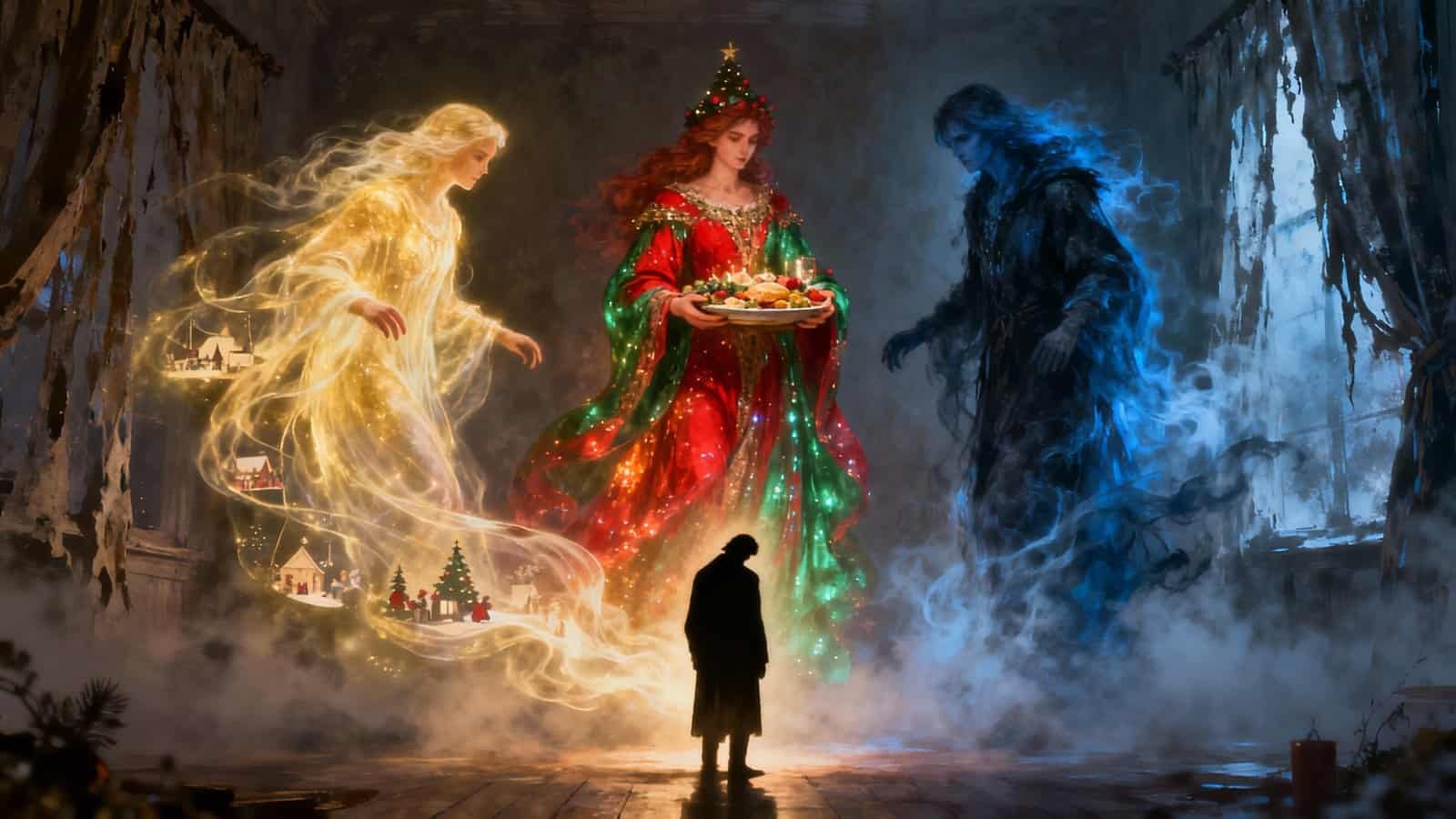
30 Nov Three Ghosts in a Christmas Carol: Meaning and Lessons
You’ll discover Dickens’s three ghosts operate as psychological mechanisms transforming Scrooge’s consciousness through temporal intervention. The Past ghost enacts Freud’s “return of the repressed,” forcing confrontation with abandoned compassion through curated memory scenes. Present embodies Bakhtin’s carnivalesque dissolution of hierarchies, activating empathy via what Nussbaum calls “narrative imagination.” Yet to Come manifests Benjamin’s messianic time through silence and gesture, staging mortality’s ethical urgency. Each spirit employs distinct narrative strategies that progressively reconstruct identity’s relationship to community.
Table of Contents
Key Takeaways
- The Ghost of Christmas Past forces Scrooge to confront forgotten memories and his abandoned compassionate self, enabling psychological transformation through memory.
- The Ghost of Christmas Present reveals joy and suffering in the present community, awakening Scrooge’s dormant empathy through immersive social experiences.
- The Ghost of Christmas Yet to Come shows Scrooge’s unmourned death and erased legacy, using mortality’s reality to catalyze ethical change.
- Each ghost represents a temporal dimension—past memories, present connections, and future consequences—working together to reconstruct Scrooge’s fractured identity.
- The three spirits teach that redemption requires confronting personal history, embracing community bonds, and accepting mortality’s role in meaningful existence.
The Ghost of Christmas Past: Memory as Mirror to Our Former Selves
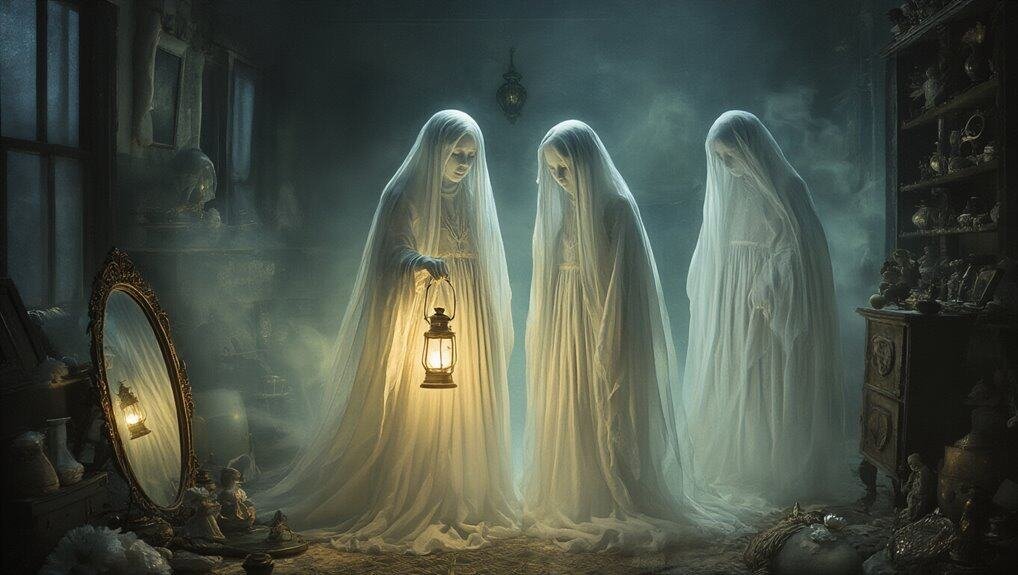
Examining the Ghost of Christmas Past reveals Dickens’s sophisticated understanding of memory’s role in psychological transformation.
When you encounter this ethereal figure, you’re witnessing more than supernatural intervention—you’re observing what Freud would later theorize as the return of the repressed (Freud, 1915).
The ghost doesn’t merely show Scrooge memories; it forces confrontation with abandoned versions of himself.
Through nostalgic reconstruction, you see how Scrooge’s past self contained compassion and joy before capitalism’s corrosive influence.
This temporal journey demonstrates what Ricoeur (1991) calls “narrative identity”—you understand yourself through the stories you tell about your past.
The ghost ensures identity continuity by connecting Scrooge’s present misanthropy to specific moments of loss and disappointment.
You recognize that Dickens anticipates modern psychological insights: memory isn’t passive recording but active reconstruction that shapes present behavior.
The ghost’s selective curation of scenes reveals how you’ve betrayed your younger self’s values, making redemption possible through remembering.
The Ghost of Christmas Present: Awakening to Joy and Human Connection
Encountering the Ghost of Christmas Present transforms Scrooge’s isolated consciousness into participatory awareness of communal celebration. You witness Dickens’s deliberate construction of what Bakhtin termed “carnivalesque” space—where hierarchical boundaries dissolve through shared festivity.
The ghost’s cornucopia symbolizes abundance’s democratizing force, spreading joy regardless of economic station.
When you observe Bob Cratchit’s humble feast, you’re experiencing what Martha Nussbaum identifies as “narrative imagination”—fiction’s capacity for empathy activation through perspectival shifts. The ghost doesn’t merely show Scrooge others’ lives; he immerses him in their emotional realities.
Fiction activates empathy through immersive perspectival shifts into others’ emotional realities.
You see how Dickens anticipates modern affect theory: emotions aren’t individual properties but circulate through social networks.
The spirit’s declining vitality mirrors time’s passage, yet his message remains urgent. You’re confronted with present-tense existence—not memory’s shadows or future’s anxieties, but immediate human connection.
Through Fred’s toast and Tiny Tim’s blessing, you understand how joy multiplies through distribution, challenging capitalism’s scarcity logic.
The Ghost of Christmas Yet to Come: Confronting Mortality and Legacy
Where the previous spirit embodied temporal presence and communal warmth, the Ghost of Christmas Yet to Come manifests as pure absence—a void that speaks through silence.
You encounter death’s herald not through dialogue but through gesture, what Derrida might term “the trace of the unspeakable” (Specters of Marx, 1993). This phantom doesn’t teach; it reveals.
Through Scrooge’s confrontation with his unmourned death, Dickens stages mortality acceptance as prerequisite for ethical transformation.
You’re forced to witness capitalism’s ultimate reduction: human worth measured solely in material redistribution. The spirit’s muteness amplifies what Bakhtin calls “answerability”—you can’t negotiate with death’s finality.
Legacy stewardship emerges through negative space.
Scrooge’s abandoned grave represents time’s erasure of uncommitted lives. The spirit’s methodical unveiling—from servants stealing possessions to Tiny Tim’s empty chair—constructs what Benjamin termed “messianic time,” where you recognize present actions’ future reverberations.
This ghost doesn’t prophesy; it demonstrates consequence’s architecture.
Frequently Asked Questions
Why Does Marley’s Ghost Appear First Before the Three Christmas Spirits?
Marley’s ghost appears first because you need a narrative catalyst to initiate Scrooge’s transformation journey.
He serves as psychological priming for the supernatural visitations that’ll follow.
As Scrooge’s former partner, Marley’s credibility establishes the story’s metaphysical framework (Patten, 2012). You’re witnessing Dickens’s strategic deployment of a liminal figure who bridges mortality and eternity, preparing both protagonist and reader for the Three Spirits’ pedagogical interventions through shared capitalist history.
What Inspired Charles Dickens to Create These Specific Three Ghosts?
You’ll find Dickens drew from Gothic literary influences and medieval morality plays when crafting his spectral trinity.
He’s transforming traditional memento mori figures into vehicles for Victorian morality‘s emphasis on social responsibility.
You’re witnessing his synthesis of Shakespeare’s ghosts with contemporary spiritualism’s séance culture.
As Ackroyd (1990) argues, Dickens consciously adapted the three-act structure of classical drama, where each ghost represents dialectical stages of moral awakening through temporal examination.
Are the Christmas Ghosts Angels, Demons, or Something Else Entirely?
You’ll find Dickens deliberately maintains spiritual ambiguity regarding the ghosts’ nature.
They’re neither definitively angels nor demons, but liminal beings operating between salvation and damnation.
Contemporary psychological readings suggest they’re manifestations of Scrooge’s conscience (see Wilson, 1941).
Victorian spiritualism influenced Dickens’s portrayal—they’re redemptive spirits without explicit Christian theology.
You should interpret them as moral agents transcending traditional religious categories, embodying what Goldfarb (1972) calls “secular supernatural intervention.”
Why Doesn’t the Ghost of Christmas yet to Come Speak?
You’ll find the Ghost of Christmas Yet to Come employs Silent Authority as a narrative device, functioning through what Barthes termed “zero degree writing.”
Its muteness creates Visual Foreshadowing—you’re forced to interpret gestural semiotics rather than verbal discourse.
This speechlessness amplifies the specter’s ontological weight; as Miller (1985) argues, silence becomes “more terrible than accusation.” You can’t negotiate with death’s inevitability—it simply points toward your predetermined terminus.
How Long Does Scrooge’s Supernatural Journey Actually Take in Real Time?
You’ll find Scrooge’s entire supernatural journey occurs within a single night, from Christmas Eve to Christmas morning.
While Dickens presents this temporal compression literally, you can’t ignore the dream theory interpretation that scholars like Glancy (2000) propose—suggesting you’re witnessing psychological time rather than chronological time.
You’ll notice Scrooge awakens at each ghost’s departure, reinforcing both the single night framework and the possibility you’re experiencing Scrooge’s transformative dream-vision.
Conclusion
You’ve witnessed how Dickens’s spectral trinity functions as what Bakhtin would term a “chronotope”—collapsing temporal boundaries to facilitate moral transformation. These ghosts aren’t merely supernatural plot devices; they’re manifestations of consciousness itself, forcing you to confront memory’s weight, presence’s immediacy, and futurity’s uncertainty. Through their interventions, you’re compelled to recognize that redemption isn’t passive—it demands active engagement with time’s tripartite structure, transforming spectatorship into ethical action within your own narrative arc.





No Comments