

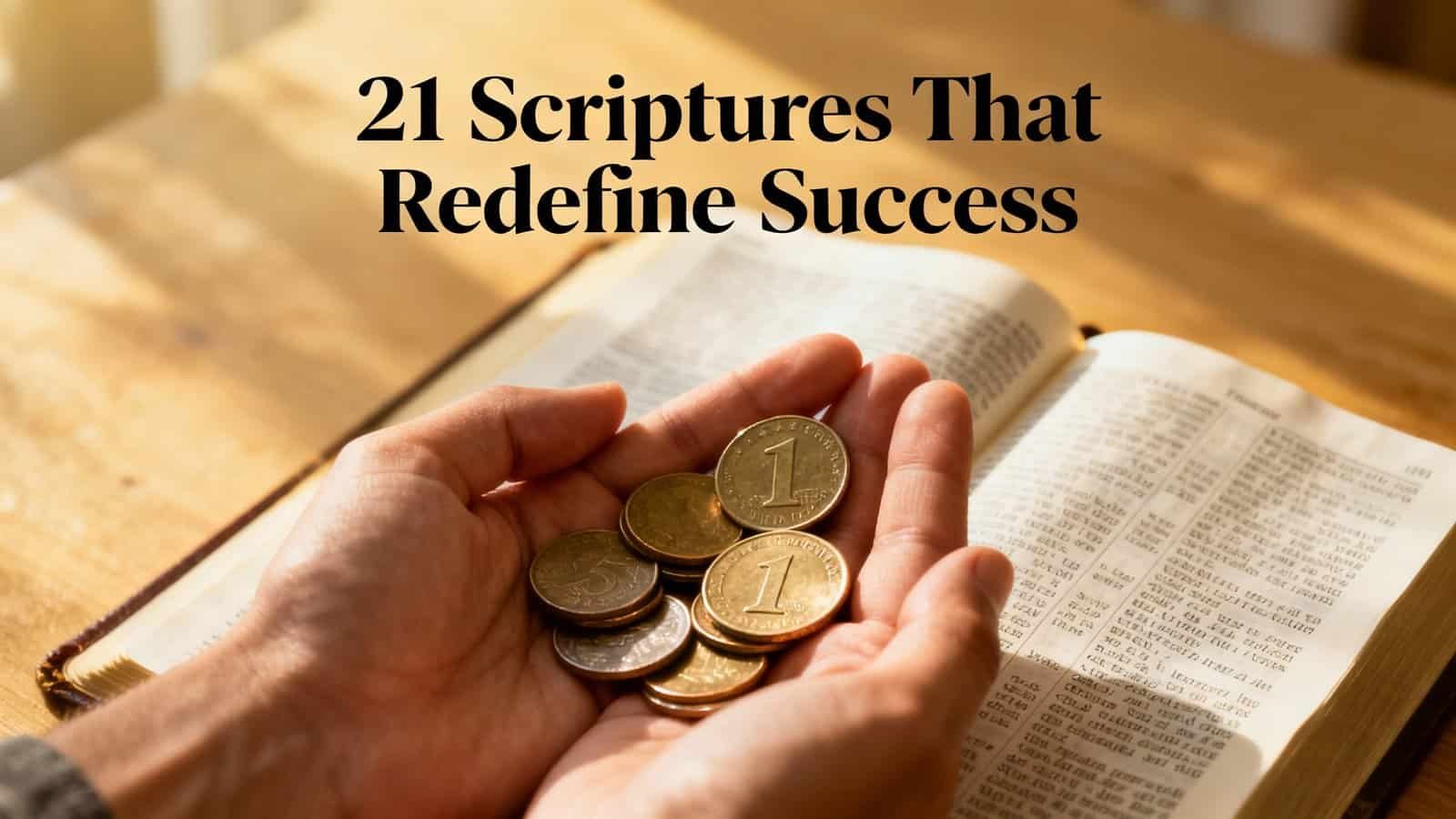
30 Nov 21 Scripture on Money in the Bible Scriptures That Redefine Success
You’ll discover Scripture doesn’t condemn wealth but reveals how money competes for your heart’s allegiance. From Matthew 6:24’s impossibility of serving two masters to 1 Timothy 6:10’s warning about greed’s corrupting power, God’s Word exposes money’s true nature as a loyalty test. Your spending patterns, debt decisions, and generosity habits shape your character and reveal your kingdom citizenship. These biblical truths about contentment, stewardship, and sacrificial giving transform financial stress into spiritual freedom when you understand what comes next.
Table of Contents
Key Takeaways
- Scripture teaches that true success means storing treasures in heaven through generosity rather than accumulating earthly wealth that decays and disappears.
- Biblical financial success requires complete allegiance to God, as serving both God and money proves impossible according to Jesus’s teachings.
- Contentment in Christ defines genuine prosperity, while the endless pursuit of wealth leads to dissatisfaction, broken relationships, and spiritual emptiness.
- God measures success by faithful stewardship of small amounts, using financial decisions as primary tests for character development and kingdom trustworthiness.
- Scripture redefines success as righteousness that delivers from death, while warning that wealth proves worthless in times of ultimate crisis.
Matthew 6:24 – You Cannot Serve Both God and Money
This isn’t merely financial advice—it’s a Loyalty Test that determines your Kingdom Citizenship.
Your financial decisions are divine loyalty tests that reveal your true citizenship and eternal allegiance.
When you’re torn between God’s call and financial gain, you’re standing at eternity’s crossroads.
You can’t split your allegiance.
Money demands your anxiety, time, and compromise.
God demands your trust, obedience, and surrender.
You’ve probably felt this tension when facing ethical dilemmas at work or struggling with generosity.
Christ’s words aren’t condemning wealth itself but exposing divided hearts.
Your bank account reveals your theology.
Where you invest your treasure exposes your true master.
Choose today whom you’ll serve—because neutrality isn’t an option in God’s kingdom.
1 Timothy 6:10 – The Love of Money Is the Root of All Evil
You’ve likely seen how the pursuit of wealth can change people’s hearts, leading them away from what truly matters in God’s kingdom.
Paul’s warning in 1 Timothy 6:10 isn’t about money itself but about the love of it—that consuming desire that corrupts your priorities and blinds you to spiritual dangers. When you’re tempted to chase riches, remember that greed promises satisfaction but delivers emptiness, while contentment in Christ offers the true treasure your soul needs.
Greed Corrupts Hearts
When Paul warned Timothy that “the love of money is the root of all evil,” he wasn’t condemning wealth itself but exposing how greed can poison the human heart. You’ve probably witnessed this moral erosion firsthand—watching someone’s character crumble as their appetite for wealth grows insatiable.
Greed doesn’t announce itself; it creeps in quietly, reshaping your priorities until money becomes your master.
This corruption leads to relationship sabotage. You’ll sacrifice friendships, betray trust, and neglect family when greed takes hold. But here’s the hope: recognizing greed’s destructive power is your first defense. God’s warning isn’t meant to shame you but to protect you. When you understand that contentment brings true wealth, you’re freed from greed’s chains and positioned to experience the abundant life Christ promises.
Pursuing Wealth’s Dangers
Though wealth itself isn’t sinful, Scripture reveals that pursuing riches can lead you down a treacherous path filled with spiritual pitfalls.
Paul’s warning in 1 Timothy 6:10 isn’t about money itself—it’s about what happens when you make wealth your ultimate goal.
When you’re consumed by financial gain, you’ll experience moral erosion as compromises become easier to justify.
You might sacrifice integrity for profit or abandon compassion for advancement.
Time poverty follows, stealing precious moments from family, prayer, and service as work demands multiply.
God doesn’t condemn your success, but He knows the dangers lurking in unchecked ambition.
The pursuit of wealth can pierce you with many sorrows, pulling your heart away from eternal treasures.
Instead, seek first His kingdom, trusting that He’ll provide what you truly need.
Proverbs 22:7 – The Borrower Is Slave to the Lender
When you’re carrying debt, you understand the weight of Solomon’s words in Proverbs 22:7—that borrowing creates a form of bondage that limits your choices and steals your peace. God’s Word reveals this truth not to condemn you but to illuminate the path toward financial freedom, where you can serve Him without the constant pressure of what you owe.
Through biblical wisdom and practical steps, you can break these chains and build the financial independence that allows you to be generous, purposeful, and truly free.
Understanding Biblical Debt Slavery
As you navigate financial decisions in today’s complex economy, Proverbs 22:7 offers sobering wisdom: “The rich rule over the poor, and the borrower is slave to the lender.”
This ancient truth reveals how debt creates more than just financial obligation—it establishes a form of bondage that restricts your freedom, influences your choices, and can even compromise your ability to serve God wholeheartedly.
In historical contexts, debt slavery wasn’t metaphorical—it was literal.
Ancient Israelites who couldn’t repay debts became servants to their creditors.
While modern legal remedies like bankruptcy offer protection you wouldn’t have had then, the spiritual principle remains unchanged.
Debt still controls where you work, how you spend, and limits your generosity.
You’re not free to follow God’s calling when you’re bound to monthly payments.
Breaking Free From Debt
Before you can experience true financial freedom, you’ll need to confront the reality of your debt honestly and develop a biblical strategy for elimination.
Start by listing every debt you owe, then commit your situation to prayer, asking God for wisdom and provision.
You’ll need budget discipline to break free.
Create a spending plan that honors God first through tithing, covers necessities, and aggressively attacks debt using the smallest-to-largest method.
Every dollar matters in this spiritual battle.
While paying off debt, build emergency savings—even $500 can prevent future borrowing when unexpected expenses arise.
Remember, you’re not alone in this journey.
God promises to supply all your needs according to His riches in glory.
Stay faithful, work diligently, and trust Him to guide you toward freedom.
Building Financial Independence
Building financial independence requires shifting from a borrower’s mindset to an owner’s mindset, recognizing that true freedom comes when you’re no longer enslaved to lenders.
You’re called to be a wise steward, and that starts with establishing an emergency fund—your first line of defense against unexpected expenses that might otherwise push you back into debt.
Scripture encourages diligent planning, and this extends to your career planning decisions.
You don’t have to stay stuck in financial limitations.
God’s given you talents and opportunities to increase your earning potential through strategic career moves, additional training, or developing multiple income streams.
Each step toward independence honors the biblical principle of good stewardship.
As you build wealth God’s way, you’ll discover the joy of giving generously rather than living paycheck to paycheck.
Luke 12:15 – Life Does Not Consist in Abundance of Possessions
When someone in the crowd asked Jesus to settle an inheritance dispute, Christ seized the moment to deliver one of Scripture’s most penetrating warnings about money: “Take care, and be on your guard against all covetousness, for one’s life doesn’t consist in the abundance of his possessions” (Luke 12:15).
You’ve likely felt the pull to define yourself by what you own.
Yet Jesus confronts this tendency head-on. Your identity formation doesn’t depend on your bank balance or material goods—it’s rooted in being God’s beloved child.
When you grasp this truth, you’re freed from the exhausting pursuit of more.
This verse also reshapes how you view your vocational calling. Instead of choosing work based solely on income potential, you can pursue what God’s equipped you to do.
You’re not working to prove your worth through accumulation but to serve God’s kingdom purposes with your unique gifts.
Hebrews 13:5 – Be Content With What You Have
When you’re constantly scrolling through social media or comparing your life to others, contentment feels impossible—but God’s Word offers a different path.
Hebrews 13:5 commands you to “be content with what you have” because God himself promises, “Never will I leave you; never will I forsake you.” This powerful verse doesn’t just address your wallet; it speaks to the deepest needs of your heart, offering freedom from material obsession and the exhausting comparison game that steals your joy.
Freedom From Material Obsession
As you examine your relationship with money and possessions, God’s Word offers a liberating truth: contentment isn’t found in accumulating more, but in trusting the One who promises never to leave you.
When you’re trapped in material obsession, you can’t experience the freedom Christ offers.
Breaking free starts with Mindful Minimalism—intentionally evaluating what you truly need versus what culture says you must have.
You’ll discover that less often means more peace, more clarity, and more resources to bless others.
Cultivating a daily Gratitude Practice transforms your perspective.
Instead of focusing on what you lack, you’ll see God’s provision everywhere.
Thank Him for today’s bread, shelter, and breath.
This spiritual discipline weakens materialism’s grip and strengthens your trust in God’s faithfulness, bringing the contentment that money never could.
God’s Promised Presence
Though your bank account may fluctuate and possessions come and go, God’s promise in Hebrews 13:5 anchors your soul: “I will never leave you nor forsake you.”
This divine guarantee transforms how you view contentment, shifting your security from temporary wealth to eternal presence.
When financial storms threaten your peace, you’re not navigating alone.
God’s Comforting Presence surrounds you in every season—abundance or scarcity.
He doesn’t abandon you when markets crash or jobs disappear.
His faithfulness remains constant while everything else shifts.
You’ll discover true contentment when you trust His Guiding Presence over your portfolio’s performance.
He leads you through financial decisions, career changes, and unexpected expenses.
Your heavenly Father knows what you need before you ask, and He’s committed to providing through His perfect wisdom and timing.
Breaking Comparison Habits
How often do you scroll through social media and feel inadequate about your financial situation?
You’re not alone in this struggle.
Hebrews 13:5 reminds you to “be content with what you have,” but that’s challenging when everyone else appears to be thriving financially.
Breaking free from comparison requires intentional action.
First, limit your social media exposure, especially accounts that trigger financial envy.
Unfollow influencers who make you feel “less than.”
Second, develop a daily gratitude practice by writing three things you’re thankful for each morning.
This rewires your brain to notice abundance rather than lack.
God’s economy doesn’t operate like Instagram’s highlight reel.
He measures success by faithfulness, not followers or finances.
When comparison creeps in, remember that you’re seeing curated glimpses, not complete pictures of others’ lives.
Ecclesiastes 5:10 – Whoever Loves Money Never Has Enough
Someone who chases wealth will always feel empty, no matter how much they accumulate.
Ecclesiastes 5:10 reveals this timeless truth: “Whoever loves money never has money enough; whoever loves wealth is never satisfied with their income.”
You’ve probably experienced this yourself—reaching a financial goal only to immediately set your sights on the next milestone.
This endless pursuit creates relational strain as you prioritize earning over relationships.
Your mental health suffers under the weight of never feeling content.
You’re caught in a cycle where “enough” doesn’t exist because the target keeps moving.
God’s warning isn’t against having money but loving it.
When wealth becomes your primary source of security and identity, you’ll discover it can’t deliver what it promises.
True satisfaction comes from finding your worth in Christ, not your net worth.
He offers the contentment that no amount of money can purchase.
Matthew 19:21 – Sell Your Possessions and Give to the Poor
Consider the weight of Jesus’ words to the rich young ruler: “If you want to be perfect, go, sell your possessions and give to the poor, and you’ll have treasure in heaven.” This radical call challenges you to examine what holds ultimate authority in your life.
The historical context reveals this wasn’t merely about poverty. Jesus identified the young man’s heart condition—his wealth had become his god.
While rabbinic parallels encouraged charity, Jesus’ complete divestment command was unprecedented, exposing how possessions can possess you.
You’re not necessarily called to literal poverty, but you’re invited to spiritual freedom. When money controls your decisions, relationships, and peace, it’s become your master.
Jesus offers liberation through generous living. Start small—release what you’re gripping tightly.
Give sacrificially to those in need. You’ll discover that loosening your hold on earthly treasures strengthens your grasp on eternal ones.
True perfection isn’t found in what you accumulate but in what you’re willing to surrender for God’s kingdom.
Proverbs 11:4 – Wealth Is Worthless in the Day of Wrath
Security crumbles when you place your ultimate trust in wealth, for Proverbs 11:4 declares a sobering truth: “Wealth is worthless in the day of wrath, but righteousness delivers from death.”
You’ve likely witnessed how quickly financial markets can crash, fortunes evaporate, and material possessions lose their value during crisis.
The historical background of ancient Israel reveals that Solomon wrote these words during unprecedented prosperity, yet he understood wealth’s limitations.
Within the literary context of Proverbs, this verse appears among sayings contrasting the righteous and wicked, emphasizing that moral integrity outweighs material accumulation.
You’re not called to poverty, but to perspective. Money serves temporary purposes, but righteousness yields eternal dividends. When judgment comes—whether through personal tragedy, economic collapse, or life’s final breath—your bank account can’t save you.
Only right standing with God provides true security. Build your life on what endures: faith, integrity, and love. These investments never depreciate and deliver you through any storm.
1 Timothy 6:17-19 – Command the Rich to Do Good
Building on the truth that righteousness outlasts riches, Paul’s instructions to Timothy reveal how those blessed with wealth should live.
You’re called to resist arrogance and place your hope in God, not uncertain riches.
Your wealth isn’t meant for hoarding but for kingdom purposes.
When you’re generous and ready to share, you exercise tremendous moral influence in your community.
Your willingness to do good with what God’s entrusted to you becomes a powerful public witness that points others to Christ.
You’re storing up treasure as a good foundation for the future, taking hold of life that’s truly life.
Don’t let wealth isolate you from others’ needs.
Instead, use it to demonstrate God’s love practically.
Whether you’re funding ministry, helping the poor, or supporting your church, you’re showing that money serves a higher purpose.
Your generosity proves that you understand wealth’s temporary nature and eternal life’s permanent value.
Luke 16:13 – Faithfulness in Little Leads to Much
When you’re faithful with the twenty dollars in your wallet today, you’re actually preparing for God to entrust you with greater responsibilities tomorrow.
Your small acts of integrity—returning extra change, tithing on a modest income, or sharing from limited resources—become the testing ground where God develops your character for future greatness. He’s watching how you handle the little because it reveals what you’ll do with much.
Small Steps Matter Most
Starting with just five dollars in savings might seem insignificant.
But Jesus taught that your faithfulness with small amounts determines whether God will trust you with greater resources.
You don’t need perfect circumstances to begin honoring God with your finances.
Those micro habits you’re developing—tithing from your part-time job, saving loose change, or choosing generic brands—they’re building spiritual muscle.
Each incremental win matters to God.
When you resist that impulse purchase or faithfully set aside ten percent from a small paycheck, you’re proving yourself trustworthy.
Heaven celebrates these victories because they reveal your heart’s transformation.
God isn’t measuring the size of your bank account; He’s watching how you steward what’s already in your hands.
Your small steps of obedience today prepare you for tomorrow’s larger responsibilities.
Testing Ground for Greatness
Although money might seem like a mundane part of daily life, God uses it as His primary testing ground for developing greatness in your character.
Every financial decision you make shapes your Character Formation, revealing whether you’re trustworthy with kingdom resources.
When you handle ten dollars with integrity, God knows He can trust you with ten thousand.
Luke 16:13 teaches that faithfulness in small financial matters qualifies you for greater spiritual authority.
Your Leadership Development doesn’t begin on a platform—it starts in your wallet.
How you manage today’s paycheck determines tomorrow’s influence.
God’s watching how you tithe, save, and give because He’s preparing you for assignments that require proven character.
Before He’ll entrust you with souls, He tests you with silver.
Proverbs 13:11 – Dishonest Money Dwindles Away

If you’ve ever wondered why some wealth seems to vanish while other resources multiply, Proverbs 13:11 reveals a profound truth: “Dishonest money dwindles away, but whoever gathers money little by little makes it grow.”
This ancient wisdom speaks directly to the heart of financial integrity, teaching that wealth gained through deception, shortcuts, or unethical means carries within it the seeds of its own destruction.
You’ll find that illicit earnings create a fragile foundation.
They’re built on broken trust and compromised values that eventually collapse.
Reputation erosion follows dishonest gain—once others discover the deception, opportunities disappear and relationships crumble.
God’s design for prosperity isn’t just about accumulation; it’s about faithful stewardship.
When you gather resources honestly, even slowly, you’re building something eternal.
Your integrity becomes your greatest asset, attracting both divine favor and human trust.
Choose the patient path of honest work—it leads to lasting abundance.
Matthew 6:19-21 – Store Up Treasures in Heaven
When you choose between earthly and heavenly treasures, you’re actually choosing where your heart will dwell—because Jesus promises that your heart follows your treasure.
Your money isn’t just currency; it’s a tool for eternal investment that can build God’s kingdom and transform lives forever.
Earthly Vs Heavenly Treasures
As you navigate life’s financial decisions, Jesus’ teaching in Matthew 6:19-21 offers transformative wisdom about where to invest your resources.
Earthly treasures—money, possessions, status—are temporary and vulnerable to decay, theft, and loss.
They can’t follow you beyond this life.
But heavenly treasures endure forever.
This perspective shift doesn’t mean you shouldn’t save or plan wisely.
Instead, it’s about recognizing that eternal investments matter most.
When you’re generous with the poor, serve others sacrificially, and use your resources for God’s kingdom, you’re storing up imperishable wealth.
Your legacy focus changes from accumulating material goods to impacting souls and advancing God’s purposes.
Where your treasure is, there your heart will be also.
Choose investments that’ll outlast your earthly life.
Where Your Heart Is
The profound truth Jesus reveals in Matthew 6:21—”where your treasure is, there your heart will be also”—exposes the intimate connection between your money and your spiritual condition. Your spending patterns don’t lie; they reveal your true allegiance.
When you examine your bank statements, you’re looking at your internal compass pointing toward what you value most.
This isn’t about guilt—it’s about awareness. God’s inviting you to align your financial decisions with Kingdom priorities.
You can’t serve two masters, but you can choose which one receives your devotion. Every dollar you steward becomes a declaration of faith.
As you intentionally redirect resources toward eternal purposes, something beautiful happens: your heart follows. You’ll find yourself caring more deeply about God’s work and His people.
Eternal Investment Strategy
How do you build wealth that moth and rust can’t destroy? Jesus reveals heaven’s investment strategy in Matthew 6:19-21, calling you to store treasures above rather than below.
Every act of generosity, each moment of service, and all sacrificial love generates soul dividends that compound eternally.
Your kingdom portfolio isn’t measured in stocks or bonds but in transformed lives, answered prayers, and God’s glory advanced.
When you feed the hungry, clothe the naked, or share the Gospel, you’re making deposits that outlast earthly markets.
These investments can’t crash, depreciate, or disappear.
Where you place your treasure reveals your heart’s true home.
Choose wisely—earthly wealth stays here when you leave, but what you’ve invested in God’s kingdom welcomes you into eternity.
Philippians 4:19 – God Will Meet All Your Needs
Providence flows through one of Scripture’s most treasured promises: “And my God will meet all your needs according to the riches of his glory in Christ Jesus” (Philippians 4:19).
God’s providence flows through Scripture’s most treasured promises, meeting every need according to His infinite riches in Christ.
This verse isn’t about getting everything you want—it’s about trusting God’s Providence Timing for what you genuinely need.
You’ll discover peace when you understand the difference between wants and needs.
God knows your necessities before you ask.
He’s already working behind the scenes, orchestrating provision in ways you can’t see.
This promise leads to Anxiety Release because you’re not carrying the burden alone.
Paul wrote these words after the Philippians had generously supported him.
He’s teaching that when you give sacrificially, God replenishes what you’ve released.
Your needs—physical, emotional, spiritual—matter to Him.
He won’t leave you lacking.
Trust His timing, even when circumstances seem impossible.
His riches in Christ Jesus are inexhaustible, and His faithfulness to provide never wavers.
Proverbs 3:9-10 – Honor the Lord With Your Wealth
When you honor God with your wealth, you’re acknowledging He owns everything you possess.
“Honor the LORD with your wealth, with the firstfruits of all your crops; then your barns will be filled to overflowing, and your vats will brim over with new wine” (Proverbs 3:9-10).
Your honor practices reveal your heart’s true priorities.
When you give God your firstfruits—not leftovers—you’re demonstrating trust in His provision. This isn’t about earning God’s favor; it’s about faithful gratitude for what He’s already given you.
Notice the promise attached to this principle. God doesn’t need your money, but He knows you need to give.
Generosity breaks materialism’s grip on your heart and aligns you with His kingdom purposes. You’re not just managing resources; you’re participating in God’s work on earth.
Start by tithing consistently, supporting your local church, and helping those in need. As you practice honoring God first, you’ll discover that His blessings overflow beyond mere financial provision.
Malachi 3:10 – Test God Through Tithing
The historical context reveals Israel’s unfaithfulness in withholding tithes during post-exile reconstruction.
They’d robbed God by keeping what belonged to Him, causing temple services to suffer.
Yet God doesn’t condemn without offering restoration.
He promises that when you’re faithful with your tithe, He’ll rebuke devouring forces and make you flourish.
Your tithing creates profound community impact—it sustains ministry, helps the needy, and builds God’s kingdom.
You’re not just giving money; you’re participating in divine partnership where God guarantees His abundant response.
2 Corinthians 9:7 – God Loves a Cheerful Giver
You’re called to give with a Cheerful Heart, not from guilt or pressure.
God doesn’t want your reluctant offerings – He desires gifts flowing from joy and gratitude.
God treasures the joyful giver’s heart far more than grudging gifts offered from duty or obligation.
Your Willing Spirit matters more than the amount you contribute.
This scripture liberates you from giving out of obligation.
Instead, you’re invited to experience the blessing of generous living.
When you understand that everything belongs to God, sharing becomes natural.
You’ll discover that cheerful giving transforms both the giver and receiver.
God’s economy operates differently – He multiplies what’s given freely and joyfully, creating abundance where scarcity once existed.
Proverbs 28:22 – The Stingy Are Eager to Get Rich
While God delights in cheerful generosity, Proverbs warns against the opposite extreme – a stingy heart consumed by wealth.
Proverbs 28:22 reveals, “The stingy are eager to get rich and are unaware that poverty awaits them.”
You’ll notice this verse exposes a dangerous spiritual blindness that accompanies greed.
When you’re driven by instant gratification, you can’t see the poverty that’s approaching.
This isn’t just financial poverty – it’s relational, spiritual, and emotional bankruptcy.
The stingy person’s impatient accumulation of wealth creates a devastating irony: the very thing they’re hoarding becomes their undoing.
You weren’t designed to clutch tightly to resources God’s entrusted to you.
The stingy heart believes there’s never enough, but Scripture teaches that generosity actually creates abundance.
When you release your grip on wealth, you’ll discover true riches in relationships, peace, and God’s provision.
Don’t let eagerness for riches blind you to the poverty that stinginess brings.
James 5:1-3 – Warning to Rich Oppressors
When James addresses wealthy oppressors in chapter 5, he doesn’t mince words about their coming judgment. “Now listen, you rich people, weep and wail because of the misery that’s coming on you,” he begins, painting a vivid picture of corroded wealth that’ll testify against those who’ve gained riches through exploitation.
Corroded wealth will testify against those who’ve gained riches through exploitation of the vulnerable.
While the Authorship Debate continues among scholars, James’s Rhetorical Strategy remains powerfully clear—he’s confronting economic injustice head-on.
Your gold and silver won’t protect you; they’ll actually become evidence of misplaced trust and oppressive practices.
This isn’t a blanket condemnation of wealth itself. James targets those who’ve hoarded resources while others suffered, who’ve built fortunes on the backs of the vulnerable.
You’re called to examine how you’ve acquired and used your resources.
Have you withheld fair wages? Have you lived in luxury while ignoring needs around you?
God’s economy operates differently—it values justice, generosity, and care for the marginalized over accumulated wealth.
Acts 20:35 – More Blessed to Give Than Receive
The stark warnings against exploitation find their counterpoint in Paul’s farewell words to the Ephesian elders, where he recalls Jesus’s teaching that giving brings greater blessing than receiving.
You’ll discover this principle transforms your understanding of true prosperity.
The Historical Context reveals Paul working with his own hands to support himself and others, modeling generosity even while facing hardship.
He wasn’t merely teaching theory—he lived this radical economics daily.
You’re witnessing a revolutionary approach to wealth that challenged both Jewish and Greco-Roman cultural norms.
The Linguistic Nuances in the Greek word “makarios” (blessed) suggest deep, lasting joy rather than temporary happiness.
When you give, you’re participating in God’s own nature as the ultimate Giver.
This isn’t about guilt-driven charity but discovering the profound satisfaction that comes through open-handed living.
You’ll find that loosening your grip on possessions actually increases your capacity for joy, connection, and spiritual wealth that can’t be measured in earthly terms.
Deuteronomy 8:18 – God Gives You the Ability to Produce Wealth
Humility becomes essential as you contemplate Deuteronomy’s profound reminder that your abilities, skills, and opportunities all flow from God’s generous hand.
“But remember the LORD your God, for it’s he who gives you the ability to produce wealth” (Deuteronomy 8:18).
God equips you with the ability to produce wealth—your success flows from His generous provision.
This scripture doesn’t promote passivity; rather, it acknowledges God as the source of your Economic Creativity and entrepreneurial capacity.
You’re called to steward the talents He’s entrusted to you. Your Vocational Calling isn’t separate from your spiritual life—it’s an expression of worship through work. When you innovate, build businesses, or excel in your profession, you’re exercising God-given abilities for His glory.
This truth liberates you from both pride and despair. Success isn’t solely your achievement, nor is struggle a sign of abandonment. God equips you with wisdom, strength, and creativity to generate resources that bless your family and advance His kingdom.
You’re His partner in creating value and meeting needs.
Matthew 25:14-30 – Parable of the Talents
Since God entrusts you with resources according to your ability, Christ’s parable in Matthew 25:14-30 reveals His expectation that you’ll multiply what He’s given you.
The servants who doubled their five and two talents heard “Well done, good and faithful servant,” while the one who buried his talent faced judgment. This isn’t about comparing yourself to others—it’s about stewarding what you’ve received.
Your Master’s Expectations aren’t unreasonable. He knows your capacity and provides accordingly.
You’re called to invest, not hide. The fearful servant’s excuse reveals how wrong thinking paralyzes action. When you view God as harsh rather than generous, you’ll bury your Hidden Abilities instead of developing them.
Don’t let fear keep your talents underground. Whether you’re managing much or little, God’s looking for faithfulness and fruitfulness.
He’s already equipped you with everything needed to succeed in His kingdom economy. Your job? Put it to work.
Frequently Asked Questions
How Should Christians Handle Debt Consolidation and Bankruptcy Decisions?
You’re facing tough financial choices that require prayer and wisdom.
Consider debt consolidation as a tool for responsible stewardship, but approach bankruptcy only after exhausting alternatives.
Practice debt repentance by acknowledging mistakes while seeking God’s guidance.
Pursue creditor reconciliation through honest communication about your situation.
Remember, God’s grace covers financial failures too.
You’re not defined by debt—make decisions that honor both biblical principles and legal obligations while trusting God’s provision.
What Does the Bible Say About Investing in Stocks or Cryptocurrency?
The Bible doesn’t directly address stocks or cryptocurrency, but you’re called to be a wise steward of God’s resources.
When considering investments, practice ethical investing by avoiding companies that contradict biblical values.
Crypto ethics matter too—ensure you’re not supporting harmful practices.
Remember, “whoever gathers money little by little makes it grow” (Proverbs 13:11).
Don’t let greed drive your decisions.
Instead, invest prayerfully, seeking God’s wisdom while diversifying responsibly.
Is It Wrong for Christians to Pursue Wealth Through Entrepreneurship?
You’re not wrong to pursue wealth through entrepreneurship when your Stewardship Motivation aligns with God’s purposes. Scripture encourages diligent work and wise planning (Proverbs 21:5).
Kingdom Entrepreneurship means using your gifts to serve others while generating income. The key isn’t avoiding wealth but ensuring it doesn’t become your master. When you create value, provide jobs, and steward resources faithfully, you’re honoring God through business success.
How Much Should Christians Save for Retirement Versus Giving Away?
You’ll find wisdom in practicing Stewardship Balance between saving and giving.
Scripture doesn’t prescribe exact percentages, but encourages both prudent planning and radical generosity.
Through Generous Budgeting, you can honor God by preparing responsibly for retirement while sacrificially supporting Kingdom work.
Start by prayerfully setting aside what you need, then stretch your faith by increasing your giving percentage each year.
God honors those who trust Him with their financial future.
What’s the Biblical Perspective on Leaving Inheritance to Children?
The Bible affirms leaving inheritance to your children as wise stewardship, but you’re called to prioritize their spiritual legacy above material wealth. Proverbs 13:22 says a good person leaves an inheritance, yet Jesus warns against storing earthly treasures.
Your generational stewardship should balance providing financially while investing primarily in their faith formation. You’ll impact future generations most powerfully through godly character, biblical wisdom, and Kingdom values passed down.
Conclusion
You’ve discovered that biblical success isn’t measured by your bank account but by your heart’s posture toward God and others. These scriptures don’t condemn wealth—they transform how you view it. You’re called to be a faithful steward, generous giver, and content soul who trusts God’s provision. When you prioritize His kingdom over earthly riches, you’ll find true abundance that money can’t buy. Let these truths reshape your financial decisions and redefine your success story.










No Comments