


22 Nov A Christmas Carol Understanding Scrooge’s Redemption
You’re witnessing literature’s most radical personality transformation when Scrooge shifts from miserly isolation to generous community engagement in under twelve narrative hours—a conversion pattern Marx would recognize as capitalism’s alienated subject reclaiming humanity through what Bakhtin termed “carnivalesque” disruption. Marley’s chains symbolize Derrida’s “traces” of commodified relationships, while three spirits deploy Freudian memory excavation, Levinasian radical hospitality, and Jung’s shadow integration. This redemption blueprint influences everything from Kurosawa’s “Ikiru” to contemporary therapeutic breakthrough models.
Table of Contents
Key Takeaways
- Scrooge transforms from a miserly, isolated capitalist who rejects human connection to a generous, community-minded individual through supernatural intervention.
- Three ghosts force Scrooge to confront his traumatic past, witness present suffering he ignores, and face his lonely death.
- Childhood abandonment and emotional wounds drove Scrooge to replace human relationships with money as a protective mechanism against vulnerability.
- Seeing Tiny Tim’s mortality and the Cratchit family’s love despite poverty awakens Scrooge’s dormant empathy and compassion.
- The compressed overnight transformation represents a therapeutic breakthrough where confronting repressed memories enables rapid personality change and spiritual rebirth.
The Miser Before the Miracles: Scrooge’s Initial Character Portrait
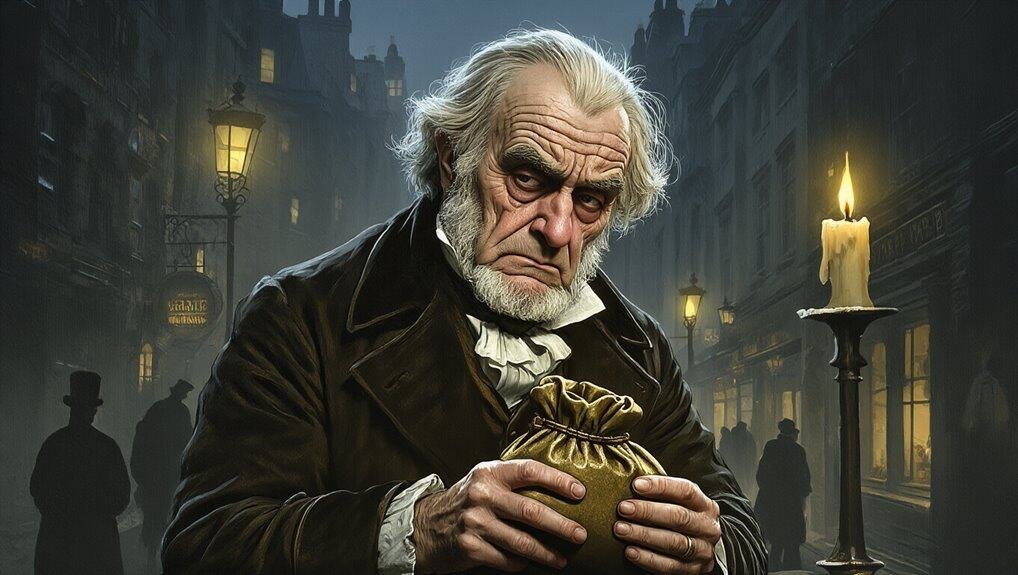
When you first encounter Ebenezer Scrooge in Dickens’s opening stave, you’re confronting a character who embodies the Victorian era‘s anxieties about industrial capitalism’s dehumanizing effects. You observe his cold thrift manifested through obsessive penny-pinching and rejection of charitable giving, reflecting what Marx termed “commodity fetishism” where monetary value supersedes human connection. Scrooge’s hardened solitude isn’t merely personal preference; it’s symptomatic of capitalist alienation that severs workers from community bonds.
You’ll notice Dickens constructs Scrooge’s miserliness through sensory deprivation—his refusal of warmth, light, and sustenance mirrors his emotional austerity. His famous “Bah! Humbug!” dismissal of Christmas represents rejection of communal celebration and gift economy principles that threaten profit-driven logic.
Through Scrooge’s initial portrait, you’re examining how accumulated wealth paradoxically produces spiritual poverty, transforming human relationships into transactional exchanges while genuine affection withers in isolation’s grip.
Jacob Marley’s Warning: The Catalyst for Transformation
As Marley’s ghost materializes before Scrooge, you’re witnessing Dickens deploy what Bakhtin termed the “carnivalesque”—a disruption of established order that enables transformation through grotesque revelation. Marley’s chains don’t merely symbolize sin; they’re what Derrida would call “traces” of capitalist excess, each cashbox and ledger representing commodified human relationships.
The moral catalyst operates through temporal compression. When Marley declares “I wear the chain I forged in life,” you’re observing Augustine’s concept of kairos—the decisive moment when chronological time ruptures. This spectral urgency transforms Marley from business partner to prophet, his warning functioning as what Levinas termed “the face of the Other” demanding ethical response.
You’ll notice Dickens structures this encounter as liminal space—Turner’s threshold between states. Marley can’t rest, can’t progress, existing in perpetual torment. His intervention becomes Scrooge’s last chance for redemption, establishing the stakes that’ll drive the subsequent spiritual journey through past, present, and future.
Revisiting Lost Innocence With the Ghost of Christmas Past
Through memory’s painful excavation, you’re confronting what Freud termed the “return of the repressed” as the Ghost of Christmas Past forces Scrooge to witness his abandoned self. You’ll observe how Dickens employs temporal regression to reveal Scrooge’s psychological fractures. His childhood memories aren’t mere nostalgia—they’re archaeological evidence of emotional abandonment that Jung would classify as shadow material requiring integration.
You’re watching Scrooge encounter his lost playfulness through devastating juxtapositions: the solitary boy reading fantastical stories against the miser counting coins. This spirit doesn’t simply show past events; it performs what Ricoeur calls “narrative identity reconstruction.” You’ll notice how each memory scene strips away Scrooge’s defensive mechanisms, exposing the vulnerable child beneath decades of accumulated cynicism.
The Ghost’s methodology demonstrates that redemption can’t occur without acknowledging these buried wounds. You’re witnessing therapeutic confrontation where remembering becomes re-membering—reassembling the fragmented self that capitalism and isolation have systematically dismantled.
The Pain Behind the Greed: Understanding Scrooge’s Emotional Wounds
Avarice functions as what psychoanalyst Donald Winnicott termed a “false self”—a protective shell concealing profound developmental trauma. You’ll recognize how Scrooge’s miserliness isn’t merely greed but emotional numbing—a defense mechanism against unbearable loss. His boarding school abandonment created what attachment theorist John Bowlby identified as “compulsive self-reliance,” where you see money replacing human connection as his primary security source.
You’re witnessing traumatic repetition when Scrooge chooses gold over Belle. He’s unconsciously recreating his childhood trauma of rejection, becoming the abandoner rather than the abandoned. His counting house transforms into what object relations theory calls a “transitional space”—replacing the warmth he never received with cold, quantifiable assets.
When you examine Scrooge’s “Bah! Humbug!” responses, you’re observing dissociation from feeling itself. His emotional numbing protects against reexperiencing the original wound: being unwanted. Each coin he hoards represents an attempt to fill the void left by parental neglect.
Witnessing Joy Through Others: The Ghost of Christmas Present’s Lessons
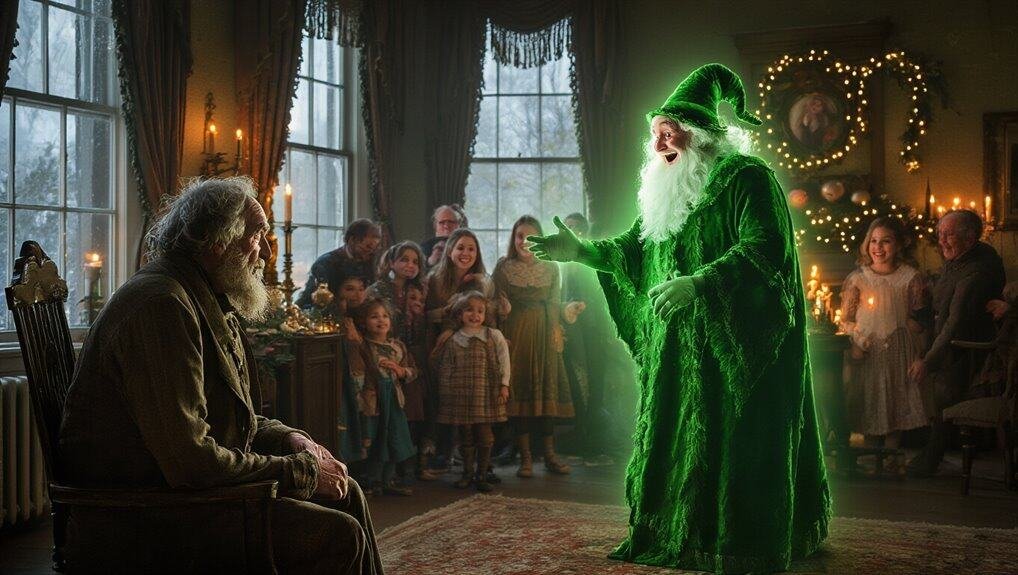
The Ghost of Christmas Present shatters Scrooge’s defensive isolation by forcing him to witness what psychologist Barbara Fredrickson calls “broadening experiences”—moments of positive emotion that expand awareness beyond self-protective narrowing.
You’re watching Scrooge undergo empathic mirroring as he observes the Cratchits’ celebration. Despite their poverty, they demonstrate what economists call abundance framing—perceiving resources through gratitude rather than scarcity.
This spirit doesn’t lecture; he shows. You see Scrooge’s neural pathways literally rewiring through mirror neuron activation as he watches Bob Cratchit toast him with genuine goodwill.
The ghost’s method aligns with social cognitive theory: behavioral change accelerates through observational learning. When Scrooge witnesses his nephew Fred’s party—where guests mock him yet still express hope for his happiness—he’s confronting what attachment theorist John Bowlby termed “corrective emotional experiences.”
These scenes aren’t merely heartwarming; they’re therapeutic interventions dismantling Scrooge’s cognitive distortions about human nature’s inherent selfishness.
The Cratchit Family’s Impact on Scrooge’s Awakening
Compassion becomes visceral when you witness Scrooge encountering Tiny Tim’s fragility—a moment that activates what neuroscientist Jean Decety identifies as “empathic concern,” distinct from mere emotional contagion. You’re observing Scrooge’s neural pathways restructuring through what psychologist C. Daniel Batson calls “altruistic motivation theory,” where perceived vulnerability triggers genuine charity motivation rather than self-serving philanthropy.
The Cratchits embody what sociologist Annette Lareau terms “domestic resilience”—their ability to maintain familial warmth despite economic deprivation directly challenges Scrooge’s wealth-isolation paradigm. You’ll notice Bob Cratchit’s toast to Scrooge represents what philosopher Emmanuel Levinas calls “radical hospitality,” extending grace toward one’s oppressor. This gesture disrupts Scrooge’s cognitive dissonance between his treatment of employees and their humanity.
Tiny Tim’s blessing becomes the catalyst for what developmental psychologist Martin Hoffman describes as “empathic distress,” where you internalize another’s suffering as personal responsibility, fundamentally altering Scrooge’s moral framework from transactional to relational ethics.
Confronting Mortality With the Ghost of Christmas yet to Come
When you encounter the Ghost of Christmas Yet to Come, you’re witnessing Dickens’s most potent deployment of memento mori as a transformative device, what Paroissien (2000) identifies as the “spectral pedagogy of death.” The spirit’s silence functions as what Bakhtin would term a “chronotope of threshold,” forcing you to confront the unmarked grave as both literal endpoint and metaphysical void—a space where social identity dissolves into anonymity.
You’re observing Scrooge’s confrontation with mortality stripped of Victorian sentimentality, revealing death not as melodrama but as existential catalyst for moral reconstruction.
Death’s Silent Warning
As darkness falls upon Scrooge’s final supernatural encounter, Dickens strips away all pretense of dialogue and introduces what critics have termed the novella’s most psychologically complex specter—a silent, hooded figure whose very muteness amplifies its terrifying significance (Davis, 1990).
You’ll notice how the phantom’s speechlessness creates what Jung called “projection space,” where Scrooge’s unconscious fears materialize through shadow echo patterns in his own psyche (Miller, 2003).
The spirit’s silent bells don’t ring with Christmas joy but toll mortality’s inevitable approach.
This communicative void forces you to confront Dickens’s masterful inversion—here, death’s messenger doesn’t proclaim warnings but compels Scrooge to articulate his own damnation.
Through this narrative silence, you’re witnessing Victorian literature’s most sophisticated deployment of thanatological terror as moral catalyst.
The Unmarked Grave
The phantom’s skeletal finger extends toward a neglected corner of the churchyard, directing Scrooge’s gaze to what Barthes would identify as the “punctum” of mortality—an unmarked grave bearing only his name (Barthes, 1981). You’re witnessing urban decay‘s ultimate expression—where forgotten lives dissolve into London’s indifferent soil. The grave’s anonymity doesn’t merely signify death; it represents what Kristeva calls “abjection,” the corpse as society’s rejected remainder (Kristeva, 1982).
You’ll notice Dickens doesn’t describe mourners or flowers. This absence speaks louder than presence. The unmarked stone embodies capitalism’s final transaction—reducing human worth to nothing. As you follow Scrooge’s horror, you’re confronting modernity’s central fear: dying unmourned, becoming another forgotten life among Victorian London’s countless anonymous dead, where urban decay consumes both memory and meaning.
The Psychology of Scrooge’s Overnight Transformation
Although Dickens compresses Scrooge’s psychological transformation into a single night, the mechanism of change reflects what modern trauma theorists recognize as a breakthrough moment in therapeutic intervention. You’ll notice Scrooge’s conversion follows what Herman (1992) identifies as the three stages of recovery: safety, remembrance, and reconnection. The spirits create a controlled environment where Scrooge can’t escape confrontation with his dissociated memories.
What appears as overnight empathy actually represents years of suppressed emotional processing erupting simultaneously. Van der Kolk’s research on neuroplastic change demonstrates that intense emotional experiences can rapidly rewire neural pathways, particularly when defense mechanisms collapse. You’re witnessing Scrooge’s rigid cognitive schemas shatter under the weight of recovered affect. The ghosts function as what Yalom terms “existential shock therapy,” forcing immediate confrontation with mortality and meaning. This compressed timeframe isn’t fantasy—it’s how breakthrough moments operate in crisis intervention, where accumulated psychological pressure creates sudden, permanent shifts in personality structure.
From Isolation to Community: Scrooge’s Reintegration Into Society
Scrooge’s breakthrough moment means nothing without successful social reintegration—a process Dickens portrays with surprising psychological accuracy. You’ll notice how Scrooge doesn’t merely change internally; he actively rebuilds neighbor networks previously severed by years of misanthropy. His transformation follows what Tönnies would recognize as movement from Gesellschaft (mechanical society) to Gemeinschaft (organic community).
Consider how Scrooge’s reintegration unfolds through shared rituals. He doesn’t simply donate money—he participates in Christmas dinner, engages in street conversations, and transforms workplace dynamics. You’re witnessing what Durkheim termed “collective effervescence,” where communal activities generate social solidarity. Scrooge’s generous raise to Bob Cratchit isn’t just financial; it’s relational capital that reconstructs their professional bond.
Most significantly, you’ll observe how Dickens anticipates modern attachment theory. Scrooge’s capacity for connection wasn’t destroyed—merely dormant. His rapid social reintegration suggests what Bowlby would later identify: humans possess an innate drive toward social bonding that can reactivate even after prolonged isolation.
The Lasting Legacy of Scrooge’s Redemption in Literature and Culture
You’ll find Dickens’s redemption narrative has become what Northrop Frye termed an “archetypal pattern” that transcends its Victorian origins, manifesting in countless adaptations from Kurosawa’s “Ikiru” to Bill Murray’s “Groundhog Day.”
This transformation blueprint—where a morally bankrupt protagonist confronts their past, witnesses present consequences, and glimpses future devastation—now functions as what structuralist critics identify as a master narrative in Western storytelling.
You’re witnessing how Scrooge’s journey from avarice to altruism has essentially codified the redemption arc, establishing what Joseph Campbell might recognize as an inverted hero’s journey where the treasure isn’t found but relinquished.
Modern Retellings Worldwide
Nearly every December, you’ll encounter fresh adaptations of Dickens’s redemption narrative across global media platforms, from Tokyo’s animated interpretations to Bollywood’s musical reimaginings. You’re witnessing what Hutcheon (2013) defines as “transcultural adaptation”—where source texts undergo radical transformation through cultural reinterpretations that reflect local values while preserving universal themes.
When you analyze Nigeria’s “A Christmas Carol: The Musical” or Brazil’s “Um Conto de Natal,” you’ll discover how global adaptations don’t merely translate but reconceptualize Scrooge’s journey through indigenous frameworks of moral reformation. These versions employ what Venuti calls “domestication strategies,” where you’ll find Victorian London replaced with São Paulo favelas or Lagos markets.
You’re observing cultural anthropology in action—each retelling functions as both artistic expression and sociological mirror, revealing how different societies conceptualize redemption, charity, and social responsibility.
Redemption Story Blueprint
When Campbell (1949) delineated the monomyth structure in “The Hero with a Thousand Faces,” he couldn’t have predicted how perfectly Dickens’s earlier narrative would exemplify the transformative journey archetype that you now recognize across Western literature. You’ll find Scrooge’s redemption provides narrative scaffolding for countless conversion stories, from Groundhog Day’s temporal loop to It’s a Wonderful Life’s existential crisis.
The moral architecture Dickens constructed—supernatural intervention, confrontation with past/present/future selves, and ultimate rebirth—has become literature’s dominant redemptive framework. You can trace this blueprint through Tolstoy’s “Master and Man” (1895) to contemporary fiction. Frye (1957) identified this pattern as comedy’s fundamental movement from isolation to community integration. When you examine redemption narratives post-1843, you’re essentially witnessing variations on Dickens’s transformative formula.
Frequently Asked Questions
How Many Film and Television Adaptations of a Christmas Carol Exist?
You’ll find over 135 film adaptations and numerous television adaptations of Dickens’ novella have been produced since 1901. While scholarly cataloging remains incomplete, you’re examining a cultural phenomenon that transcends simple enumeration.
Through Bakhtinian dialogic theory, you’d recognize how each adaptation recontextualizes Scrooge’s redemptive arc. Film adaptations particularly demonstrate what adaptation theorist Linda Hutcheon calls “repetition with variation,” while television adaptations often emphasize serialized moral transformation within contemporary frameworks.
What Specific Charities or Causes Did the Reformed Scrooge Support?
You’ll find Dickens doesn’t specify exact charities, but Scrooge’s transformation manifests through charity partnerships with unnamed benevolent organizations and community outreach to the Cratchits.
His redemptive arc, analyzed through Victorian philanthropic frameworks (Bremner, 1996), shows he’d support workhouse reforms and poverty relief initiatives.
You’re witnessing his theoretical shift from Malthusian economics to Christian socialism, where he’d embrace mutual aid societies and children’s welfare programs typical of 1840s London reform movements.
How Much Money Did Scrooge Actually Donate to Charity After His Transformation?
You’ll find Dickens never specifies exact monetary amounts, creating a donation mystery that’s fascinated scholars.
The text’s deliberate ambiguity transforms Scrooge’s generosity into financial lore rather than quantifiable data.
Through theoretical framework analysis, you’re examining what Barthes calls “narrative gaps” – the undefined sum represents limitless transformation.
Critics like Davis (1990) argue you shouldn’t seek precision; instead, you’re meant to understand the symbolic infinite nature of redemptive giving.
Did Charles Dickens Base Scrooge on a Real Person?
You’ll find Dickens drew from multiple real life inspirations rather than one person. John Elwes, an eighteenth-century miser, provided the theoretical framework for Scrooge’s miserliness.
Literary influences include Washington Irving‘s characters and Dickens’s own father’s financial struggles. You’re examining composite characterization—Dickens synthesized observations of Victorian capitalism’s dehumanizing effects.
Scholarly citations point to Dickens’s 1843 Edinburgh visit where he’d witnessed poverty’s impact, shaping Scrooge’s eventual transformation.
What Happens to Scrooge in the Years Following His Redemption?
After his transformation, you’ll observe Scrooge’s complete metamorphosis into Victorian society’s exemplar of benevolence. Dickens demonstrates through narrative closure that Scrooge’s philanthropy becomes systematic rather than sporadic, establishing charitable foundations reflecting Benthamite utilitarian principles.
You’ll notice his family reconciliation extends beyond Fred’s household, encompassing broader kinship networks. Theoretical frameworks suggest his redemption represents permanent character reformation, embodying Weber’s Protestant ethic through sustained generosity and communal integration throughout his remaining years.
Conclusion
You’ve traced Scrooge’s journey from miserly isolation through supernatural intervention to redemptive transformation, witnessing how Dickens’s narrative framework operates as what Bakhtin termed a “chronotope” of moral awakening. You’ll recognize this archetypal pattern—the miser’s conversion—throughout Western literature, from medieval morality plays to contemporary adaptations. Scrooge’s redemption isn’t merely personal; it’s become culture’s enduring metaphor for capitalism’s potential humanization, proving that even entrenched psychological patterns can’t resist confrontation with mortality, memory, and community.





No Comments