

30 Nov 9 Best Online Piano Courses for Adults That Actually Work
You’ll find the most effective online piano courses combine real-time audio recognition technology with structured pedagogical frameworks—Simply Piano’s acoustic fingerprinting detects mistakes in milliseconds, while Piano Marvel‘s conservatory-level curriculum builds sight-reading through 2,400+ progressive exercises. Pianote offers live masterclasses with professional coaching, Playground Sessions gamifies learning with celebrity instructors, and Flowkey provides 1,500+ songs with tempo control. Each platform’s distinct approach—from Skoove’s AI-powered feedback to Piano With Jonny’s jazz specialization—addresses specific learning objectives you’re targeting.
Table of Contents
Key Takeaways
- Pianote offers live weekly masterclasses with one-on-one coach access and modular curriculum specifically designed for adult cognitive patterns and learning styles.
- Simply Piano uses real-time audio recognition technology that provides instant feedback on mistakes, adapting difficulty levels based on individual skill progression.
- Piano With Jonny specializes in jazz, blues, and pop styles with practical, gig-ready skills rather than purely theoretical knowledge.
- Playground Sessions gamifies learning with celebrity instructors like Quincy Jones, using points and achievements to maintain adult learner engagement.
- Flowkey provides 1,500+ professionally arranged pieces across all genres with tempo control and split-hand practice features for flexible adult schedules.
Playground Sessions: Celebrity Teachers Meet Gamified Learning for Maximum Engagement
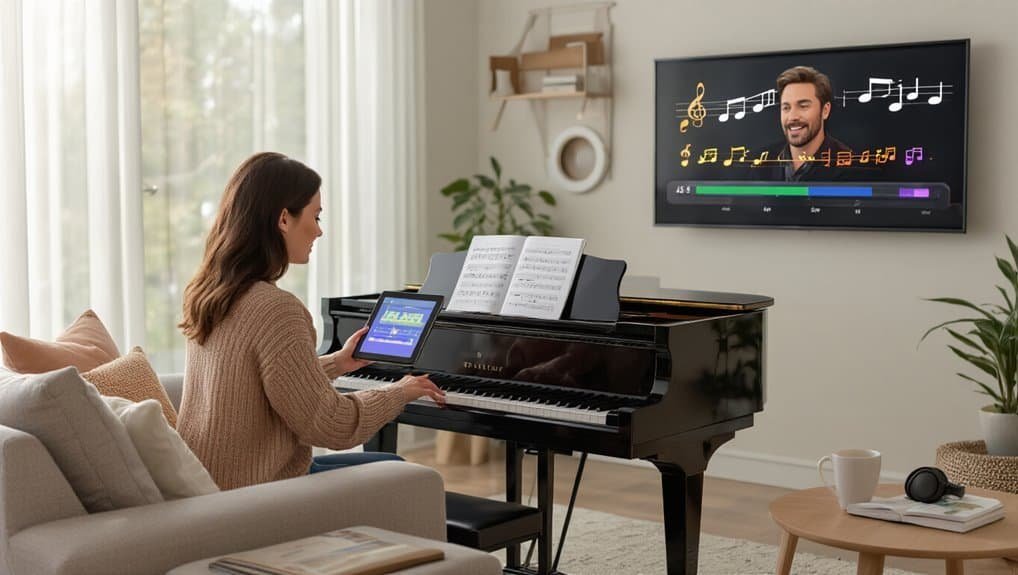
You’ll immediately notice Playground Sessions distinguishes itself through its unique fusion of celebrity instruction and game-based learning mechanics.
The platform’s celebrity influence extends beyond marketing appeal—instructors like Quincy Jones, Harry Connick Jr., and David Sides deliver masterclasses that break down complex techniques into digestible segments. You’re not just watching; you’re actively participating through real-time feedback systems that track your accuracy and timing.
The gamification mechanics transform traditional practice into achievement-driven sessions.
You’ll earn points for hitting correct notes, unlock new songs after completing challenges, and progress through structured levels that adapt to your skill development. The software’s note recognition technology provides instant visual feedback, displaying your performance metrics on-screen while you play. This immediate reinforcement loop accelerates muscle memory development and maintains engagement levels typically lost in conventional practice routines. You’re essentially experiencing the dopamine rewards of gaming while building legitimate piano proficiency.
Simply Piano: The App That Listens While You Play and Corrects Your Mistakes in Real Time
Simply Piano’s acoustic fingerprinting technology captures your playing through your device’s microphone and analyzes each note against the sheet music in milliseconds, identifying wrong notes, timing errors, and missed keys before you’ve finished the phrase.
When you hit an incorrect note, the app’s neural network processor highlights the mistake on your screen while the adaptive algorithm adjusts upcoming exercises to target your specific weakness patterns.
You’ll experience immediate correction loops that mirror a human teacher’s intervention—the software won’t advance until you’ve played the passage correctly, ensuring muscle memory develops around accurate technique rather than repeated errors.
Real-Time Audio Recognition
When you’re practicing piano without an instructor present, immediate feedback becomes crucial for developing proper technique and avoiding the formation of bad habits. Simply Piano’s real-time audio recognition technology analyzes your playing through your device’s microphone, detecting pitch accuracy, timing precision, and note duration instantly.
The system employs advanced model compression techniques, allowing the AI to process complex musical patterns directly on your device without latency issues.
You’ll appreciate that all audio processing happens locally, ensuring complete data privacy—your practice sessions never leave your device.
The recognition engine identifies specific errors, distinguishing between wrong notes, early releases, and rhythmic inconsistencies. It’s calibrated to filter ambient noise while maintaining sensitivity to subtle dynamic variations, providing professional-grade feedback that adapts to your skill level and playing style.
Instant Mistake Detection
As your fingers strike the keys, Simply Piano’s instant mistake detection system processes each note within milliseconds, comparing your performance against the sheet music’s expected pitch, timing, and duration parameters. The algorithm’s latency management ensures you’ll receive feedback before completing the next measure, maintaining your practice flow without disruptive delays.
You’ll notice the app highlights errors through color-coded indicators while filtering out false positives that could interrupt legitimate stylistic variations or pedal resonances. The detection threshold adapts to your skill level, becoming more precise as you advance through lessons.
When you play incorrect notes, the system immediately marks them red and pauses if you’re struggling with a particular passage. This real-time correction accelerates muscle memory development by preventing you from reinforcing mistakes through repetition.
Adaptive Learning Technology
Building on this mistake detection foundation, the adaptive learning technology analyzes your performance patterns across multiple practice sessions to calibrate lesson difficulty and pacing specifically for your progression rate.
The system’s algorithmic feedback engine processes thousands of data points from your playing—timing accuracy, note precision, rhythm consistency—to create your unique learner profile.
You’ll experience personalized progression as the software automatically adjusts exercise complexity based on your mastery levels.
When you consistently nail C major scales, it’ll introduce G major.
Struggle with syncopated rhythms? You’ll receive additional practice patterns before advancing.
This machine learning approach eliminates the one-size-fits-all methodology that frustrates adult learners.
The technology doesn’t just track what you’re playing wrong—it understands why you’re making specific errors and restructures your learning path accordingly.
Flowkey: Stream Your Favorite Songs and Learn Them at Your Own Pace
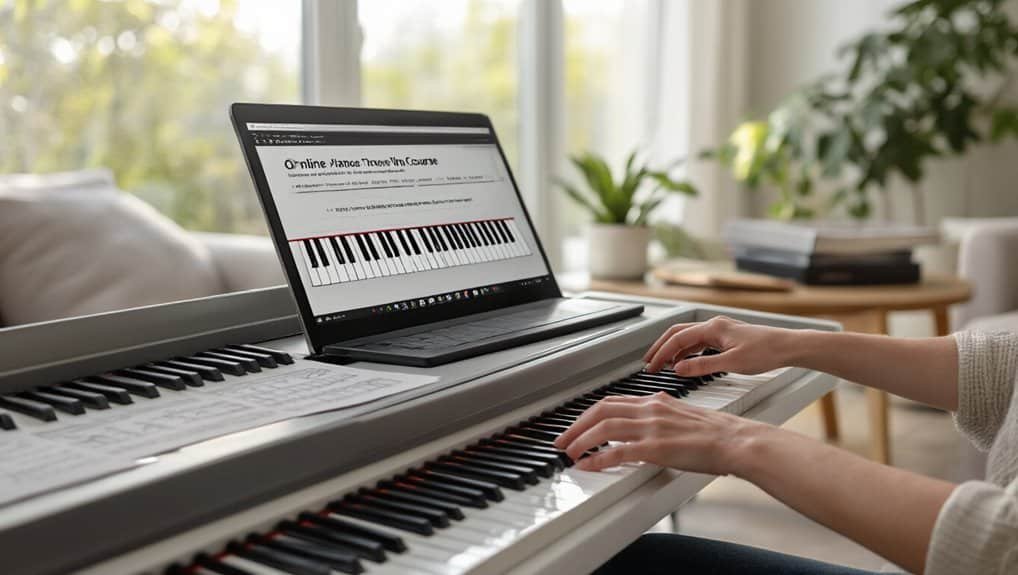
Have you ever wanted to master that catchy pop melody or classical piece you’ve been streaming on repeat? Flowkey transforms your streaming habits into structured piano practice through its extensive song library spanning classical, pop, jazz, and film music.
You’ll access over 1,500 professionally arranged pieces adapted for various skill levels.
The platform’s acoustic recognition technology listens to your playing through your device’s microphone, providing real-time feedback on accuracy and timing. You’re controlling the tempo completely—the app waits for correct notes before advancing, eliminating the pressure of keeping up with rigid metronomes.
Flexible scheduling becomes effortless since you’re not locked into predetermined lesson times. You’ll practice whenever inspiration strikes, whether that’s during lunch breaks or late-night sessions.
The loop function lets you isolate challenging passages, while the split-hand practice mode develops coordination systematically. Sheet music displays alongside falling note visualizations, bridging traditional notation reading with modern learning interfaces.
Skoove: Interactive Lessons With Instant Feedback for Self-Directed Learners
Why struggle through self-teaching when Skoove’s AI-powered listening technology can guide your progress with precision? You’ll receive real-time feedback as the platform’s acoustic recognition system analyzes your playing, identifying missed notes, timing errors, and rhythm inconsistencies.
This immediate correction loop accelerates skill acquisition while preventing the formation of detrimental habits.
Skoove’s curriculum integrates ear training exercises directly into performance practice. You’re not just memorizing finger positions—you’re developing pitch recognition and harmonic awareness simultaneously.
The platform’s structured approach combines classical technique with contemporary repertoire, ensuring technical proficiency across genres.
You’ll connect with Skoove’s user community through progress tracking and achievement sharing features. The platform’s pedagogical framework adapts to your learning velocity, adjusting difficulty parameters based on performance metrics.
With over 400 lessons spanning beginner to advanced levels, you’re accessing a comprehensive musical education that rivals traditional instruction methods while maintaining the flexibility self-directed learners require.
Piano Marvel: The Academic Approach That Fast-Tracks Music Theory and Sight-Reading
When traditional methods prioritize performance over foundational literacy, Piano Marvel’s methodology reverses this paradigm through systematic music theory integration.
Piano Marvel revolutionizes piano education by establishing music theory foundations before performance, reversing traditional pedagogical approaches.
You’ll encounter a curriculum that mirrors conservatory-level instruction, where sight reading becomes second nature through progressive interval training and rhythmic pattern recognition.
The platform’s assessment engine tracks your accuracy across 2,400+ exercises, adjusting difficulty algorithms based on your error patterns.
You’re not just playing notes—you’re internalizing musical grammar through chord progression analysis and harmonic function identification.
Piano Marvel’s exam preparation modules align with ABRSM and RCM standards, ensuring you’ll develop testable competencies alongside practical skills.
The instant scoring system evaluates pitch accuracy, rhythm precision, and articulation clarity within milliseconds.
What distinguishes this platform is its emphasis on music literacy before repertoire.
You’ll build sight-reading fluency through structured exercises that isolate specific challenges—syncopation, key signatures, dynamic markings—before combining them in performance contexts.
Pianote: Live Classes and Personal Coaching From Professional Musicians
You’ll access Pianote’s core strength through its live weekly masterclasses, where professional musicians demonstrate advanced techniques and answer your questions in real-time.
The platform’s one-on-one coach access provides personalized feedback on your playing, while the structured learning path ensures you’re developing fundamental skills alongside repertoire.
This combination of scheduled live instruction and on-demand coaching creates a hybrid learning environment that mirrors traditional conservatory training with the flexibility of online education.
Live Weekly Masterclasses
Pianote consistently delivers live weekly masterclasses that connect you directly with accomplished pianists and educators who understand adult learning patterns.
These sessions tackle advanced techniques, music theory applications, and repertoire interpretation while addressing performance psychology challenges specific to adult learners.
You’ll explore jazz voicing, classical phrasing, and contemporary chord progressions through real-time demonstrations and structured practice segments.
Each masterclass incorporates community feedback, allowing you to submit questions and receive personalized guidance on technical obstacles.
The instructors break down complex concepts into manageable components, demonstrating fingering solutions, pedaling techniques, and rhythm patterns at multiple tempos.
You’ll gain insights into practice efficiency, memorization strategies, and stage presence development. The interactive format ensures you’re not just watching but actively participating in your musical growth through targeted exercises and peer discussion.
One-on-One Coach Access
Beyond the collaborative environment of masterclasses, Pianote’s one-on-one coaching platform pairs you with professional musicians who customize instruction to your specific technical challenges and musical goals.
You’ll receive targeted feedback on fingering techniques, pedaling precision, and rhythmic accuracy that generic tutorials can’t provide.
The platform’s scheduling flexibility lets you book 30-minute sessions across multiple time zones, accommodating your work commitments while maintaining consistent practice momentum.
You’re connecting with conservatory-trained instructors who understand adult learning patterns and adjust pedagogical approaches accordingly.
Pianote’s pricing transparency eliminates surprise fees—you’ll see exact coaching rates upfront, with packages starting at $89 monthly for two sessions.
Your coach tracks progress through recorded submissions, providing timestamped annotations on your performances and creating personalized practice routines that address specific weaknesses in your technique.
Learning Path Structure
How does Pianote organize its curriculum to maximize adult learning retention?
You’ll progress through a modular curriculum designed specifically for adult cognitive patterns.
Each module builds upon previous competency milestones, ensuring you’ve mastered foundational skills before advancing to complex techniques.
Your learning path adapts to your pace.
You’re not locked into rigid timelines—instead, you’ll complete skill assessments that verify readiness for subsequent modules.
The structure integrates sight-reading, technique, and repertoire simultaneously rather than treating them as isolated subjects.
This parallel approach mirrors how professional musicians actually develop their craft.
You’ll encounter checkpoints every four weeks that measure technical proficiency and musical interpretation.
These competency milestones aren’t arbitrary—they’re calibrated to industry standards that working pianists meet.
Your coach reviews these assessments, adjusting your path when needed.
Hoffman Academy: Family-Friendly Method That Works Brilliantly for Adult Beginners
While Hoffman Academy originally designed its curriculum for children, you’ll discover its methodical approach creates an exceptionally clear learning path for adult beginners who want comprehensive music education without overwhelming complexity.
The platform’s gentle progression builds technical skills through bite-sized video lessons that introduce concepts systematically—you’ll master proper hand position before tackling scales, ensuring foundational technique remains solid throughout your journey.
What distinguishes Hoffman’s pedagogy is its integration of music theory with practical application.
You’re not just memorizing finger patterns; you’re understanding why specific chord progressions work while developing sight-reading capabilities simultaneously.
The structured practice routines incorporate rhythm exercises, ear training, and improvisation elements that transform mechanical repetition into musical expression.
Adult learners particularly benefit from Mr. Hoffman’s patient teaching style and the platform’s self-paced format.
You’ll access supplementary PDFs, play-along tracks, and activity pages that reinforce each lesson’s objectives without infantilizing the learning experience.
Piano With Jonny: Jazz, Blues, and Pop Specialization for Genre-Specific Learning
Where traditional classical methods often leave aspiring jazz and blues pianists struggling to translate formal training into contemporary styles, Piano With Jonny bridges this gap through specialized curriculum that deconstructs genre-specific techniques into learnable frameworks.
You’ll master essential comping techniques through structured progressions that break down complex chord voicings into manageable components, ensuring you’re building authentic jazz vocabulary rather than approximating it.
The platform’s strength lies in its methodical approach to stylistic nuance—you’re not just learning generic blues scales but understanding why specific note choices define Chicago versus Texas blues.
Each course module isolates critical elements like swing feel, syncopation patterns, and characteristic progressions, then systematically combines them into professional-sounding performances.
You’ll progress from basic seventh chords to sophisticated rootless voicings, with clear benchmarks marking your advancement through intermediate to advanced territory.
The result isn’t theoretical knowledge but practical, gig-ready skills.
Artistworks: One-On-One Video Exchange Lessons With World-Class Pianists
When you’re serious about mastering piano technique but can’t access in-person instruction from elite performers, Artistworks revolutionizes remote learning through its proprietary Video Exchange platform that connects you directly with Grammy-winning artists and conservatory professors.
You’ll submit video recordings of your playing and receive detailed, personalized feedback from instructors like Christie Peery and George Whitty.
The critique turnaround typically takes 3-5 days, ensuring you maintain practice momentum while awaiting professional guidance. Each instructor’s repertoire curation spans classical foundations through contemporary styles, with structured pathways adapting to your skill level.
The platform’s asynchronous format lets you practice on your schedule while building a video library documenting your technical evolution.
You’re not just watching pre-recorded content—you’re engaging in authentic mentor-student dialogue that addresses your specific fingering challenges, interpretive choices, and performance anxiety.
This targeted feedback loop accelerates skill development beyond traditional online courses, making Artistworks invaluable for adults pursuing professional-level proficiency.
Frequently Asked Questions
How Much Practice Time Should I Dedicate Daily as an Adult Beginner?
You’ll need 20-30 minutes daily as an adult beginner, structured strategically for optimal neural pathway development.
Start with 5-minute warm up routines targeting finger independence and scales.
Follow with 15-20 minute focused sessions on sight-reading, technique, or repertoire—never all three simultaneously.
Your adult brain requires concentrated, deliberate practice rather than lengthy unfocused repetition.
Consistency trumps duration; daily 20-minute sessions outperform sporadic hour-long practices for skill retention and motor memory formation.
Can I Learn Piano Online Without Any Prior Musical Experience?
Yes, you can absolutely learn piano online without prior musical experience. Today’s structured courses teach foundational theory progressively, starting with note reading and rhythm basics.
You’ll master hand positioning, scales, and chord progressions through guided video lessons. Effective platforms incorporate motivation strategies like gamification, achievement tracking, and repertoire selection tailored to adult interests.
Choose courses offering systematic curriculum design, clear demonstrations, and feedback mechanisms to ensure proper technique development from day one.
Do I Need a Full 88-Key Piano or Will a Keyboard Suffice?
You’ll succeed with a 61-key keyboard initially, but you’ll need 88 weighted keys within six months for proper technique development.
Weighted keys replicate acoustic piano resistance, training your fingers’ muscle memory correctly. Don’t compromise on the sustain pedal—it’s essential from day one for phrasing and expression. Budget keyboards without these features will limit your progress and force relearning proper touch sensitivity later, ultimately costing more time and money.
How Long Before I Can Play My Favorite Songs Fluently?
You’ll typically achieve basic fluency with simple pop songs within 3-6 months, reaching fundamental technique milestones like chord progressions and steady rhythm.
Intermediate pieces require 1-2 years of consistent practice.
Song complexity determines timeline significantly—Beatles tunes come faster than Chopin études.
Your practice frequency, prior musical experience, and quality of instruction directly impact progression speed.
Most adult learners play recognizable versions of favorite songs confidently after 6-12 months of dedicated study.
What’s the Average Cost Comparison Between Online Courses and Traditional Lessons?
You’ll typically spend $15-40 monthly for online courses versus $30-100 per traditional lesson.
Payment flexibility lets you pause subscriptions or choose annual plans, while traditional lessons require weekly commitments.
Your long-term savings become substantial—online courses cost $180-480 yearly compared to $1,560-5,200 for weekly in-person instruction.
Quality online platforms offer comprehensive curricula matching traditional pedagogical standards, though you’ll sacrifice real-time feedback and personalized technique correction that private instructors provide.
Conclusion
You’ve explored nine proven platforms that’ll transform your piano journey in 2025. Whether you’re drawn to Playground Sessions‘ gamified approach, Simply Piano‘s real-time corrections, or Artistworks‘ personalized video exchanges, you’ll find a method that matches your learning style. Don’t overthink it—pick the platform that aligns with your musical goals and start practicing. Your technique will develop faster with structured guidance than fumbling through YouTube tutorials. Commit to consistent practice, and you’ll see measurable progress.











No Comments