


30 Nov How to Create the Perfect Christmas Songs Medley
You’ll create a seamless Christmas medley by mapping key signatures and identifying pivot chords between songs, maintaining tempo relationships within 10-15 BPM ranges, and crafting 8-16 bar transitions using shared progressions or chromatic voice leading. Balance 3-4 traditional carols with 2-3 contemporary favorites, building dynamic peaks two-thirds through your arrangement. Layer instrumentation progressively, use sleigh bells to mask modulations, and adjust density for your venue’s acoustics. Master these technical foundations to transform individual songs into one cohesive performance.
Key Takeaways
- Select 3-4 traditional carols for emotional depth and 2-3 contemporary favorites for energy peaks and audience connection
- Map song keys and use pivot chords or ii-V-I progressions to create seamless 8-16 bar transitions between pieces
- Match songs within 10-15 BPM ranges and use gradual tempo changes to maintain rhythmic flow throughout the medley
- Layer instrumental textures progressively and use ambient elements like sleigh bells during modulations to mask key changes
- Structure dynamics with your strongest moment two-thirds through, alternating full ensemble passages with intimate stripped-down arrangements
Selecting Songs That Complement Each Other Musically and Thematically

When you’re building a Christmas medley, you’ll need to analyze each song’s key signature, tempo, and harmonic progression to ensure smooth transitions between pieces.
Start by grouping songs in related keys—pieces in C major flow naturally into F major or G major. Match tempos within 10-15 BPM ranges to maintain rhythmic continuity without jarring shifts.
Consider thematic coherence through lyric imagery.
You can’t jump from “Silent Night’s” reverent nativity scene to “Jingle Bell Rock’s” party atmosphere without disrupting emotional flow. Instead, create narrative arcs that progress logically—sacred to secular, contemplative to celebratory.
Examine each song’s cultural origins to build authentic connections.
Pair traditional English carols with Victorian-era pieces, or link American standards from the same decade. This historical awareness strengthens your medley’s artistic integrity while respecting each composition’s heritage. You’re crafting a unified performance, not just stringing songs together.
Mapping Out Key Signatures and Tempo Relationships
You’ll need to chart each song’s original key and identify modulation points that create smooth harmonic progressions between pieces.
Map tempo relationships by calculating beats per minute for each selection, then design accelerandos or ritardandos that bridge contrasting speeds without jarring transitions.
Document these relationships in a visual flow chart that shows both key centers and tempo markings, giving you a technical roadmap for rehearsal and performance.
Compatible Key Analysis
Before arranging multiple Christmas songs into a cohesive medley, you’re tasked with analyzing the harmonic compatibility between each piece to ensure smooth transitions and maintain musical coherence throughout the performance.
You’ll need to identify songs sharing common tones or residing within closely related keys—such as relative majors and minors or keys one fifth apart.
Consider modal interchange opportunities where parallel keys can bridge seemingly incompatible songs. For instance, transitioning from “Silent Night” in C major to “God Rest Ye Merry Gentlemen” in D minor becomes seamless through a C major to C minor pivot.
You’ll find that dominant relationships create the strongest connections, while mediant relationships offer unexpected color. Chart each song’s tonic, dominant, and subdominant to reveal natural pivot points that’ll guide your arrangement decisions.
Tempo Flow Strategies
After establishing key relationships, you must map tempo progressions that maintain energy flow while accommodating each song’s inherent rhythmic character.
Start by documenting each song’s original BPM, then identify natural tempo bridges between pieces.
You’ll discover that gradual accelerandos or ritardandos between selections create smoother transitions than abrupt tempo changes.
Practice with metronome discipline ensures consistent pacing throughout your medley.
Set transition tempos at intermediate BPMs—if moving from “Silent Night” at 68 BPM to “Jingle Bells” at 120 BPM, establish a bridge passage at 94 BPM.
Apply micro rubato strategically within phrases to add expression without disrupting the overall temporal framework.
This controlled flexibility lets you emphasize emotional moments while maintaining structural integrity.
Chart these tempo relationships visually, marking acceleration and deceleration zones clearly for rehearsal efficiency.
Creating Smooth Transitions Between Different Christmas Songs
When you’re arranging a Christmas medley, the transitions between songs determine whether your performance flows seamlessly or feels disjointed. You’ll need to identify common elements between songs—shared chord progressions, melodic intervals, or rhythmic patterns that serve as natural bridges.
Match your reverb settings across tracks to maintain spatial consistency, ensuring each song occupies the same acoustic environment.
Consider using pivot chords that exist in both songs’ keys.
If you’re moving from “Silent Night” in C to “O Holy Night” in D, use the G chord as your transitional anchor.
Adjust your stereo imaging gradually during transitions, avoiding abrupt panning shifts that break immersion.
You can overlap melodic fragments, letting the ending phrase of one song become the opening motif of the next.
Time signature changes require careful attention—use ritardandos or accelerandos to guide listeners through metric shifts.
These technical decisions transform individual songs into one cohesive performance.
Balancing Traditional Carols With Modern Holiday Favorites
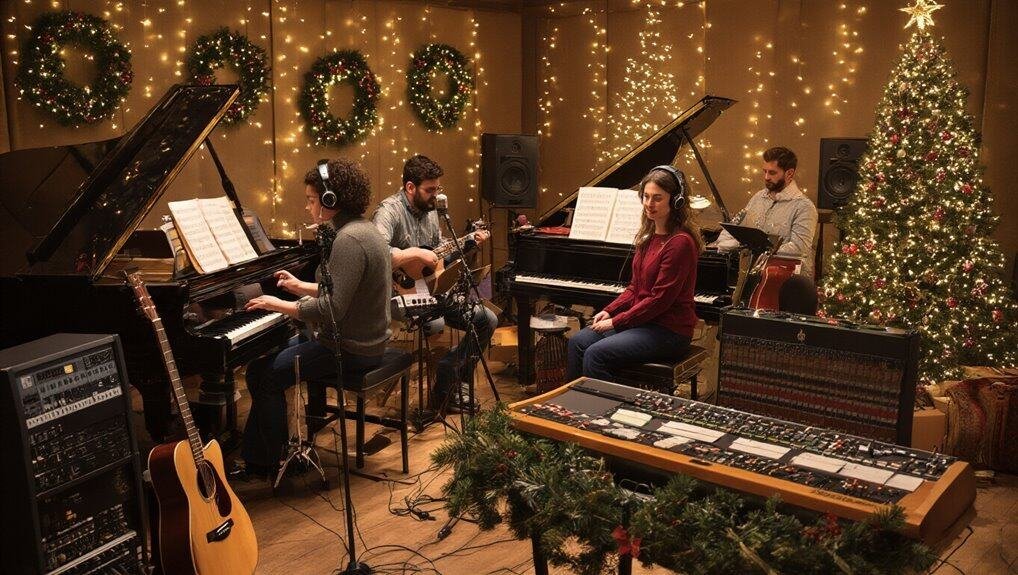
You’ll need to strategically balance timeless carols like “Silent Night” and “O Holy Night” with contemporary hits from artists like Mariah Carey and Michael Bublé to maintain audience engagement throughout your medley.
Select 3-4 traditional pieces that anchor your arrangement’s emotional depth, then integrate 2-3 modern favorites that provide energy peaks and familiar hooks your audience expects.
Apply modulation bridges, tempo mapping, and instrumental overlays to create cohesive transitions that respect both the reverence of classical carols and the dynamic drive of modern holiday tracks.
Classic Carol Selection
The foundation of any successful Christmas medley rests on strategic carol selection that bridges generational preferences while maintaining musical cohesion. You’ll need to evaluate each carol’s historical origins to understand its emotional weight and cultural significance. Consider how “Silent Night” originated in Austria while “God Rest Ye Merry Gentlemen” emerged from English tradition—these regional variations offer distinct melodic structures you can exploit for transitions.
Select carols that share compatible keys or contain modulation points for seamless connections. You’re aiming for three to four cornerstone carols that represent different eras: medieval, Victorian, and early twentieth century. Prioritize pieces with recognizable refrains that audiences can sing along to.
Balance contemplative carols like “O Holy Night” against jubilant selections such as “Joy to the World” to create dynamic contrast.
Contemporary Hit Integration
Modern holiday hits demand careful integration with traditional carols to maintain your medley’s structural integrity without alienating audience segments.
You’ll need to evaluate licensing considerations for contemporary tracks like Mariah Carey’s “All I Want for Christmas” or Wham’s “Last Christmas” before including them in public performances.
Match production aesthetics by analyzing tempo relationships, key signatures, and dynamic ranges between old and new selections.
Bridge disparate styles through transitional arrangements that respect both genres’ characteristics.
Consider using contemporary songs as bookends while placing traditional carols centrally, or alternate between styles using modulations and tempo shifts.
You can’t simply juxtapose “Silent Night” with “Rockin’ Around the Christmas Tree” without careful harmonic planning.
Balance vocal arrangements to accommodate both the reverent nature of carols and the energetic drive of modern hits.
Seamless Transition Techniques
When you’re crafting transitions between traditional carols and modern favorites, pivot tones serve as your primary architectural tool for maintaining musical coherence across stylistic boundaries.
You’ll identify common notes between ending and beginning phrases, then sustain these pitches while shifting harmonic context underneath.
Execute tempo modifications through graduated accelerandos or ritardandos across four-bar bridges.
You’re synchronizing lighting cues with these tempo shifts—dimming during deceleration phases and brightening for uptempo entries.
Deploy sound effects strategically: sleigh bells mask key changes, while wind chimes provide textural coverage during modulations.
Build transitional passages using shared chord progressions.
You’ll discover that many carols contain ii-V-I movements compatible with contemporary arrangements.
Layer percussion gradually when moving from acoustic to produced sections, maintaining pulse continuity while transforming sonic character.
Arranging Your Medley for Different Performance Settings
Because your performance venue directly impacts every musical decision, you’ll need to tailor your Christmas medley’s arrangement to match specific acoustic environments and audience configurations.
Small church settings require intimate voicings and reduced instrumentation, while outdoor venues demand amplified arrangements with doubled melody lines for projection.
You’ll adapt dynamics based on natural reverb—concert halls need controlled volume swells, whereas gymnasiums require consistent forte passages to overcome dead acoustics.
Consider staging logistics when scoring instrumental breaks.
Position soloists downstage center for living room concerts, but spread them across risers for auditorium performances.
You’re managing sight lines differently: cabaret-style seating allows subtle choreography, while proscenium stages need bold gestures readable from the balcony.
Acoustic adaptation determines your orchestration density.
Strip arrangements to piano-vocal for coffeehouse gigs, but layer strings and brass for symphony hall presentations.
You’ll modify tempo relationships too—slower transitions work in reverberant cathedrals, while dry rooms need quicker cuts between songs.
Building Dynamic Contrast and Emotional Flow Throughout
While your medley’s song selection provides raw material, you’ll craft emotional impact through strategic dynamic mapping that creates peaks and valleys across the entire performance arc.
Start by marking crescendos and diminuendos between sections, using vocal intensity shifts to highlight contrasting moods.
You’ll build tension through gradual volume increases before releasing into softer, intimate moments.
Create textural contrast by alternating full ensemble passages with stripped-down arrangements.
Layer voices progressively through verses, then pull back to solo lines for emotional emphasis.
Position your most powerful dynamic moment approximately two-thirds through the medley, allowing sufficient buildup and resolution time.
Map tempo fluctuations alongside dynamics—accelerandos heighten excitement while ritardandos create reflection.
Use sudden dynamic shifts sparingly for maximum impact.
Connect songs through graduated transitions rather than abrupt changes unless you’re intentionally creating surprise.
Document these decisions in your score with specific markings, ensuring every performer understands their role in shaping the medley’s emotional journey.
Adding Creative Bridges and Musical Interludes
Crafting seamless bridges between songs transforms your medley from a simple collection into a cohesive musical narrative. You’ll create momentum by designing transitional passages that maintain audience engagement while shifting between keys, tempos, and moods.
Consider incorporating ambient soundscapes during quieter bridges—sleigh bells fading into wind chimes or layered vocal pads that dissolve one carol into another.
Build musical interludes using unique instrumentation that wasn’t featured in the main arrangements. You can introduce a solo harp glissando, a string quartet variation, or an unexpected jazz piano riff between traditional pieces.
These moments provide breathing space while maintaining forward motion. Design your bridges to last 8-16 bars, long enough to reset the listener’s ear but brief enough to preserve energy. Use modulation techniques like pivot chords or chromatic voice leading to navigate key changes smoothly.
Remember that effective bridges don’t just connect—they enhance the emotional journey you’re creating through your medley.
Timing Your Medley for Maximum Impact and Engagement
When you’re structuring your Christmas medley’s duration, you’ll need to balance audience attention spans with musical completeness.
Aim for 8-12 minutes total runtime for live performances, or 15-20 minutes for concert settings.
Map your audience pacing by placing energetic songs at minutes 1-2 and 7-8, with reflective pieces at minutes 4-5.
You’ll maximize engagement by synchronizing lighting cues with tempo changes.
Program warm ambers during “Silent Night,” then shift to bright whites for “Jingle Bells.”
Create visual punctuation by dimming lights during bridge transitions and brightening for chorus entries.
Time your most recognizable songs for the opening and closing segments—they’ll anchor audience attention.
Monitor crowd energy throughout rehearsals.
If attention dips at specific points, you’ve identified where to insert dynamic shifts or shorten segments.
Build your medley’s arc with 30% familiar classics, 50% contemporary arrangements, and 20% unexpected selections.
This timing formula maintains interest while delivering nostalgic satisfaction.
Frequently Asked Questions
How Many Songs Should I Include in a Christmas Medley?
You’ll typically include 4-8 songs in your Christmas medley, depending on your duration target and desired song variety.
For a 10-minute performance, select 5-6 songs with 90-120 second segments each.
You’re balancing audience engagement with musical coherence—too few songs limit variety, while too many create choppy transitions.
Consider your venue’s time constraints and audience demographics when determining your final count.
Structure selections to maintain energy flow throughout.
Do I Need Permission to Perform Copyrighted Christmas Songs Publicly?
Yes, you’ll need permission for public performances of copyrighted Christmas songs. You must obtain performance rights through organizations like ASCAP, BMI, or SESAC.
Many venues already carry blanket licenses that cover multiple songs from their catalogs. If you’re performing at an unlicensed venue, you’ll need to secure proper licensing yourself.
Check each song’s copyright status first—traditional carols like “Silent Night” are typically public domain and don’t require permission.
What Instruments Work Best for Accompanying a Christmas Songs Medley?
You’ll achieve optimal results with piano arrangements as your foundation, providing harmonic structure and melodic flexibility for transitions between songs.
Add a brass ensemble featuring trumpets and trombones to deliver powerful crescendos and traditional holiday warmth.
Layer strings for emotional depth, incorporate sleigh bells and chimes for seasonal authenticity, and use acoustic guitar for intimate moments.
Balance your instrumentation based on venue acoustics and ensemble size for maximum impact.
How Far in Advance Should I Start Preparing a Holiday Medley?
You’ll need 6-8 weeks minimum for proper preparation.
Start your practice timeline with individual song selection and arrangement during weeks 1-2.
Dedicate weeks 3-5 to rehearsals, focusing on transitions and tempo changes.
Reserve the final weeks for venue logistics—coordinate sound checks, confirm equipment needs, and test acoustics.
If you’re performing with others, add two extra weeks for ensemble synchronization.
Book your performance space immediately to secure preferred dates.
Can I Legally Sell Recordings of My Christmas Medley Arrangements?
You’ll need mechanical licenses to sell recordings of copyrighted Christmas songs in your medley.
These licenses cover reproduction rights but don’t automatically permit derivative works like arrangements.
You must secure arrangement rights separately from publishers if you’ve significantly altered the original compositions.
For public domain songs, you’re free to arrange and sell without licenses.
Contact the Harry Fox Agency or individual publishers to obtain proper permissions before distributing your medley commercially.
Conclusion
You’ve mastered the technical framework for constructing a compelling Christmas medley. Apply these arrangement principles to create seamless transitions that maintain harmonic coherence and rhythmic momentum. Your medley’s success depends on strategic song selection, calculated key relationships, and purposeful dynamic shaping. Execute these elements with precision, and you’ll deliver a performance that engages audiences while showcasing your arranging expertise. Now it’s time to implement these techniques and bring your holiday medley to life.












No Comments