

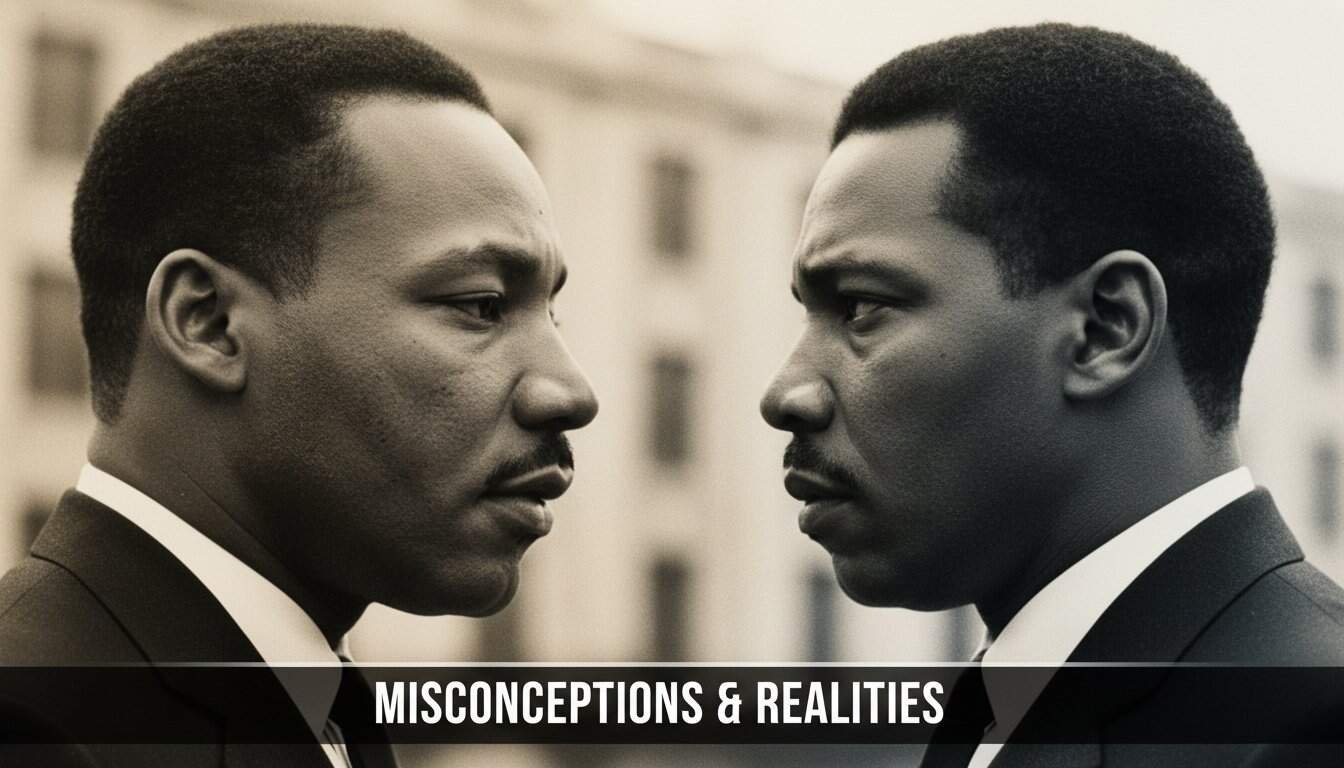
19 Jan Martin Luther King and Malcolm X: What People Get Wrong
You’ve been taught that Martin Luther King Jr. was purely “peaceful” while Malcolm X was “violent,” but this binary thinking misses their actual complexity. King advocated strategic nonviolence as active resistance, not submission, while Malcolm X distinguished between violence and self-defense. Both evolved significantly—Malcolm moved from separatism toward human rights after his Mecca pilgrimage, while King grew more radical, critiquing capitalism and war. Their philosophies converged more than you realize, and understanding their true positions reveals why today’s movements still grapple with their unresolved tensions.
Table of Contents
Key Takeaways
- MLK and Malcolm X are wrongly portrayed as simply “peaceful” versus “violent” when both had nuanced philosophies about strategic resistance.
- Malcolm X evolved from racial separatism to supporting cross-racial coalitions after his 1964 Mecca pilgrimage transformed his worldview.
- MLK became increasingly radical in his final years, expanding beyond civil rights to critique capitalism and militarism.
- Both leaders shared the core goal of liberation from systemic oppression despite their different methods and approaches.
- Popular narratives reduce their complex, evolving ideologies to oversimplified soundbites that ignore their strategic thinking and growth.
The “Peaceful vs. Violent” Myth That Misses the Real Story
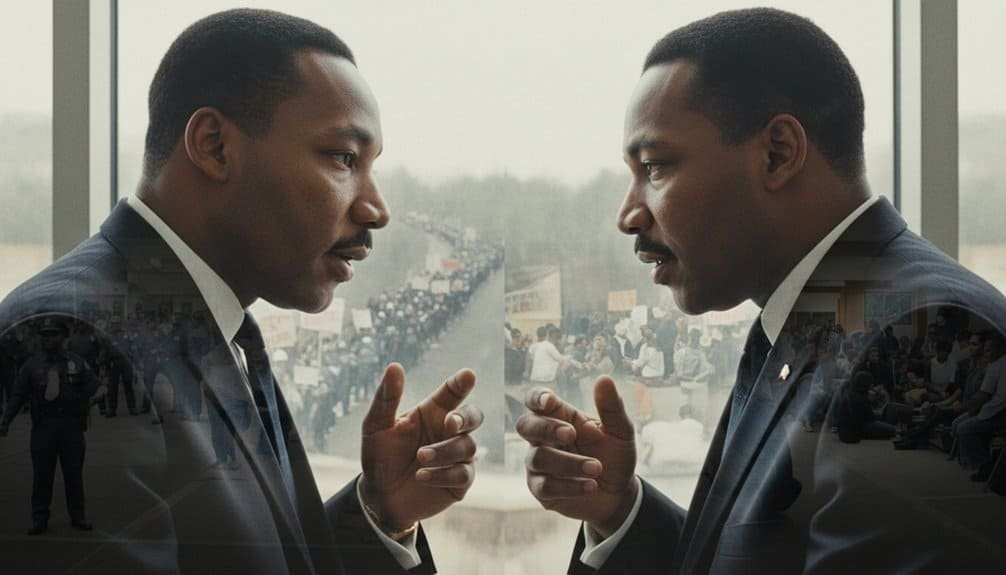
How many times have you heard Martin Luther King Jr. described as the “peaceful” civil rights leader while Malcolm X gets labeled as the “violent” one? This oversimplified narrative represents one of the most persistent misperceptions about both men. You’re encountering violent myths that distort their actual philosophies and evolution. King wasn’t merely passive—he advocated strategic nonviolence as active resistance, not submission. Malcolm X, meanwhile, distinguished between violence and self-defense, arguing people had the right to protect themselves from aggression. Two word discussion ideas like “peaceful versus violent” flatten complex ideologies into digestible but inaccurate soundbites. Both leaders understood that liberation required confronting systemic oppression, though they initially disagreed on methods. This subtopic reveals how reducing their legacies to simple binaries obscures their sophisticated political thinking.
How Malcolm X Moved From Black Separatism to Human Rights
What transforms a person from advocating complete racial separation to embracing universal human rights? You’ll find Malcolm X’s evolution wasn’t sudden but methodical. His 1964 pilgrimage to Mecca shattered his previous two word ideas about race being absolute. Witnessing Muslims of all colors worship together forced him to reconsider black separatism’s limitations.
You can trace this transformation through his post-Mecca speeches, where he began connecting American racism to global colonialism. He started framing civil rights as human rights violations, making them international discussion topics rather than domestic issues. Malcolm’s new approach emphasized building coalitions across racial lines while maintaining black pride and self-determination. This shift positioned him closer to King’s inclusive vision than many realize.
Why MLK Got More Radical (Not Less) Before His Death
Where did the popular image of Martin Luther King Jr. as a moderate peacemaker come from?
You’ve likely encountered this sanitized version that ignores his final years’ radicalization paradox. King didn’t become more moderate—he became more militant about economic justice and anti-war activism.
By 1967, King’s strategic shift challenged America’s entire power structure. He denounced the Vietnam War as morally bankrupt, linking it to domestic poverty. His Poor People’s Campaign demanded $12 billion in anti-poverty spending. He called capitalism’s extreme materialism fundamentally flawed.
You’ll find King’s later speeches contained revolutionary language about restructuring society’s economic foundations. This radical King threatened established interests far more than the “I Have a Dream” speaker. That’s precisely why his revolutionary evolution gets erased from popular memory.
What Both Leaders Would Say About Today’s Movement
Examining today’s Black Lives Matter movement through the lens of King and Malcolm X reveals striking parallels that would likely earn both leaders’ recognition and critique. You’d find King appreciating BLM’s emphasis on civic solidarity—its ability to mobilize diverse coalitions across racial lines while maintaining focus on systemic police violence. He’d recognize the moral imagination required to transform “Black Lives Matter” from slogan to global consciousness-shift.
Malcolm would respect the movement’s decentralized structure and international perspective, seeing echoes of his pan-African vision. However, both leaders might critique the lack of sustained economic analysis and concrete policy frameworks. They’d likely push for deeper engagement with class dynamics and more strategic long-term organizing beyond protest cycles.
Frequently Asked Questions
Did Martin Luther King Jr. and Malcolm X Ever Meet in Person?
You’ll find that MLK and Malcolm X met only once in person, briefly encountering each other at the U.S. Capitol on March 26, 1964, during Senate debate on the Civil Rights Act.
Their meeting lasted mere minutes, consisting mainly of a handshake and brief conversation. Despite persistent questions about deeper collaboration, this singular interaction represents their only documented face-to-face encounter before Malcolm’s assassination in 1965.
What Were the Main Religious Differences Between MLK and Malcolm X?
You’ll find their intellectual diversity stemmed from contrasting religious roots. King’s Baptist Christianity emphasized love, nonviolence, and integration through Jesus’s teachings.
Malcolm X’s Nation of Islam promoted Black separatism, self-defense, and viewed whites as inherently evil. After his Hajj pilgrimage, Malcolm embraced orthodox Sunni Islam, softening his racial views.
King maintained consistent Christian pacifism while Malcolm’s religious evolution fundamentally transformed his ideology.
How Did Their Childhood Experiences Shape Their Different Approaches to Activism?
You’ll notice that childhood trauma profoundly shaped their contrasting approaches. MLK’s middle-class Atlanta upbringing provided stability and educational opportunities, while family influence from his preacher father fostered belief in peaceful resistance. Malcolm X endured poverty, his father’s death, family separation, and racism in foster care. This trauma created his initial militant stance, contrasting sharply with King’s integrationist philosophy rooted in security.
What Role Did Their Wives Play in Influencing Their Political Views?
You’ll find that wives’ influence shaped both leaders’ evolution significantly. Coretta Scott King reinforced Martin’s commitment to nonviolence through her own pacifist beliefs and intellectual partnership. Betty Shabazz provided Malcolm with domestic stability that allowed deeper reflection, while her questions about Nation of Islam doctrine contributed to his theological questioning. Their domestic life created spaces for ideological refinement away from public pressures.
How Did the FBI Surveillance Affect Both Leaders’ Activism and Safety?
You’ll find FBI surveillance dramatically compromised both leaders’ activist safety through constant monitoring and infiltration attempts. The bureau’s COINTELPRO program disrupted their organizations, spread disinformation, and created paranoia within their circles. This surveillance forced them to alter communication methods, limit trust among supporters, and constantly fear for their lives.
The psychological pressure and practical obstacles significantly hampered their movement-building capabilities and personal security.
Conclusion
You’ve seen how reducing King and Malcolm to simple opposites erases their complexity and evolution. Both leaders challenged systemic racism through different but complementary approaches that shifted over time. You can’t understand either without recognizing Malcolm’s turn toward inclusive human rights or King’s growing economic radicalism. Their legacies aren’t competing philosophies—they’re interconnected strategies for dismantling oppression that today’s movements continue building upon through diverse tactics.










No Comments