


17 Jan Why Martin Luther King Jr.’s Dream Still Shapes 2026
You’re still seeing King’s dream shape 2026 because his coalition-building blueprint—from Birmingham jail letters to the Poor People’s Campaign—provides tested strategies for today’s voting rights battles and intersectional organizing. His nonviolent direct action tactics now address algorithmic discrimination and climate injustice, while his economic justice framework exposes widening racial wealth gaps that exceed 1963 levels. The dream’s moral authority persists precisely where its promises remain unfulfilled, creating the creative tension that drives contemporary movements toward redistributive policies and systemic change.
Table of Contents
Key Takeaways
- King’s nonviolent resistance tactics directly inform 2026 voting rights campaigns and intersectional organizing strategies across multiple social movements.
- The racial wealth gap exceeds 1963 levels, proving King’s economic justice vision remains unfulfilled despite civil rights progress.
- His Poor People’s Campaign blueprint guides contemporary efforts demanding guaranteed income, full employment, and federal housing programs.
- Nonviolence principles now apply to fighting algorithmic discrimination through data transparency campaigns and technology equity audits.
- King’s coalition-building methodology connects 1960s labor organizing to today’s multiracial movements addressing climate and economic justice.
Why MLK’s Dream Still Defines Social Justice in 2026
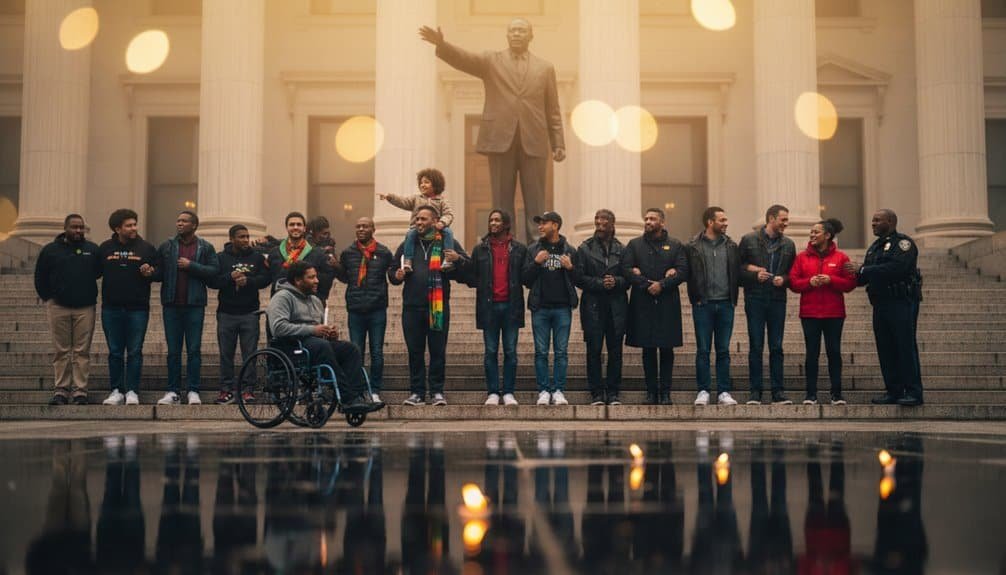
How does a speech delivered over six decades ago continue to anchor contemporary movements for equality and justice? You’ll find MLK’s 1963 address embedded in today’s activism through its foundational dream ethics—principles demanding both racial equity and economic justice. Archival research reveals King’s framework shaped coalition strategy across generations, from 1960s labor alliances to 2026’s intersectional organizing. Contemporary movements cite his Birmingham jail letters and Poor People’s Campaign when building multiracial coalitions addressing systemic inequality. You’re witnessing his methodology in current voting rights battles, where organizers employ his nonviolent direct action tactics. The speech’s endurance stems from its tactical blueprint: it provided activists concrete strategies for challenging institutional racism while maintaining moral authority, making it indispensable for today’s social justice infrastructure.
Where the Dream Falls Short: Wealth, Housing, and Policing Gaps
Despite King’s vision of economic justice, today’s racial wealth gap exceeds 1963 levels—Black families hold roughly one-eighth the wealth of white families, according to Federal Reserve data tracking asset accumulation since the Civil Rights era. You’ll find these wealth gaps rooted in systemic barriers: discriminatory lending practices, redlining’s lasting effects, and housing scarcity that disproportionately impacts Black communities.
The racial wealth gap has worsened since 1963, with systemic barriers perpetuating disparities King fought to dismantle.
Homeownership rates reveal the disconnect—white families own homes at nearly twice the rate of Black families.
Policing disparities compound economic inequality; you’re witnessing how over-incarceration disrupts income stability and generational wealth building.
While King advocated for guaranteed income and fair housing, contemporary policy hasn’t matched his ambition. The dream’s moral framework remains intact, yet its economic promises haven’t materialized for millions.
King’s Economic Justice Vision Beyond Civil Rights
King’s assassination in 1968 occurred while he was organizing the Poor People’s Campaign, a multiracial movement demanding economic restructuring that extended far beyond desegregation. You’ll find in his later speeches that he advocated for guaranteed income, full employment, and federal housing programs—positions that challenged capitalism itself. His 1967 address “Where Do We Go From Here” explicitly connected racial inequality to economic justice, arguing that civil rights meant little without material security.
Today’s wealth gaps mirror those King confronted: Black families possess one-tenth the wealth of white families, unchanged since the 1960s. His economic vision remains largely unrealized because it threatened power structures more fundamentally than desegregation ever did. You’re witnessing ongoing resistance to redistributive policies he championed sixty years ago.
Applying Nonviolent Resistance to AI Bias and Climate Racism
When King developed his six principles of nonviolence in the 1950s, he couldn’t have anticipated algorithmic discrimination or environmental racism’s climate dimensions, yet his framework translates directly to these modern injustices. You’ll find activists applying his methods to challenge algorithmic inequity in hiring systems, predictive policing, and credit scoring. Documentation from the King Center archives shows his emphasis on “beloved community” aligns with mutual aid networks forming in climate-vulnerable neighborhoods—predominantly communities of color bearing disproportionate pollution burdens. Contemporary movements employ King’s “creative tension” principle through data transparency campaigns and algorithmic audits. His insistence that “injustice anywhere is a threat to justice everywhere” now encompasses both discriminatory code and carbon inequality, demonstrating nonviolent resistance’s adaptability across technological and ecological frontiers.
Frequently Asked Questions
What Was Martin Luther King Jr.’S Actual Cause of Death?
You’ll find Martin Luther King Jr. died from a gunshot wound on April 4, 1968, in Memphis, Tennessee.
James Earl Ray fired the fatal shot from a boarding house, striking King’s jaw and neck.
Death causes included severe blood loss and spinal cord damage.
Ray’s international contacts remain debated among researchers—he fled to Canada, then London, before authorities captured him.
Archival evidence confirms the assassination occurred at 6:01 p.m. at the Lorraine Motel’s balcony.
Did MLK Ever Meet With International Civil Rights Leaders During His Lifetime?
Yes, you’ll find extensive archival evidence of King’s international alliances throughout the 1960s. He met with anti-apartheid leaders in London, corresponded with Gandhi’s followers in India, and consulted with liberation movement representatives from Africa and Latin America. These documented exchanges demonstrate his global influence, as he deliberately connected American civil rights struggles to worldwide anti-colonial movements, creating transnational networks that shaped his philosophy and strategic approach.
How Many Times Was Martin Luther King Jr. Arrested During His Activism?
You’ll find that Martin Luther King Jr. was arrested approximately 29 times throughout his activism. Archival records document these arrests for civil disobedience, from the Montgomery bus boycott to Birmingham demonstrations. While counterarguments claimed his methods disrupted public order, King’s spiritualism anchored his nonviolent resistance philosophy. Prison became his platform, evidenced by “Letter from Birmingham Jail,” transforming confinement into powerful testimony that galvanized the civil rights movement nationwide.
What Books or Authors Most Influenced Mlk’s Philosophy and Thinking?
You’ll find MLK’s philosophical roots in several key texts: Henry David Thoreau’s “Civil Disobedience” shaped his resistance methods, while Walter Rauschenbusch’s “Christianity and the Social Crisis” informed his social gospel theology. Gandhi’s writings on nonviolence became foundational. Reinhold Niebuhr’s “Moral Man and Immoral Society” influenced his realism about power structures. These authors’ influence created King’s synthesis of Christian ethics, nonviolent resistance, and prophetic activism that challenged systemic injustice.
Are There National MLK Memorials Outside the United States?
You’ll find global monuments honoring King in several countries, reflecting deliberate diplomatic outreach during and after the Civil Rights era. Through archival research, you can trace memorials in London’s Westminster Abbey, where a statue stands among martyrs, and in Amsterdam’s Oosterpark.
India maintains commemorative sites linking King to Gandhi’s legacy. These international tributes demonstrate how King’s philosophy transcended American borders, establishing his global humanitarian significance through sustained cross-cultural recognition.
Conclusion
You’ve examined how King’s vision persists through archival evidence and contemporary data—from Birmingham jail letters to 2026 inequality metrics. Yet you’ve also traced where his economic justice blueprint remains unrealized: persistent wealth gaps, residential segregation, and discriminatory policing that FBI records document. As you apply his nonviolent framework to algorithmic bias and environmental racism, you’re not merely commemorating King’s legacy—you’re extending his unfinished Poor People’s Campaign into today’s intersecting crises.












No Comments