


25 Jan The Christian Prayer Board Trend That’s Transforming Family Worship Time
Christian prayer boards are transforming family worship by creating visual focal points where you’ll organize prayer requests, track answered prayers, and display Scripture verses together. You can adapt these boards for any age—from felt boards for toddlers to sophisticated designs for teenagers—using simple materials like poster board and sticky notes. When you establish daily rhythms around your board, reading Scripture aloud and updating prayers morning and evening, your children witness God’s faithfulness tangibly, leading to spontaneous prayers and deeper faith engagement that’ll revolutionize your household’s spiritual foundation.
Table of Contents
Key Takeaways
- Christian prayer boards are visual organizers that display prayer requests, answered prayers, and Scripture verses to track God’s faithfulness during family worship.
- These adaptable boards suit every age from toddler felt boards to teen minimalist designs, using affordable materials like poster board and sticky notes.
- Families can create their first prayer board in under 30 minutes by dividing sections for praise reports, requests, and Scripture focus.
- Daily morning and evening routines around the board establish consistent family prayer rhythms with age-appropriate responsibilities for each member.
- Prayer boards transform worship by making God’s responses tangible, inspiring spontaneous prayer from children and reducing family conflict during prayer time.
What Exactly Is A Christian Prayer Board?
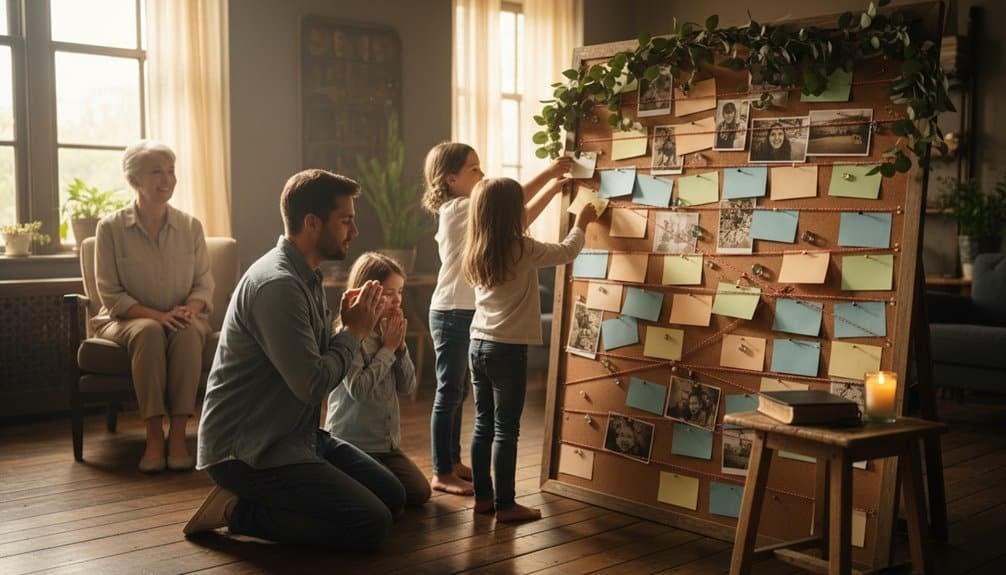
How can a simple board transform your family’s prayer life from scattered requests to purposeful worship?
A Christian prayer board serves as a visual focal point where your household gathers to organize, display, and track prayer requests and praises together.
Definition overview: This sacred space typically features sections for ongoing petitions, answered prayers, Scripture verses, and family devotional themes.

You’ll find boards arranged with pockets, clips, or designated areas where written prayers can be placed and revisited during worship time.
Origins usage: While formalized prayer boards emerged from Sunday school traditions, their roots trace back to biblical practices of recording God’s faithfulness.
Families now adapt this congregational tool for home use, creating accountability in prayer and teaching children to witness God’s responses firsthand.
Your prayer board becomes a testament to God’s provision, helping your family develop consistent worship rhythms while building faith through visible reminders of His active presence in daily life.
Simple Prayer Board Designs For Every Family Size And Age
The beauty of prayer boards lies in their adaptability to serve families whether you’re nurturing toddlers or guiding teenagers in their faith journey.

Your board layouts can range from simple poster boards with colorful stickers for young children to sophisticated cork boards with designated sections for different prayer categories.
For toddlers, create tactile experiences using felt boards where they can move pictures representing family members, friends, and missionaries.
Elementary-aged children thrive with magnetic boards featuring Bible verses and prayer request pockets.
Teenagers respond well to minimalist designs incorporating scripture journaling spaces and world map sections for global prayer focus.
Cost considerations needn’t overwhelm your budget.
Dollar store supplies like poster board, markers, and pushpins create effective prayer stations.
Repurpose old picture frames or bulletin boards you already own.
Remember, God honors our hearts’ intentions over elaborate displays.
As Matthew 18:3 reminds us, approaching Him with childlike faith matters more than perfect presentation.
How To Make Your First Prayer Board In Under 30 Minutes
Now that you’ve chosen your ideal design, let’s create something beautiful that’ll bring your family together before God’s throne.
Your materials list doesn’t need complexity—gather a poster board, colorful markers, sticky notes, and clear tape.
God’s sanctuary was built with simple, purposeful elements, and your prayer board follows this biblical principle.
Start with time hacks that maximize your thirty minutes.
Divide your board into sections while family members write prayer requests on sticky notes simultaneously.
This creates fellowship while you work, reflecting how early believers gathered with one accord.
Create designated areas: “Praise Reports,” “Prayer Requests,” and “Scripture Focus.”
Let children decorate borders while teens organize prayer categories.
Remember, Moses appointed helpers to share the workload—delegate age-appropriate tasks.
Position your finished board where you’ll see it daily.
Like the Israelites’ doorpost scriptures, this visual reminder will keep God’s presence central in your home’s rhythm.
Daily Routines That Keep Your Prayer Board Active And Meaningful
While creating your prayer board marks an important beginning.
Establishing consistent daily rhythms transforms it from wall decoration into a living altar where God meets your family.
Creating sacred rhythms breathes life into your prayer board, turning simple wall art into a holy meeting place with God.
Morning rituals anchor your day in God’s presence.
Gather your family before the prayer board each morning, reading one scripture verse aloud and selecting one prayer request to lift together.
This simple practice invites the Holy Spirit into your day’s agenda.
Evening reflections complete the circle.
Before bedtime, return to your prayer board to share how God moved throughout your day.
Update answered prayers with praise, and add new concerns that emerged.
Accountability prompts keep everyone engaged.
Assign each family member a weekly responsibility—updating scripture cards, organizing prayer requests, or leading family intercession.
When children own pieces of your prayer ministry, they develop deeper spiritual investment.
Real Families Share How Prayer Boards Changed Their Kids’ Faith
When God’s Word becomes tangible through prayer boards, children experience faith transformation that surpasses parents’ greatest expectations.
Sarah from Tennessee shares how her eight-year-old daughter began praying spontaneously after seeing answered prayers marked on their board.
“She’d run to update it whenever something happened,” Sarah recalls.
The visual representation helped her daughter understand God’s faithfulness.
The Martinez family testimonies reveal how their twin boys stopped arguing during prayer time once they could write requests themselves.
They’d compete to find Bible verses that matched our prayers,” Maria explains.
Their prayer board became a spiritual battleground where children learned warfare through worship.
Pastor Mike’s personal stories highlight his youngest son’s transformation from reluctant participant to prayer warrior.
“He started asking deep theological questions after tracking our family’s prayer journey visually.”
Frequently Asked Questions
Can Prayer Boards Replace Traditional Family Devotions and Bible Study Time?
No, you shouldn’t replace traditional devotions entirely.
The effectiveness debate centers on prayer boards as supplements, not substitutes.
While they’re valuable visual tools, they can’t match Scripture’s transformative power through study and meditation.
Your time commitment should include both—use prayer boards to enhance engagement while maintaining biblical foundation.
Man shan’t live by bread alone, but by every word of God.”
What Age Should Children Start Using Prayer Boards Independently?
Children typically reach independence thresholds for prayer boards around ages 7-8, when they’ve developed reading skills and spiritual awareness.
These age milestones align with Scripture’s call to “train up a child in the way he should go” (Proverbs 22:6).
You’ll notice they’re ready when they can express personal prayer requests and understand God’s faithfulness.
Start with guided sessions, then gradually release them into independent communion with Christ.
How Do You Handle Sensitive Prayer Requests on Family Boards?
You’ll need clear privacy boundaries when family members share delicate concerns.
Practice consent etiquette by asking permission before writing others’ personal struggles on shared boards.
Create separate sections for private requests that only parents can see, following Christ’s teaching about praying in secret (Matthew 6:6).
Remember that “bearing one another’s burdens” (Galatians 6:2) requires wisdom and respect for each person’s comfort level with transparency.
Are Digital Prayer Board Apps as Effective as Physical Boards?
Both digital and physical boards can effectively serve God’s purposes, but they offer different strengths.
Physical boards create tangible, communal experiences that mirror Acts 2’s fellowship.
Digital apps provide convenient app usability for busy families, though privacy concerns may hinder vulnerability.
Consider your family’s worship style—some flourish with technology’s accessibility, while others need physical reminders of God’s faithfulness displayed prominently in their homes.
How Often Should Prayer Requests Be Updated or Removed?
You should establish an update cadence that reflects God’s faithfulness in answering prayers.
Remove answered requests immediately to celebrate His goodness, while keeping ongoing needs visible for continued intercession.
Consider weekly reviews as your removal criteria, asking “Has God moved?”
Keep requests fresh so your family doesn’t lose heart but maintains fervent, expectant prayer habits together.
Conclusion
You’ve discovered how prayer boards can revolutionize your family’s spiritual journey together. As Deuteronomy 6:7 reminds us, you’re called to teach God’s ways diligently to your children throughout each day. Your prayer board becomes that visual reminder, keeping Christ at your family’s center. Don’t wait—start creating your board today. Watch how this simple tool draws your household closer to the Lord and builds faith that’ll last generations.












No Comments