

19 Jan The Biblical Story Behind the Prayer That Stops Time
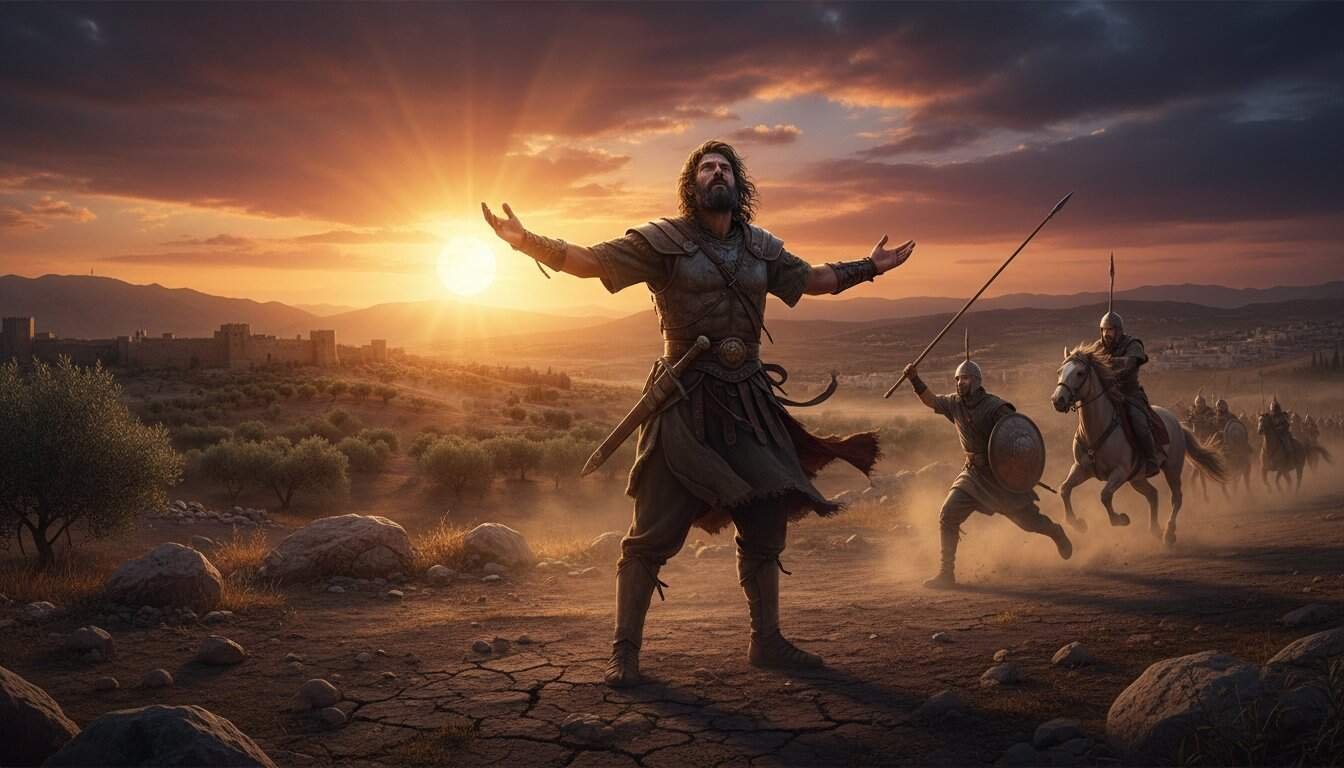
You’ll discover this miraculous account in Joshua 10:12, where Israel’s commander prayed for celestial intervention during warfare against five Amorite kings besieging Gibeon. Joshua boldly petitioned, “Sun, stand still over Gibeon; you, moon, over the Valley of Aijalon,” using Hebrew terms *dom* and *’amad* (cease/stop). Scripture records that God suspended natural laws, granting extended daylight for military victory. This demonstrates divine sovereignty over creation’s order and God’s responsiveness to covenant-aligned prayer. The theological implications and practical prayer principles from this extraordinary biblical narrative reveal profound truths about faith-filled petitions.
Table of Contents
Key Takeaways
- Joshua prayed for the sun and moon to stand still during Israel’s battle against a five-king Amorite coalition.
- The prayer occurred when Israel defended Gibeon, their treaty ally, against Jerusalem’s king Adoni-Zedek and his confederates.
- God answered by suspending celestial movement, creating the longest day in Scripture to complete Israel’s victory.
- The miracle demonstrated God’s sovereignty over creation and His faithfulness to covenant obligations through divine intervention.
- Joshua’s bold, specific prayer aligned with God’s purposes, providing a model for faith-filled petitions that honor divine authority.
The Battle That Required a Miracle: Five Kings Against Israel

When Joshua’s military campaign reached its southern phase, the Gibeonites’ deceptive treaty with Israel (Joshua 9:3-15) triggered an unprecedented coalition response that would necessitate divine intervention.
You’ll discover that King Adoni-Zedek of Jerusalem orchestrated a five-king alliance including Hoham of Hebron, Piram of Jarmuth, Japhia of Lachish, and Debir of Eglon (Joshua 10:3-5).
Their covenant tactics aimed to punish Gibeon’s defection and prevent Israel’s strategic foothold in Canaan’s heartland.
You’re witnessing military miracles unfold as these Amorite kings besieged Gibeon, forcing Joshua into a critical decision.
The treaty obligated Israel’s protection of their new allies, despite the deceptive circumstances of the agreement.
This convergence of political maneuvering and divine covenant created the perfect storm requiring supernatural intervention.
The stage was set for one of Scripture’s most extraordinary demonstrations of God’s power over creation itself.
The Prayer That Actually Stopped the Sun and Moon
As the Amorite coalition pressed their siege against Gibeon, Joshua’s tactical assessment revealed a time-sensitive military dilemlar that demanded unprecedented divine assistance (Joshua 10:12-13).
You’ll discover that Joshua’s audacious prayer wasn’t whispered privately but declared publicly: “Sun, stand still over Gibeon, and you, moon, over the Valley of Aijalon” (v. 12).
Bold faith speaks publicly, declaring God’s power over impossible circumstances with unwavering authority and specific petition.
This demonstrates critical prayer mechanics—specific, faith-filled petition delivered with authority.
The Hebrew text employs *dom* (stand still) and *’amad* (stop), indicating complete celestial suspension rather than mere deceleration (v. 13).
You’re witnessing one of Scripture’s most extraordinary moon miracles, where cosmic forces yielded to divine intervention.
The narrator emphasizes this event’s uniqueness: “There has been no day like it before or since” (v. 14).
Your understanding of this miracle reveals God’s sovereignty over natural laws when His covenant purposes require supernatural intervention for His people’s victory.
How God Suspended Natural Laws for Joshua’s Victory
Beyond the miraculous spectacle itself, Joshua’s extended day reveals fundamental theological principles about divine sovereignty over creation’s established order.
You’re witnessing God’s absolute authority over natural laws He established (Genesis 1:14-16).
The miracle mechanics demonstrate that divine intervention doesn’t contradict natural order but transcends it through sovereign power.
Scripture emphasizes God’s response to prayer rather than magical manipulation of cosmic forces.
When you examine the Hebrew text, “dom shemesh” suggests the sun’s movement ceased relative to earth’s perspective, not necessarily requiring complete planetary stillness.
Ancient Near Eastern cosmology understood celestial bodies as divine instruments serving God’s purposes.
The ethical implications prove significant: God intervenes in history to fulfill covenant promises and execute justice against wickedness.
You see divine power serving moral purposes—protecting His people while judging Canaanite nations for centuries of sin (Leviticus 18:24-25).
This miracle affirms God’s commitment to His redemptive plan through Israel.
Why God Honors Impossible-Sounding Prayer Requests
Your understanding of faith testing becomes crucial here.
God doesn’t respond to impossible prayers despite their impossibility, but often because of it.
Calvin notes that extraordinary circumstances require extraordinary divine intervention, revealing God’s sovereignty over creation’s mechanisms.
When you pray beyond human capability, you’re acknowledging divine supremacy over natural order.
The Septuagint’s rendering emphasizes duration: the sun “stood” (*estē*) until victory was complete.
This validates your boldest prayers—God’s power isn’t constrained by your limited perspective of possibility.
How to Pray Bold Prayers When Facing Impossible Odds
When circumstances appear insurmountable, Joshua’s prayer methodology provides a framework for approaching God with audacious requests. Joshua’s intercession demonstrates three critical components for bold prayer under impossible conditions.
First, establish intent clarity through specific articulation. Joshua didn’t request general assistance; he commanded celestial bodies with precision (Joshua 10:12). Your prayers must contain definitive objectives rather than vague appeals for help.
Second, implement habit formation through consistent boldness in prayer. Joshua’s confidence stemmed from established patterns of approaching God’s throne room with reverence yet audacity (Exodus 33:11). Regular practice in smaller requests builds spiritual muscle memory for crisis moments.
Third, align requests with divine purposes. Joshua’s petition served Israel’s covenant mission, not personal ambition (Joshua 10:14). Commentator Matthew Henry notes that God honors prayers advancing His kingdom agenda over self-serving appeals. When facing impossible odds, combine scriptural precedent with unwavering faith in God’s sovereignty.
Frequently Asked Questions
How Long Did the Sun Actually Stay Still During Joshua’s Battle?
You’ll find no specific sun duration mentioned in Joshua 10:12-14, where the text states the sun “stood still”.
and “didn’t hurry to go down for about a whole day.” Biblical scholars debate this miracle timing, with interpretations ranging from a literal 24-hour extension to poetic description of divine intervention.
The Hebrew phrase suggests prolonged daylight rather than precise temporal measurement, leaving the exact duration deliberately ambiguous in canonical Scripture.
Did Other Ancient Cultures Record This Astronomical Event Happening?
You’ll find no corroborating ancient sources documenting this astronomical phenomenon outside biblical literature.
Egyptian, Mesopotamian, and Chinese celestial records from the Late Bronze Age don’t reference prolonged daylight or disrupted solar cycles circa 1400-1200 BCE.
However, you must consider that astronomical record-keeping wasn’t universally systematic, and localized phenomena might’ve escaped documentation.
The absence of extrabiblical evidence remains a significant scholarly challenge for historicity assessments.
What Specific Words Did Joshua Use in His Prayer to God?
You’ll find Joshua’s exact words in Joshua 10:12, where the textual syntax reveals his divine wording: “Sun, stand still over Gibeon, and you, moon, over the Valley of Aijalon” (NIV).
The Hebrew text employs imperative verbs (דום and עמד), demonstrating Joshua’s authoritative command rather than supplication.
Exegetical analysis shows this wasn’t traditional petition language but declarative speech, reflecting his confidence in God’s covenant promises during Israel’s military campaign.
Has God Ever Stopped Time Again for Anyone Else in History?
You’ll find no other biblical accounts of divine intervention stopping time completely like Joshua’s miracle.
However, you can identify similar miracle occurrences in 2 Kings 20:8-11, where God reverses the sun’s shadow ten degrees for King Hezekiah (cf. Isaiah 38:8).
Some scholars argue this represents temporal manipulation rather than complete cessation.
Exegetical analysis reveals these remain the only scriptural instances of celestial-temporal divine intervention affecting chronological progression.
What Scientific Explanations Have Scholars Proposed for This Miracle?
You’ll find scholars proposing several naturalistic explanations for Joshua’s long day.
Some suggest atmospheric refraction created an optical illusion, making the sun appear stationary while Earth’s rotation continued (Wonderly, 1987).
Others theorize miraculous cloud formations or supernatural light extension rather than astronomical cessation (Kitchen, 2003).
Critical exegetes often interpret the passage as phenomenological language describing prolonged daylight rather than literal time suspension (Longman & Dillard, 2006).
Conclusion
When you encounter seemingly insurmountable circumstances, Joshua’s audacious petition at Gibeon (Joshua 10:12-14) demonstrates that God responds to faith-filled prayers that align with His purposes. The Hebrew text emphasizes Joshua’s confidence through the imperfect verb form “וַיֹּאמֶר” (wayomer), indicating decisive action rather than tentative request (Waltke & O’Connor, 1990). You’re invited to pray boldly, knowing that the same God who suspended celestial mechanics for Israel’s victory remains unchanged in His power and faithfulness today.









No Comments