

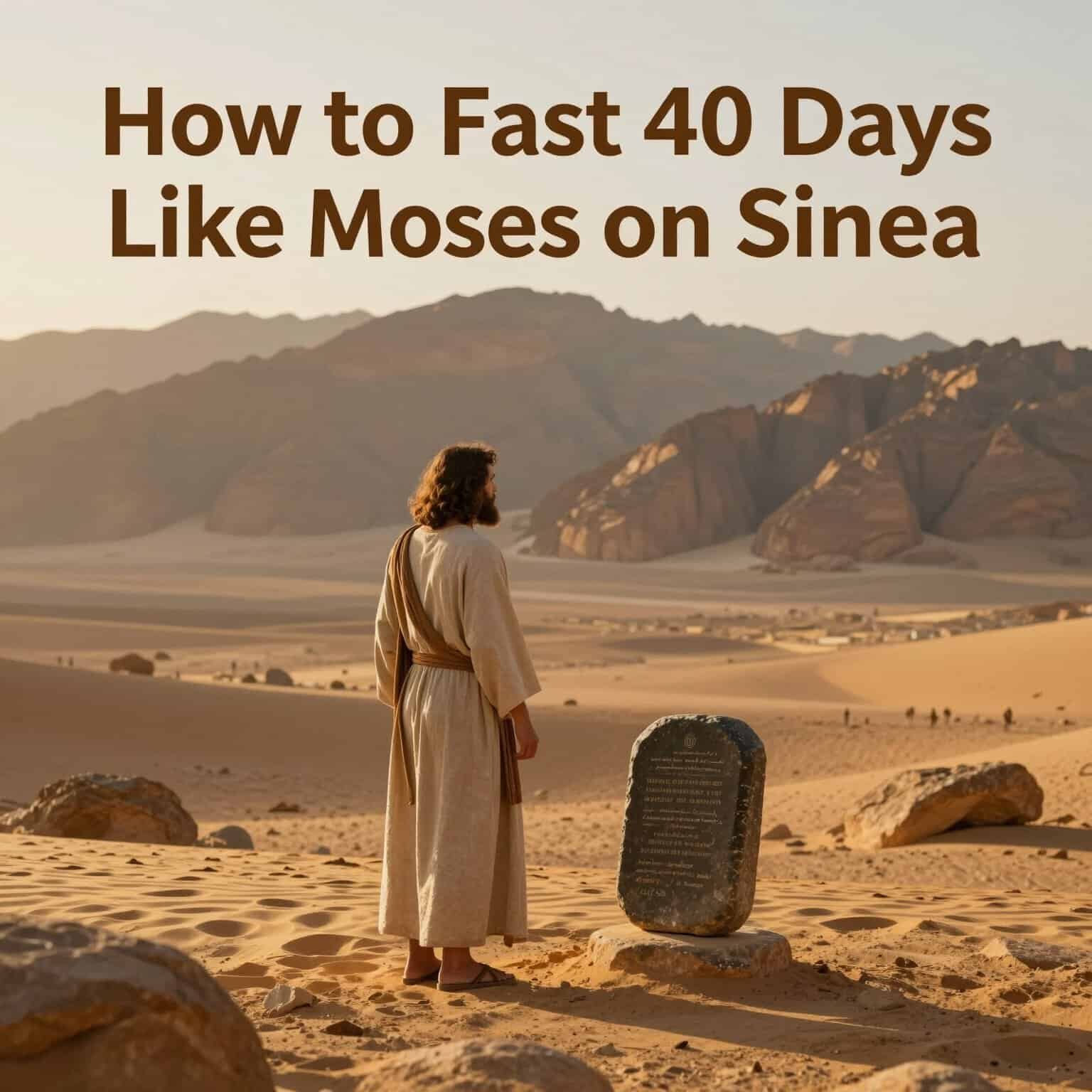
02 May How to Fast 40 Days Like Moses on Sinai
Get a doctor’s clearance first, then start with a 24‑hour water‑only fast and add a day each week, never exceeding 48 hours without supervision. Drink 2–3 liters of water daily, add a pinch of sea‑salt and magnesium citrate each 12 hours, and monitor urine color, weight, and blood pressure. Keep a simple log, stop if you feel dizziness, dark urine, or >2 % weight loss, and refeed gradually with broth, pureed veggies, then solids over 3–5 days. Continue for more details on spiritual rhythm and safety.
Table of Contents
Answer the Core Question: How to Fast 40 Days Safely
How can you attempt a 40‑day fast without endangering your health? First, get a doctor’s clearance; they’ll check kidneys, electrolytes, and heart function. Then, design a phased plan: start with a 24‑hour water‑only fast, add a day each week, and never exceed 48 hours without supervision. During the fast, drink at least 2 liters of water daily and supplement electrolytes—sodium, potassium, magnesium—to avoid hyponatremia and muscle cramps. Keep a light, nutrient‑dense broth on hand for occasional sips if you feel dizzy. Monitor weight, blood pressure, and urine color; any sign of dehydration or faintness means you must stop. After the longest stretch, reintroduce food slowly—broth, then pureed vegetables, then solid meals—over 3–5 days to prevent refeeding syndrome. Pair the physical regimen with prayer or meditation, but never replace medical oversight with spiritual belief alone. This structured, supervised approach lets you explore extended fasting safely.
What the Bible Says About Moses’ 40‑Day Fast
Where does the biblical record place Moses during his forty‑day fast? Exodus 24:18 says he ascended Mount Sinai and stayed there for forty days and nights; Exodus 34:28 adds that he ate no bread and drank no water. The text presents the fast as a literal, continuous deprivation, not a symbolic pause. You’ll notice the narrative links the fast directly to the giving of the Law, implying divine empowerment. The passage doesn’t mention any angelic provision for Moses, unlike Elijah’s journey in 1 Kings 19:8. Because the Hebrew wording is clear—“neither ate bread nor drank water”—the claim is absolute, leaving no room for a partial or intermittent fast. When you read the verses, you see a single, uninterrupted period of total abstinence, framed as a covenantal encounter rather than a mere tradition. This description sets the benchmark for any theological discussion of Moses’s forty‑day fast.
Symbolic Meaning of the Number 40 in Scripture
Why does the number 40 keep appearing in biblical narratives? You’ll notice it marks periods of testing, transformation, and divine preparation. In the flood story, 40 days of rain cleanse the earth; Israel’s 40 years in the wilderness purify a nation; Elijah’s 40‑day trek to Horeb refines his prophetic resolve. The number signals a threshold where ordinary limits give way to supernatural intervention. When Moses spends 40 days on Sinai, the duration underscores the intensity of the covenant revelation and his total dependence on God. You can read the same pattern in Jesus’ 40‑day wilderness fast, a prelude to his ministry. Symbolically, 40 functions like a spiritual “reset button,” a div period that compresses hardship into a purposeful, redemptive interval. Recognizing this motif helps you see the fast not merely as a physical ordeal but as a conduit for divine encounter and renewed purpose.
Biblical Passages That Describe Moses’ 40‑Day Fast
Wondering which verses actually recount Moses’ forty‑day fast? You’ll find the core narrative in Exodus 24:18, where Moses climbs Mount Sinai and stays there for forty days and nights.
Exodus 34:28 repeats the detail, stressing that he ate no bread and drank no water during that span.
These two passages form the biblical backbone of the fast. While the text doesn’t describe every hour, the parallel verses confirm a continuous, water‑free period.
You might also notice the pattern of divine sustenance in other scriptures—Jesus’ wilderness fast (Matthew 4:2) and Elijah’s journey (1 Kings 19:8) echo the same reliance on God.
However, for Moses specifically, Exodus 24:18 and Exodus 34:28 are the definitive references you need.
Keep these verses in mind as you explore the theological and practical implications of a forty‑day fast.
Physical vs. Divine Sustenance: What the Bible Says
How does the Bible reconcile Moses’ forty‑day water‑free fast with human physiology? You’ll notice the text doesn’t claim human stamina alone made it possible; it repeatedly emphasizes divine provision. Exodus 24:18 and 34:28 state that Moses “neither ate bread nor drank water,” yet the narrative surrounds him with God’s presence, a cloud, and a voice that sustains him. The same pattern appears with Elijah (1 Kings 19:8) and Jesus (Matthew 4:2), where an angel or the Spirit supplies the needed vitality. Scripture therefore frames the fast as a supernatural exception, not a natural benchmark. You’re invited to see the water‑free period as a sign of total reliance on God, a temporary suspension of ordinary biology. The biblical message is clear: when God intervenes, ordinary limits dissolve, and the focus shifts from physical endurance to spiritual revelation.
Medical Evidence on Survival Without Water for a 40‑Day Biblical Fast
Can you imagine surviving forty days without a drop of water? Medical research tells you that a healthy adult typically reaches fatal dehydration after three to four days in temperate conditions. Even under extreme heat, documented cases of water deprivation rarely exceed ten days, and those survivors suffer severe renal failure, electrolyte collapse, and irreversible organ damage. No peer‑reviewed study records a forty‑day water‑free interval in a living, non‑ventilated subject.
The human body relies on water to maintain plasma volume, thermoregulation, and cellular metabolism; once those systems falter, consciousness fades and death follows. To reconcile the biblical claim with biology, scholars invoke supernatural intervention, noting that the text explicitly attributes divine sustenance to Moses and Elijah. In contrast, modern physiology offers no natural mechanism that could sustain you for forty days without fluid, underscoring the extraordinary nature of the scriptural account.
Health Risks and Contra‑indications for a 40‑Day Fast
What’re the primary health risks and contraindications you’ll face when attempting a 40‑day fast? You’ll encounter severe dehydration, electrolyte imbalance, and acute kidney injury within days without water. Prolonged caloric deprivation can cause hypoglycemia, muscle catabolism, and cardiac arrhythmias. Orthostatic hypotension and dizziness increase fall risk, while impaired cognition hampers decision‑making.
People with diabetes, hypertension, heart disease, or renal insufficiency must avoid such a fast; medications that require food for absorption (e.g., warfarin, lithium) become dangerous. Pregnancy, lactation, and childhood are absolute contraindications because fetal and developmental needs far exceed any possible reserve. Even healthy adults risk refeeding syndrome if they resume normal meals abruptly after the fast. Monitoring blood pressure, electrolytes, and renal function is essential, and a medical professional should supervise any attempt beyond 48 hours. Ignoring these warnings can lead to irreversible organ damage or death.
How Supernatural Claims Reconcile Scripture With Physiology?
A supernatural framework lets you view the biblical forty‑day fast as a divinely sustained event rather than a purely physiological process. When you accept that God intervened, you bypass the natural limits of dehydration and organ failure. Scripture records angels providing sustenance to Elijah (1 Kings 19:8) and the Holy Spirit empowering Jesus (Matt 4:2). These accounts imply a supernatural supply of energy, hydration, or cellular regeneration that ordinary biology can’t explain.
Manuscript Evidence Supporting “Neither Bread Nor Water
Where does the manuscript tradition anchor the claim that Moses “neither ate bread nor drank water”? You’ll find it in the Masoretic Text of Exodus 34:28, which is reproduced verbatim in the Codex Leningradensis (1008 CE) and in the Aleppo Codex (10th century).
The Dead Sea Scrolls fragment 4QExod^a (3rd century BCE) mirrors this wording, confirming that the phrase existed centuries before the medieval codices. The Samaritan Pentateuch, too, retains the exact formulation, showing a cross‑community consensus.
Even the Septuagint (LXX) translates the phrase literally, indicating that early Greek‑speaking Jews preserved the same tradition. These independent witnesses—Hebrew, Greek, and Samaritan—demonstrate a stable transmission line.
You can trust that the textual evidence for Moses’ water‑free, bread‑free fast isn’t a later editorial invention but a well‑attested component of the biblical manuscript heritage.
Comparing Moses’ Fast With Elijah’s and Jesus’ Fasts
The manuscript evidence shows Moses’ forty‑day water‑free fast is firmly rooted in ancient sources, and that same reliability lets us examine how his experience stacks up against Elijah’s and Jesus’ fasts. You’ll notice three key differences. First, Moses endured no food or water, whereas Elijah received an angelic provision of bread and water after his first thirty‑three days (1 Kings 19:8). Second, Jesus fasted for forty days but drank water only sparingly, relying on divine sustenance (Matthew 4:2). Third, the purpose varies: Moses sought covenant revelation, Elijah pursued prophetic renewal after fleeing Jezebel, and Jesus prepared for public ministry and temptation resistance. All three fasts share the symbolic number forty, signaling testing and purification. Yet the physiological claims diverge—Moses’ water‑free claim is extraordinary, Elijah’s includes divine supply, and Jesus’ remains ambiguous, reflecting distinct theological emphases while preserving the core motif of divine empowerment.
Debunking Myths About 40‑Day Water‑Free Fasts
Even if you’ve heard that people can survive forty days without water, the science simply doesn’t support that claim. Human physiology needs water to maintain blood volume, temperature regulation, and cellular function; dehydration becomes fatal after three to four days under normal conditions. Medical case studies show extreme dehydration lasting up to ten days, but organ failure and irreversible damage invariably follow. No verified, healthy adult has endured a forty‑day water‑free period without supernatural intervention. Biblical accounts that mention “neither ate bread nor drank water” are understood by scholars as theological language, not literal physiology. Modern fasting protocols always include water, electrolytes, and medical monitoring, even when caloric intake is restricted for weeks. Recognizing the biological limits prevents dangerous experimentation and honors the spiritual intent behind the scriptural narrative without misrepresenting human capability.
Guided Spiritual Preparation Checklist for a 40‑Day Biblical Fast
Understanding that a forty‑day water‑free fast defies human biology, you’ll now focus on the spiritual groundwork that makes a biblical‑style fast meaningful and safe.
First, set a clear purpose: write a purpose a you seek revelation, repentance, or intercession. Write it down and revisit it daily.
Second, choose a sacred space—an altar, a corner, or a wilderness‑like area—where you’ll pray without distraction.
Third, schedule regular Scripture reading, aligning passages with the fast’s theme; use a journal to record insights.
Fourth, enlist a spiritual mentor or accountability partner for weekly check‑ins, ensuring you stay grounded.
Fifth, incorporate rhythmic worship—chant, hymn, or silence—so your heart remains attuned to God.
Sixth, plan brief, purposeful service acts that keep you connected to others while you withdraw.
Finally, prepare a post‑fast transition plan: gradual re‑entry, continued prayer, and a gratitude offering for the encounter you’ve cultivated.
Daily Prayer Themes for a 40‑Day Biblical Fast
When you begin a 40‑day biblical fast, let each day’s prayer focus on a distinct theme that builds your spiritual journey step by step. Start with humility, asking God to strip away pride. Move to repentance, confessing hidden sins. Shift to gratitude, recalling past blessings. Then explore trust, surrendering control to divine provision. Meditate on obedience, recalling Moses’ willingness to stay on Sinai. Embrace forgiveness, both receiving and extending it. Reflect on worship, offering praise despite scarcity. Consider intercession, lifting others’ needs. Contemplate patience, enduring the slow work of transformation. Dive into love, echoing Christ’s sacrificial heart. End with renewal, envisioning a fresh covenant after the fast. Write each theme on a journal page, read Scripture that matches, and pray aloud. Keep the rhythm simple: read, reflect, speak, and listen. This structure guides you through a purposeful, Spirit‑filled journey.
Day‑by‑Day Schedule for the First Ten Days of the Fast
Begin each morning by setting a clear intention for the day’s theme, then follow a simple rhythm: read a short Scripture passage, pray the specific focus, journal insights, and spend a few minutes in silent listening. Day 1 centers on humility; choose a verse about surrender, pray for a heart that yields, and note any resistance.
Day 2 moves to repentance; confess hidden sins, ask for cleansing, and record the weight lifted.
Day 3 focuses on gratitude; list blessings, thank God, and observe how gratitude reshapes perspective.
Day 4 emphasizes listening; meditate on God’s voice, silence distractions, and write the stillness you hear.
Day 5 calls for obedience; commit to a small act of faith, pray for courage, and track the outcome.
Day 6 explores compassion; pray for others, extend kindness, and journal the ripple effect.
Day 7 highlights worship; sing a psalm, feel reverence, and capture the awe.
Day 8 seeks wisdom; ask for discernment, study a proverb, and note insights.
Day 9 celebrates perseverance; recall past trials, pray for stamina, and record endurance.
Day 10 embraces hope; envision the future, pray for assurance, and write the promise you cling to.
Nutrition‑Free Hydration Strategies (If Required)
Can you sustain a forty‑day fast without compromising your health? If you must stay hydrated while abstaining from calories, focus on pure water, herbal infusions, and electrolyte‑free broths. Drink 2–3 liters of filtered water daily, spacing intake evenly to avoid spikes. Add a pinch of sea salt only if you notice dizziness, but keep it minimal to preserve a nutrition‑free profile. Herbal teas—peppermint, chamomile, rooibos—provide flavor without calories; steep for 5 minutes, then chill and sip. Avoid fruit‑based or vegetable‑based drinks, as they introduce sugars and micronutrients. Monitor urine color; pale straw indicates adequate hydration, while dark amber signals a need for more fluid. If you feel light‑headed, pause the fast and re‑hydrate with plain water before resuming. Remember, the goal is to maintain fluid balance while keeping caloric intake at zero, preserving both safety and the spirit of the fast.
Manage Electrolytes During Extended Fasting
Keeping your fluid intake pure is only half the battle; you also need to preserve electrolyte balance to avoid cramps, dizziness, and cardiac strain. During an extended fast you’ll lose sodium, potassium, magnesium, and calcium through urine and sweat, so supplement them deliberately. Use a pinch of sea‑salt (≈ 0.5 g) per liter of water to replace sodium and chloride; add a magnesium citrate tablet (≈ 200 mg) every 12 hours to keep muscles relaxed. If you’re active, a potassium chloride supplement (≈ 50 mg) twice daily prevents arrhythmias. Monitor your urine color—pale straw indicates adequate hydration, while dark amber signals a need for more electrolytes. Avoid over‑correction; excess sodium raises blood pressure, and too much magnesium can cause diarrhea. Keep a simple log of intake and symptoms, and adjust doses if you notice tingling, fatigue, or irregular heartbeat. Consistent, measured electrolyte support lets you sustain the fast safely while staying mentally sharp.
Safe Refeeding Practices After Prolonged Deprivation
Why is refeeding after a prolonged fast so risky? Your body’s metabolism has slowed, insulin sensitivity is blunted, and electrolytes are depleted. Introducing carbs too quickly spikes glucose, triggers a massive insulin surge, and drives potassium and phosphate into cells, causing refeeding syndrome. To stay safe, start with clear liquids—broth, diluted fruit juice, or herbal tea—about 200 ml every hour for the first 24 hours. Add a pinch of sea salt to replace sodium and consider a magnesium supplement. After two days, introduce easily digestible foods such as plain oatmeal, boiled potatoes, or scrambled eggs, keeping portions under 150 g and protein below 0.8 g/kg body weight. Monitor heart rate, blood pressure, and any signs of edema. Continue to hydrate with electrolyte‑balanced fluids, and avoid high‑fat, high‑sugar meals for at least a week. Gradual escalation lets your organs adjust, minimizes metabolic shock, and protects you from life‑threatening complications.
Identify Dehydration Warning Signs and Stop Criteria
What signs tell you you’re slipping into dangerous dehydration? You’ll notice a dry mouth, reduced urine output, and dark‑colored urine.
Skin loses elasticity, and a rapid heartbeat replaces your normal pulse.
Dizziness, headache, and confusion signal that your brain isn’t getting enough fluid. If you feel extreme thirst that isn’t relieved by a few sips, stop the fast immediately.
Monitor weight loss; a drop of more than 2 % of body weight in a day is a red flag. Stop the fast if you develop fever, rapid breathing, or muscle cramps, as these indicate electrolyte imbalance.
Any fainting, severe nausea, or vomiting also demands cessation. When any of these warning signs appear, rehydrate with water and electrolytes, and seek medical evaluation before resuming any fasting practice.
Medical Clearance Steps Before Attempting Long Fasts
Recognizing those dehydration warnings means you must get medical clearance before any fast longer than 48 hours. First, schedule a pre‑fast exam with a physician experienced in metabolic health. Bring a full medication list, recent labs, and any history of diabetes, heart disease, kidney problems, or thyroid disorders. The doctor will order baseline blood work: electrolytes, kidney function, liver enzymes, fasting glucose, and a complete blood count. If you take diuretics, blood‑pressure meds, or insulin, discuss dose adjustments and monitoring plans.
Next, obtain written clearance outlining safe duration, required daily check‑ins, and red‑flag symptoms that demand immediate cessation. Arrange for a follow‑up lab panel after one week and before ending the fast to catch electrolyte shifts or refeeding risk.
Finally, secure a contact person—family member or friend—who can alert medical services if you become unresponsive or develop severe weakness. This structured protocol protects you while you pursue an extended fast.
Find Qualified Health Professionals for Supervised Fasting
Where do you start when you need a professional to oversee a long‑term fast? Begin by identifying a clinician who specializes in metabolic or integrative medicine, as they understand the physiological shifts of prolonged fasting. Look for board‑certified physicians—endocrinologists, internists, or family doctors—who have published or practiced therapeutic fasting protocols. Verify that they can monitor electrolytes, blood glucose, and renal function daily, and that they’ve a clear plan for re‑feeding. Nutritionists or dietitians with fasting experience can design safe meal‑break schedules and supplement regimens. Ask for references from patients who completed extended fasts under their care. Ensure the provider offers tele‑health options for frequent check‑ins and can coordinate with laboratories for blood work. Finally, confirm that they respect your spiritual goals while maintaining medical rigor, so you stay safe throughout the forty‑day journey.
Historical Ascetics Who Fasted 30+ Days (Brief Accounts)
Ever wondered how historical ascetics pushed the limits of human endurance? You’ll find that Buddhist monks in the Tibetan tradition sometimes entered ultra‑silent retreats, surviving on tea and butter tea for up to 40 days while meditating nonstop. In Hindu lore, the sadhus of the Nath order practiced “Sanjivani” fasts, abstaining from solid food and water for 30‑45 days under a guru’s supervision, relying on breathwork and mantra to sustain vitality. Early Christian hermits like Saint Simeon Stylites perched on a pillar for months, subsisting on minimal rations and occasional water, stretching his fast beyond 30 days. In medieval Islam, the mystic Ibn ‘Arabi recorded a 33‑day “tawakkul” fast, where he survived on a single spoonful of dates and prayer. These brief accounts show that, with strict discipline, communal support, and spiritual focus, ascetics have historically endured prolonged deprivation, though each case required careful oversight and a belief in divine assistance.
Modern Clinical Studies Teach Us About Water‑Only Fasts (Relevant to a 40‑Day Biblical Fast)
Explore the findings of recent clinical trials that examine water‑only fasting, and you’ll see how modern science frames the limits of human physiology. You’ll learn that most supervised studies cap continuous water‑only abstention at 10–14 days; beyond that, markers of renal strain, electrolyte imbalance, and cardiac arrhythmia rise sharply. One randomized trial reported a median of 12 days before participants experienced a ≥20 % drop in glomerular filtration rate, prompting early termination. Another crossover study showed that after 7 days, cortisol spikes and muscle catabolism accelerate, while cognitive performance declines measurably. Researchers stress that refeeding syndrome can be lethal if caloric intake resumes too quickly after two weeks of zero intake. They also note that even with meticulous electrolyte supplementation, the body can’t sustain cellular homeostasis without water beyond a fortnight. These data suggest that a forty‑day water‑only fast exceeds documented physiological tolerance and would require extraordinary medical intervention.
Psychological Benefits Observed in Long‑Term Fasting
What draws you to long‑term fasting isn’t just the physical challenge; it also reshapes your mental landscape. You’ll notice heightened clarity as blood glucose steadies, reducing the “brain fog” that follows meals. Mood stabilizes because fasting lowers insulin spikes, which can trigger irritability. You may experience a deeper sense of control, reinforcing self‑efficacy when you choose to delay gratification. Extended abstinence often triggers a meditative state, allowing thoughts to settle and insight to surface. Many report reduced anxiety, likely linked to increased production of brain‑derived neurotrophic factor (BDNF) that supports neural resilience. Your stress response can become more adaptable, as cortisol rhythms normalize without constant food‑related spikes. Memory recall improves when you practice mindful fasting, because attention narrows and distractions fade. Overall, the psychological shift fuels confidence, purpose, and a calmer mind, turning the fast into a mental as as a physical one.
Techniques for Managing Hunger and Cravings
How can you keep hunger at bay during a long fast? First, schedule a light, low‑calorie broth in the early morning to cue your stomach without breaking the fast. Sip herbal teas—peppermint, ginger, or rosemary—to distract cravings and calm the gut. Practice intermittent chewing: chew a piece of sugar‑free gum or a small mint to stimulate saliva, which signals satiety to the brain. Engage in gentle movement—stretching, walking, or yoga—to release endorphins that suppress appetite. Use mindfulness: label each urge, observe its rise and fall, and let it pass without acting. Keep a hunger journal, noting time, intensity, and trigger, then adjust your routine accordingly. Finally, ensure adequate electrolytes; a pinch of sea salt or a magnesium supplement reduces “hangry” spikes. These tactics together keep cravings manageable while you pursue a disciplined, spiritual fast.
Meditation Practices to Deepen Spiritual Focus During the Fast
When you sit in stillness, focus on the breath as a bridge between body and spirit, letting each inhale draw in divine presence and each exhale release distraction. Begin with a simple count: inhale for four beats, hold two, exhale six. This rhythm steadies the nervous system and mirrors the pulse of prayer.
Shift attention to a single biblical phrase—“Be still, and know” —and repeat it silently, allowing the words to settle like a stone in a stream. If thoughts drift, acknowledge them, then guide the mind back to the mantra without judgment.
Incorporate a body‑scan after ten minutes, feeling each limb soften as you release tension. End each session with gratitude, naming three insights that emerged. Practicing this routine twice daily deepens focus, aligns your heart with purpose, and sustains spiritual clarity throughout the fast.
Tips for Maintaining Mental Clarity Without Food
A clear mind during a food‑free fast hinges on steady blood‑sugar, balanced electrolytes, and purposeful mental habits. First, sip electrolyte‑rich water every few hours; a pinch of sea salt and a dash of potassium citrate keep nerve signals firing.
Second, schedule short, focused breathing cycles—four‑second inhale, six‑second exhale—to oxygenate the brain and curb cravings.
Third, maintain a light activity routine: brisk walks or gentle yoga boost circulation without draining glycogen stores.
Fourth, use a simple mantra or visual anchor during moments of mental fog; repetition steadies attention and reduces rumination.
Fifth, protect sleep hygiene by dimming lights an hour before bed and avoiding screens; deep rest consolidates the clarity you’ve cultivated.
Finally, keep a brief journal of insights, noting patterns in mood and cognition; this reflective habit reinforces mental sharpness throughout the fast.
Record Spiritual Insights Daily During the Fast
Ever wondered how to capture the fleeting moments of divine clarity that surface each day of a forty‑day fast? Grab a small notebook or a digital note app before sunrise, and write a single sentence describing the insight you felt. Keep it brief—no more than 20 words—so the raw impression stays vivid. Tag each entry with the day number and a keyword (e.g., “trust,” “silence”) to spot patterns later. Review yesterday’s note before you pray or meditate; this reinforces the thread of revelation and prevents repetition. If a vision feels urgent, record the timing, location, and any scriptural reference that comes to mind. At night, skim the day’s entry and add a short gratitude line; this closes the loop and deepens your awareness. By the end of the fast, you’ll have a concise journal that maps your spiritual trajectory, making the forty‑day journey both measurable and memorable.
Maintain Community Support While Fasting
Community support keeps a long fast sustainable, providing encouragement, accountability, and practical help when cravings hit. You should tell a trusted friend or a small group about your intention, set regular check‑ins, and ask them to send brief messages or call at key moments. Choose a partner who respects your spiritual goal and can gently remind you of your purpose when temptation rises. Arrange a shared prayer or meditation schedule so you’re not isolated; the rhythm of collective worship reinforces your resolve. If you experience physical discomfort, let your support circle know immediately so they can suggest medical advice or adjust the fast’s intensity. Use a messaging app to post daily reflections, letting others witness your progress and offer encouragement. When you break the fast, invite your community to celebrate the milestone together, reinforcing the bond that helped you endure the forty days.
Common Practical Obstacles and How to Overcome Them
How do you keep momentum when hunger, fatigue, and daily responsibilities clash with a forty‑day fast? First, schedule micro‑breaks for light movement—stretching, short walks, or gentle yoga—to boost circulation and curb lethargy without breaking the fast.
Second, use a simple electrolyte mix (a pinch of sea salt and a squeeze of lemon) to stave off cramping and dizziness; it’s water‑only and won’t disrupt the spiritual intent.
Third, set a clear, measurable goal for each day—such as a prayer focus or a scripture passage—to keep your mind anchored.
Fourth, anticipate social pressure: politely decline food offers with a brief explanation, and keep a “fast‑friendly” snack on hand for others (e.g., fruit) so you’re not the odd one out.
Finally, track your energy levels in a journal; noting patterns lets you adjust sleep, breathing, or meditation techniques before fatigue becomes overwhelming. These tactics turn obstacles into manageable steps, preserving both physical safety and spiritual focus.
Balancing Work or Ministry Responsibilities During a 40‑Day Fast
When the hunger‑induced fatigue you just tackled meets the demands of a job or ministry, the key is to weave the fast into your schedule rather than force it to clash with it.
Start by mapping your essential tasks and identifying windows where mental intensity is lower—early mornings or late evenings often work.
Communicate your fast to supervisors or team members, explaining that you’ll maintain productivity but may need brief prayer breaks.
Use those pauses for quick hydration (if your fast permits) or silent reflection, turning a potential distraction into a spiritual asset.
Prioritize high‑impact work first, then delegate or postpone lower‑priority items.
Set realistic goals for each day; a 40‑day fast isn’t a marathon of nonstop output.
Keep a concise log of completed tasks and prayer insights, allowing you to track progress without over‑checking.
Adjusting the Fast for Different Climate Conditions
Ever wonder how temperature and humidity reshape a 40‑day fast? In hot, dry air you’ll lose water faster, so you must increase electrolyte intake and monitor urine color. Sip mineral‑rich water every hour, and add a pinch of sea salt to replace sodium lost through sweat.
In humid climates, dehydration occurs more slowly, but excess moisture can cause nausea; keep your fluid temperature cool and limit sugary drinks that exacerbate fungal imbalance.
Cold environments lower metabolic demand, allowing slightly longer periods between water sips, yet risk hypothermia if you’re under‑fed; wear layers and keep a thermos of warm broth handy.
Altitude adds another variable: reduced oxygen accelerates breathing, which can dehydrate you quicker. Adjust by drinking a bit more water and resting often.
Always listen to your body, pause the fast if dizziness or dark urine appears, and consult a health professional before extending beyond a week in extreme conditions.
Appropriate Clothing and Shelter for a Desert‑Style Fast
After noting how temperature and humidity dictate fluid needs, you’ll need gear that keeps you cool, protected, and able to rest safely during a desert‑style fast.
Choose loose, breathable fabrics—linen or light cotton—to wick sweat and allow airflow.
A wide‑brimmed hat shields your head and neck from sunburn, while UV‑blocking sunglasses protect eyes without hindering vision.
Wear a lightweight, reflective‑coated tarp or emergency shelter that can be pitched quickly; it should provide shade, resist wind, and allow ventilation.
Anchor the shelter with sandbags or stakes, and line the floor with a thin foam pad to insulate against hot ground.
Pack a compact, insulated water carrier for the few ounces you’ll sip, and keep a small cooling pouch with frozen gel packs for midday heat spikes.
Ensure all items are easy to carry, set up, and dismantle, so you stay mobile yet safe throughout the fast.
Honoring the Covenant Theme Throughout the 40 Days
Why should you weave the covenant theme into every day of your fast? Because it turns a personal trial into a communal reminder of God’s promises.
Begin each sunrise by recalling the covenant oath, then frame your prayers as a renewal of that bond.
Use a simple journal entry to note how the day’s challenges echo the desert’s testing, linking your hunger to Israel’s longing for a land.
When you feel weak, recite the covenant’s blessings, letting them fuel perseverance.
Incorporate a brief meditation on the tablets—visualize the stone, the law, the grace that sustains you.
Share a weekly reflection with a trusted friend, reinforcing accountability and mutual encouragement.
Daily Scripture Reading Plan Aligned With the Fast
We’ve anchored each day in the covenant, now let’s pair that focus with Scripture that deepens the journey. Begin each morning by reading a short passage that mirrors the day’s theme—trust, obedience, or renewal. Use a 40‑day matrix: Days 1‑10 cover the Exodus narrative, Days 11‑20 explore Psalms of lament and hope, Days 21‑30 shift to prophetic calls for holiness, and Days 31‑40 draw from the Gospels’ wilderness accounts. Keep a journal beside the text; note how the words speak to your hunger for God. Allocate ten minutes for silent reflection after each reading, allowing the Holy Spirit to illuminate the passage. If a day feels heavy, pause and meditate on a single verse rather than a whole chapter. By aligning the fast with a disciplined reading plan, you reinforce spiritual dependence and keep the covenant’s purpose vivid throughout the forty days.
Incorporating Worship and Praise Into the Routine
How can you weave worship and praise into a forty‑day fast without breaking its rhythm? Start each day with a brief, focused prayer that sets your intention, then move into a short hymn or psalm that matches the mood of your reading. Use a timer to allocate 5‑minute blocks for singing, chanting, or spoken gratitude, ensuring the rhythm stays consistent. Keep a worship journal: note the verses that sparked awe, the melodies that lifted you, and any spontaneous prayers that arose. Rotate your worship styles—corporate a cappella, instrumental, or spoken word—to prevent monotony while preserving reverence. Schedule a mid‑day pause for a reflective worship meditation, then resume your tasks, allowing the praise to echo in your thoughts. End each evening with a closing benediction, thanking God for sustaining you through the fast, and review your journal to see how worship deepened your spiritual stamina. This structure maintains flow, honors the fast, and keeps worship integral.
Track Daily Physical Health Metrics
What numbers will tell you about your body’s response to a forty‑day fast? Begin each morning by logging weight, resting heart rate, blood pressure, and temperature. Use a simple spreadsheet or health app to chart trends; a steady weight loss of 0.5–1 lb per day is typical, while a resting heart rate that climbs more than 10 bpm may signal stress. Record sleep duration and quality, noting any nighttime awakenings or restless periods. Track hydration by counting cups of water and electrolytes; aim for at least 2 L of fluid plus sodium, potassium, and magnesium supplements. Log any dizziness, headaches, or muscle cramps, and assign a severity rating from 1 to 5. Capture blood glucose if you have a meter, watching for readings below 70 mg/dL. Finally, note mood and mental clarity, as these subjective metrics often correlate with physiological shifts during prolonged fasting.
Mid‑Fast Spiritual Check‑In: Questions to Ask Yourself
Ever notice how the silence of a long fast can amplify your inner dialogue? Use this pause to ask yourself three core questions. First, what purpose drives your fast—are you seeking clarity, repentance, or deeper communion with God? Name the intention plainly; vague motives dilute focus.
Second, which emotions surface when hunger intensifies—fear, impatience, or unexpected peace? Track each feeling without judgment, noting patterns that reveal hidden resistance or trust.
Third, how does your prayer life respond—do words flow effortlessly, or do you stumble for words? If the latter, consider whether the fast is becoming a performance rather than a surrender.
Write brief answers in a journal, then compare them to the goals you set at the start. This mid‑fast check‑in grounds you, prevents spiritual drift, and aligns the physical discipline with the divine purpose you pursue.
Interpreting Dreams or Visions During the Fast
One of the most striking effects of an extended fast is the surge of vivid dreams and symbolic visions that often accompany the heightened spiritual awareness.
You’ll notice narratives dreams become longer, more colorful, and packed with biblical imagery.
When a vision appears, pause and write it down immediately—details fade fast.
Look for recurring symbols: water may signal renewal, a burning bush could point to divine presence, and a mountain might represent a place of revelation.
Compare the scene with Scripture; the Bible often uses the same motifs to convey God’s message.
Ask yourself what the vision is urging you to change or pursue—perhaps a new prayer focus or a call to serve.
Trust the Holy Spirit to illuminate meaning, but keep your interpretation rooted in biblical truth rather than personal fantasy.
This disciplined approach turns fleeting images into concrete spiritual guidance.
Expected Spiritual Transformation After a 40‑Day Biblical Fast
Usually, after completing a 40‑day biblical fast you’ll notice a profound shift in your inner life: your prayer becomes more focused, your mind clearer, and your sense of dependence on God deepens.
You’ll feel a heightened awareness of the Holy Spirit’s prompting, as if the veil between divine and human thins.
Expect a deepened reverence for Scripture; passages that once seemed abstract now speak directly to your circumstances.
Your emotions tend to settle into a steadier rhythm, reducing anxiety and impulsive reactions.
Expect you’ll begin to prioritize God’s will over personal ambitions, experiencing a renewed sense of purpose that aligns with biblical calling.
The fast also cultivates humility, reminding you that strength comes from reliance on God rather than self‑sufficiency.
As you emerge, you’ll likely notice an increased capacity for compassion, a clearer moral compass, and an eagerness to share the insights God has revealed during those forty days.
Post‑Fast Celebration Ritual and Resources for Ongoing Growth
After the deepening you’ve experienced, it’s time to mark the conclusion with a celebration that both honors what God has done and sets the stage for continued growth. Gather your family or fellowship, share a short testimony, and sing a hymn that echoes the covenant promise you’ve received. Light a simple candle to symbolize the renewed fire of the Spirit, and break a modest meal—preferably whole‑grain bread and fruit—to remind you that nourishment follows spiritual renewal.
To sustain momentum, schedule weekly “reflection evenings” where you journal insights, pray the Scriptures you meditated on, and set a new spiritual goal. Subscribe to a trusted devotional app that delivers daily verses and prompts. Join a small‑group Bible study for accountability, and consider a mentorship relationship with a mature believer. Finally, keep a gratitude jar; each day, add a note of thanks to remind yourself of God’s ongoing faithfulness.
Frequently Asked Questions
Can I Fast 40 Days Without Medical Supervision?
No, you shouldn’t attempt a 40‑day fast without medical supervision.
Your body needs water, electrolytes, and monitoring to avoid dehydration, organ damage, or refeeding syndrome.
Even short, water‑only fasts can be risky if you have hidden health issues.
If you’re determined, schedule a pre‑fast exam, get a professional to track vitals, and have a clear plan for safe re‑nutrition afterward.
What Legal Liabilities Exist for Encouraging Unsupervised Extreme Fasting?
You could face civil liability if someone you advised suffers injury, because courts treat reckless health advice as negligence.
Criminal charges—like reckless endangerment or manslaughter—might arise if your encouragement directly leads to death or severe harm.
Professional licensing boards could revoke or suspend your credentials, and insurers may deny coverage.
Documenting warnings, obtaining informed consent, and referring to medical professionals can mitigate, but not eliminate, these risks.
How Do I Document Spiritual Experiences for Future Scholarly Study?
You should keep a daily journal, noting date, time, location, and any prayers or meditations you performed. Record sensory details, emotions, and specific images or messages you perceive, using concise, objective language. Capture audio or video snippets when possible, and tag each entry with keywords for later coding. Store everything in a secure, searchable digital folder, and back it up to a cloud service for preservation.
Are There Insurance Policies Covering Complications From Prolonged Fasting?
You won’t find standard health policies that specifically cover complications from a forty‑day fast; insurers treat extreme self‑induced deprivation as an excluded risk. Some high‑net‑worth or specialty policies might add a rider for “experimental health practices,” but they usually require medical documentation and pre‑approval. Check your policy’s exclusions, ask about supplemental accident or critical‑illness riders, and consult a lawyer to draft a tailored endorsement if you insist on such a prolonged fast.
What Are the Ethical Implications of Promoting Miraculous Fasting Claims?
You should weigh honesty, safety, and vulnerability when you promote miraculous fasting claims. Misleading people into dangerous deprivation breaches medical ethics and can cause legal liability. Respect individuals’ autonomy, but don’t exploit faith for profit. Emphasize evidence‑based guidance, disclose risks, and avoid presenting supernatural guarantees as facts. By prioritizing transparency and health, you uphold professional integrity and protect vulnerable audiences.
Conclusion
You’ve learned how to fast 40 days safely, why Moses’ fast matters, and what the number 40 symbolizes. By following biblical guidance, checking in spiritually, and honoring post‑fast celebrations, you can experience profound transformation while protecting your health. Trust the process, stay mindful, and let this disciplined journey deepen your faith and purpose.











No Comments