

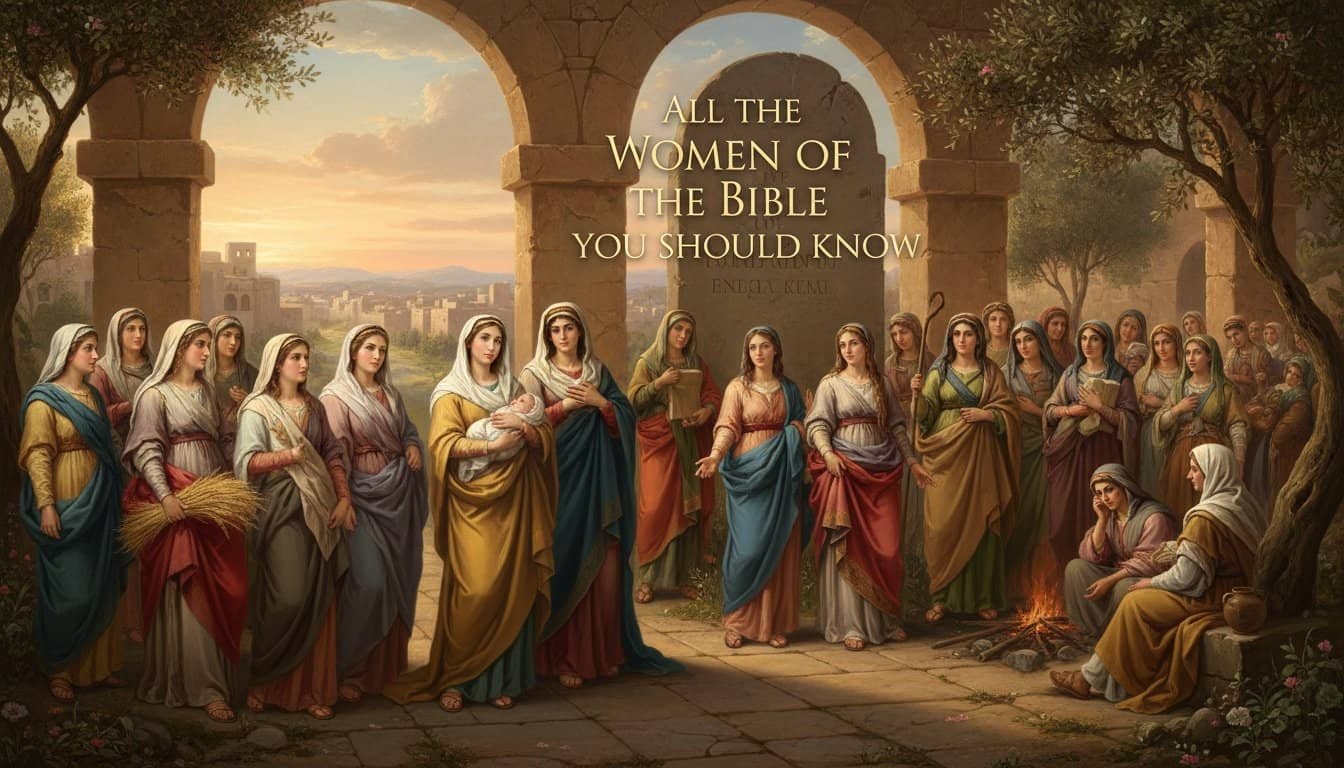
25 Apr All the Women of the Bible You Should Know
You’ll meet Eve, whose garden choice set humanity’s destiny; Sarah, whose trust birthed Isaac and the covenant; Miriam, who sang triumph after the Red Sea; Deborah, the judge‑prophetess who led Israel’s army; Ruth, the loyal Moabite whose line produced David; Hannah, whose prayerful vow gave Samuel; Esther, who risked her throne to save her people; Mary Magdalene, first to witness the risen Christ; Priscilla, who taught Apollos; Phoebe, the deaconess delivering Paul’s letter; and Lydia, who hosted the first house church. Keep going and you’ll discover how each woman shaped faith, leadership, and history.
Table of Contents
Foundational Biblical Women of the Old Testament
When you trace the roots of biblical history, the Old Testament’s foundational women—Eve, Sarah, Miriam, Deborah, and Ruth—stand out as the pillars of faith, leadership, and lineage that shape Israel’s story. You’ll see Eve’s choice in the garden sets humanity’s destiny, while Sarah’s trust in God’s promise brings forth Isaac, the covenant’s heir. Miriam’s song after the Red Sea celebrates deliverance, and her prophetic voice guides the people. Deborah’s decisive judgment and battlefield strategy deliver Israel from Canaanite oppression, showing that women can lead nations. Ruth’s loyalty to Naomi and marriage to Boaz secure a lineage that culminates in King David, confirming that devotion reshapes history. Each woman embodies a distinct virtue—curiosity, patience, courage, wisdom, and steadfast love—providing a template for faith and action that reverberates through the biblical narrative.
Prophetic Biblical Women Who Served as Judges
Building on the foundational women of the Old Testament, you now encounter prophetic figures who also held judicial authority. Deborah stands out as the archetype: a judge and prophetess who led Israel’s army, settled disputes, and delivered God’s law from the hill of Ephraim. Her song in Judges 5 still echoes her leadership and divine insight.
Though the text mentions only Deborah explicitly as a judge‑prophetess, Huldah’s role as a consulted prophet in 2 Kings 22 shows a similar blend of legal authority and divine revelation; she verified the Book of the Law and advised King Josiah on covenant renewal. Both women demonstrate that prophetic insight could accompany civic governance, shaping Israel’s moral and legal direction.
Their stories invite you to see biblical leadership as a partnership of spiritual discernment and judicial responsibility, reinforcing the notion that women exercised decisive authority in God‑ordered societies.
Genealogical Biblical Women and Their Legacy
Genealogical women in the Bible don’t just fill family trees—they shape the narrative’s destiny. You’ll notice Rebekah’s decisive choice at the well set Jacob’s lineage on a course that produced Israel’s twelve tribes. Leah’s prolific motherhood gave birth to six tribal founders, anchoring the nation’s identity. Rachel’s beloved status produced Joseph and Benjamin, linking the future king‑line to the story of redemption. Zipporah’s participation in the covenant ceremony affirmed the legitimacy of Moses’s leadership and his family’s role in delivering Israel. Bathsheba’s complex story culminated in Solomon’s reign, preserving the Davidic line that would later be celebrated in messianic expectations. Each of these women contributed more than names; they forged pivotal connections, secured inheritances, and ensured the continuity of God’s covenant across generations. Their legacies remind you that behind every pivotal figure lies a woman whose decisions and faith propelled biblical history forward.
Faithful Biblical Women Shaping the Messiah’s Lineage
Ever wondered how a handful of devoted women steered history toward the promised Messiah? You’ll see that the genealogy of Jesus isn’t a straight line of men; it’s woven through courageous women whose faith altered destiny.
Sarah, barren for decades, trusted God’s promise and birthed Isaac, the covenant’s cornerstone. Hannah’s desperate prayer produced Samuel, whose leadership secured Israel’s future and set the stage for David’s line.
Ruth, a Moabite outsider, clung to Naomi and embraced Israel’s God, becoming David’s great‑grandmother. Rahab, a Canaanite prostitute, sheltered spies, and her daring act earned her a place in the Messiah’s ancestry.
Bathsheba, though marred by scandal, bore Solomon, whose reign preserved the royal house. Each of these women, through obedience, perseverance, and bold faith, helped shape the bloodline that would bring the Savior into the world.
New‑Testament Biblical Women Who Pioneered the Early Church
The story of Jesus’s lineage shows how women of faith shaped history, and the same pattern continues in the New Testament as those women step onto the stage of the early church. You’ll meet Mary Magdalene, who first saw the risen Christ and announced the resurrection to the disciples, becoming the apostle to the apostles.
Martha, sister of Lazarus, models practical service and bold faith, inviting Jesus into her home and trusting his power over death.
Priscilla, together with Aquila, teaches Apollos more accurately about the way of God, demonstrating women’s role in theological instruction.
Phoebe carries Paul’s letter to the Romans, serving as a deaconess and trusted messenger.
Lydia opens her home to believers in Philippi, financing missions and creating a house church.
The Samaritan woman at the well spreads the good news beyond Jewish borders, showing how personal testimony fuels evangelism.
Each of these women pioneers leadership, hospitality, and proclamation, shaping the fledgling church’s identity and expansion.
Courageous Biblical Women Who Changed Israel’s History
When Israel faced existential threats, courageous women stepped forward to reshape its destiny. You’ll see how Deborah’s battlefield leadership turned a Canaanite onslaught into a triumph, her song still echoing in the hills. Miriam’s prophetic voice lifted the nation’s morale after the Red Sea crossing, and her sister’s sister‑in‑law, Huldah, halted idolatry by delivering God’s warning to Josiah.
Esther risked her crown to expose a murderous plot, saving her people from annihilation. Abigail’s quick diplomacy a bloodshed and won David’s respect, while Rahab’s daring shelter of spies earned her a place in the lineage of the Messiah. Jael’s decisive strike against Sisera shattered an enemy army, and Shiphrah’s defiance of Pharaoh’s decree saved countless Hebrew infants.
Each woman acted with boldness, shaping Israel’s history and proving that courage can alter a nation’s fate.
What Biblical Women Teach About Faith and Leadership Today
Courage isn’t just about battlefield tactics; it’s also about trusting God and guiding others with humility. When you study biblical women, you see faith and leadership woven together in everyday actions.
Deborah’s decisive judgment shows that authority can be exercised with wisdom, not aggression.
Ruth’s loyal perseverance teaches you that steadfast love fuels community restoration.
Mary Magdalene’s bold testimony after the resurrection reminds you that witnessing truth can reshape cultures.
Priscilla’s teaching alongside Aquila demonstrates that partnership and knowledge empower congregations.
Lydia’s hospitality creates a launchpad for new believers, showing that generosity opens doors for the gospel.
The Samaritan woman’s conversation with Jesus illustrates that personal encounters spark evangelism.
Each story invites you to lead with humility, trust God’s timing, and let faith drive your influence in any sphere today.
Frequently Asked Questions
Which Biblical Woman First Used a Name Meaning “Light”?
You should know that Lydia was the first biblical woman whose name means “light.” In Acts 16, Paul meets her in Philippi; the Greek name Λυδία derives from “lumen,” indicating brightness. She’s described as a dealer of purple cloth and a worshiper of God, and she becomes the first European convert, opening her home to believers. Her name’s meaning highlights her role as a spiritual illuminator in the early church.
How Many Women Are Explicitly Called “Prophetess” in Scripture?
You’ll find five women explicitly labeled “prophetess” in the Bible: Miriam (Exodus 15), Deborah (Judges 4‑5), Huldah (2 Kings 22), Anna (Luke 2), and the unnamed prophetess who warned Joash (2 Chronicles 34).
No other passages give the exact term “prophetess” to a woman, though several are described as having prophetic insight.
This count reflects the literal usage of the title.
Did Any Biblical Woman Hold a Political Office Besides Queen?
You won’t find a biblical woman holding a formal political office like a governor or mayor—only queens such as Esther and Bathsheba exercised sovereign authority.
The text does give women leadership roles—Deborah judged Israel, Huldah advised the king—but those are judicial or prophetic, not civic positions.
Which Woman’s Story Links the Old and New Testaments Through Genealogy?
You’re looking for Ruth. She’s a Moabite widow who marries Boaz, becomes David’s great‑grandmother, and appears in the genealogy of Jesus in Matthew 1. Her story bridges the Old Testament’s tribal history with the New Testament’s messianic line, showing how a foreign woman’s faith and loyalty link Israel’s past to Christ’s birth.
Are There Biblical Women Who Authored Any Surviving Texts?
You won’t find any biblical books bearing a woman’s name as author, but you do encounter women whose words survived. Miriam’s song in Exodus 15, Hannah’s prayer in 1 Samuel 2, and Anna’s proclamation in Luke 2 are quoted directly.
The New Testament records Mary Magdalene’s testimony (Matt 27‑28) and the Samaritan woman’s dialogue (John 4). These passages preserve their voices, even though they aren’t full manuscripts.
Conclusion
You’ve seen how these women—whether judges, prophets, ancestors, or early believers—shaped faith, leadership, and destiny. Their stories remind you that courage, wisdom, and devotion aren’t bound by era or role. By studying their lives, you can draw strength for today’s challenges, knowing that bold, faithful action can change history and inspire generations to come.










No Comments