

10 Sep Why Did Daniel Fast for 21 Days? Biblical Meaning and Lessons
You’ll discover Daniel fasted for twenty-one days after receiving a devastating vision about Israel’s future conflicts during Cyrus’s third year (536 BCE). He’d abstained from delicacies, meat, and wine while practicing hitpallel and tachanun, mourning the revelation’s weight. Gabriel’s response faced unprecedented opposition from the “prince of Persia” for twenty-one days until Michael intervened, revealing how your persistent prayer activates heavenly warfare—a cosmic reality that transforms understanding of spiritual authority.
Table of Contents
Key Takeaways
- Daniel fasted for 21 days after receiving a disturbing vision about Israel’s future struggles and persecution under successive kingdoms.
- The fast was a form of mourning and spiritual preparation to process the overwhelming revelation that left him physically and emotionally devastated.
- His prayer and fasting triggered spiritual warfare in heaven, where Gabriel faced 21-day opposition from the “prince of Persia.
- The fast coincided with Passover and involved abstaining from delicacies, meat, and wine while engaging in intense prayer three times daily.
- Daniel’s persistence demonstrated that breakthrough in spiritual matters requires sustained effort, as heavenly battles can delay divine responses to prayer.
The Historical Context of Daniel’s 21-Day Fast

When you examine Daniel 10:2-3, the prophet’s twenty-one day fast occurs during the third year of Cyrus king of Persia (approximately 536 BCE), a pivotal moment in Israel’s post-exilic history.
You’re witnessing Daniel’s response to disturbing revelations about his people’s future struggles, despite Cyrus’s decree permitting their return to Jerusalem.
The historical significance of this fast extends beyond personal devotion. Daniel’s abstinence from “pleasant bread” (lechem chamudot in Hebrew), meat, and wine reflects ancient practices of mourning and spiritual preparation common throughout Near Eastern cultures.

You’ll notice he doesn’t completely abstain from food but adopts a restricted diet, distinguishing this from absolute fasting.
This occurred during Nisan, coinciding with Passover and the Feast of Unleavened Bread, when Jews traditionally removed leaven.
Daniel’s fast represents intercessory prayer for national restoration, as only 50,000 exiles had returned while many remained in Babylon, creating theological tension about covenant fulfillment.
Daniel’s Troubling Vision That Prompted the Fast

You’ll find Daniel’s vision recorded in chapter 10 contained apocalyptic imagery of future conflicts between earthly kingdoms and spiritual powers, described with such intensity that it left him physically weakened and emotionally devastated (Dan. 10:8-9).
The Hebrew text emphasizes his profound distress through the phrase “ḥamdāt nišʾār-bî” (no strength remained in me), indicating a complete depletion that went beyond mere physical exhaustion to encompass psychological and spiritual anguish.

This visceral response to divine revelation—where Daniel mourned for three full weeks while processing the vision’s implications for Israel’s future suffering—demonstrates how prophetic insight often carries an unbearable emotional burden that necessitates extended periods of fasting and prayer.
Vision’s Disturbing Content
As Daniel gazed upon the prophetic panorama unfolding before him, the sheer magnitude of future devastation struck him with overwhelming force, compelling his three-week fast of mourning (Dan. 10:2-3).
You’ll notice the vision’s content revealed successive kingdoms’ rise and fall, depicting unprecedented warfare and persecution against God’s covenant people. The Hebrew term “ḥāzôn” (vision) conveyed not merely future events but their spiritual implications, showing cosmic conflict between divine and demonic forces.
The vision interpretation demanded spiritual preparation through fasting significance that transcended mere abstinence.
You’re witnessing Daniel’s response to revelations of the “abomination of desolation” and intense tribulation awaiting Israel. His prophetic sight penetrated centuries ahead, revealing Antiochus Epiphanes’ desecration and ultimately pointing toward eschatological fulfillment, prompting his desperate intercession.
Emotional Impact on Daniel
Though Daniel had received numerous revelations throughout his prophetic ministry, this particular vision left him physically depleted and emotionally devastated for twenty-one days, demonstrating the profound psychological toll of encountering divine mysteries (Dan. 10:8-9).
You’ll notice Daniel’s description reveals unprecedented emotional turmoil: “no strength remained in me” (כֹּחִי, koachi), indicating complete depletion of his life force. His “radiant appearance” transformed into “deathly pallor” (הוֹדִי נֶהְפַּךְ), suggesting the vision’s overwhelming nature exceeded human capacity to process.
When you examine Daniel’s response, you’re witnessing how divine revelation doesn’t always bring immediate spiritual clarity. Instead, it can shatter one’s equilibrium, requiring extended periods of mourning and fasting to integrate such weighty revelations.
The Hebrew term חָלִיתִי (chaliti, “I became weak”) emphasizes his prolonged suffering wasn’t merely physical but encompassed his entire being.
The Spiritual Disciplines Daniel Practiced During His Fast
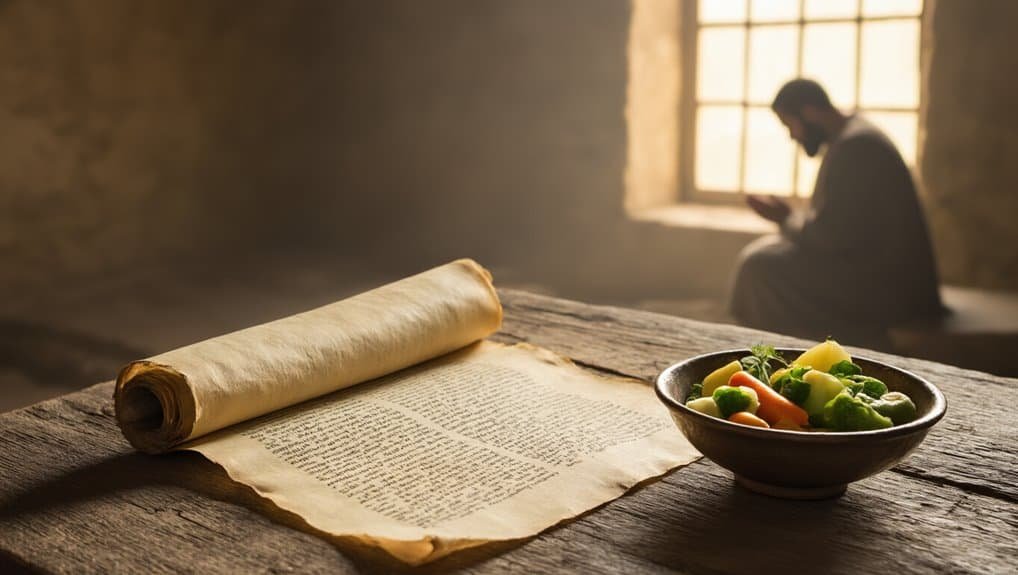
While Daniel’s twenty-one-day fast involved abstaining from delicacies, meat, and wine (Daniel 10:3), the text reveals that his physical discipline served as a framework for intensified spiritual practices.
You’ll notice Daniel engaged in hitpallel (התפלל) – reflexive prayer that transforms the supplicant. His thrice-daily prayers toward Jerusalem (Daniel 6:10) continued during the fast, demonstrating unwavering spiritual discipline despite physical weakness.
The fasting benefits extended beyond mere abstinence. Daniel practiced tachanun (תחנון), supplication marked by confession and petition (Daniel 9:3-19). He coupled fasting with sackcloth and ashes, external symbols reflecting internal contrition.
You can observe how he synchronized physical humiliation with spiritual seeking, creating space for divine revelation. His discipline included meditation on Jeremiah’s prophecies (Daniel 9:2), showing how fasting sharpened scriptural comprehension.
The Aramaic term ṣûm (צום) encompasses both the physical act and its spiritual intention, revealing fasting’s dual nature as bodily restraint facilitating spiritual receptivity.
What Daniel Abstained From: Understanding “Pleasant Food”
The Hebrew phrase lechem chamudot (לֶחֶם חֲמֻדוֹת), translated as “pleasant food” or “delicacies,” reveals Daniel’s comprehensive dietary restriction during his three-week fast (Daniel 10:3).
You’ll notice Daniel’s diet excluded three specific categories: meat (basar), wine (yayin), and oil for anointing (suk). This abstinence wasn’t merely about hunger but represented a deliberate spiritual discipline of self-denial.
When you examine the term chamudot, derived from the root חמד (chamad, “to desire”), you understand Daniel rejected foods that brought pleasure or comfort. He likely consumed only basic sustenance—water and simple vegetables or grains—similar to his earlier ten-day test in Babylon (Daniel 1:12).
This voluntary deprivation created space for heightened spiritual receptivity. By denying his flesh’s desires, Daniel positioned himself to receive divine revelation. His dietary restrictions functioned as an external expression of internal mourning and intercession for Israel’s restoration, demonstrating how physical abstinence can facilitate spiritual breakthrough.
The Role of Mourning and Grief in Daniel’s Prayer
You’re witnessing theological lament in action.
Daniel mourned not personal loss but corporate sin, embodying what Westermann calls “complaint directed toward God’s promises.”
His twenty-one days paralleled the three weeks between Passover and Shavuot, a period traditionally associated with counting the *omer* and spiritual refinement, transforming grief into purposeful intercession.
Spiritual Warfare Behind the 21-Day Delay
When you examine Daniel 10:12-13, you’ll discover that Gabriel’s delayed arrival wasn’t due to God’s reluctance but rather an unseen cosmic conflict involving the “prince of the kingdom of Persia” (שַׂר־מַלְכוּת פָּרַס).
This territorial spirit‘s resistance required Michael, identified as “one of the chief princes” (אַחַד הַשָּׂרִים הָרִאשֹׁנִים), to provide decisive intervention in the heavenly realm.
The twenty-one day battle reveals that your prayers initiate spiritual warfare in dimensions beyond human perception, where angelic forces contend with principalities that govern earthly kingdoms.
Angelic Battle Revealed
Although Daniel’s prayer received an immediate response in heaven (Daniel 10:12), the manifestation of that answer encountered unprecedented spiritual opposition for twenty-one days.
You’re witnessing the unveiling of cosmic warfare where territorial spirits exercise spiritual authority over earthly domains. The “prince of Persia” (שַׂר־פָּרַס, sar-Paras) represents a high-ranking entity within the angelic hierarchy opposing God’s messenger.
Michael’s intervention (Daniel 10:13) demonstrates the structured nature of spiritual battles. As “one of the chief princes” (אַחַד הַשָּׂרִים הָרִאשֹׁנִים), he possesses superior spiritual authority to break through demonic resistance.
This revelation exposes why you’ll sometimes experience delays despite God’s immediate response—unseen battles rage in heavenly realms. The twenty-one-day conflict wasn’t about God’s reluctance but about angelic forces contending for breakthrough in the spiritual dimension.
Prince of Persia
The prince of Persia (שַׂר־פָּרַס) represents a specific category of territorial spirit exercising delegated authority over the Persian Empire’s spiritual atmosphere.
You’re encountering here a מַלְאָךְ (malak) of considerable rank within Satan’s celestial hierarchy, positioned to influence earthly kingdoms through spiritual conflict. This entity’s resistance delayed Gabriel for twenty-one days, revealing organized opposition in the heavenlies (Ephesians 6:12).
When you examine Daniel 10:13, you’ll notice this prince isn’t merely symbolic but an actual spiritual being with governmental authority over Persia’s domain.
The text indicates structured spiritual conflict where territorial spirits maintain jurisdiction until divine intervention occurs. Michael’s assistance proved necessary to overcome this opposition, demonstrating that certain spiritual battles require higher-ranking angelic involvement.
This reveals why your prayers sometimes experience delays—not from God’s reluctance but from genuine warfare in celestial realms.
Michael’s Divine Intervention
As Gabriel struggled against the prince of Persia, Michael’s arrival marked a decisive turning point in the celestial conflict that had detained heaven’s messenger.
You’ll notice Michael’s designation as “one of the chief princes” (שַׂר הָרִאשֹׁנִים, sar ha-rishonim) establishes his preeminent authority in heaven’s hierarchy. His divine support enabled Gabriel’s breakthrough after twenty-one days of spiritual warfare.
Michael’s guidance specifically protected Israel’s interests, as Daniel 10:21 identifies him as “your prince” (שַׂרְכֶם, sarkhem).
You’re witnessing here the theological principle that earthly prayer activates heavenly armies. The Talmud (Yoma 77a) recognizes Michael as Israel’s advocate before God’s throne.
This intervention demonstrates that you’re not alone in spiritual battles—heaven dispatches its mightiest warriors when you persist in prayer and fasting, revealing the cosmic significance of your intercession.
The Angelic Messenger and the Prince of Persia
When Daniel’s three-week fast concluded, he encountered a celestial being whose appearance defied mortal comprehension—a figure clothed in linen with a face like lightning and eyes like flaming torches (Dan. 10:5-6).
This divine messenger revealed that he’d been dispatched immediately when you began praying, yet the “prince of Persia” (שַׂר־פָּרַס, sar-paras) detained him for twenty-one days (Dan. 10:13).
You’re witnessing unprecedented disclosure of angelic hierarchy and cosmic warfare. The text identifies territorial spirits exercising spiritual authority over earthly kingdoms—malevolent powers opposing God’s purposes through geopolitical influence.
Michael, designated as “one of the chief princes” (אַחַד הַשָּׂרִים הָרִאשֹׁנִים), intervened to break this supernatural deadlock.
This passage illuminates why your prayers sometimes experience delays. You’re not contending merely with human opposition but with organized principalities systematically resisting heaven’s agenda.
The messenger’s struggle demonstrates that spiritual authority operates through contested realms where angelic forces clash over nations’ destinies.
Why God Delayed His Response to Daniel
You’ll notice that God’s response to Daniel wasn’t delayed by divine indifference but by cosmic resistance—the Hebrew term שַׂר (sar, “prince”) in Daniel 10:13 designates a high-ranking spiritual entity who opposed the angelic messenger for twenty-one days.
This textual evidence reveals that your prayers can encounter territorial opposition in the heavenly realms, where malevolent principalities actively resist God’s messengers as described in Ephesians 6:12’s stratified hierarchy of spiritual powers.
The protracted battle between God’s angel and the Prince of Persia demonstrates that divine answers sometimes require angelic warfare to break through satanic blockades established over nations and regions.
Spiritual Warfare Interference
Though Daniel’s prayer reached heaven immediately upon his lips (Daniel 10:12), the manifestation of God’s answer encountered a twenty-one-day delay due to direct spiritual opposition in the celestial realm.
The angelic messenger explicitly revealed that the “prince of Persia” (שַׂר־פָּרַס, sar-Paras) withstood him for twenty-one days, requiring Michael’s intervention (Daniel 10:13). This confrontation exposes the reality of territorial principalities governing earthly kingdoms, as Paul later affirms in Ephesians 6:12.
You’re witnessing here how spiritual resilience becomes essential when heaven’s answers face demonic resistance.
Daniel’s prayer strategies—combining fasting with persistent intercession—didn’t overcome God’s reluctance but rather sustained the cosmic battle until breakthrough occurred.
The text demonstrates that delayed answers don’t indicate divine rejection but often signal intensified spiritual warfare requiring steadfast endurance.
Angelic Battle Delays
Since God dispatched His messenger immediately when Daniel began praying (Daniel 10:12), the twenty-one-day delay stemmed not from divine hesitation but from active resistance in the second heaven where territorial spirits operate.
The “prince of Persia” (שַׂר פָּרַס, sar paras) represents a principality within the angelic hierarchy opposing God’s purposes. This territorial archon wielded sufficient power to withstand Gabriel until Michael’s intervention (v. 13).
You’re witnessing the spiritual significance of persistent prayer during cosmic warfare. Daniel’s fasting didn’t change God’s mind—it sustained the prophet through the unseen battle.
The text reveals stratified spiritual dominions where malevolent powers govern earthly kingdoms (Ephesians 6:12). Your prayers traverse contested realms where opposing forces resist divine responses, necessitating endurance until breakthrough manifests.
The Prophetic Revelation Daniel Received After 21 Days
After Gabriel touched Daniel and strengthened him at the conclusion of the twenty-one day fast (Dan. 10:18-19), the angelic messenger unveiled an extraordinary prophetic panorama spanning from the Persian Empire through the eschaton.
You’ll notice the divine revelation contained in chapters 11-12 represents Scripture’s most detailed pre-written history, chronicling the Ptolemaic-Seleucid conflicts with remarkable precision.
The prophetic significance extends beyond mere historical prediction. Gabriel’s message (מַרְאֶה, mar’eh) encompasses the “time of trouble” (עֵת צָרָה, et tsarah) unprecedented in scope (Dan. 12:1), culminating in resurrection and final judgment.
You’re witnessing Daniel receive insight into the cosmic struggle between earthly kingdoms and God’s sovereign purposes.
This revelation wasn’t merely informational—it demanded Daniel’s participation through continued prayer warfare. The angel’s departing words, “I must return to fight against the prince of Persia” (10:20), indicate the spiritual battle continued even as prophetic mysteries unfolded.
Lessons From Daniel’s Persistence in Prayer and Fasting
You’ll discover that persistence in prayer isn’t about changing God’s mind but aligning yourself with His purposes.
Daniel’s continued fasting and petition, even without immediate breakthrough, reveals spiritual warfare’s reality (Dan. 10:13). The prince of Persia’s resistance shows you’re engaging cosmic forces requiring sustained spiritual discipline.
The fasting benefits extend beyond physical deprivation—they cultivate spiritual acuity and humility before God.
Daniel’s persistence teaches you that breakthrough often comes precisely when you’re tempted to abandon hope. His twenty-one-day commitment proves that spiritual victories demand endurance, not mere momentary devotion.
Frequently Asked Questions
Can Christians Today Do a Daniel Fast for Personal Breakthrough?
Yes, you can practice the Daniel Fast as a spiritual discipline for personal breakthrough.
While Daniel’s fast (Hebrew: צוֹם, tzom) served specific prophetic purposes in Daniel 10:3, you’re applying timeless biblical principles of consecration.
This practice facilitates personal growth through dietary restriction coupled with intensified prayer.
Reformed theologians like Richard Foster affirm fasting’s role in spiritual formation, though you must avoid viewing it as meritorious work rather than means of grace.
What Specific Foods Can I Eat During a Modern Daniel Fast?
You’ll consume only plant-based foods during your Daniel Fast, following Daniel 10:3’s dietary restrictions.
Your vegetable options include leafy greens, cruciferous vegetables, root vegetables, and legumes—all unprocessed forms. Fruits, whole grains, nuts, and water constitute permitted sustenance.
The Hebrew term “ḥamudot” (pleasant bread) indicates abstaining from delicacies.
These fasting benefits emerge through simplified nutrition while maintaining adequate nourishment, facilitating spiritual focus alongside physical discipline during your consecrated period.
Is the Daniel Fast Safe for People With Medical Conditions?
You shouldn’t undertake the Daniel Fast with medical conditions without consulting your physician first.
The Hebrew term צוֹם (tzom) implies abstinence, but Scripture prioritizes life (pikuach nefesh).
Theological scholars note Daniel’s practice wasn’t prescriptive but descriptive (Daniel 10:3).
Modern fasting guidelines must accommodate diabetes, heart disease, pregnancy, and medication requirements.
Paul’s teaching on bodily stewardship (1 Corinthians 6:19-20) suggests adapting spiritual disciplines to preserve health while maintaining devotional intent.
How Does the Daniel Fast Differ From Other Biblical Fasts?
You’ll find the Daniel fast differs from other Biblical fasting practices through its partial abstinence model.
While traditional fasting types like those in Joel 2:12 involve complete food restriction (צוֹם, tzom), Daniel’s approach allowed vegetables and water (Daniel 10:3).
Unlike Esther’s absolute fast or Christ’s wilderness fast, you’re practicing dietary modification rather than total abstention.
This distinction reflects Daniel’s need to maintain strength while seeking divine revelation through extended spiritual discipline.
Should I Consult My Pastor Before Starting a Daniel Fast?
You’re not biblically required to consult your pastor before undertaking a Daniel fast, though pastoral guidance can provide valuable accountability and wisdom (Hebrews 13:17).
Your spiritual readiness matters more than formal permission—examine your heart’s motivation (Hebrew: *kavanah*, intention).
Consider seeking pastoral counsel if you’re new to fasting, have health concerns, or sense God leading you toward communal participation.
Your pastor can offer theological insights and prayer support for your journey.
Conclusion
You’ve discovered through Daniel’s 21-day fast (Daniel 10:3) that spiritual breakthrough often requires persistent prayer despite divine delays. When you’re troubled by revelation or circumstance, following Daniel’s model of *ta’anit* (fasting) and *hitpallel* (intercession) can position you for heavenly response. You’ll face spiritual opposition—the “Prince of Persia” represents *kosmokratōr* forces (Ephesians 6:12)—but don’t surrender. Your persistence moves heaven’s armies. Daniel’s experience proves that breakthrough comes to those who won’t relent until heaven answers.





No Comments