

18 Apr 5 Historical Contexts Behind Isaiah’s Prophecies Explained
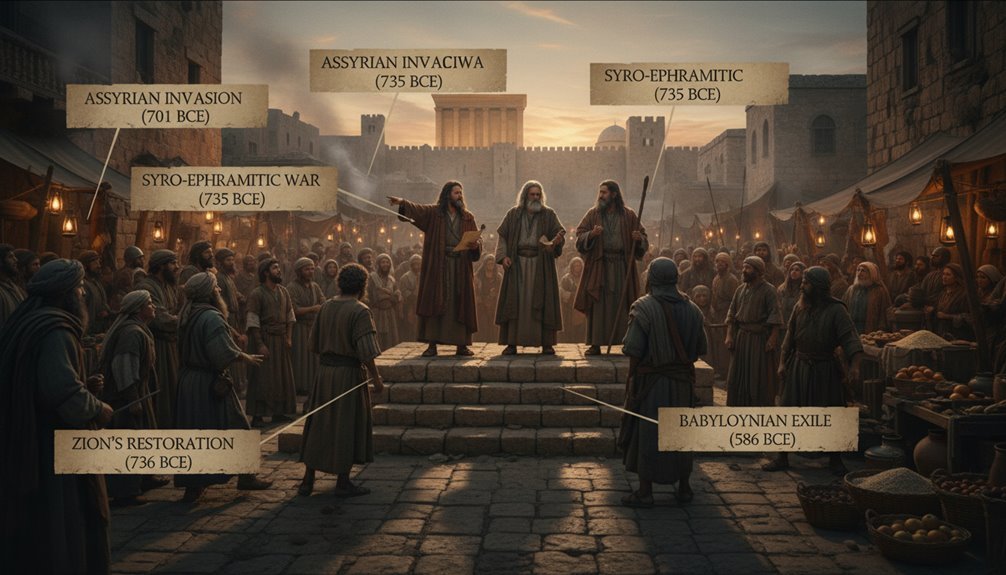
You’ll see how the Assyrian siege of Samaria in 722 BCE shattered Israel’s identity and sparked the first “servant” motifs, how the Babylonian exile and temple’s in 586 BCE reshaped the servant into a faithful remnant, how Cyrus’s 538 BCE decree let the exiles return and rebuild worship, how post‑exilic reforms cemented covenant fidelity in new servant songs, and how Hellenistic ideas later recast the servant as a universal ethical ideal—keep going to discover each layer in depth.
Table of Contents
What the Assyrian Invasion Did to Samaria and Early Isaiah Servant Themes?
How did the Assyrian on reshape Samaria and set the stage for Isaiah’s early servant motifs? You see the Assyrians stormed Samaria in 722 BCE, deporting most Israelites and installing foreign settlers. This demographic upheaval shattered the kingdom’s identity, leaving a shattered, vulnerable community. You witness the prophet Isaiah interpreting the disaster as divine judgment, yet also as a call for renewal. He frames a “servant” figure who embodies Israel’s suffering and future restoration, reflecting the collective trauma of exile. The servant isn’t a single individual but a corporate voice for the remnant, tasked with bearing the nation’s sins and heralding hope. You recognize that this early motif emerges directly from the Assyrian devastation, linking national catastrophe to a theological narrative that promises redemption through faithful obedience. This backdrop fuels Isaiah’s later, more elaborate servant songs, grounding them in lived experience.
Babylonian Exile, Temple Destruction, and the Servant Narrative
When the Babylonians razed Jerusalem in 586 BCE and carried the people into exile, the loss of the temple and the rupture of cultic life forced Israel to rethink its identity, and Isaiah’s servant motif shifted from a corporate remnant to a singular, faithful voice that could endure suffering while embodying hope for restoration. You feel the terror of a shattered sanctuary, yet you also sense a new theological resilience. The exile dissolves the old covenantal framework, prompting Isaiah to recast the servant as a representative of the faithful remnant, a person who bears the nation’s grief and yet speaks of divine vindication. This re‑imagined servant becomes a conduit for prophetic assurance, reminding you that God’s covenant persists beyond stone walls. You recognize that the narrative now stresses personal obedience, inner devotion, and collective hope, preparing you for eventual return and rebuilding under a renewed divine promise.
When Persia Rose, How Did the Exiles Return?
The fall of Babylon opened the door for the Persian Empire, and Cyrus the Great’s decree in 538 BCE invited the exiles back to Judah. You’ll see that Cyrus framed his policy as a divine mandate, proclaiming that the LORD had stirred his heart to restore the temple. Administratively, he appointed a governor, Gobryas, to oversee the return, and he allocated funds from the royal treasury for rebuilding.
You travel with a convoy of families, artisans, and priests, each carrying personal belongings and sacred objects salvaged from Babylon. The journey follows the Euphrates, then the Jordan, where you encounter a mixture of hostility and hospitality from remaining locals.
Upon arrival, you witness the reconstruction of the altar, the re‑establishment of worship, and the re‑founding of a community that had survived exile. This organized, state‑supported repatriation reshapes Jewish identity and sets the stage for the post‑exilic reforms that follow.
Post‑Exilic Worship Reforms and Isaiah’s Servant Songs
After the temple’s walls rose again, the community seized the chance to reshape its worship, and Isaiah’s servant songs became the theological backbone of those reforms. You’ll notice that the leaders prioritized a liturgy that emphasized covenant fidelity, and they used the servant motifs to illustrate a new, obedient Israel. The songs, especially those in Isaiah 42, 49, and 53, reframed suffering as redemptive service, encouraging priests to teach that the servant’s humility mirrored the nation’s need for repentance.
You’ll see reforms that re‑established Sabbath observance, purified altar rites, and introduced prophetic readings during festivals, all anchored in the servant’s image of faithful obedience. By aligning worship with these texts, you help the community internalize a vision where collective identity rests on serving God rather than merely restoring a building. This theological shift sustains unity and guides moral conduct throughout the post‑exilic era.
Hellenistic Influence on Later Isaiah Servant Interpretations
Although Alexander’s conquests reshaped the Mediterranean, Jewish scholars began re‑reading Isaiah’s servant songs through a Hellenistic lens, interpreting the servant as a universal moral exemplar rather than a solely national figure. You’ll notice they borrowed Greek philosophical categories—virtue, logos, and the ideal of the “philosopher‑king”—to frame the servant’s mission. This shift allowed them to dialogue with contemporary Hellenistic thought, presenting the servant as embodying rational ethics and cosmic order. You’ll see the influence in the way later rabbinic commentaries cite Stoic ideas of natural law, arguing that the servant’s suffering serves a didactic purpose for all humanity. Moreover, the Hellenistic diaspora’s exposure to Alexandrian scholarship encouraged a more allegorical reading, moving away from strictly historical nationalism. By adopting these perspectives, you understand how the servant motif evolved into a bridge between Jewish tradition and the broader Greco‑Roman intellectual world.
Frequently Asked Questions
How Did Isaiah’s Prophecies Influence Later Jewish Liturgy?
You’ll find that Isaiah’s visions shape much of Jewish liturgy, especially the High Holy Days. His calls for repentance echo in Selichot and the Yom Kippur confession. The “servant” passages inspire the Amidah’s petitions for redemption. The “holy one” language fuels the Kedushah and the daily blessings. Even the “peace” and “justice” motifs in Isaiah permeate the Birkat HaMazon, guiding worshippers toward hope and moral renewal.
What Archaeological Evidence Supports Isaiah’s Historical Context?
You’ll find that the Tell Qasile ostracon, the Siloam inscription, and the Bullae bearing “Isaiah” confirm a 8th‑century Judean setting.
The Mesha Stele mentions Israel’s king during Judah’s turmoil, matching Isaiah’s references.
Excavations at Lachish and Hezekiah’s tunnel reveal massive fortifications and waterworks that align with his calls for repentance and divine protection.
Together, these finds anchor Isaiah’s prophecies in a concrete historical landscape.
Did Isaiah’s Servant Motifs Affect Early Christian Theology?
You’ll find that Isaiah’s servant motifs shaped early Christian theology profoundly. They provided a scriptural foundation for seeing Jesus as the promised servant who suffers, dies, and redeems humanity. The New Testament writers quoted Isaiah 53 and related passages to argue that Christ fulfilled these prophecies, framing his mission as a divine, sacrificial service. This connection reinforced doctrines of atonement, messianic identity, and the continuity between Hebrew prophecy and Christian belief.
How Were Isaiah’s Texts Used in Medieval Jewish Mysticism?
You’ll find that medieval Jewish mystics treated Isaiah’s texts as a key source for prophetic insight and divine cryptography. They quoted his visions to illustrate the hidden workings of the divine realm, especially in the Zohar and Sefer Yetzirah. By interpreting Isaiah’s “holy one” and “new heavens,” they linked his language to the emanation of sefirot, using his verses to map spiritual ascent and to legitimize mystical rituals.
What Role Did Political Propaganda Play in Isaiah’s Writings?
You see political propaganda shaping Isaiah’s writings as a tool to rally Judah around a divine mandate, urging loyalty to the Davidic line and resistance against foreign domination.
He frames foreign powers as instruments of God’s judgment, turning geopolitical threats into moral lessons.
Conclusion
You’ve seen how each era—Assyrian siege, Babylonian exile, Persian restoration, post‑exilic reforms, and Hellenistic thought—shaped Isaiah’s servant imagery. These contexts reveal a prophetic voice that evolves with history, turning suffering into hope and divine purpose. Understanding this timeline lets you grasp the depth of Isaiah’s messages and their lasting impact across centuries.











No Comments