

05 Mar Why Does Jesus Entry Fulfill Typology?
Jesus’ triumphal entry fulfills Old Testament typology by demonstrating how He is the long-awaited Messiah whose peaceful kingdom was prophesied. By riding a donkey, He aligns with Zechariah’s predictions, symbolizing His humble kingship. The crowds’ celebration with palm branches and shouts of “Hosanna” further validate His Messianic identity, uniting the Old and New Testaments. This prelude to Passion Week establishes the path to salvation not through military might, but through sacrifice – a deeper understanding of which you’ll find as you continue exploring this event.
Key Takeaways
- Jesus’ triumphal entry into Jerusalem fulfills Old Testament prophecies about the Messiah, establishing his identity as the anointed one.
- The donkey riding fulfills Zechariah’s prophecy, emphasizing Jesus’ humility and the peaceful nature of his kingdom.
- The crowds’ celebration with palm branches and shouts of “Hosanna” validate Jesus’ messianic identity.
- Jesus’ entry demonstrates continuity between the Old and New Testaments, as the culmination of God’s redemptive plan.
- The triumphal entry sets the stage for Jesus’ crucifixion and resurrection, linking his sacrifice to ultimate victory over sin and death.
The Significance of Jesus’ Triumphal Entry
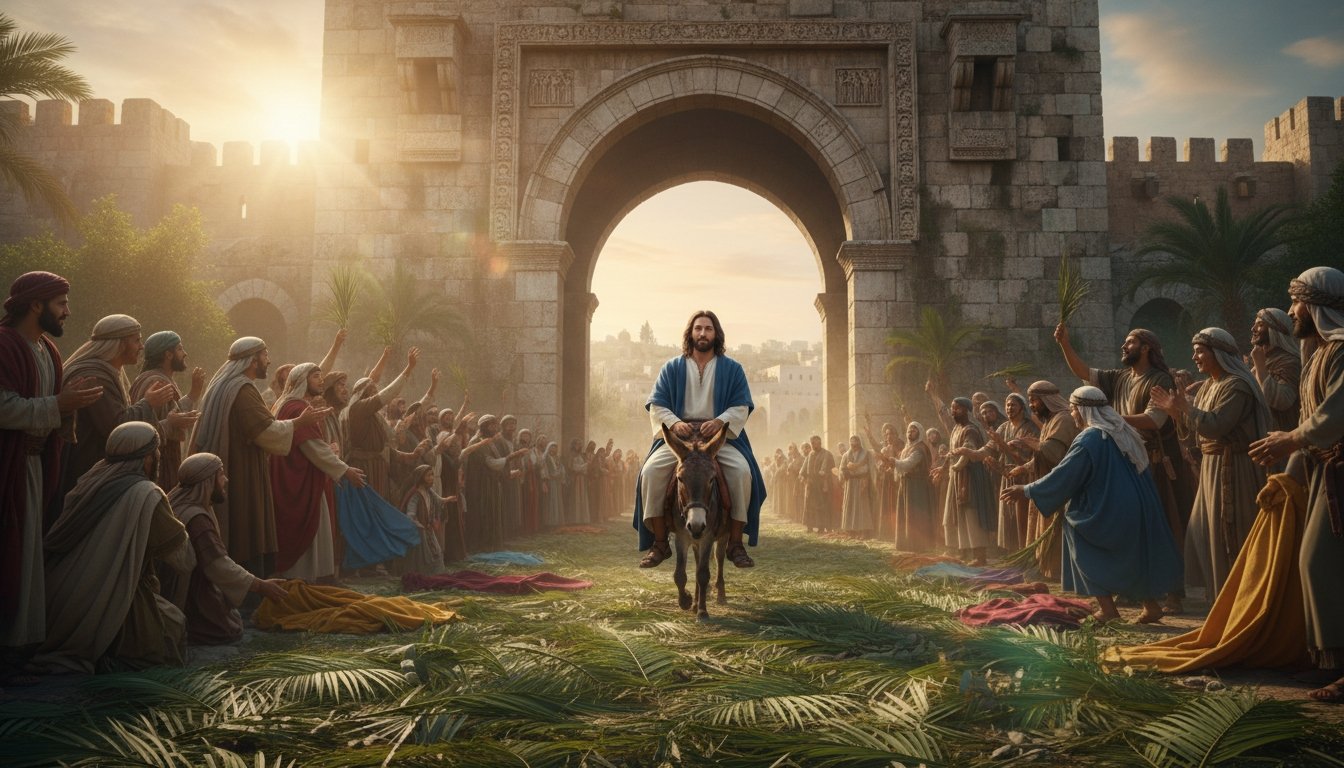
Why did Jesus’ triumphal entry into Jerusalem hold such significance? It fulfilled numerous Old Testament prophecies about the Messiah’s arrival. Jesus deliberately chose to enter the city riding on a donkey, fulfilling Zechariah’s prediction of the king coming humbly, not in a conquering chariot. The crowds’ joyful welcome, waving palm branches and shouting “Hosanna!”, mirrored the ancient custom of celebrating a victorious king. This event marked Jesus’ public declaration of His Messiahship and kingdom. His entry symbolized His rightful claim to the throne of David. Ultimately, Jesus’ triumphal entrance set the stage for His final week, culminating in His crucifixion and resurrection – the pivotal events that would secure salvation for all who believe.
Old Testament Prophetic Fulfillment in Jesus’ Arrival
Jesus’ triumphal entry into Jerusalem didn’t just symbolize His rightful claim to the throne of David. It also fulfilled Old Testament prophecies, demonstrating that He’s the Messiah long promised. You see, Zechariah foretold the arrival of the king riding on a donkey. This pointed to Jesus’ humble nature and peaceful kingdom, not a military conquest.
Plus, the crowds’ shouts of “Hosanna” echoed Psalm 118, where the Messiah is greeted. Jesus’ actions clearly identified Him as the anointed one. By aligning with these ancient prophecies, He proved His divine identity and role as the Savior.
His entry underscored that He’s the culmination of God’s redemptive plan revealed throughout the Old Testament.
The Symbolic Meaning of Jesus Riding on a Donkey
The symbolic meaning of Jesus riding on a donkey can’t be overstated. It’s a powerful image that connects Jesus to the Old Testament prophecies and underscores His identity as the promised Messiah. Riding a donkey was a sign of humility and peace, in contrast to the war horses of conquering kings. Jesus deliberately chose this mode of transportation to fulfill Zechariah’s prophecy and demonstrate that His kingdom isn’t of this world.
His entry into Jerusalem on a donkey proclaimed His role as the humble, servant-king who’d bring salvation, not through military might, but through sacrificial love. This symbolic act highlighted Jesus’ true nature and mission, setting the stage for His ultimate triumph over sin and death on the cross.
Frequently Asked Questions
What Is the Connection Between Jesus’ Entry and Old Testament Typology?
Jesus’ entry into Jerusalem fulfills Old Testament typology because it points back to significant figures and events in the Hebrew Scriptures. His triumphal entry as the Messianic King echoes the coronations of biblical kings, while his humble and peaceful arrival on a donkey aligns with the prophecies about the coming Messiah. This connection demonstrates how Jesus is the culmination and fulfillment of God’s plan revealed throughout the Old Testament.
How Does Jesus’ Triumphal Entry Relate to His Role as Messiah?
Jesus’ triumphal entry relates to his role as Messiah by fulfilling Old Testament prophecies and typologies. His arrival on a donkey symbolizes his humble and peaceful kingship, contrasting with the conquering warrior-king expected by many. This event marked the beginning of his public ministry and presentation as the long-awaited Messiah who’d bring salvation and establish God’s eternal kingdom.
Why Did Jesus Choose to Ride a Donkey Into Jerusalem?
Jesus chose to ride a donkey into Jerusalem because it fulfilled Old Testament prophecy and typology of the Messianic King.
The donkey was a symbol of humility, peace, and service – reflecting Jesus’ role as the Suffering Servant who’d establish His kingdom, not through military might, but through sacrificial love.
This entry demonstrated Jesus’ true identity as the long-awaited Messiah.
What Are the Theological Implications of Jesus’ Fulfillment of Prophecy?
Jesus’ fulfillment of the prophecy of the Messiah riding into Jerusalem on a donkey has profound theological implications. It demonstrates that Jesus is the promised Messiah, the Son of God, and the King of Israel. His humble entry on a donkey, rather than a warhorse, shows His servant leadership and the nature of His kingdom, which isn’t of this world.
How Does Jesus’ Triumphal Entry Challenge Traditional Messianic Expectations?
Jesus’ triumphal entry challenges traditional messianic expectations by subverting the common notion of a powerful, conquering king.
Instead, he arrives humbly on a donkey, demonstrating his kingdom isn’t of this world.
This fulfills prophecy and typology, revealing Jesus as the true Messiah who comes not to conquer by force but to serve and save through self-sacrifice.
Conclusion
You’ll find that Jesus’ triumphal entry fulfills Old Testament prophecy, demonstrating He’s the long-awaited Messiah. By riding a donkey, He’s revealed as a humble, yet powerful, king who’s come to save His people. This symbolic event points to the deeper spiritual truths Jesus embodies – the fulfillment of God’s plan for redemption.






No Comments