

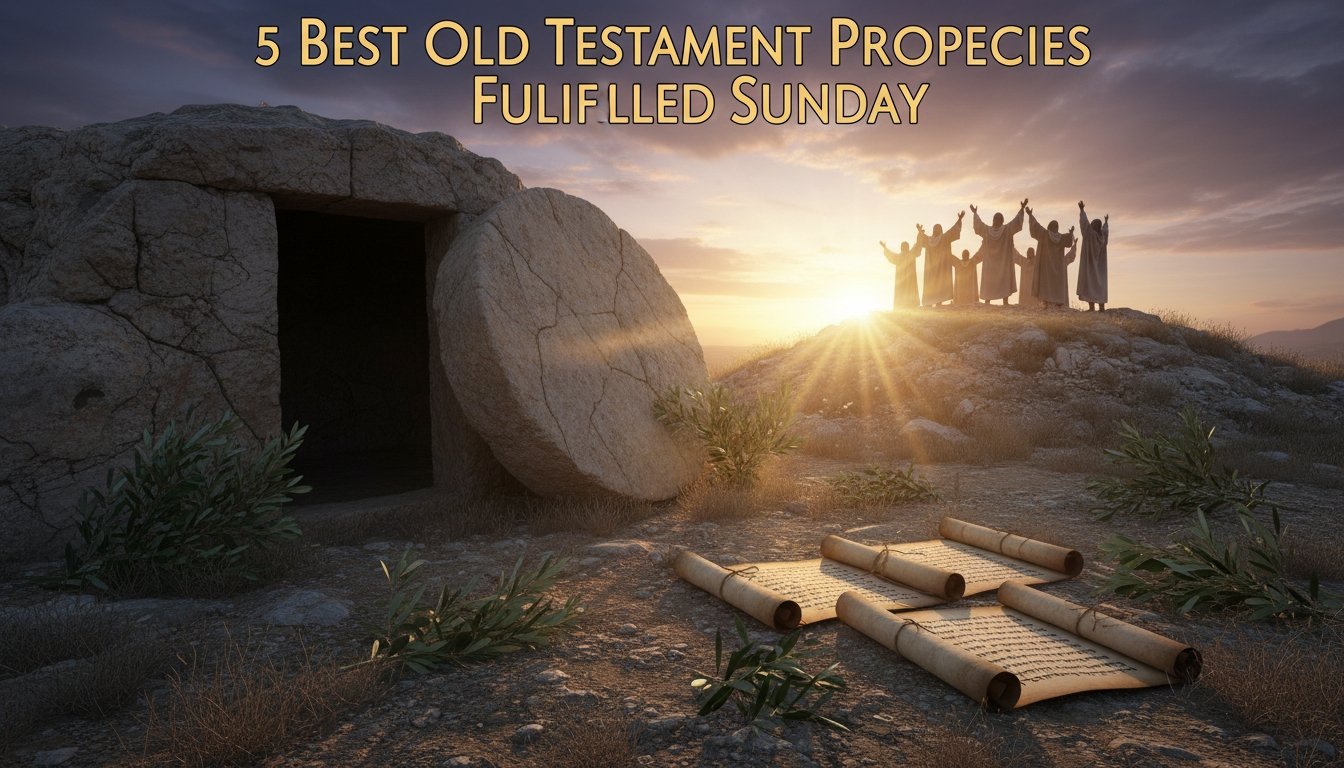
09 Mar 5 Best Old Testament Prophecies Fulfilled Sunday
You’ll be amazed by the 5 best Old Testament prophecies fulfilled on that first Palm Sunday. Jesus fulfilled Zechariah’s prophecy of the Messiah entering Jerusalem humbly on a donkey. Isaiah foretold the Suffering Servant, which Jesus embodied. Jeremiah’s warning about the cursed fig tree foreshadowed Jerusalem’s judgment. Ezekiel’s vision of dry bones coming to life mirrors Christ’s resurrection. And Malachi’s prophecy of the Lord purifying His temple is seen in Jesus cleansing the temple. There’s much more to discover about these remarkable fulfillments.
Table of Contents
Key Takeaways
- The Triumphal Entry into Jerusalem, where Jesus fulfills Zechariah’s prophecy by entering humbly on a donkey as the long-awaited Messiah.
- The Suffering Servant prophecy in Isaiah, which foreshadows Christ’s suffering, death, and salvation brought through his sacrifice.
- The cursed fig tree in Jeremiah, symbolizing the judgment and desolation that would befall the fruitless and rebellious nation of Judah.
- Ezekiel’s vision of the valley of dry bones, which prefigures Christ’s resurrection and God’s power to restore and revive.
- The cleansing of the temple, as predicted in Malachi, where Jesus drives out the corrupt merchants and money changers, restoring the temple as a house of prayer.
The Triumphal Entry: Fulfilling Zechariah’s Prophecy
One of the most significant Old Testament prophecies fulfilled on that fateful Sunday was the Triumphal Entry, as foretold by the prophet Zechariah. Centuries earlier, Zechariah had proclaimed that the Messiah would enter Jerusalem, “humble and mounted on a donkey” (Zechariah 9:9). As Jesus rode into the city, the crowds welcomed Him as the long-awaited King, waving palm branches and shouting, “Hosanna!” This event not only fulfilled Zechariah’s specific prophecy but also demonstrated Jesus’ divine authority and the people’s recognition of Him as the Messiah. The Triumphal Entry marked a pivotal moment in the life of Christ, paving the way for His final week on earth and the ultimate fulfillment of God’s redemptive plan.
The Suffering Servant: Isaiah’s Foresight
The prophet Isaiah’s foresight concerning the Suffering Servant is another profound Old Testament prophecy fulfilled in the life and death of Jesus Christ. Isaiah foretold that the Messiah would be “despised and rejected by mankind” and would “suffer and be acquainted with grief.” This aligns perfectly with Christ’s rejection, torture, and crucifixion.
Isaiah also described the Servant as being “led like a lamb to the slaughter” and bearing “the sin of many.” This prescient imagery points directly to Jesus, the Lamb of God, sacrificing Himself for the sins of humanity.
The Suffering Servant prophecy underscores how the Old Testament repeatedly foreshadowed the Messiah’s suffering and the salvation He’d bring.
The Cursed Fig Tree: Jeremiah’s Warning
Why did the prophet Jeremiah issue a warning about the cursed fig tree?
Jeremiah’s prophecy foretold the destruction of Judah and Jerusalem due to the people’s sin and idolatry. The fig tree symbolized the nation of Judah – fruitless and cursed. Jeremiah warned that God would strip away their prosperity and leave them desolate if they refused to repent.
Jeremiah’s prophecy foretold the destruction of Judah and Jerusalem due to the people’s sin and idolatry. The fig tree symbolized the fruitless and cursed nation.
Sure enough, Babylonian armies invaded, sacked Jerusalem, and carried the people into exile. Jeremiah’s sobering words proved true – the cursed fig tree withered, just as he’d predicted.
This ancient warning reminds us that God won’t tolerate sin indefinitely. He desires our repentance, but if we persist in rebellion, we risk experiencing His righteous judgment.
Ezekiel’s Vision and the Resurrection of Christ
How does Ezekiel’s vision of the valley of dry bones connect to the resurrection of Christ? In Ezekiel 37, God shows the prophet a valley filled with lifeless, dried-up bones. Yet, at God’s command, the bones come together, are covered with sinews and flesh, and are revived – a powerful picture of the resurrection. This foreshadows Christ’s victory over death. Just as God breathed life into the dry bones, He raised Jesus from the grave, conquering sin and death. Ezekiel’s vision points to the ultimate triumph of the Messiah, who’d bring new life to those dead in sin. The resurrection demonstrates Christ’s power to restore what was lost, renewing our hope in God’s ability to redeem the seemingly hopeless. Ezekiel’s vision and the resurrection are inextricably linked, both revealing God’s sovereign plan to restore and revive His people.
The Cleansing of the Temple: Malachi’s Prophecy
Surely, Malachi’s prophecy of the Messiah’s arrival found remarkable fulfillment in Jesus’ cleansing of the temple. The prophet had foretold that the Lord would suddenly come to his temple, purifying the Levites and refining them like gold and silver. True to this word, Jesus stormed into the temple courts, denouncing the merchants and money changers who’d corrupted God’s house. He drove them out with a whip, overturning tables and declaring, “My Father’s house shall be a house of prayer, but you have made it a den of robbers.” This dramatic episode demonstrated Jesus’ zeal for holiness and his authority as the Messiah, the messenger of the covenant.
Frequently Asked Questions
What Is the Significance of the Number Seven in Biblical Prophecy?
The number seven holds great significance in biblical prophecy. It represents completeness, perfection, and divine fulfillment. From the seven days of creation to the seven seals of Revelation, the number seven symbolizes God’s sovereign plan unfolding. Prophetic passages often utilize this number to convey the totality and certainty of the events foretold, highlighting the perfect timing and execution of the divine will.
How Do Old Testament Prophecies Relate to Modern-Day Events?
Old Testament prophecies relate to modern-day events by providing a framework for understanding God’s plan and purposes throughout history. These prophecies offer insight into the ongoing spiritual battle between good and evil, and they point to the ultimate fulfillment of God’s promises in the life, death, and resurrection of Jesus Christ. Paying attention to how these ancient prophecies continue to be realized can deepen your faith and strengthen your hope in God’s sovereign control over the world.
What Is the Role of Fasting in Interpreting Biblical Prophecies?
Fasting can play a crucial role in interpreting biblical prophecies.
By denying physical needs, you open yourself to greater spiritual awareness and discernment.
This heightened state allows you to perceive nuances and symbolic meaning within the prophecies that may otherwise be missed.
Fasting also aligns your heart and mind with God, enabling you to receive His wisdom and guidance in understanding prophetic messages.
How Can We Verify the Authenticity of Old Testament Prophecies?
To verify the authenticity of Old Testament prophecies, you can examine their historical and contextual accuracy, their fulfillment in later events, and their coherence with the broader biblical narrative.
Look for specific details that were accurately predicted, corroboration from other sources, and a clear connection between the prophecy and its eventual realization.
This meticulous analysis can help establish the reliability of these ancient prophetic utterances.
What Are the Implications of Fulfilled Prophecies for Christian Theology?
The fulfillment of Old Testament prophecies in the New Testament has profound implications for Christian theology. It affirms the divine inspiration of Scripture, validates Jesus as the Messiah, and demonstrates God’s sovereignty over history. These fulfilled prophecies strengthen the believer’s faith, bolster the reliability of the Bible, and underscore the seamless unity between the Old and New Testaments.
Conclusion
You’ve seen how the Old Testament prophecies were fulfilled on that pivotal Sunday. The Triumphal Entry, the Suffering Servant, the cursed fig tree, Ezekiel’s vision, and the Cleansing of the Temple – they all came to pass, just as the prophets had foretold. These events confirm the divine inspiration of Scripture and the power of God’s plan for salvation.






No Comments