


23 Dec Why Christmas Is the Best Holiday Science, Traditions, and Joy You Can Feel in 2025
Christmas triggers measurable neurochemical changes in your brain, with psychiatric emergency visits dropping 40% as anticipatory dopamine floods your reward systems during familiar rituals. You’re joining 88% of Americans and 77% of non-Christians participating in 2025’s record-breaking celebrations, spending an average $902 on traditions that create “perceived controllability” and reduce mental fatigue. Real Christmas trees provide sensory restoration while collective rituals like tree decorating and communal feasting generate happiness that transcends religious boundaries, creating universal cultural practices that science confirms.
Table of Contents
Key Takeaways
- Christmas triggers measurable dopamine surges and anticipatory reward activation, with 64% of people reporting increased happiness from festive environments.
- Real Christmas trees provide proven sensory restoration and improve concentration while reducing mental fatigue better than artificial alternatives.
- Psychiatric emergency visits and self-harm behaviors decline dramatically during Christmas, demonstrating the holiday’s protective mental health effects.
- With 88% of Americans participating in 2025, Christmas transcends religious boundaries to become a universal cultural practice fostering widespread social connection.
- Repetitive Christmas traditions create predictable structure and perceived controllability, while nostalgia from rituals strengthens social bonds and optimism.
The Science Behind Christmas Joy: How Holiday Traditions Actually Boost Mental Health and Well-Being
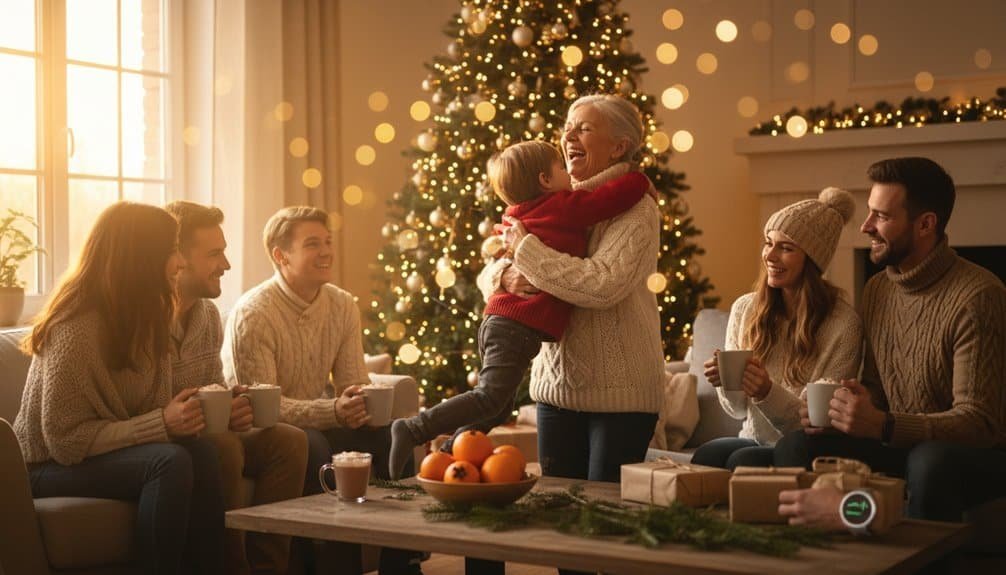
While holiday skeptics dismiss Christmas as commercialized chaos, emerging research reveals that your brain responds to holiday traditions with measurable improvements in mental health and psychological resilience.
Studies show psychiatric emergency visits decline dramatically during Christmas, with self-harm behaviors and suicide attempts dropping significantly pre-holiday. This protective effect stems from anticipatory dopamine release when you engage in familiar rituals, activating reward systems that buffer anxiety and stress.
Real Christmas trees provide sensory restoration through soft fascination, reducing mental fatigue while improving concentration. Researchers found that exposure to real trees helps people recover from mental fatigue better than artificial alternatives.
Early decorating triggers dopamine surges, with 64% of people reporting increased happiness from festive environments.
These repetitive traditions create predictable structure, making your world feel more controllable while evoking nostalgia that strengthens social connectedness and optimism throughout the season.
Record-Breaking 2025 Holiday Celebrations: 122 Million Americans Can’t Be Wrong About Christmas Magic
This neurological understanding of Christmas’s mental health benefits explains why participation rates continue climbing year after year, reaching unprecedented levels in 2025.
You’re witnessing 88% of Americans planning Christmas celebrations, creating a collective ritual that transcends religious boundaries.
When you examine the data, 77% of non-Christians participate, demonstrating Christmas’s evolution into a universal cultural practice.
You’ll find this massive participation generates significant Economic Impact, with average spending reaching $902 per person.
The celebration creates a Travel Surge as 122 million Americans engage in holiday traditions—from watching movies (86%) to baking cookies (81%).
Even as religious attendance declines to 47%, you’re seeing Christmas transform into something larger: a shared cultural experience that unites diverse populations through common rituals and collective joy.
Why Christmas Outshines Every Other Holiday: The Perfect Storm of Family, Food, and Festive Experiences
When you analyze what makes Christmas uniquely powerful among holidays, you discover it’s the only celebration that simultaneously activates three fundamental human needs: deep family connection, abundant communal feasting, and immersive sensory experiences.
Christmas uniquely satisfies three core human needs: profound family bonding, shared feasting rituals, and complete sensory immersion.
Christmas creates unmatched Intergenerational Bonding through rituals spanning generations—from parents building snowmen with children (45% participation rate) to 56% maintaining Santa traditions.
These ceremonies forge connections across age gaps that other holidays can’t replicate.
The Culinary Traditions reach extraordinary scale: 10 million turkeys cooked, 94% sharing Christmas dinner, creating communal abundance unmatched by any celebration.
Meanwhile, Christmas delivers total sensory immersion—75% listening to holiday music, 72% watching festive films, 84% decorating trees.
This tri-dimensional experience of family, feast, and sensory celebration creates psychological satisfaction no other holiday achieves.
Frequently Asked Questions
How Much Should I Budget for Christmas Gifts in 2025?
You should budget $1,100-$1,600 for Christmas gifts in 2025, based on current spending projections.
Income budgeting becomes crucial since tariffs’ll add $130 per shopper.
If you’re high-income, expect to increase spending by $100; low-income earners should decrease by $100.
Consider gift pooling with family members to share costs across traditions.
Factor in 26% price increases when calculating your ceremonial gift-giving ritual budget.
What Are the Best Travel Dates to Avoid Holiday Traffic?
You’ll find optimal travel windows in early December or by choosing midweek travel dates like December 22-23.
Christmas Day itself offers surprisingly light traffic before 10am and after 5pm—a pattern observed across cultures that prioritize family gathering rituals.
Avoid December 19-21 and 26-28 when post-holiday migration creates predictable congestion.
January 1st provides another excellent low-traffic option for returns.
Should I Shop Online or In-Store for Better Christmas Deals?
You’ll find better deals through strategic omnichannel shopping rather than choosing one method. Start with online price comparison across retailers like Amazon and Target, then verify in-store availability for immediate gratification.
Review return policies carefully—online purchases often offer extended return windows, while physical stores provide instant exchanges. Practice webrooming: research digitally, then touch products in-store before purchasing where you’ll get the best final price.
When Do Christmas Decorations Typically Go on Sale After the Holidays?
You’ll find Postseason Clearance begins December 26th across most retailers, with markdowns accelerating through early January. Hobby Lobby starts their cycle December 15th, reaching 90% off by January 2nd.
January Discounts progress systematically—60% off initially, then 70%, finally 90%—creating ritualistic shopping patterns. You’re balancing deeper savings against dwindling selection, as popular items vanish quickly.
Most clearance events conclude by January 8th when Valentine’s merchandise arrives.
What Percentage of My Holiday Budget Should Go Toward Food and Entertaining?
You’ll want to allocate 20-30% of your holiday budget toward meal allocation and hosting costs. This percentage accommodates diverse cultural traditions—whether you’re preparing elaborate feasts, hosting intimate gatherings, or participating in community celebrations.
Analyze your guest count, dietary requirements, and ceremonial food significance within your traditions. Higher hosting costs justify increased allocation when you’re creating meaningful ritualistic experiences that honor your heritage and strengthen social bonds through shared meals.
Conclusion
You’ve witnessed the convergence of ancient winter solstice rituals with modern neurological responses—your brain releases dopamine when you participate in gift-giving ceremonies, while your cortisol levels decrease during communal feasting traditions. Whether you’re lighting candles, sharing meals, or gathering with chosen family, you’re engaging in cross-cultural practices that’ve sustained human communities for millennia. Christmas synthesizes these universal elements more comprehensively than any other celebration, creating measurable psychological benefits you can’t ignore.










No Comments