

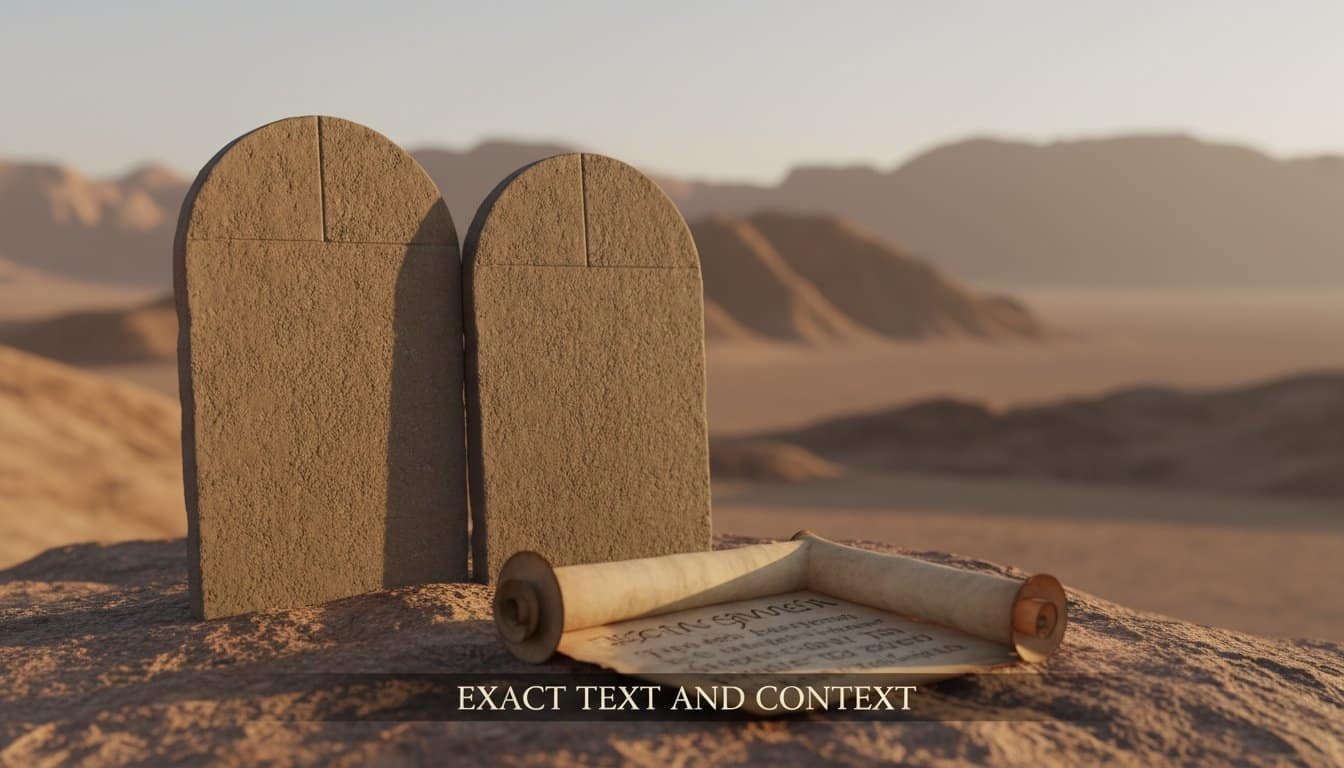
22 Dec Ten Commandments in Bible Verses: Exact Text and Context
You’ll find the Ten Commandments in Exodus 20:1-17 and Deuteronomy 5:4-21, where God speaks directly to Moses on Mount Sinai. These passages reveal Hebrew terms like “rāṣaḥ” (murder) and “chamad” (covet) that provide nuanced understanding beyond English translations. The commandments address both observable behaviors and heart inclinations, establishing Israel’s covenant relationship with Yahweh while forming the ethical foundation for ancient Near Eastern society. Each commandment carries deeper theological significance that illuminates broader biblical themes.
Key Takeaways
- The Ten Commandments appear in two biblical texts: Exodus 20:1-17 and Deuteronomy 5:4-21 with slight variations.
- The Fifth Commandment uses Hebrew “kaved” meaning to honor parents, promising longevity for obedience to parental authority.
- The Sixth Commandment employs Hebrew “rāṣaḥ” specifically prohibiting unlawful killing, not all forms of taking life.
- The Seventh Commandment uses Hebrew “na’aph” addressing adultery between married women and other men, protecting marriage sanctity.
- The Tenth Commandment features Hebrew “chamad” targeting covetous desires of the heart, not just observable behaviors.
The First Commandment: No Other Gods Before Me

When God delivered the Israelites from Egyptian bondage, He established His covenant relationship with them through the Ten Commandments, beginning with the foundational declaration: “You shall have no other gods before me” (Exodus 20:3). This commandment’s Hebrew phrase “al-panai” literally means “before my face,” establishing God’s absolute supremacy and demanding exclusive allegiance.
The historical context reveals Israel’s exposure to Egyptian polytheism and surrounding Canaanite deities. God’s command wasn’t merely prohibiting multiple gods but affirming His singular divine authority. The phrase doesn’t imply other gods exist but forbids treating anything as divine alongside Yahweh.
You’ll find this principle reinforced throughout Scripture, including Deuteronomy 6:4-5 and Isaiah 45:5. False gods worship extends beyond ancient idolatry today into modern forms: materialism, career advancement, relationships, or technology. When you prioritize anything above God’s rightful place in your life, you’re violating this fundamental commandment that demands wholehearted devotion to Him alone.
The Second Commandment: No Idols or Graven Images
Building upon the prohibition against recognizing other deities, the Second Commandment addresses how believers approach the one true God: “You shan’t make idols” (Exodus 20:4-6). This commandment specifically forbids graven image creation of anything “in heaven above, or that’s in the earth beneath, or that’s in the water under the earth.” You’re called to worship God without relying on physical representations.
The Hebrew term “pesel” encompasses carved images, while “temunah” refers to any likeness or form. Ancient Near Eastern cultures regularly employed symbolic representation in their religious practices, crafting statues of their deities for worship. Israel’s prohibition stood uniquely against this widespread practice.
This commandment doesn’t merely forbid creating images; it prohibits bowing down to them or serving them. You’re warned that God is jealous, visiting consequences upon generations who hate Him, yet showing steadfast love to thousands who love Him and keep His commandments.
The Third Commandment: Do Not Take God’s Name in Vain
You’ll find the Third Commandment recorded in Exodus 20:7 and Deuteronomy 5:11, where God declares, “You shan’t take the name of the Lord your God in vain, for the Lord won’t hold him guiltless who takes his name in vain.” The Hebrew term *shav’* (שָׁוְא) encompasses emptiness, falsehood, and worthlessness, indicating that this commandment extends beyond mere profanity to include any misuse of God’s sacred name.
Understanding this prohibition requires examining both its original covenant context and its broader theological implications for how you approach divine reverence in speech and conduct.
Biblical Text and Translation
Although the Third Commandment appears deceptively simple in its prohibition against taking God’s name in vain, the Hebrew text reveals layers of theological and linguistic complexity that have shaped centuries of interpretation.
The original Hebrew phrase “lo tissa et-shem YHWH eloheicha lashav” employs the verb “nasa” (to lift, carry, bear), suggesting more than casual misuse. You’ll find that translation accuracy becomes crucial when examining “lashav” (in vain), which encompasses emptiness, falsehood, and worthlessness.
Textual variants between Exodus 20:7 and Deuteronomy 5:11 show minimal differences, yet rabbinic tradition expands this commandment’s scope to include false oaths, broken vows, and frivolous invocation of divine authority. Ancient Near Eastern parallels demonstrate universal reverence for divine names across cultures.
Meaning and Application
When you examine the Third Commandment’s practical application, the prohibition extends far beyond casual profanity to encompass any misuse of God’s sacred name that diminishes its holiness. You’re called to reverence God’s name in worship, prayer, and daily conversation, avoiding empty oaths or invoking divine authority for personal gain.
Ancient Hebrew culture viewed names as expressing character and essence, making God’s name particularly sacred. You’ll find that living faithfully requires thoughtful speech that honors divine holiness rather than treating God’s name as commonplace. This commandment shapes your spiritual disciplines by cultivating reverence in prayer, careful use of religious language, and authentic worship that reflects genuine devotion rather than superficial religious expression.
The Fourth Commandment: Remember the Sabbath Day

You’ll find the Fourth Commandment articulated in Exodus 20:8-11 and Deuteronomy 5:12-15, where the Hebrew verb *zakhor* (“remember”) establishes the Sabbath as both creation ordinance and covenant sign for Israel.
The biblical text presents Sabbath observance as fundamentally rooted in God’s creative rest (Genesis 2:2-3) and Israel’s liberation from Egyptian bondage, creating a theological foundation that encompasses worship, rest, and social justice.
Your understanding of this commandment requires examining how its ancient Near Eastern context, rabbinic interpretation, and New Testament fulfillment inform contemporary Christian practice regarding rest, worship, and human dignity.
Biblical Text and Translation
Where exactly does the Fourth Commandment appear in Scripture, and how do different translations render this pivotal text? You’ll find it primarily in Exodus 20:8-11 and Deuteronomy 5:12-15, with significant textual variants between these passages.
The Hebrew verb “zakhor” (remember) in Exodus becomes “shamor” (observe) in Deuteronomy, reflecting different manuscript evidence traditions. The Masoretic Text preserves these distinctions, while the Septuagint occasionally harmonizes them. Modern translations like ESV and NASB maintain literal accuracy, rendering “remember” and “observe” respectively. The NIV opts for “remember” in both instances, smoothing textual differences.
Archaeological discoveries at Qumran provide additional manuscript evidence supporting these variant readings, confirming that ancient scribes recognized both memorial and practical dimensions of Sabbath observance within Israel’s covenant relationship.
Sabbath Day Significance
When you examine sabbath day principles, you’re encountering both temporal and eternal dimensions. The commandment serves as memorial (*zecher*) of creation and anticipation of eschatological rest.
Ancient Israel’s observance distinguished them among nations, while contemporary application requires understanding cultural context versus universal principle. You’ll find that Sabbath observance reflects divine rhythm established in creation itself.
Modern Application Principles
The transition from ancient Israelite Sabbath observance to contemporary Christian practice requires careful exegetical distinction between ceremonial law and moral principle. You must recognize that while Saturday Sabbath observance represented covenant stipulations for Israel, the underlying principle of rest remains morally binding.
Modern interpretation shouldn’t dismiss the commandment’s contemporary relevance but rather understand its fulfillment through Christ’s lordship over the Sabbath (Mark 2:28).
You’ll find that Christian liberty allows flexibility in day selection while maintaining the essential rhythm of work and worship. The commandment’s enduring value lies in protecting human dignity against exploitation, providing spiritual renewal, and acknowledging God’s sovereignty over time.
Your application should emphasize rest as both physical necessity and spiritual discipline, reflecting creation’s divine order.
The Fifth Commandment: Honor Your Father and Mother
Among humanity’s most fundamental relationships stands the bond between parent and child, which the fifth commandment addresses with striking directness: “Honor your father and your mother, so that you may live long in the land the Lord your God is giving you” (Exodus 20:12).
The Hebrew term *kaved* (honor) carries profound meaning beyond mere respect for parents. It implies giving weight to their position, acknowledging their authority, and providing care throughout their lives. This commandment establishes the first human relationship addressed in the Decalogue, bridging divine-human obligations with interpersonal responsibilities.
Ancient Near Eastern societies understood obeying parents as foundational to social stability. The promised longevity wasn’t merely personal but communal—societies honoring generational wisdom and authority would prosper. Paul’s New Testament citation in Ephesians 6:2-3 calls this “the first commandment with promise,” emphasizing its enduring significance. You’ll notice this commandment uniquely links obedience with blessing, establishing parental honor as both moral duty and pathway to divine favor.
The Sixth Commandment: You Shall Not Murder

You’ll find the Sixth Commandment stated concisely in Exodus 20:13 and Deuteronomy 5:17 as “You shan’t murder,” where the Hebrew term *rāṣaḥ* specifically denotes unlawful killing rather than all forms of taking life.
When you examine this commandment within its ancient Near Eastern context, you discover it addresses premeditated homicide and establishes the fundamental sanctity of human life as bearing God’s image. You must understand that this prohibition formed the cornerstone of Israel’s legal framework, distinguishing between murder, manslaughter, and justifiable killing in warfare or capital punishment.
Biblical Text Analysis
Examining the Hebrew text of the sixth commandment reveals nuanced distinctions that significantly impact its interpretation and application. The Hebrew word “ratsach” (רָצַח) differs significantly from other Hebrew terms for killing, such as “harag” or “nakah.” Biblical interpretations consistently demonstrate that “ratsach” specifically denotes unlawful killing or murder, excluding justified actions like capital punishment or warfare.
Ancient Near Eastern legal codes provide crucial context, showing how Israelite law distinguished between intentional murder and accidental death. Textual comparisons between Exodus 20:13 and Deuteronomy 5:17 reveal consistent usage, reinforcing the precise meaning. Archaeological evidence from ancient Hebrew inscriptions confirms this semantic distinction. You’ll find that understanding this Hebrew specificity prevents misapplication of the commandment to legitimate governmental or defensive actions, maintaining the text’s original intent within its covenant framework.
Historical Context Significance
Understanding the historical context of the sixth commandment requires recognition that ancient Israel existed within a violent Ancient Near Eastern world where life held varying degrees of value depending on social status, tribal affiliation, and political circumstances.
You’ll discover that this commandment’s historical significance emerges from its radical departure from surrounding cultural traditions that permitted killing for honor, revenge, or territorial disputes. Unlike neighboring societies where blood feuds perpetuated cycles of violence, Israel’s law established divine protection for human life.
The Hebrew term “ratsach” specifically prohibits unlawful killing, distinguishing it from warfare or capital punishment. This divine mandate transformed ancient Israel’s legal framework, establishing unprecedented value for individual life regardless of social standing, fundamentally reshaping their community’s moral foundation.
The Seventh Commandment: You Shall Not Commit Adultery
While ancient Near Eastern cultures often practiced polygamy and concubinage as socially acceptable norms, the seventh commandment established a revolutionary standard that protected the sanctity of marriage and family structures within Israelite society.
You’ll find this commandment in Exodus 20:14 and Deuteronomy 5:18, stated simply as “You shan’t commit adultery.” The Hebrew term *na’aph* specifically refers to sexual relations between a married woman and a man who isn’t her husband. This prohibition wasn’t merely about sexual morality—it addressed property rights, inheritance lines, and covenant faithfulness.
Marital fidelity became central to Israel’s identity, reflecting their exclusive relationship with Yahweh. The adultery significance extends beyond individual behavior to encompass Israel’s spiritual unfaithfulness to God. Prophets like Hosea and Ezekiel consistently used adultery metaphors to describe Israel’s idolatry, demonstrating how this commandment established both social stability and theological understanding of covenant relationship.
The Eighth Commandment: You Shall Not Steal
Property rights formed the backbone of ancient Near Eastern societies, and the eighth commandment directly addressed violations against these fundamental social structures.
When you examine Exodus 20:15’s simple declaration “You shan’t steal,” you’re encountering a prohibition that encompasses far more than modern theft concepts.
Ancient Hebrew law distinguished between various forms of stealing, from livestock rustling to land boundary manipulation. You’ll find that biblical consequences for theft weren’t merely punitive but restorative. The Mosaic Law established detailed restitution requirements, often demanding multiple compensation—sometimes four or fivefold repayment for stolen livestock (Exodus 22:1).
This commandment protected society’s economic foundation while emphasizing restoration over retribution. You’re seeing God’s concern for both victim and perpetrator, as restitution requirements aimed to repair community relationships rather than simply punish wrongdoing. The principle extends beyond material possessions to encompass integrity in all interpersonal dealings.
The Ninth Commandment: You Shall Not Bear False Witness
Truth telling stands at the heart of biblical justice systems, and the ninth commandment in Exodus 20:16 establishes a crucial safeguard for legal proceedings and community trust. The Hebrew text reads “Lo ta’aneh b’re’akha ed shaqer,” literally meaning “You shan’t answer against your neighbor as a false witness.” This prohibition extends beyond courtroom perjury to encompass all forms of deceptive speech that damage others’ reputations or well-being.
The commandment’s legal context reflects ancient Near Eastern judicial practices where community elders relied heavily on witness testimony to determine guilt or innocence. Deuteronomy 19:15-21 reinforces this principle, requiring multiple witnesses and prescribing severe penalties for false accusers. The broader biblical narrative demonstrates that avoiding deception protects the vulnerable from exploitation and maintains social cohesion. Truthful testimony becomes not merely a legal obligation but a moral imperative that reflects God’s character as the source of ultimate truth and justice.
The Tenth Commandment: You Shall Not Covet
Desire itself becomes the target of divine regulation in the tenth commandment found in Exodus 20:17, which states “Lo tachmod,” meaning “You shan’t covet.” This final prohibition uniquely addresses internal attitudes rather than external actions, forbidding the coveting of a neighbor’s house, wife, servants, animals, or any possessions.
The Hebrew term “chamad” encompasses intense longing that leads to acquisition attempts. Unlike previous commandments targeting observable behaviors, this addresses the heart’s inclinations. Ancient Near Eastern law codes rarely regulated emotions, making this commandment revolutionary.
Coveting material goods represents humanity’s perpetual struggle with contentment and social comparison. The comprehensive list—house, wife, servants, livestock—reflects ancient Israel’s socioeconomic structure while establishing universal principles. Coveting neighbor’s blessings destroys community harmony and personal peace.
Paul’s interpretation in Romans 7:7-8 demonstrates how this commandment reveals sin’s nature, showing that desire itself, when misdirected, violates divine standards and damages relationships within covenant communities.
Frequently Asked Questions
Why Are There Different Versions of the Ten Commandments in Different Religions?
You’ll find religious interpretation differences stem from distinct theological traditions that developed independently. Scriptural translation variations occur because Hebrew manuscripts contain ambiguities that translators resolve differently across denominations.
Judaism, Catholicism, and Protestantism divide the same biblical text into ten commandments using varying numerical systems. You’re encountering centuries of exegetical analysis where scholars emphasized different aspects of the original Exodus and Deuteronomy passages based on their community’s doctrinal priorities.
Where Exactly in the Bible Are the Ten Commandments Written?
You’ll find the Ten Commandments in two primary biblical locations: Exodus 20:1-17 and Deuteronomy 5:4-21. The scriptural context reveals Moses receiving these laws directly from God on Mount Sinai.
Archaeological evidence from ancient Near Eastern law codes, including Hammurabi’s Code, provides historical framework for understanding these commandments within their cultural milieu. Both passages offer slightly different wording, reflecting distinct theological emphases in their respective narratives.
Did Moses Receive the Commandments Once or Twice on Mount Sinai?
You’ll find Moses received the commandments twice according to biblical narrative.
After God’s revelation on Mount Sinai, Moses broke the first tablets upon witnessing Israel’s golden calf worship (Exodus 32:19). This necessitated commandment repetition when God instructed Moses to prepare new stone tablets (Exodus 34:1).
The second giving demonstrates divine patience and covenant renewal despite Israel’s breach of faith through idolatry.
How Do the Ten Commandments Apply to Modern Christian Life Today?
You’ll find the Ten Commandments retain profound modern relevance through their personal application as moral imperatives transcending ceremonial law.
Christ’s fulfillment doesn’t abolish their ethical principles but transforms your understanding of righteousness. Their personal application extends beyond mere rule-keeping to heart transformation, addressing contemporary issues like idolatry, integrity, and relationships.
You’re called to embody these timeless principles through Spirit-empowered obedience rather than legalistic adherence.
What Happened to the Original Stone Tablets Containing the Commandments?
You’ll find that Moses shattered the first tablets in anger upon witnessing Israel’s golden calf worship (Exodus 32:19).
God commanded him to carve replacement tablets, which were subsequently placed in the Ark of the Covenant (Exodus 34:1-4, Deuteronomy 10:1-5).
When Babylon destroyed Solomon’s Temple in 586 BCE, the Ark vanished from historical records.
The original tablets were lost in translation between covenantal promises and human failings, their remnants destroyed through Israel’s apostasy.
Conclusion
You’ve examined the Decalogue’s foundational role in biblical ethics and covenant theology. These commandments, delivered at Sinai, establish humanity’s relationship with God and neighbor through divine imperatives. You’ll notice their enduring influence spans millennia, shaping Judeo-Christian moral frameworks and legal systems. As you study these texts within their Ancient Near Eastern context, you’re engaging with humanity’s earliest systematic ethical code—one that continues defining moral discourse in contemporary theological scholarship.











No Comments