

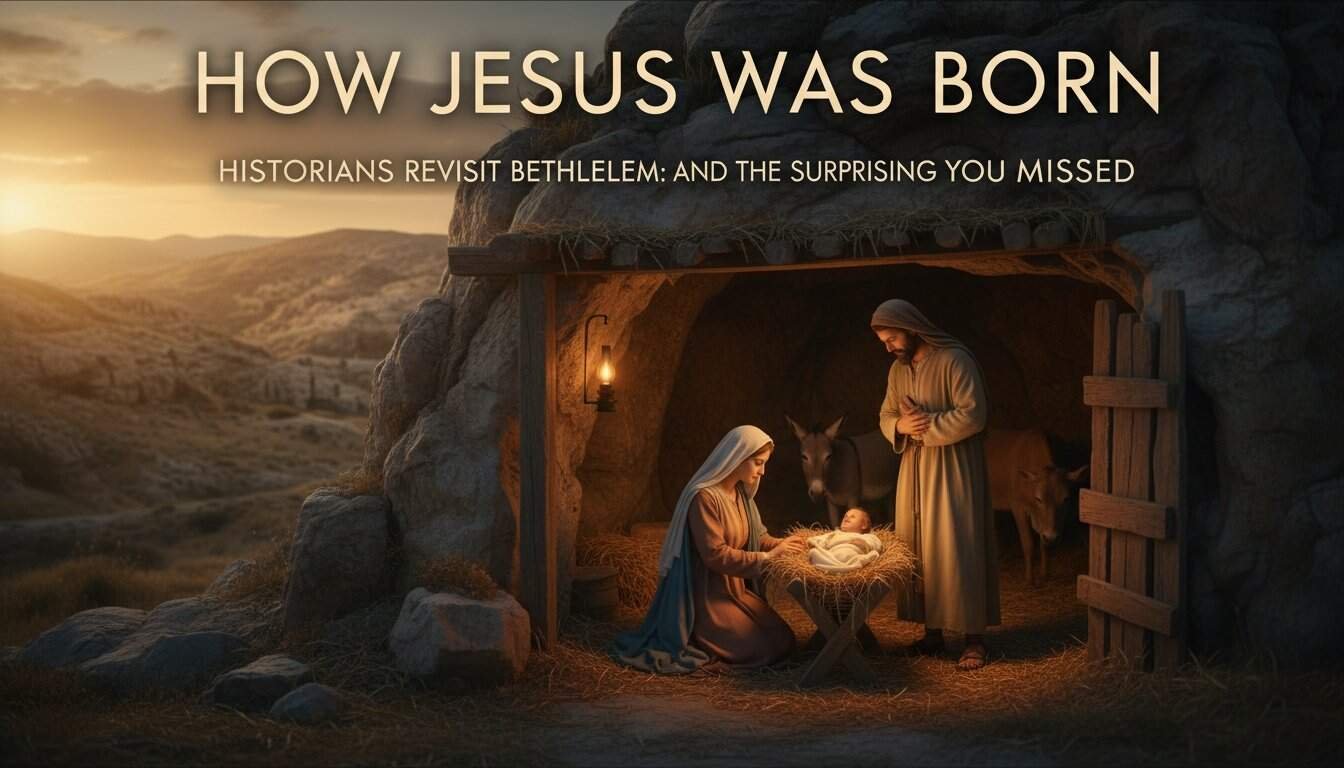
22 Dec How Jesus Was Born Historians Revisit Bethlehem: How Jesus Was Born and the Surprising Details You Missed
Recent archaeological discoveries beneath Bethlehem’s Church of the Nativity confirm first-century occupation, but you’ll find the Gospel accounts present two surprisingly different birth narratives. Matthew emphasizes Jewish messianic prophecies and includes Magi, while Luke focuses on shepherds and universal salvation for Gentile audiences. Historical problems emerge with Luke’s census timing and Quirinius’s governorship, creating chronological gaps with Matthew’s timeline. Early Christian traditions later expanded these brief Gospel mentions into the elaborate nativity stories that shaped your modern Christmas understanding.
Table of Contents
Key Takeaways
- Matthew and Luke present contrasting birth narratives targeting different audiences—Jews versus Gentiles—with non-overlapping post-birth details.
- Archaeological evidence confirms first-century Bethlehem as a small settlement with limestone caves used for livestock shelters.
- Luke’s census under Quirinius creates chronological problems since Quirinius governed Syria in AD 6, after Herod’s death.
- Second-century apocryphal gospels introduced cave births, elderly Joseph, and manger animals absent from original Gospel accounts.
- Roman census procedures didn’t require ancestral-town registration or pregnant women traveling, questioning Luke’s historical accuracy.
The Gospel Accounts: Two Different Stories of the Same Birth
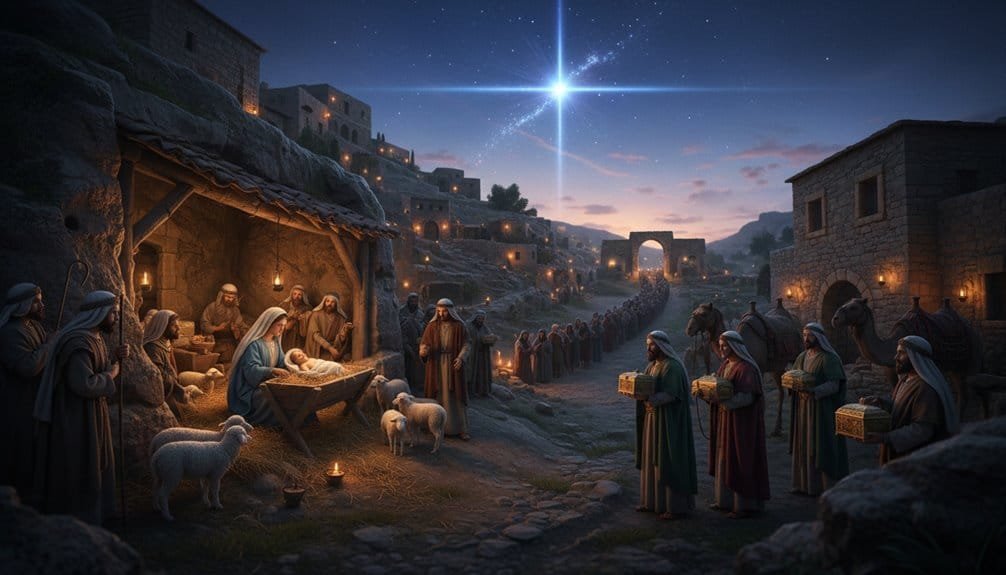
These differences reveal contrasting theological emphases.
Matthew, writing for Jewish readers, focuses on messianic prophecies and kingly lineage, emphasizing Jesus’s royal heritage.
Luke, targeting Gentile audiences, stresses humble shepherds and universal salvation themes.
You won’t find overlap in their post-birth narratives—Matthew omits shepherds and temple rites entirely, while Luke excludes the Magi and Egyptian exile.
Rather than contradictions, these represent complementary perspectives enriching our understanding of Jesus’s birth. Luke traces Jesus’s ancestry to Adam, emphasizing universal humanity over specifically Jewish heritage.
Both accounts confirm Jesus’s birth in Bethlehem during Herod’s reign, establishing the historical timeframe for this pivotal event. Matthew’s Gospel records eleven Old Testament quotations and allusions that connect Jesus’s birth to ancient prophecies.
Archaeological Evidence From First-Century Bethlehem
A small clay fragment unearthed from Jerusalem’s City of David provides the earliest archaeological confirmation that Bethlehem existed as a named settlement centuries before Jesus’s birth. This 2,700-year-old bulla bears Hebrew inscriptions linking Bethlehem to the Kingdom of Judah’s administrative system during the 8th-7th centuries BCE.
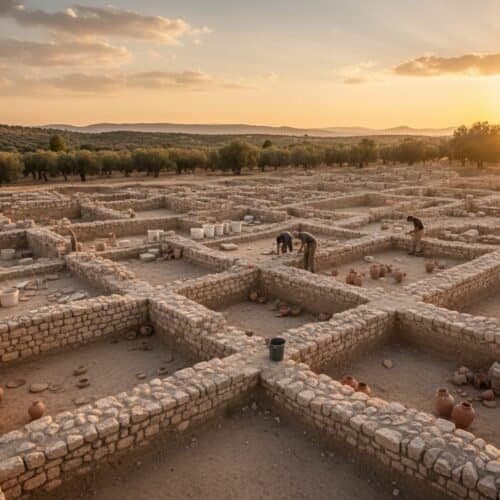
You’ll find the archaeological record for first-century Bethlehem itself frustratingly sparse. Modern construction and religious monuments severely limit excavation access, forcing archaeologists to rely on cave systems and peripheral sites. However, excavations beneath the Church of the Nativity have uncovered first-century artifacts and stratified deposits indicating domestic occupation.
Regional surveys reveal telling details about Jesus’s era. Rural pottery from nearby sites matches styles found throughout first-century Judea, while ritual pools cut into bedrock demonstrate Jewish purity practices among local communities. Stone enclosure walls and watchtowers reflect the agrarian economy that likely characterized Bethlehem’s landscape during the Roman period. Archaeological evidence shows homes were often constructed near or over natural limestone caves that served as shelters for livestock. The tiny shard, measuring just 1.5 centimeters across, represents a remarkable preservation of ancient administrative records.
The Historical Problems With Luke’s Census and Matthew’s Timeline
While archaeological evidence confirms Bethlehem’s existence during Jesus’s era, the Gospel accounts of his birth present historians with significant chronological puzzles that resist easy resolution.
The Quirinius discrepancy creates the most serious chronological challenge.
Luke places Jesus’s birth during a census conducted by Quirinius as Syrian governor, yet historical records show Quirinius didn’t govern Syria until AD 6—over a decade after Herod’s death in 4 BC.
This timing gap contradicts both Matthew’s and Luke’s placement of Jesus’s birth before Herod died.
Chronology conflicts extend beyond dating.
Matthew depicts the family residing in Bethlehem without mentioning any census, while Luke describes their Nazareth origins and census-prompted journey.
Roman census procedures further complicate Luke’s account, as no evidence supports requiring ancestral hometown registration or pregnant women traveling for taxation purposes.
Some scholars propose Quirinius held an earlier subordinate role, while others suggest Luke’s census refers to a later administrative flash-forward.
How Early Christian Traditions Shaped What We Think We Know
Beyond these chronological puzzles lies another layer of complexity: the early Christian traditions that filled gaps left by the sparse Gospel accounts.
You’ll find that second-century texts like the Protoevangelium of James dramatically expanded the nativity story, introducing concepts of perpetual virginity and depicting Jesus born in a cave near Bethlehem.
This apocryphal work portrayed Joseph as an elderly widower, fundamentally shaping how Christians understood the holy family.
The Patristic Fathers further developed these traditions. Justin Martyr affirmed the cave birth, while Augustine connected March 25’s conception date to December 25’s birth—a calculation that became standard.
You can trace how apocryphal gospels like Pseudo-Matthew introduced nativity iconography we recognize today: the ox and ass at the manger appear nowhere in canonical scriptures. These early Christian writers transformed brief Gospel mentions into elaborate narratives that continue influencing Christmas celebrations worldwide.
Frequently Asked Questions
Why Do Some Scholars Think Jesus Was Born in Nazareth Instead of Bethlehem?
You’ll find scholars favor Nazareth because Mark’s Gospel, considered earliest, consistently identifies Jesus’s Galilean origins there without mentioning Bethlehem.
They argue oral transmission preserved “Jesus of Nazareth” as his authentic origin, while Matthew and Luke later created Bethlehem birth narratives to fulfill Davidic prophecy.
The divergent infancy accounts suggest theological construction rather than historical fact, making Nazareth the more credible birthplace.
What Does Archaeology Tell Us About Daily Life in First-Century Bethlehem?
You’ll find that domestic architecture reveals modest stone houses with plastered floors, often incorporating natural caves for storage and livestock.
Foodways evidence shows households used coarse cooking pottery, storage jars, and limestone vessels for ritual purity.
You’d see terraced agriculture supporting mixed farming—cereals, olives, grapes—while craft activities like stone-working occurred within multi-generational family compounds clustered around springs and the main ridge road.
How Do We Reconcile the Different Chronologies Between Matthew and Luke’s Accounts?
You’ll find scholars employ Textual Harmonization by blending complementary elements—both accounts agree on Bethlehem birth and virgin conception.
Modern Chronological Models suggest Jesus’ birth occurred 7-4 BC, allowing the Quirinius census to precede Herod’s death.
You can reconcile the timelines by positioning the Magi’s visit 1-2 years post-nativity, giving Matthew’s family time for Egypt’s flight before Herod’s documented 4 BC death.
When Did December 25TH Become Associated With Jesus’s Birth Date?
You’ll find December 25th first explicitly documented as Jesus’s birth date in AD 336‘s Roman Chronograph.
Calendar Adoption accelerated under Constantine-era Christianity through calculated theology—March 25th conception plus nine months—and strategic timing alongside Winter Festivals like Dies Natalis Solis Invicti.
This Roman innovation provided Christian alternatives to popular pagan celebrations, though no earlier Palestinian sources support this date, making it primarily 4th-century political and liturgical construction.
Are There Any Non-Christian Sources That Mention Jesus’s Birthplace?
You won’t find explicit mentions of Jesus’s birthplace in surviving non-Christian sources.
While Tacitus Testimony confirms Jesus’s execution under Pontius Pilate, it doesn’t specify where he was born.
Similarly, Josephus References acknowledge Jesus’s existence through mentions of his brother James, but provide no geographical birth details.
Early Roman historians like Pliny and Suetonius focus on Christians’ practices rather than Jesus’s biographical origins.
Conclusion
You’ve seen how the Gospel narratives differ significantly, how archaeological evidence from first-century Bethlehem remains sparse, and how historical inconsistencies challenge traditional timelines. You’ve discovered that early Christian traditions likely influenced these accounts more than pure historical memory. When you examine the evidence critically, you’ll find that reconstructing Jesus’s actual birth circumstances requires separating theological meaning from historical facts—a complex task that continues challenging scholars today.








No Comments