

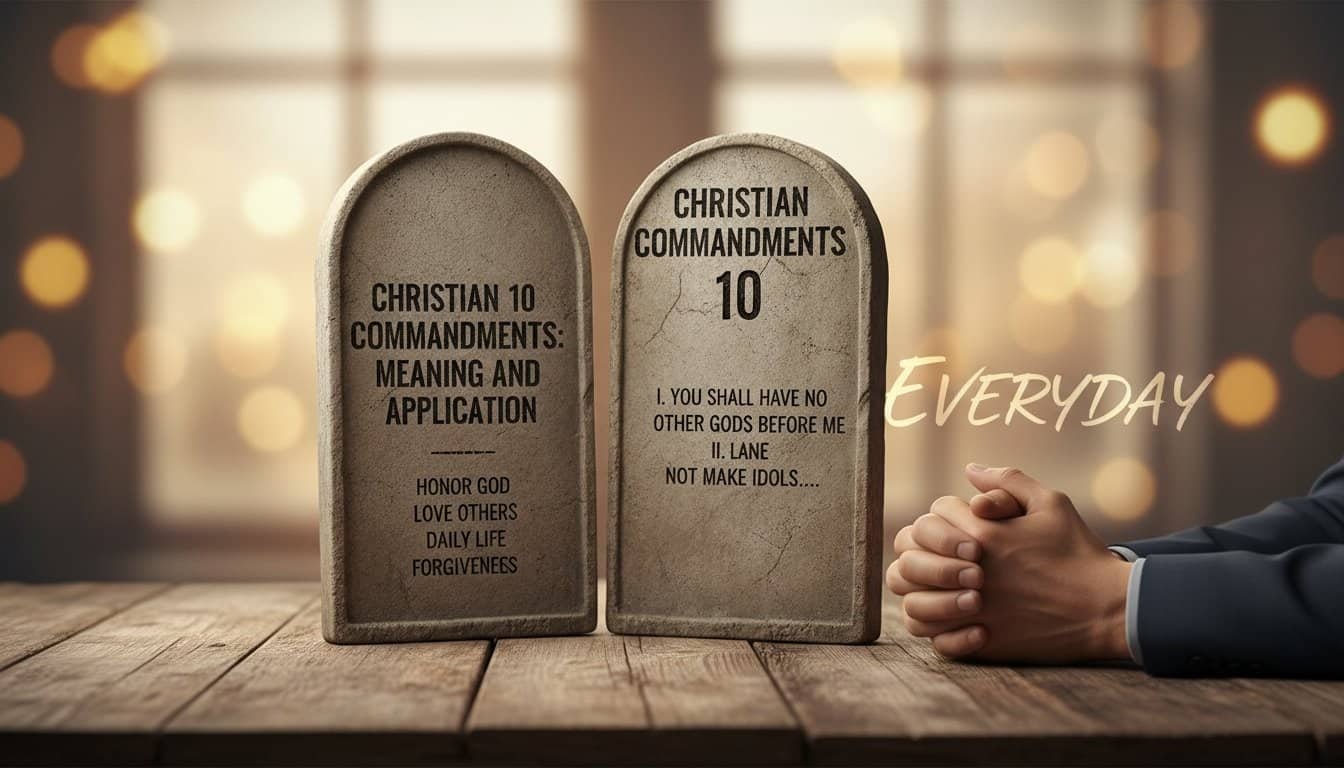
23 Dec Christian 10 Commandments Meaning and Application
The Ten Commandments aren’t just ancient rules—they’re God’s blueprint for authentic living that remains powerfully relevant today. You’ll find they divide into two parts: loving God completely (commandments 1-4) and loving others genuinely (commandments 5-10). They address everything from idolatry and honoring parents to sexual purity, honesty, and contentment. Rather than restricting your freedom, they protect your relationships with God and others while building healthy communities. Discover how these timeless principles transform modern life.
Table of Contents
Key Takeaways
- The Ten Commandments establish foundational principles for relationship with God and others, beginning with absolute loyalty and rejection of idolatry.
- Modern applications include avoiding idolatry through materialism, technology addiction, and social media validation while maintaining reverence for God’s name.
- The Sabbath commandment promotes physical and spiritual renewal, freedom from busyness, and trust in God’s provision through rest and worship.
- Commandments five through seven address honoring parents, protecting human life, and maintaining sexual purity within marriage’s sacred covenant boundaries.
- The final commandments demand honesty in possessions and relationships, prohibiting theft, lying, gossip, and requiring truthful communication reflecting God’s character.
You Shall Have No Other Gods Before Me

When God thundered these words from Mount Sinai, He established the fundamental principle that defines authentic faith: absolute loyalty to Him alone.
The purpose of commandment one isn’t merely about rejecting ancient pagan deities. It’s about recognizing God’s rightful position as supreme authority in your life. You’re called to worship Him exclusively, acknowledging His sovereignty over every aspect of your existence.
Personal idolatry takes countless forms in modern life. When career, money, relationships, or even ministry becomes more important than God, you’ve violated this commandment. Anything that captures your ultimate devotion, trust, or love above the Lord becomes an idol.
This commandment demands you examine your heart regularly. What receives your first thoughts, deepest affections, and highest priorities? God requires undivided allegiance—not because He’s insecure, but because He alone deserves worship and can satisfy your soul’s deepest longings.
You Shall Not Make Idols or Worship Images
You’ll discover that God’s command against idolatry extends far beyond the golden calves and carved images of ancient times.
Today’s idols often take subtler forms—money, success, technology, or even relationships—that can quietly usurp God’s rightful place in your heart.
Understanding the biblical foundation of this commandment reveals God’s passionate desire for your undivided worship and protects you from the spiritual bondage that idolatry always brings.
Modern Forms of Idolatry
Many Christians today struggle to recognize idolatry in their daily lives because it rarely involves bowing down to golden statues or wooden figurines. Modern idolatry manifests through subtler yet equally destructive forms that capture your heart’s devotion.
You’ll find idolatry thriving in our consumerist culture, where material possessions promise fulfillment that only God provides. Your career, relationships, or pursuit of wealth can become idols when they supersede your love for Christ.
Social media platforms create digital shrines where you worship self-image, seeking validation through likes and followers rather than God’s approval.
Technology itself becomes idolatrous when you’re more devoted to your devices than prayer and Scripture. Even good things like family or ministry become idols when they eclipse your primary allegiance to God.
Biblical Context and Purpose
God established the second commandment against idolatry immediately after declaring His exclusive claim to worship, revealing His deep concern for protecting His people from spiritual adultery. You’ll find this commandment carries tremendous historical significance as Israel emerged from Egyptian captivity, where idol worship dominated religious practice. The biblical interpretation shows God’s jealous love—He won’t share His glory with carved images or false representations.
This commandment serves multiple purposes in your spiritual life. It protects you from reducing the infinite God to finite objects, preserves the mystery of His transcendent nature, and guards against manipulating Him through physical representations. You’re called to worship God as He truly is, not as you’d prefer to imagine Him through human-made symbols or images.
You Shall Not Take the Lord’s Name in Vain
The third commandment calls you to honor God’s name with reverence and respect, recognizing its sacred nature and divine authority.
When you misuse the Lord’s name through casual oaths, empty promises, or profanity, you’re violating this holy standard and diminishing God’s glory in your daily speech.
You’ll find that understanding this commandment’s true meaning transforms how you speak about God and impacts every aspect of your Christian witness.
Understanding Sacred Name Reverence
When you speak God’s name, you’re handling something infinitely precious and holy. The third commandment establishes reverence for deity as fundamental to faithful living. You’re called to honor God’s name through respectful speech, genuine worship, and authentic living.
Misusing sacred names extends beyond casual profanity. When you invoke God’s name in false oaths, empty promises, or manipulative prayers, you violate this commandment. You dishonor Him when your lifestyle contradicts your verbal profession of faith.
True reverence means treating God’s name with the same respect you’d show His presence. Your words should reflect His character—truthful, loving, and pure. Guard your speech carefully, remembering that His name represents His very essence and authority over creation.
Modern Applications Today
Reverence for God’s name faces unique challenges in our digital age. Social media influence creates pressure to use casual, often irreverent language that diminishes the sacred. You’re constantly exposed to God’s name being trivialized through memes, posts, and trending phrases that treat the holy as commonplace.
Consumer materialism compounds this challenge by encouraging you to view everything, including faith, as a commodity. Marketing campaigns frequently exploit religious language for profit, reducing God’s name to a brand or slogan. You must resist these cultural pressures by maintaining intentional reverence in both digital and physical spaces.
Practice deliberate speech online and offline. Choose words that honor God’s holiness. Remember that your reverence reflects your heart’s true condition and witnesses to others about Christ’s transformative power in your life.
Consequences of Misuse
Breaking God’s third commandment carries both immediate and eternal consequences that extend far beyond casual speech. When you misuse God’s name, you’re damaging your relationship with Him and undermining your Christian witness. Your credibility suffers when others hear you speak carelessly about sacred things.
This extends into everyday life. Just as unclaimed property disputes arise from neglecting rightful ownership, misusing God’s name shows disregard for His rightful honor. Similarly, financial management errors occur when we’re careless with resources—misusing God’s name reflects carelessness with His reputation.
The consequences include spiritual numbness, weakened prayer life, and diminished reverence. You’ll find it harder to approach God with proper awe. Others may question your faith’s authenticity, hindering evangelism opportunities and damaging the church’s testimony in your community.
Remember the Sabbath Day and Keep It Holy
The fourth commandment calls you to honor God’s design for rest and worship by setting aside the Sabbath as holy. This isn’t merely about religious ritual—it’s about recognizing your need for physical, spiritual, and emotional renewal that comes through intentional rest.
Sabbath observance involves ceasing from regular work and dedicating time to worship, reflection, and community. You’re called to step away from the endless demands of productivity and remember that your worth isn’t tied to your output. This practice acknowledges God as Creator and Sustainer.
Sabbath renewal restores your perspective, reminding you that God controls what you cannot. It provides space for prayer, Scripture study, fellowship, and genuine rest. When you honor the Sabbath, you demonstrate trust in God’s provision and reject the lie that everything depends on your constant effort.
This commandment offers freedom from the tyranny of busyness while deepening your relationship with God.
Honor Your Father and Mother
You’ll find the fifth commandment in Exodus 20:12, where God establishes honoring parents as foundational to healthy society and spiritual growth. This biblical mandate carries profound weight because it’s the first commandment with a promise—long life in the land God gives you.
Yet you’re likely wrestling with how to apply this ancient principle when facing complex family dynamics, toxic relationships, or situations where parents haven’t fulfilled their God-given roles.
Biblical Foundation and Context
When God inscribed the fifth commandment on stone tablets at Mount Sinai, He established a fundamental principle that bridges the gap between our relationship with Him and our relationships with others. Honor your father and your mother, so that you may live long in the land the Lord your God is giving you” (Exodus 20:12) stands as the first commandment accompanied by a promise, marking the transition from duties toward God to duties toward fellow human beings.
Scriptural exegesis reveals that the Hebrew word “kabbed” means to give weight, respect, and reverence. The historical background shows that ancient Near Eastern societies understood parental authority as foundational to social order.
Paul reinforces this principle in Ephesians 6:1-3, calling it “the first commandment with promise,” demonstrating its enduring significance across both testaments.
Modern Application Challenges
While ancient societies provided clear cultural frameworks for honoring parents, today’s believers face complex scenarios that challenge straightforward application of this commandment. You’re navigating unprecedented territory when parents struggle with addictions, abuse, or destructive patterns. How do you honor while maintaining healthy boundaries?
Social media idolatry complicates relationships as parents and children compete for digital validation rather than investing in authentic connection. Technological distractions fragment family time, making meaningful honoring difficult when everyone’s absorbed in devices.
You must discern between blind obedience and biblical honoring. Sometimes honoring means refusing to enable destructive behavior while maintaining respect. Prayer, wise counsel, and Scripture study guide you through these modern complexities, helping you honor authentically while protecting your spiritual and emotional well-being.
You Shall Not Murder
The sixth commandment, “You shan’t murder,” establishes the fundamental sanctity of human life as created in God’s image. This commandment goes beyond simply avoiding homicide—it calls you to actively pursue respecting life in all its forms. You’re called to protect the vulnerable, defend the innocent, and treat every person with dignity.
Avoiding violence isn’t just about physical harm. Christ expanded this teaching in Matthew 5:21-22, showing that harboring anger and hatred violates the spirit of this commandment. You must guard your heart against bitterness, seek reconciliation when wronged, and pursue peace in relationships.
This principle extends to how you speak about others. Your words can destroy someone’s reputation or spirit. You’re commanded to use your influence to build up rather than tear down. Whether in family conflicts, workplace tensions, or community disagreements, you’re called to be a peacemaker who values and preserves the precious gift of life God has given.
You Shall Not Commit Adultery
God’s seventh commandment, “You shan’t commit adultery,” protects the sacred covenant of marriage and calls you to honor sexual purity in all relationships. This commandment establishes marital fidelity as God’s design, recognizing marriage as a holy union between one man and one woman.
Adultery violates the exclusive commitment spouses make to each other and breaks the trust that forms marriage’s foundation. When you commit adultery, you sin against your spouse, yourself, and God who created marriage as a reflection of Christ’s relationship with the church.
Jesus expanded this commandment’s meaning, teaching that lustful thoughts also constitute adultery in the heart. This reveals that sexual purity involves both actions and attitudes. You’re called to guard your heart, mind, and body, maintaining faithfulness whether single or married.
God designed sexuality as a gift to be enjoyed within marriage’s protective boundaries, where intimacy builds unity and reflects His covenant love for His people.
You Shall Not Steal
Just as marriage requires exclusive commitment between spouses, God’s eighth commandment, “You shan’t steal,” demands exclusive respect for what belongs to others. This commandment extends beyond taking physical possessions—it encompasses cheating, fraud, dishonest business practices, and withholding what’s rightfully owed to others.
The importance of honesty reflects God’s character and builds trust within communities. When you steal, you’re not just harming another person; you’re violating God’s design for righteous living and damaging relationships that require integrity to flourish.
The consequences of theft ripple far beyond immediate gain. Stealing destroys trust, breeds suspicion, and corrupts your character. It leads to guilt, broken relationships, and spiritual separation from God. Scripture warns that thieves won’t inherit God’s kingdom unless they repent.
Instead, you’re called to work honestly, earn your living through legitimate means, and even share with those in need. This transforms you from a taker into a giver, reflecting Christ’s generous heart.
You Shall Not Bear False Witness Against Your Neighbor

Truth forms the foundation of every healthy relationship, yet God’s ninth commandment, “You shan’t bear false witness against your neighbor,” protects far more than courtroom proceedings. This commandment safeguards the integrity of your community and preserves trust between individuals.
Truth serves as the cornerstone of healthy relationships, while God’s ninth commandment protects community integrity and preserves essential trust between neighbors.
When you spread rumors, exaggerate stories, or remain silent when truth needs speaking, you violate this sacred principle. Your witness credibility becomes compromised, affecting not only your relationships but your Christian testimony. God calls you to speak truthfully, especially when others’ reputations hang in the balance.
Neighborly communication requires careful attention to accuracy and motive. Before sharing information about someone, ask yourself: Is it true? Is it necessary? Does it build up or tear down? Your words carry power to heal or harm.
This commandment extends beyond avoiding outright lies—it encompasses gossip, slander, and character assassination. God desires that your speech reflects His nature of truth and love.
You Shall Not Covet
While material possessions promise satisfaction, the tenth commandment “You shan’t covet” exposes the deeper heart issue that drives human dissatisfaction. You’re commanded not to desire your neighbor’s house, spouse, servants, or anything belonging to them. This isn’t merely about external actions—it’s about internal attitudes that corrupt your relationship with God and others.
Coveting material goods reveals misplaced trust in worldly wealth rather than God’s provision. When you constantly want what others have, you’re essentially declaring God’s gifts insufficient. Coveting social status breeds comparison, jealousy, and resentment that destroys community relationships.
This commandment strikes at sin’s root: the rebellious heart that questions God’s goodness and wisdom. You’re called to contentment, trusting that God knows your needs and provides accordingly. Gratitude becomes your weapon against covetousness. When you appreciate what you’ve received, coveting loses its power. True satisfaction comes from knowing God, not acquiring possessions or positions.
Frequently Asked Questions
Are the Ten Commandments Still Relevant for Christians Today?
Yes, you’ll find the Ten Commandments remain absolutely relevant for Christians today. They’re foundational principles reflecting God’s character and moral standards that transcend time.
While biblical interpretations vary regarding their application under the New Covenant, theological discussions consistently affirm their enduring wisdom. You’re called to love God supremely and love your neighbor, which Christ confirmed encompasses these ancient commandments perfectly.
How Do the Commandments Differ Between Catholic and Protestant Traditions?
You’ll find both Catholic and Protestant traditions honor the same Ten Commandments, though they differ in numbering and scriptural interpretations. Catholics follow Augustine’s division, combining idolatry prohibitions while separating coveting commands.
Protestants typically use Reformed numbering, distinguishing graven images separately. These historical developments reflect theological emphases—Catholics stress church authority in interpretation, while Protestants emphasize individual biblical study and conscience.
What Happens if Someone Breaks One of the Commandments?
Breaking a commandment doesn’t condemn you eternally. While there are consequences of breaking commandments—spiritual separation, guilt, and relational damage—God’s grace provides a path forward.
You’ll face accountability for your actions, but forgiveness after breaking commandments comes through genuine repentance and Christ’s sacrifice. God doesn’t abandon you; He draws you back through His love, offering restoration and renewed relationship when you turn to Him.
Did Jesus Replace the Ten Commandments With New Teachings?
Jesus didn’t replace the Ten Commandments but fulfilled and expanded their spiritual interpretations. He said he came to fulfill the law, not abolish it.
Within proper scriptural context, you’ll see Jesus deepened the commandments’ meaning—transforming external obedience into heart transformation. His teachings on love, mercy, and internal righteousness build upon Moses’ foundation, revealing God’s ultimate intent behind each commandment through grace.
How Should Christians Prioritize Commandments When They Seem to Conflict?
You should follow Jesus’ teaching that love for God and neighbor forms the foundation for prioritizing personal values when commandments appear to conflict.
Start by seeking God’s wisdom through prayer and Scripture study, balancing moral obligations against Christ’s greatest commandments. Consider context, seek wise counsel, and remember that true obedience flows from love, not legalism.
God’s Spirit will guide your discernment.
Conclusion
You’ve now explored God’s timeless commandments—His blueprint for righteous living. Don’t view these as burdensome restrictions, but as loving boundaries that protect and guide you toward flourishing. They’re not mere suggestions; they’re divine imperatives that shape your relationship with God and others. As you apply these truths daily, you’ll discover the freedom that comes from walking in God’s ways. Let His commandments transform your heart and direct your steps.











No Comments