

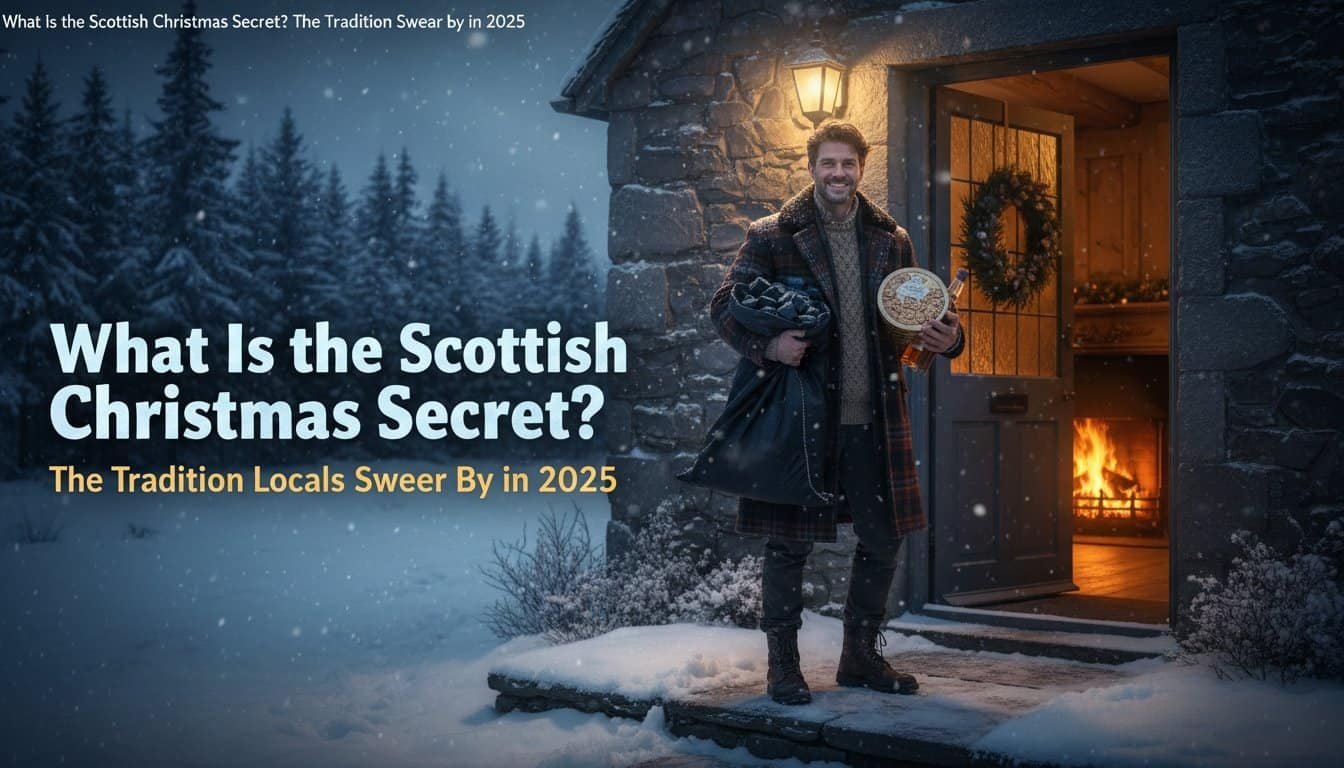
20 Dec What Is the Scottish Christmas Secret? the Tradition Locals Swear by in 2025
Scotland’s Christmas secret isn’t found in gift exchanges—it’s embedded in ancient midwinter practices locals still honor today. You’ll discover communities swinging blazing Stonehaven fireballs to banish evil spirits, dark-haired first-footers crossing thresholds at midnight with coal and whisky, and rowan sprigs hung beside hearth tools as protective talismans. These pre-Christian fire rituals and protective customs survived centuries of suppression, transmitted through kitchen-table storytelling and heritage workshops that transform folklore into living practice, revealing deeper layers of Scotland’s spiritual winter traditions.
Key Takeaways
- First-footing remains Scotland’s most cherished New Year tradition, with dark-haired visitors bringing coal, whisky, salt, and shortbread for luck.
- Ancient fire rituals like Stonehaven’s fireballs and Burghead’s burning clavie continue banishing evil spirits during winter’s darkest nights.
- Protective rowan sprigs and holly wreaths guard Scottish homes, with families exchanging ceremonial branches during Yule celebrations.
- Kitchen-table storytelling and heritage workshops preserve midwinter folklore through community gatherings and hands-on learning experiences.
- Museums and tourism partnerships adapt traditional practices into safe, symbolic forms while maintaining their spiritual significance.
The Ancient Fire Rituals That Still Burn Bright in Modern Scotland
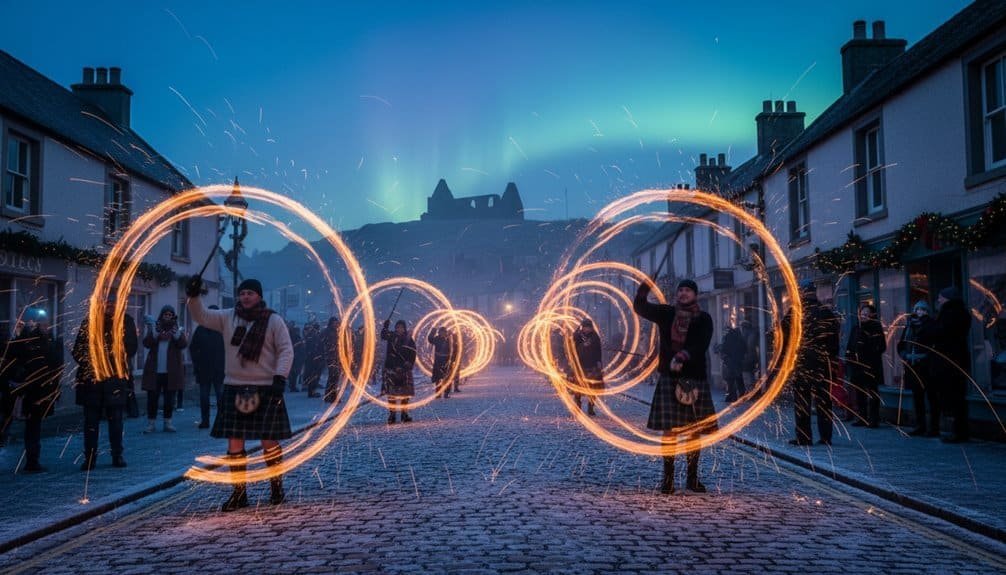
When December’s darkness settles across the Scottish Highlands, you’ll witness fire rituals that have persisted for over a millennium, their flames connecting modern communities to pre-Christian ancestors who understood light as both practical necessity and spiritual protection.
You’ll find these ancient practices manifesting in spectacular fire parades like Stonehaven’s Hogmanay fireballs, where participants swing blazing orbs through streets to banish evil spirits.
At Burghead, you’ll see the Burning of the Clavie—a tar-filled barrel carried ceremonially on January 11th, following the old calendar.
Within households, you’ll discover rowan smudging customs where families burn rowan twigs to cleanse negative energy and restore harmony. These protective traditions were historically embraced by Highland clans such as the Malcolms and MacLachlans, who passed down the mystical properties of the rowan tree through generations.
These botanical rituals complement the grander Yule log traditions, where hearth fires burned continuously through winter’s darkest nights. The winter solstice was celebrated long before Christmas as communities marked the return of longer days with fire ceremonies.
These customs gained particular significance during Scotland’s history when Christmas observance was severely limited following the Reformation, making winter fire festivals even more vital for community celebration and spiritual comfort.
Modern practitioners adapt these customs through symbolic candle displays and museum demonstrations, preserving ethnographic continuity while satisfying contemporary safety requirements and cultural tourism demands.
First-Footing: Why Dark-Haired Strangers Bring the Best Luck
As midnight strikes on Hogmanay, you’ll encounter Scotland’s most enduring superstition: the belief that your year’s fortune depends entirely on who first crosses your threshold. This first-footing tradition reveals deep cultural anxieties rooted in Viking Origins, where blonde raiders brought terror rather than prosperity. Consequently, dark-haired males became the preferred harbingers of good luck.
Scotland’s ancient first-footing superstition transforms New Year visitors into fortune-tellers, where hair color determines whether prosperity or peril crosses your threshold.
You’ll notice the Gender Preference isn’t arbitrary—it reflects medieval power structures where male visitors symbolized protection and authority. Communities often select strangers matching these criteria, prioritizing superstition over familiarity.
Your ideal first-footer arrives bearing coal for warmth, whisky for cheer, salt for prosperity, and shortbread for sustenance. The complete bundle of traditional gifts ensures comprehensive protection and abundance for the household throughout the coming year.
This practice emerged when Christmas celebrations were banned post-1640, shifting focus to Hogmanay. Despite Presbyterian disapproval, the tradition persisted until gaining official recognition in 1958. The shortest day of the year timing connects these winter celebrations to ancient Celtic solstice rituals that sought to brighten the darkness.
Today, you’ll witness this ancient ritual seamlessly integrated with modern celebrations, demonstrating Scotland’s remarkable cultural continuity.
Hidden Charms and Sacred Greenery That Protect Scottish Homes
Beyond the midnight visitors who shape your fortune, Scottish homes harbor another layer of supernatural protection woven into their very architecture. You’ll find holly doorways adorning thresholds throughout the Highlands, where spiky leaves serve as spiritual sentries against malevolent forces seeking winter entry.
Rowan talismans appear strategically placed beside keys and hearth tools, their red berries believed to guard against enchantment. Scottish families weave ivy into protective wreaths, binding household members together through the darkest months. You’ll discover mistletoe suspended in central rooms, functioning as both protective charm and fertility symbol.
These evergreen guardians follow ancient harvesting rituals—cutting performed with ceremony on specific Yule nights to maximize potency. Neighboring households exchange protective sprigs as reciprocal pledges, creating community-wide spiritual barriers. This botanical defense system transforms ordinary homes into fortified sanctuaries, where each carefully placed sprig reinforces Scotland’s enduring belief in nature’s protective power.
How Local Communities Keep Secret Midwinter Customs Alive Today
Gathering around kitchen tables on December evenings, Scottish elders transform storytelling sessions into vital transmission mechanisms that preserve midwinter customs across generations.
Scottish elders weave winter folklore into living memory through intimate December kitchen gatherings that bridge generations.
You’ll find these intimate gatherings complemented by structured heritage workshops where volunteers teach bread-plaiting and rowan-branch preparation, converting passive knowledge into practiced skills.
Local schools integrate first-footing and wassailing songs into curricula, while digital archiving projects capture audio recordings and annotated transcripts that younger residents reference when reviving customs.
Municipal winter markets showcase traditional performances, maintaining public visibility of these practices.
Village competitions for best black bun or yule loaf incentivize skill retention between communities.
You’ll notice traditional elements adapting—first-footing gifts evolve into artisanal tokens suitable for modern households, while urban communities create scaled versions like community-centre yule loaf baking.
Tourism partnerships fund annual reenactments that generate conservation revenue while keeping rare customs active.
This multi-layered approach ensures midwinter traditions survive through community engagement rather than mere documentation.
Frequently Asked Questions
Why Was Christmas Banned in Scotland for 400 Years?
You’ll find Christmas was banned because Presbyterian reformers viewed it as Catholic corruption with pagan origins.
Covenanter legislation from 1583 prohibited celebrations, considering them unbiblical idolatry.
Religious suppression continued through parliamentary acts, emphasizing weekly Sabbath over annual feasts.
Unlike England’s Anglican acceptance, Scotland’s Calvinist theology rejected “popish” traditions.
You’d see workers fined for observing Christmas while productivity concerns reinforced theological opposition until 1958’s reversal.
What Happens if a Fair-Haired Person Becomes Your First-Footer?
Nothing inherently negative happens if a fair-haired person becomes your first-footer.
This superstition stems from historical Norse invasion fears, but you’ll find no documented supernatural consequences.
Contemporary Scottish communities have embraced alternative firstfooting practices, welcoming any visitor regardless of hair color.
You’re participating in symbolic tradition rather than magical ritual—the gesture’s intent matters more than physical attributes in modern interpretations.
Can Tourists Participate in Authentic Scottish Christmas Rituals Without Offending Locals?
You can absolutely participate through Respectful Participation in public rituals like wassailing, midnight mass, and Christmas markets.
Local Etiquette demands you ask permission before joining intimate family first-footing visits or private ceilidhs.
Unlike commercialized celebrations elsewhere, Scottish customs maintain strong boundaries between public and private spaces.
You’ll find authentic engagement by following locals’ lead, avoiding clan insignia appropriation, and understanding Hogmanay’s historical primacy over Christmas festivities.
How Do Urban Scottish Families Celebrate Differently From Rural Highland Communities?
You’ll notice urban Scottish families embrace international food variations at bustling Christmas markets, while Highland communities preserve traditional recipes in intimate settings.
Your music preferences differ too—cities feature large-scale concerts and diverse performers, whereas rural areas prioritize local choirs and traditional Scottish musicians.
Urban celebrations span weeks with commercial entertainment, but Highland families gather for community-driven workshops and nature-integrated festivities that strengthen local bonds.
What’s the Difference Between Scottish Christmas Customs and Regular Hogmanay Traditions?
You’ll notice Scottish Christmas customs center on intimate family gatherings with seasonal emphasis on gift-giving, carol singing, and Santa traditions,
while Hogmanay traditions prioritize communal celebration and prosperity rituals.
The cultural symbolism differs significantly—Christmas features rowan burning for household harmony and western influences like decorated trees,
whereas Hogmanay emphasizes first-footing, debt clearing, and “redding the house” to ensure collective good fortune for the coming year.
Conclusion
You’ve witnessed how Scotland’s Christmas traditions weave ancient Celtic fire ceremonies with medieval Christian customs, creating something distinctly different from England’s Victorian celebrations. While you’ll find similar midwinter practices across Northern Europe, Scotland’s blend of first-footing, protective botanicals, and community-guarded rituals reflects centuries of cultural resistance and adaptation. You’re experiencing living folklore that’s survived precisely because local communities’ve chosen secrecy over commercialization, preserving authentic meaning within intimate social networks.







No Comments