


18 Dec Ten Commandments Meaning Plain-Language Breakdown
The Ten Commandments establish your fundamental covenant relationship with God through radical monotheism, authentic worship practices, and ethical social conduct. You’ll discover they bridge divine obligations with human responsibilities, from exclusive devotion to Yahweh and proper reverence for His name, to Sabbath observance, honoring parents, and prohibitions against murder, adultery, theft, false witness, and coveting. These ancient principles transformed Israel’s tribal structure into a unified community bound by sacred law, offering timeless frameworks that continue shaping contemporary discussions about religious expression, family integrity, and moral boundaries within modern pluralistic societies.
Table of Contents
Key Takeaways
- The First Commandment establishes exclusive worship of one God, rejecting the multiple gods common in ancient cultures.
- The Second and Third Commandments prohibit idol worship and misusing God’s name in false oaths or disrespectful ways.
- The Fourth Commandment requires setting aside regular time for rest and spiritual renewal, traditionally observed as Sabbath.
- The Fifth Commandment commands honoring parents, bridging religious duties with social responsibilities throughout one’s lifetime.
- The remaining commandments address social ethics: prohibiting murder, adultery, theft, false testimony, and coveting others’ possessions.
The First Commandment: No Other Gods Before Me

While ancient Near Eastern cultures practiced polytheism with elaborate pantheons, the First Commandment establishes radical monotheism by declaring “You shall have no other gods before me” (Exodus 20:3). This directive demands exclusive devotion to Yahweh, rejecting the syncretistic religious practices common in Israel’s surrounding nations.
The Hebrew phrase “al-panai” (before me) suggests spatial proximity rather than hierarchical ranking, emphasizing that no deity can coexist in God’s presence. You’re called to recognize Yahweh’s absolute sovereignty over creation and human affairs. This commandment doesn’t merely acknowledge other gods‘ existence while prioritizing one; it fundamentally denies their legitimacy.
Archaeological evidence reveals Israel’s constant struggle against Canaanite fertility cults and Egyptian religious influences. The commandment requires spiritual focus that transforms your worldview from polytheistic accommodation to monotheistic commitment. This foundational principle shapes Israel’s covenant relationship with God, establishing the theological framework for understanding divine nature and human responsibility within that relationship.
The Second and Third Commandments: Worship and Reverence
You’ll find that the second and third commandments establish fundamental principles governing how believers should approach divine worship and sacred language.
The prohibition against graven images (Exodus 20:4) reflects ancient Near Eastern concerns about idolatry, while the command against taking God’s name in vain (Exodus 20:7) extends beyond mere profanity to encompass false oaths and misrepresentation of divine authority.
These commandments continue to shape contemporary discussions about religious expression, blasphemy laws, and the boundaries between sacred and secular discourse.
No Graven Images
The second and third commandments establish fundamental principles governing humanity’s relationship with the divine through prohibitions against idolatry and misuse of God’s name.
The prohibition against graven images fundamentally challenges you to examine what constitutes authentic worship versus superficial representation. Defining idolatry extends beyond physical statues to encompass any created thing that displaces divine primacy in your devotional life. Ancient Near Eastern cultures routinely crafted divine representations, making this commandment revolutionary in its theological implications.
You’re called to transcend material dependencies and engage divinity through spiritual rather than tangible mediums. Avoiding superstitions becomes essential as you distinguish between legitimate reverence and misguided practices that reduce the sacred to manipulable objects or ritualistic formulas.
God’s Name Sacred
Reverence for the divine name transcends mere vocal restraint and demands recognition of God’s essential character and authority. You’re called to understand that respecting God’s name involves acknowledging the sacred nature of divine identity itself. Ancient Hebrew tradition demonstrates this principle through careful handling of the Tetragrammaton (YHWH), where scribes wouldn’t pronounce the sacred name directly.
Avoiding misuse extends beyond profanity to encompass frivolous oaths, empty religious declarations, and manipulative invocations of divine authority. You must recognize that God’s name represents divine essence, power, and holiness. Biblical scholars emphasize that this commandment establishes proper relationship boundaries between humanity and divinity. When you invoke God’s name carelessly, you diminish sacred reverence and trivialize divine majesty, violating fundamental principles of worship and spiritual integrity.
Avoiding Blasphemy Today
Modern applications of avoiding blasphemy require understanding how ancient prohibitions against misusing God’s name manifest in contemporary religious practice and secular discourse. You’ll find that avoiding irreverence extends beyond explicit profanity to include casual invocations of divine names in secular contexts, oath-making without serious intent, and using religious language for commercial gain.
Contemporary scholars like Nicholas Wolterstorff emphasize that preventing blasphemy involves cultivating reverence through mindful speech patterns. You must recognize that this commandment addresses your relationship with sacred language itself.
Whether you’re religious or secular, understanding these boundaries helps you navigate interfaith dialogue respectfully. The principle transcends specific denominations, calling for thoughtful consideration of how language shapes both personal spirituality and community relationships within pluralistic societies.
The Fourth Commandment: Remember the Sabbath Day

The Fourth Commandment establishes the Sabbath as a fundamental principle of divine worship and human rest, commanding believers to “remember the sabbath day, to keep it holy” (Exodus 20:8).
You’ll find that understanding what constitutes Sabbath observance requires examining both its theological foundations in creation theology and its practical expressions throughout history.
Contemporary believers face unique challenges in applying this ancient commandment, as modern work patterns and cultural expectations often conflict with traditional Sabbath practices rooted in biblical precedent.
What Is Sabbath?
Divine rest establishes the foundational principle behind the fourth commandment‘s directive to “remember the Sabbath day, to keep it holy” (Exodus 20:8). You’ll find that sabbath rest originates from the Hebrew word “shabbat,” meaning “to cease” or “to rest.” This concept reflects God’s cessation from creation work on the seventh day (Genesis 2:2-3).
Sabbath observance encompasses both physical rest and spiritual renewal, creating sacred time distinct from ordinary labor. You’re called to imitate divine rhythm by setting aside worldly concerns for worship and reflection. The commandment doesn’t merely prohibit work; it sanctifies time itself.
Through deliberate cessation, you participate in God’s creative order, acknowledging divine sovereignty over human activity and recognizing rest as essential for spiritual well-being.
Modern Sabbath Observance
Navigating contemporary Sabbath practices requires balancing ancient biblical principles with modern life’s complexities and denominational interpretations. You’ll find Christians predominantly observe Sunday sabbath, reflecting early church tradition and Christ’s resurrection day, while Seventh-day Adventists and Messianic Jews maintain Saturday observance.
Modern Orthodox Judaism preserves traditional Friday evening to Saturday evening practices with strict prohibitions on work and technology.
You might encounter innovative approaches like weekday sabbath observance, where individuals choose alternative days due to work schedules or personal circumstances. Contemporary scholars debate whether the commandment’s spirit—rest, worship, and renewal—matters more than specific timing.
You’ll discover that modern Sabbath observance ranges from complete liturgical adherence to flexible spiritual rest periods, reflecting diverse theological interpretations and practical adaptations within pluralistic societies.
The Fifth Commandment: Honor Your Father and Mother
While most commandments focus on humanity’s relationship with God, the fifth commandment bridges divine obligation with social responsibility by commanding honor toward parents. You’ll find this commandment uniquely positioned as the transition between theological duties and social ethics within the Decalogue.
The Hebrew term “kavod” (honor) encompasses more than simple obedience to parents—it demands reverence, respect, and care throughout their lifetime. Ancient Near Eastern cultures understood parental authority as divinely ordained, making filial piety a religious obligation. You’re called to recognize parents as God’s representatives in establishing moral foundation and social order.
This commandment extends beyond childhood compliance to include adult responsibility for aging parents’ welfare. Jewish tradition emphasizes that honoring parents equals honoring God himself. The promise attached—”that your days may be long”—suggests societal stability depends on intergenerational respect. You maintain covenant community through this fundamental relationship that mirrors divine-human dynamics.
The Sixth Commandment: You Shall Not Murder
Among all divine prohibitions in the Decalogue, the sixth commandment establishes humanity’s most fundamental social boundary by forbidding murder. You’ll find this commandment uses the Hebrew term “ratsach,” which specifically denotes unlawful killing rather than all forms of taking life. Biblical scholars distinguish this from legitimate warfare, capital punishment, and justifiable homicide, which weren’t prohibited under Mosaic law.
You’re encountering a principle that protects innocent life while recognizing society’s need for lawful force. The commandment doesn’t eliminate your right to self defense when facing imminent threat. Ancient Near Eastern legal codes similarly distinguished between premeditated murder and accidental death, establishing cities of refuge for unintentional killers.
This prohibition reflects divine image-bearing in humanity. You’re called to preserve life because each person carries inherent dignity. The commandment establishes social order by protecting the vulnerable while maintaining justice through proper legal channels.
The Seventh Commandment: You Shall Not Commit Adultery

Why does the seventh commandment specifically target adultery when numerous sexual behaviors were regulated under Mosaic law? You’ll find that adultery represents a fundamental breach of covenant relationship, mirroring humanity’s relationship with God. The purity of marriage serves as a sacred institution reflecting divine faithfulness and commitment.
Scholars note that adultery in ancient Hebrew culture violated both horizontal relationships (between spouses) and vertical relationships (with God). You’re examining more than sexual ethics; you’re confronting covenant theology itself. The biblical principles of adultery encompass betrayal of trust, violation of exclusive commitment, and destruction of societal foundations.
Archaeological evidence reveals that ancient Near Eastern cultures similarly protected marriage contracts, yet Israel’s law uniquely emphasized relational sanctity over mere property rights. You’ll discover that this commandment establishes marriage as God’s design for human flourishing, demanding exclusive devotion that parallels Israel’s exclusive worship of Yahweh.
The Eighth and Ninth Commandments: Theft and False Witness
Both commandments eight and nine address fundamental violations of community trust that threaten social cohesion in ancient Israel. You’ll find the eighth commandment, “You shan’t steal,” encompasses more than simple theft—it prohibits all forms of dishonest gain, including wage fraud, false weights, and property manipulation that scholars like Walter Brueggemann identify as economic exploitation of vulnerable populations.
The ninth commandment, “You shan’t bear false witness against your neighbor,” originally applied to judicial proceedings where wrongful accusation could result in severe punishment or death. You’re dealing with perjury that undermines justice systems essential for community survival. Archaeological evidence from ancient Near Eastern legal codes shows similar prohibitions, indicating widespread concern about legal integrity.
These commandments create protective boundaries around property rights and judicial fairness—cornerstones of civilized society that you’ll recognize as continuing ethical foundations today.
The Tenth Commandment: You Shall Not Covet
Unlike the preceding commandments that prohibit external actions, the tenth commandment ventures into internal territory by declaring “You shan’t covet your neighbor’s house, wife, servant, ox, donkey, or anything that belongs to your neighbor.” You’re confronting what biblical scholar John Durham calls the “root sin” that generates the violations addressed in commandments six through nine—murder, adultery, theft, and false witness all stem from covetous desire.
The Hebrew term “chamad” encompasses both desiring and scheming to obtain another’s possessions. Walter Kaiser explains that covetousness involves “an inordinate desire that leads to action.” You’re not merely prohibited from wanting; you’re warned against the destructive cycle where material wants consume rational judgment.
This commandment establishes contentment as a spiritual discipline. Ancient Near Eastern parallels exist, but Israel’s version uniquely addresses internal motivation rather than external acquisition. You’re called to examine your heart’s orientation toward others’ blessings, recognizing that covetousness undermines community trust and personal peace.
Frequently Asked Questions
Who Originally Received the Ten Commandments and Where Were They Given?
You’ll find that Moses originally received the Ten Commandments at Mount Sinai, as documented in Exodus 20:1-17 and Deuteronomy 5:4-21. This divine revelation established the foundational Mosaic covenant between God and Israel.
The Sinai covenant represents a pivotal moment in biblical theology, where you’re witnessing the transition from patriarchal promises to formal legal stipulations that’d govern Israel’s relationship with Yahweh throughout their covenant history.
Are the Ten Commandments Still Legally Binding in Modern Society Today?
You’ll find the Ten Commandments aren’t modern legal binding in contemporary secular jurisprudence, though they’ve influenced Western legal traditions.
While some principles like prohibitions against murder and theft remain codified, religious mandates lack constitutional enforcement in pluralistic societies. You can adopt them as your personal moral code, but they don’t carry legal weight.
Scholars note their historical significance in shaping ethical frameworks rather than contemporary statutory authority.
How Do Different Religions Interpret the Ten Commandments Differently?
You’ll find that Judaism emphasizes ethical monotheism through the Decalogue’s covenant framework, while Christianity interprets them through Christ’s fulfillment theology.
Islam recognizes similar principles within Quranic moral law, though they’re not identical texts. Different cultural perspectives shape these varying scriptural interpretations—Orthodox traditions stress literal observance, while Protestant denominations often emphasize spiritual intent over ceremonial aspects, creating distinct theological applications.
What Materials Were the Original Ten Commandments Written or Carved On?
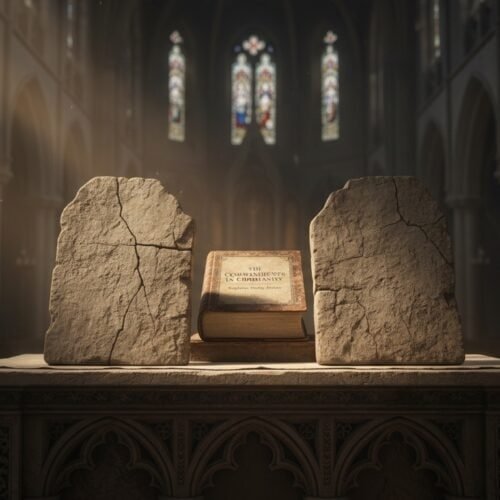
You’ll find biblical sources consistently describe the Ten Commandments as inscribed on stone tablets, specifically referenced in Exodus 31:18 and Deuteronomy 9:10. While some scholars have speculated about alternative materials like clay tablets used in ancient Near Eastern contexts, archaeological evidence and textual analysis strongly support stone as the original medium.
The Hebrew term “luchot even” explicitly denotes stone tablets, distinguishing them from Mesopotamian clay tablet traditions.
Do All Christian Denominations Number the Ten Commandments the Same Way?
No, you’ll find significant biblical interpretations differ among Christian denominations regarding commandment numbering.
Religious variations exist primarily between Catholic/Lutheran traditions versus Protestant/Orthodox approaches. Catholics and Lutherans combine the first two commandments (idolatry prohibitions) while splitting the tenth (coveting) into two separate commands. Protestants and Orthodox churches maintain distinct first and second commandments but treat coveting as one unified prohibition, reflecting diverse hermeneutical traditions.
Conclusion
You’ve examined these ancient moral imperatives that continue shaping contemporary ethical discourse. Through contextual analysis, you can observe how these commandments establish foundational principles for monotheistic worship, social relationships, and personal conduct. Scholarly interpretation reveals their function as both religious doctrine and societal framework. You’ll find that understanding their original Hebrew context enhances appreciation for their enduring influence on Western legal traditions and moral philosophy across millennia.










No Comments