

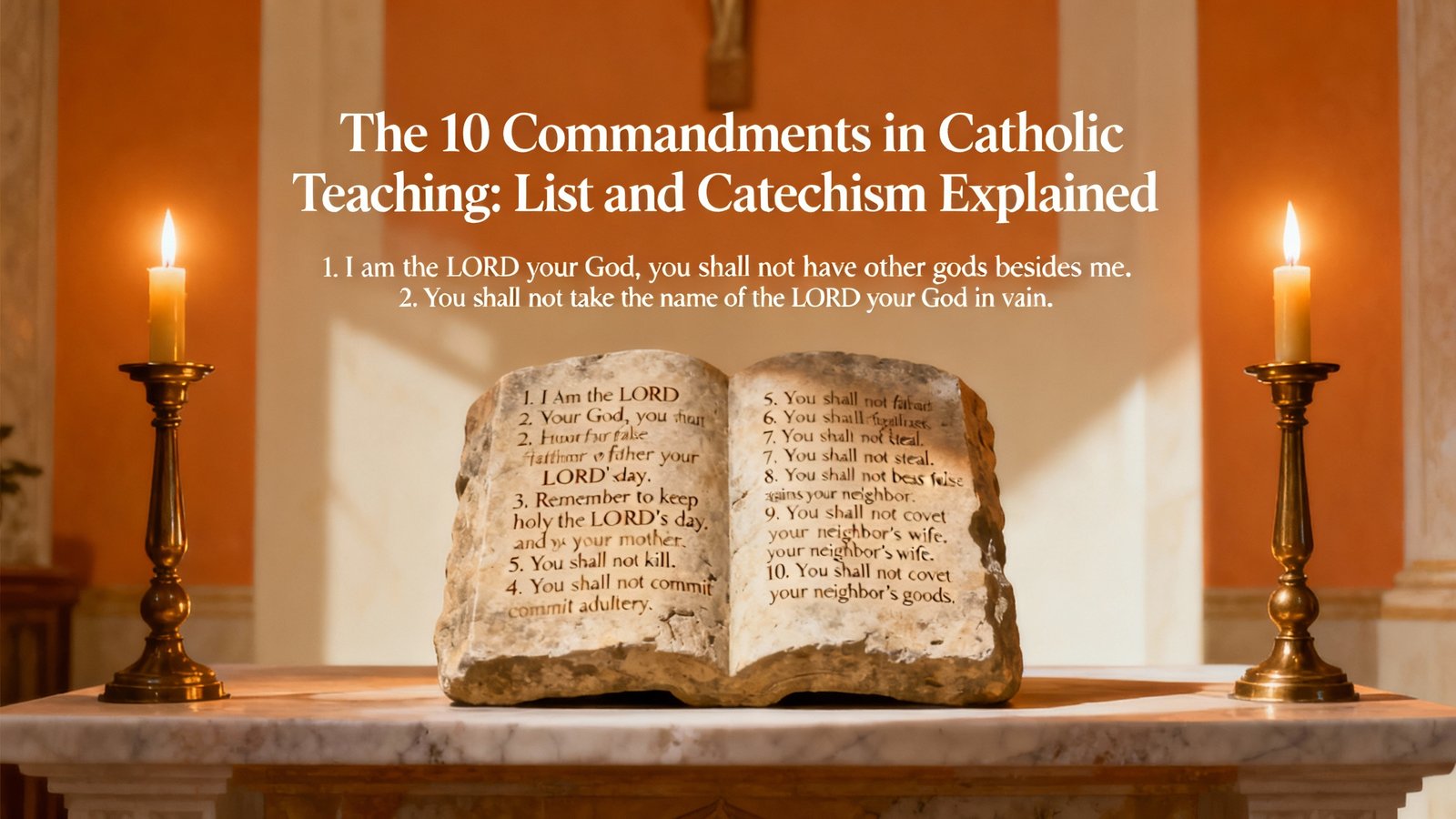
26 Nov The 10 Commandments in Catholic Teaching: List and Catechism Explained
The Ten Commandments in Catholic teaching guide you toward authentic relationship with God and neighbor through divine moral law. You’re called to worship God alone, reverence His holy name, keep Sunday sacred, honor your parents, protect life’s sanctity, maintain marital fidelity, respect others’ property, speak truthfully, and practice interior purity free from covetousness. These commandments aren’t mere ancient rules—they’re Christ’s pathway to human flourishing that addresses modern challenges from digital temptations to social justice, offering you practical wisdom for contemporary Catholic living.
Table of Contents
Key Takeaways
- The Ten Commandments demand complete allegiance to God, prohibiting idolatry including modern obsessions with money, power, and self-worship.
- Catholics must reverence God’s holy name beyond avoiding profanity, including respectful prayer, careful speech, and authentic witness in daily life.
- Sunday observance requires Mass attendance, spiritual renewal, family fellowship, and rest from unnecessary labor as consecrated worship time.
- The Fourth and Fifth Commandments uphold human dignity through honoring parents and protecting life from conception to natural death.
- Marriage represents God’s sacred covenant requiring fidelity, while prohibitions against theft and false witness demand honesty and social justice.
I Am the Lord Your God: You Shall Not Have Strange Gods Before Me

When God reveals Himself to Moses on Mount Sinai, He establishes the fundamental truth that shapes all human existence: “I am the Lord your God.” This first commandment doesn’t merely prohibit idol worship—it demands your complete allegiance to the one true God who created and sustains you.
Understanding divine transcendence means recognizing that God exists beyond all creation, infinitely surpassing any earthly substitute you might place before Him. The Church’s idolatry critique extends beyond ancient golden calves to modern obsessions: money, power, pleasure, or self-worship that compete for God’s rightful place in your heart.
This commandment calls you to authentic liturgical worship, participating fully in Mass and the sacraments. Your devotional practices—prayer, Scripture reading, and spiritual reflection—must flow from genuine love, not mere obligation. You’re invited into relationship with the living God who desires your heart completely, transforming worship from duty into joyful response to divine love.
You Shall Not Take the Name of the Lord Your God in Vain
You’re called to honor God’s holy name with the same reverence you’d show to His very presence, recognizing that His name carries divine power and sacred meaning.
This commandment extends far beyond avoiding obvious profanity—it encompasses how you speak of God in casual conversation, whether you fulfill promises made in His name, and your approach to prayer and worship.
Understanding this reverence transforms your daily speech and deepens your relationship with the Lord who revealed His sacred name to His people.
Understanding Sacred Name Reverence
The sacred name of God holds profound significance in Catholic tradition, demanding our utmost reverence and respect. Sacred name theology teaches that God’s name isn’t merely a label but represents His very essence and divine nature. When you speak God’s name, you’re invoking His presence and acknowledging His holiness.
Catholic liturgical linguistics carefully preserves this reverence through prescribed prayers and formal worship language. You’re called to avoid using God’s name carelessly in conversation, swearing falsely by His name, or employing it in anger or frivolity. This commandment extends beyond avoiding profanity—it encompasses showing proper respect whenever you mention Christ, Mary, or the saints. True reverence means approaching God’s name with the same awe you’d show when entering His presence directly.
Modern Applications and Examples
Building upon this foundation of reverence, consider how you can honor God’s name in today’s secular culture. Your daily interactions on social media present countless opportunities to either glorify or diminish God’s holy name. When you share content, comment, or engage online, ask yourself: “Does this reflect Christ’s love?” Avoid using religious language carelessly or as mere expressions of frustration.
In our consumer-driven society, you’ll encounter consumerism critique that often mocks faith traditions. Rather than responding with anger, demonstrate reverence through respectful dialogue. You can honor God’s name by living authentically Catholic values—showing compassion, practicing integrity, and speaking truthfully. Your witness becomes more powerful than any argument when you consistently reflect Christ’s character in both digital and physical spaces.
Remember to Keep Holy the Lord’s Day
You’re called to honor the Third Commandment by setting aside Sunday as a day consecrated to God through worship and rest. This sacred obligation centers on participating in the Holy Sacrifice of the Mass, where you join the universal Church in offering praise and receiving the Eucharist.
Beyond this liturgical duty, you’re invited to embrace Sunday as a time for spiritual renewal, family fellowship, and respite from unnecessary labor.
Sunday Mass Obligation
Every week, Catholics worldwide gather to fulfill one of their most fundamental obligations: attending Sunday Mass. This Sunday Mass obligation represents your active participation in Christ’s sacrifice and strengthens the Church community through collective worship and prayer.
The Church considers this duty so essential that missing Mass without serious reason constitutes grave sin. You’re required to attend the entire liturgy, arriving before the Gospel and remaining through the final blessing. Saturday evening vigil Masses satisfy this obligation, accommodating various schedules.
However, dispensation exceptions exist for legitimate circumstances: serious illness, caring for the sick, severe weather, or lack of available transportation. These situations don’t diminish your call to keep Sunday holy through prayer, Scripture reading, and rest from unnecessary work.
Rest and Worship
Beyond attending Mass, the Third Commandment calls you to embrace the fuller meaning of keeping the Lord’s Day holy through deliberate rest and worship.
You’re invited to establish a sabbath rhythm that mirrors God’s rest after creation, setting Sunday apart from weekday activities.
This sacred pause allows you to engage in contemplative prayer, spiritual reading, and meaningful fellowship with family and community.
Your rest practices shouldn’t be mere leisure but intentional renewal of spirit.
Consider how the liturgical seasons shape your Sunday observance—Advent’s anticipation, Lent’s reflection, Easter’s joy.
You’ll find that honoring this commandment creates space for God’s grace to work in your life, refreshing your soul and strengthening your relationship with Christ throughout the week ahead.
Honor Your Father and Your Mother
The fourth commandment calls you to honor your father and mother, establishing the foundation for all human relationships and social order.
This divine mandate extends beyond childhood obedience to embrace lifelong filial responsibility that deepens as you mature.
Honor encompasses respect, gratitude, and care for your parents throughout their lives.
You’re called to express parental gratitude for the gift of life and their sacrifices while maintaining appropriate family boundaries that preserve dignity for all.
This commandment doesn’t demand blind submission to parental wrongdoing but requires respectful dialogue and loving correction when necessary.
The Church teaches that honoring parents creates pathways for generational reconciliation, healing wounds that span families.
As your parents age, you’re obligated to provide physical, emotional, and spiritual support according to your circumstances.
This commandment also extends to legitimate authority figures who serve parental roles in society, fostering ordered communities rooted in mutual respect and responsibility.
You Shall Not Kill
While the fourth commandment establishes respect for life’s givers, the fifth commandment protects life itself with absolute clarity: “You shan’t kill.” God’s prohibition against murder stands as an inviolable defense of human dignity, recognizing that every person bears the divine image from conception to natural death.
You’re called to safeguard life in all circumstances.
The Church teaches that intentional killing of innocent persons constitutes grave sin, violating God’s dominion over life and death. This commandment extends beyond physical violence to encompass anger, hatred, and revenge that wound human dignity.
Catholic teaching addresses complex situations through careful moral reasoning. Self defense ethics permit protecting innocent life when facing unjust aggression, provided you use proportional force. The capital punishment debate reflects evolving Church teaching that increasingly emphasizes life’s sanctity, with recent papal pronouncements declaring the death penalty inadmissible. You’re challenged to build cultures that consistently choose life over death.
You Shall Not Commit Adultery
When you contemplate the sixth commandment, you’re called to understand marriage as God’s sacred covenant between one man and one woman.
Your fidelity within this bond isn’t merely a personal choice but a reflection of Christ’s unwavering love for His Church.
You must recognize that this commandment establishes clear moral boundaries that protect the dignity of human sexuality and the sanctity of the marital union.
Marriage as Sacred Covenant
Fidelity stands at the heart of God’s design for marriage, reflecting the unbreakable bond between Christ and His Church.
When you enter marriage, you’re participating in a sacramental union that transcends mere contract—it’s a sacred covenant witnessed by God Himself. This conjugal theology reveals marriage’s profound spiritual dimension, where two become one flesh in an indissoluble bond.
Your wedding vows aren’t just promises to each other; they’re commitments made before the Trinity. The Church teaches that marriage mirrors Christ’s sacrificial love for His bride, the Church.
You’re called to live this mystery daily through mutual self-gift, openness to life, and unwavering faithfulness. This sacred covenant demands your complete dedication, excluding all others and embracing the transformative grace God provides for your lifelong journey together.
Fidelity and Moral Boundaries
Because marriage represents God’s faithful love for humanity, adultery strikes directly at the heart of this divine mystery. You’re called to honor marital boundaries that extend beyond physical acts to encompass your entire being. Catholic teaching recognizes that infidelity begins in the heart and mind, making emotional fidelity equally crucial to your marriage covenant.
Digital temptation presents modern challenges requiring vigilance and accountability. You must guard against inappropriate relationships, pornography, and virtual affairs that compromise your commitment. These violations wound both spouses and damage your relationship with God.
When you’ve struggled with these temptations, seek confessional guidance immediately. Christ’s mercy awaits you, offering healing and strength to restore your marriage. Through prayer, sacramental grace, and pastoral support, you can rebuild trust and deepen your covenant bond.
You Shall Not Steal
Theft violates the fundamental dignity of human persons and disrupts the order God established for His creation.
Theft destroys human dignity and undermines the divine order that God intended for His creation and humanity.
When you steal, you’re taking what rightfully belongs to another, whether it’s physical property, intellectual work, or services. The Church teaches that this commandment extends beyond obvious burglary to include cheating, fraud, and even digital piracy consequences that harm creators and their livelihoods.
You’re called to respect others’ property rights while recognizing your responsibility toward those in need. The Catechism emphasizes that private ownership serves the common good, but you can’t ignore genuine poverty around you.
Charitable redistribution through legitimate means—tithing, almsgiving, and supporting just social structures—fulfills God’s intention for shared prosperity.
Rather than taking what isn’t yours, you’re invited to practice generosity and justice. This commandment challenges you to examine your relationship with material goods and consider how your economic choices reflect Christ’s love for all humanity.
You Shall Not Bear False Witness Against Your Neighbor
Truth forms the foundation of all human relationships, and when you distort or destroy it through false witness, you attack the very fabric of community that God designed for His people. The eighth commandment demands more than avoiding perjury in courtrooms—it calls you to embrace radical honesty in all circumstances.
False witness destroys reputations, fractures trust, and wounds souls. Whether through malicious lies, harmful gossip, or deliberate silence when truth is needed, you violate this commandment whenever you misrepresent reality about another person. The Church teaches that this sin requires both perjury reform in your heart and active reputation repair for those you’ve harmed.
God calls you to be a witness to truth, following Christ who declared Himself “the way, the truth, and the life.” Your words should build up rather than tear down, reflecting the divine truth that illuminates every authentic human relationship.
You Shall Not Covet Your Neighbor’s Wife
Within the depths of your heart, covetousness wages war against the peace God intends for your soul and your relationships. The ninth commandment confronts covetous thoughts that corrupt your inner chastity and threaten the sanctity of marriage.
When you harbor comparative lust or marital jealousy toward another’s spouse, you violate their spousal autonomy and dignity. The Catechism teaches that coveting represents disordered desire—wanting what rightfully belongs to another. This commandment calls you to practice emotional fidelity, not merely avoiding adultery but purifying your intentions and desires.
Catholic teaching emphasizes that marriage reflects Christ’s covenant with the Church. When you entertain lustful thoughts about another’s spouse, you damage this sacred image. The commandment demands interior conversion, transforming your heart through prayer and virtue.
True freedom comes when you respect marriage’s exclusivity and cultivate pure intentions. Guard your thoughts carefully, for they shape your character and either honor or dishonor God’s design for human love.
You Shall Not Covet Your Neighbor’s Goods
Beyond mere external theft, the tenth commandment pierces the sanctuary of your heart where envy and greed first take root. You’re called to examine your material desire honestly, recognizing how coveting corrupts your soul before any outward sin occurs.
The Church teaches that this commandment demands charitable detachment from worldly possessions. You mustn’t allow yourself to become enslaved by what others possess, whether it’s wealth, status, or comfort. Instead, cultivate gratitude for God’s provisions in your life.
Envy prevention begins with understanding that every blessing comes from divine providence. When you see others prosper, you’re invited to rejoice rather than resent. This commandment protects your interior peace by teaching proper ordering of desires.
True freedom emerges when you detach from excessive material longing. The Catechism emphasizes that coveting violates justice and charity, poisoning relationships and disturbing community harmony. Practice contentment and trust in God’s perfect timing.
Frequently Asked Questions
Why Are There Different Versions of the Ten Commandments in Various Religions?
You’ll find different versions exist due to historical divisions among faith traditions and varying translation choices from ancient Hebrew texts.
When Jewish, Catholic, Orthodox, and Protestant communities developed separately, they organized and interpreted the commandments differently. You’re seeing the result of distinct theological emphases and scholarly decisions about how to number and translate God’s original words given to Moses on Mount Sinai.
What Happens if Someone Breaks a Commandment Accidentally or Unknowingly?
If you break a commandment accidentally or unknowingly, you’re not held morally culpable for accidental sinfulness. The Church teaches that invincible ignorance—when you genuinely couldn’t have known better—removes personal guilt.
However, you’re still called to form your conscience properly through prayer, study, and spiritual guidance. Once you become aware of wrongdoing, you should seek reconciliation through the Sacrament of Penance and strive to avoid future violations.
How Do the Commandments Apply to Modern Technology and Social Media?
You must develop a digital conscience, applying God’s commandments to your online actions. Practice virtual charity by treating others with Christ-like love on social media.
Honor the sabbath through intentional screen sabbath periods, stepping away from devices for prayer and rest.
Respect privacy ethics by avoiding gossip, protecting others’ dignity, and refusing to spread harmful content.
Your digital footprint should reflect your faith and values always.
Are There Any Commandments That Catholics Consider More Important Than Others?
Catholics don’t rank the Ten Commandments in a strict hierarchy of obligations, as all reflect God’s divine law.
However, there’s moral weighting based on the gravity of sins they address. You’ll find that love of God (first three commandments) forms the foundation for love of neighbor (remaining seven).
Christ emphasized the greatest commandments involve loving God completely and your neighbor as yourself, encompassing all others.
Can Someone Be Forgiven for Breaking All Ten Commandments Repeatedly?
Yes, you can absolutely be forgiven for breaking all ten commandments repeatedly. Catholic teaching emphasizes God’s infinite mercy and the repentance possibility available to every sinner.
Through sacramental confession, you receive absolution when you’re truly contrite and resolve to avoid sin. No matter how grave or frequent your transgressions, God’s grace remains accessible through the Church’s sacraments and your sincere conversion of heart.
Conclusion
You’ve received these commandments as God’s blueprint for living in relationship with Him and others. They’re not merely ancient rules, but timeless guidance that’ll lead you toward holiness and genuine happiness. As you reflect on each commandment, remember that Christ didn’t abolish them but fulfilled them perfectly. Let His example inspire you to embrace these teachings with joy, knowing they’re paths to freedom, not burdens. Live them with confidence in God’s grace.





No Comments