


26 Nov Learn Singing for Free 13 Sites and Apps That Actually Work and Improve Your Voice
You’ll develop professional vocal technique through scientifically-designed apps that provide real-time pitch detection, personalized training plans, and structured curricula covering everything from diaphragmatic breathing to advanced belting. Master interval recognition with gamified ear training, perfect your intonation using visual feedback graphs, and expand your range through progressive exercises tailored to your voice type. These free platforms offer the same bel canto principles, mix voice development, and genre-specific techniques taught in expensive studios—discover which combination transforms your unique vocal potential.
Table of Contents
Key Takeaways
- Free apps like Vanido and SingSharp provide real-time pitch detection with visual feedback to improve intonation accuracy instantly.
- Smule offers free duet features and community challenges across genres to build confidence and practice harmonization skills.
- Swiftscales provides scientifically-designed warm-up routines adapted to your vocal range, including lip trills, sirens, and arpeggios.
- Vocalist.org offers free structured lesson plans covering breath support, resonance, and downloadable exercises for range expansion.
- Jacobs Vocal Academy’s free YouTube channel teaches classical and musical theater techniques from beginner breath management to advanced coloratura.
Smule: Social Singing App With Real-Time Pitch Correction
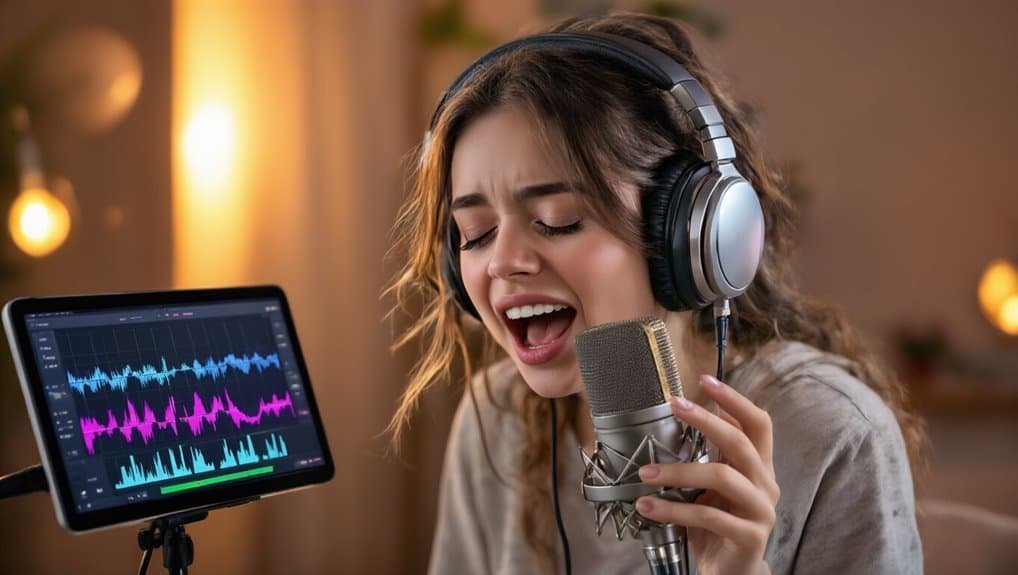
You’ll frequently find yourself searching for apps that combine entertainment with genuine vocal improvement, and Smule delivers both through its innovative real-time pitch correction technology.
The app’s auto-tune feature provides instant feedback on pitch accuracy while you’re singing, helping you identify and correct vocal inconsistencies in real-time.
You can participate in community challenges that push your technical boundaries across different genres and vocal ranges.
These competitions expose you to diverse singing styles while building confidence through peer interaction.
The app’s duet function lets you harmonize with other users globally, developing your ear training and timing skills.
Before diving in, you should understand the privacy implications of recording and sharing vocal performances.
Smule stores your recordings on cloud servers and requires microphone permissions.
Review the app’s privacy settings carefully, controlling who can access your performances.
Despite these considerations, you’ll gain valuable practice through structured vocal exercises and immediate pitch analysis that accelerates your learning curve.
Vanido: Daily Vocal Exercises With Visual Feedback
Vanido’s real-time pitch detection technology displays your vocal accuracy through intuitive visual graphs, letting you instantly correct off-key notes during practice sessions.
You’ll receive personalized training plans that adapt to your vocal range and skill level, ensuring each daily exercise targets your specific areas for improvement.
The app’s structured curriculum progressively builds your pitch control, breath support, and vocal agility through scientifically-designed exercises that take just minutes to complete.
Real-Time Pitch Detection
When you’re practicing vocal exercises, real-time pitch detection transforms guesswork into measurable progress by showing exactly how close your voice matches target notes.
Vanido’s algorithm processes your voice instantly, converting sound waves into visual feedback that displays pitch accuracy within milliseconds.
You’ll see colored indicators showing whether you’re flat, sharp, or perfectly on pitch.
The app’s latency optimization ensures there’s no delay between singing and seeing results, making adjustments feel natural and responsive.
Its noise robustness filters out background sounds, so you can practice anywhere without interference affecting accuracy.
You’ll track micro-adjustments in real-time, developing muscle memory for precise pitch control.
This immediate feedback loop accelerates learning by letting you correct mistakes instantly rather than reinforcing bad habits through repetitive incorrect practice.
Personalized Training Plans
Beyond accurate pitch detection, personalized training plans adapt to your unique vocal characteristics and learning pace through Vanido’s adaptive algorithm system.
The platform’s goal mapping feature lets you define specific objectives—whether you’re targeting pitch accuracy, expanding vocal range, or improving breath control.
You’ll receive customized exercises that match your current skill level and progressively challenge your abilities.
The system recognizes different learning styles by offering visual, auditory, and kinesthetic feedback simultaneously.
If you’re struggling with interval training, it’ll automatically adjust difficulty and provide additional practice sessions.
Your daily routines evolve based on performance metrics, ensuring you’re neither overwhelmed nor under-challenged.
This intelligent adaptation means you’ll develop proper technique while avoiding vocal strain, making consistent improvement measurable and achievable through data-driven progression tracking.
Vocalist.org: Professional Vocal Lessons and Sheet Music Library
Vocalist.org stands as a comprehensive resource hub that combines professional-grade vocal instruction with an extensive sheet music collection tailored for singers at every skill level.
You’ll discover structured lesson plans covering essential techniques like breath support, vocal registration, and resonance optimization. The platform’s teacher bios showcase certified instructors’ credentials, helping you select mentors aligned with your musical goals.
You can access downloadable exercises targeting specific vocal challenges—from expanding range to improving pitch accuracy. The sheet music library spans classical arias to contemporary pieces, all formatted with vocal-friendly keys and phonetic pronunciation guides. Community forums connect you with fellow vocalists who share performance tips and troubleshooting advice for common technical hurdles.
The site’s systematic curriculum progresses through fundamental concepts to advanced techniques like melisma and vocal agility. You’ll find diagnostic tools that identify areas needing improvement, plus practice tracks with adjustable tempos for skill-building at your pace.
30 Day Singer: Structured Course With Free Trial Access

How can you transform raw vocal potential into polished technique through methodical training? Day Singer’s structured curriculum provides the systematic approach you’ll need to develop professional-level skills. The platform’s onboarding walkthrough immediately assesses your current range, identifying specific areas for improvement through diagnostic exercises.
You’ll progress through sequential modules covering breath support, resonance placement, and articulation drills. Each lesson builds upon previous techniques, ensuring you’ve mastered fundamental concepts before advancing to complex vocal runs and belting exercises.
Sequential modules build from breath support fundamentals through resonance placement to complex vocal runs and belting techniques.
The platform’s pricing transparency means you won’t encounter hidden fees after your trial period expires.
Interactive pitch detection technology provides real-time feedback on your intonation accuracy, while video demonstrations show proper laryngeal positioning and diaphragm engagement. You can track your progress through weekly assessments that measure improvements in range extension, tonal quality, and rhythmic precision.
The trial access includes complete course materials, letting you evaluate whether this methodical approach matches your learning style.
SingTrue: Pitch Training Games for Better Intonation
Why struggle with pitch accuracy when gamified exercises can accelerate your intonation development? SingTrue transforms pitch training into an engaging experience that’ll sharpen your ear and vocal precision. You’ll progress through systematically designed levels that challenge your ability to match pitches, identify intervals, and maintain consistent intonation.
The app’s Gamified Progression system rewards accuracy with points and unlocks advanced exercises as you improve. You’ll start with basic pitch matching, then advance to complex melodic patterns and harmonies. Each module builds upon previous skills, ensuring you’re developing a solid foundation before tackling harder concepts.
What sets SingTrue apart is its Microtonal Challenges feature. You’ll train your ear to detect subtle pitch variations smaller than semitones, developing the fine-tuned perception professional singers need. The app’s real-time visual feedback shows exactly how close you’re getting to target pitches, helping you make precise adjustments. Through consistent practice, you’ll develop the muscle memory and aural skills necessary for consistently accurate singing.
Eric Arceneaux YouTube Channel: R&B and Pop Vocal Techniques
Eric Arceneaux’s YouTube channel specializes in breaking down complex vocal runs and riffs that define contemporary R&B and pop music, helping you master melismas through step-by-step demonstrations.
You’ll find structured breathing exercise tutorials that teach diaphragmatic support techniques essential for sustaining powerful notes and maintaining vocal control throughout challenging phrases.
His systematic approach to vocal agility training lets you progress from basic pentatonic runs to advanced chromatic passages at your own pace.
Vocal Run Breakdowns
Mastering vocal runs requires understanding their intricate construction, and you’ll find Eric Arceneaux’s YouTube channel offers systematic breakdowns of R&B and pop’s most challenging riffs and runs.
He’ll dissect complex passages note-by-note, teaching you how professional singers build their ornament vocabulary through deliberate practice patterns.
You’ll learn to identify common melodic decoration techniques like chromatic approaches, pentatonic scales, and blues notes within famous runs.
Eric demonstrates each component slowly, then gradually increases tempo while maintaining pitch accuracy.
He’ll show you how to connect individual notes smoothly through proper breath support and vowel modification.
His structured approach transforms intimidating runs into manageable exercises.
You’ll practice specific finger patterns on piano while singing, developing muscle memory that makes spontaneous embellishments possible during performances.
Breathing Exercise Tutorials
How effectively you support your voice depends entirely on your breathing technique, and Eric’s tutorials break down the biomechanics of diaphragmatic breathing through targeted exercises that strengthen your respiratory control.
You’ll master the intercostal expansion method while maintaining proper posture alignment throughout each exercise progression.
His systematic approach develops your diaphragmatic awareness through specific drills that isolate the transversus abdominis and external obliques.
You’re guided through appoggio techniques that coordinate your breathing muscles with vocal fold vibration, ensuring optimal subglottic pressure for sustained phonation.
Eric demonstrates the relationship between thoracic mobility and breath management, teaching you to recognize inefficient clavicular breathing patterns.
You’ll practice measured inhalation-exhalation ratios that build respiratory endurance while maintaining consistent airflow velocity during complex vocal passages.
Swiftscales: Vocal Warm-Up Companion for All Levels
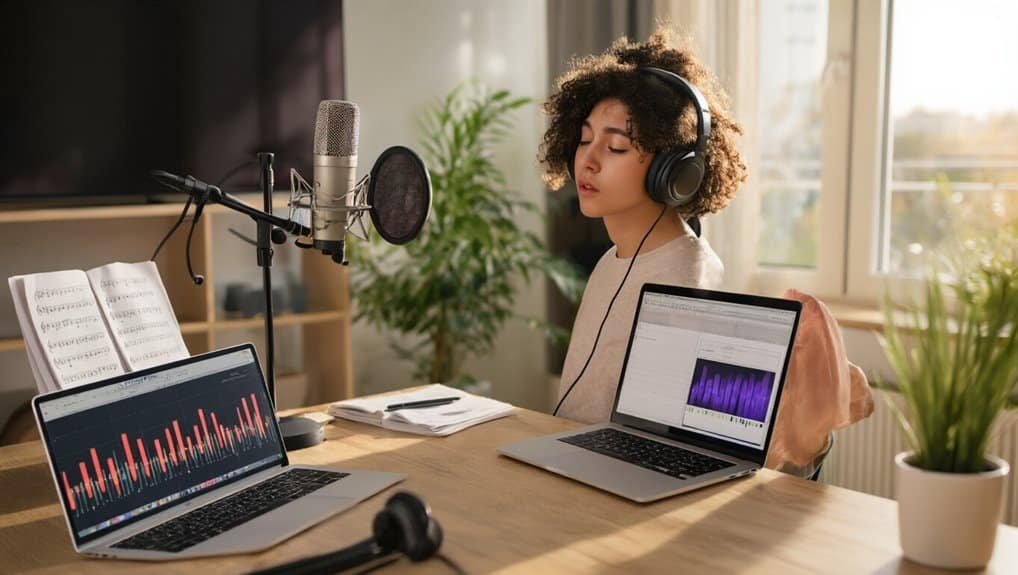
Consistently warming up your voice before singing sessions prevents vocal strain and enhances your performance quality, and Swiftscales delivers a comprehensive solution for singers at every skill level.
You’ll find scientifically-designed exercises targeting specific vocal registers, from chest voice through mix voice to head voice development.
The app’s algorithm adapts warm-up routines based on your vocal range classification—soprano, alto, tenor, or bass.
You can practice anywhere thanks to Offline Mode functionality, ensuring uninterrupted training without internet connectivity.
The platform’s Localization Support extends accessibility to non-English speakers, featuring interface translations and exercise instructions in multiple languages.
You’ll progress through structured modules covering lip trills, sirens, arpeggios, and interval training.
Each exercise includes visual pitch guides and real-time feedback mechanisms to correct intonation errors immediately.
Track your daily practice streaks, monitor range expansion, and document vocal improvements through the built-in progress journal.
The app’s customizable session lengths accommodate both five-minute pre-performance prep and thirty-minute comprehensive training routines.
Jacobs Vocal Academy YouTube: Classical and Musical Theater Training
Where can you access professional-grade vocal instruction specializing in classical technique and Broadway repertoire without spending thousands on private lessons? Jacobs Vocal Academy’s YouTube channel delivers comprehensive training that’ll transform your vocal production.
You’ll master fundamental bel canto principles through systematic exercises targeting breath support, resonance placement, and vocal registration. Their diction coaching videos break down International Phonetic Alphabet symbols, helping you articulate Italian, German, and French art songs with authentic pronunciation.
The channel’s structured playlists guide you through progressive skill-building, from beginner breath management to advanced coloratura passages. You’ll find detailed tutorials on musical theater belting techniques, including safe mix voice development and emotional storytelling through song.
Each video demonstrates proper laryngeal positioning, soft palate elevation, and vowel modification strategies. They’ve organized content by voice type, ensuring sopranos, tenors, and baritones receive targeted instruction.
Practice along with piano accompaniments while receiving real-time feedback cues that’ll refine your intonation and rhythmic accuracy.
Perfect Ear: Music Theory and Ear Training Exercises
Why struggle with pitch recognition when Perfect Ear’s comprehensive training modules transform your musical perception through scientifically designed exercises?
Perfect Ear’s scientifically designed modules transform musical perception through comprehensive pitch recognition training.
You’ll develop critical listening skills through progressive drills targeting interval recognition and chord identification—fundamental abilities every vocalist needs.
Perfect Ear’s structured curriculum covers essential music theory concepts while simultaneously training your ear.
You’ll practice identifying major and minor thirds, perfect fifths, and complex intervals that directly improve your vocal accuracy.
The app’s chord identification exercises advance from basic triads to seventh chords, enhancing your harmonic awareness during ensemble singing.
Each module adapts to your performance level, increasing difficulty as you master concepts.
You’re not just memorizing sounds—you’re building neural pathways that connect auditory perception with vocal production.
The app tracks your progress across rhythm training, scale degrees, and sight-singing exercises.
Cheryl Porter Vocal Method YouTube: Expanding Your Vocal Range
Cheryl Porter’s YouTube channel offers systematic range extension exercises that’ll help you safely access both your lower and upper registers through targeted vocal sirens, lip trills, and scale patterns.
You’ll develop stronger breath support techniques using her diaphragmatic breathing drills and sustained note exercises, which form the foundation for consistent tone production across your entire range.
Range Extension Exercises
When you’re ready to push beyond your current vocal limits, Cheryl Porter’s range extension exercises provide a systematic approach to safely expanding both your upper and lower registers.
You’ll start with sirens that promote laryngeal coordination, allowing your voice box to move freely through its entire range. These exercises train your vocal folds to thin and stretch gradually, preventing strain while accessing higher pitches.
Porter’s falsetto integration techniques help you bridge the gap between chest and head voice. You’ll practice sliding through your passaggio using specific vowel modifications that maintain consistent airflow.
Her lip trills and humming patterns stabilize your breath support while exploring new territory. Each exercise builds upon the previous one, ensuring you’re developing sustainable technique rather than forcing notes that aren’t yet accessible.
Daily Practice Routines
Consistently developing your vocal range requires a structured 20-30 minute daily practice session that systematically targets each component of healthy singing.
You’ll maximize progress by dividing practice into focused Micro Sessions: five minutes for breath support exercises, ten minutes for scales and arpeggios, five minutes for vowel modification drills, and ten minutes applying techniques to repertoire.
Establish Consistency Rituals that anchor your practice.
Start with diaphragmatic breathing while brewing morning coffee, or practice lip trills during your commute.
You’re building neural pathways that strengthen with repetition.
Schedule practice at the same time daily—your voice responds better to regular, shorter sessions than sporadic marathons.
Track your comfortable range weekly using a piano app.
When you notice fatigue, stop immediately.
Your voice needs recovery periods to build strength sustainably.
Breath Support Techniques
How you breathe determines 80% of your vocal power and range expansion, making breath support the foundation Cheryl Porter emphasizes throughout her vocal method. You’ll master diaphragmatic engagement by placing your hand on your stomach and feeling it expand outward during inhalation.
Don’t let your shoulders rise—they should remain stationary while your ribcage expands laterally.
Your posture alignment directly affects breathing capacity. Stand with feet hip-width apart, knees slightly bent, and imagine a string pulling from your crown.
Keep your chest lifted but relaxed. You’re creating optimal space for your lungs to expand fully.
Practice the “hissing exercise” Porter teaches: inhale for four counts, then release air steadily through your teeth for eight counts. This builds the muscular control you’ll need for sustained notes and dynamic phrases.
SingSharp: Real-Time Pitch Detection and Progress Tracking
SingSharp regularly stands out among free singing apps for its scientifically-grounded approach to vocal training through real-time pitch detection technology. You’ll receive instant visual feedback as colored bars display your pitch accuracy against target notes, enabling immediate self-correction during practice sessions.
Real-time pitch detection technology delivers instant visual feedback for immediate vocal correction during practice.
The app’s progressive exercise system adapts to your skill level, starting with simple intervals and advancing to complex melodic patterns. You’ll track improvement through detailed performance metrics, including pitch accuracy percentages and consistency scores stored in your personal progress dashboard.
SingSharp’s algorithm analyzes vocal stability, identifying specific notes where you’re consistently sharp or flat.
You can practice confidently knowing your data privacy remains protected through encrypted local storage. The offline mode ensures uninterrupted training sessions without internet dependency, making practice possible anywhere. You’ll develop muscle memory for correct pitch production through repetitive exercises targeting your weakest areas, while the gamification elements maintain engagement through achievement badges and streak counters.
Ken Tamplin Vocal Academy YouTube: Rock and Power Singing Techniques
While technology-based apps provide pitch accuracy training, Ken Tamplin Vocal Academy’s YouTube channel delivers professional instruction specifically engineered for rock and contemporary power singing.
You’ll access over 1,000 free videos covering advanced vocal techniques that most coaches charge premium rates to teach.
Ken’s systematic approach breaks down complex concepts into digestible segments.
You’ll master Belting Essentials through his “It’s the LAH!!! AH!!!” technique, which properly positions your tongue and throat for maximum resonance without strain.
His demonstrations show exact laryngeal positioning and breath support mechanics needed for sustained high notes.
The channel’s Distortion Safety tutorials teach you controlled grit and rasp without damaging your vocal cords.
You’ll learn glottal compression techniques, false cord engagement, and proper recovery methods between intense singing sessions.
Ken demonstrates these techniques while singing challenging songs from bands like Led Zeppelin and Dio, proving their real-world application.
His before-and-after student showcases provide concrete evidence that these methods work across different voice types.
Vocal Pitch Monitor: Visual Pitch Analysis for Practice Sessions
When you’re practicing scales or working through vocal exercises, Vocal Pitch Monitor transforms your smartphone into a professional-grade pitch analyzer that displays your vocal accuracy in real-time.
You’ll see your pitch represented as a moving line graph that tracks against musical notes, making it easier to identify when you’re sharp or flat.
The app’s harmonic visualization shows overtones and frequency patterns, helping you understand your voice’s tonal qualities beyond basic pitch.
You can record sessions and review them later, comparing your progress across different practice days.
The visual feedback accelerates your ear training development since you’re connecting what you hear with what you see on screen.
For effective tuning strategies, start with sustained single notes before attempting runs or melismatic passages.
Set the app’s sensitivity to match your vocal range, and practice matching the target pitch line precisely.
This immediate visual confirmation builds muscle memory faster than relying on hearing alone.
Frequently Asked Questions
Can I Learn Singing if I’m Completely Tone-Deaf?
You’re likely not truly tone-deaf since genuine amusia affects only 4% of people and stems from specific neurological causes.
You can undergo perception tests to determine if you have pitch processing difficulties or simply need ear training. Start with interval recognition exercises, then progress to matching single pitches.
Use apps with real-time visual feedback to develop your auditory-motor coordination. With systematic practice, you’ll improve your pitch accuracy and vocal control significantly.
How Long Does It Take to See Vocal Improvement?
You’ll notice initial improvements in breath control and pitch accuracy within 2-3 weeks with daily practice.
Significant vocal development requires 3-6 months of consistent training.
Your practice frequency directly impacts progress – aim for 20-30 minute sessions, 5 days weekly.
Realistic timelines vary: basic technique refinement takes 6 months, while advanced resonance and agility development needs 1-2 years.
Track your progress through recordings; you’re building muscle memory and coordination systematically.
Will Free Resources Work Without a Professional Teacher?
Yes, you’ll achieve results through disciplined self-assessment and consistent progress tracking.
You’ll need to record yourself regularly, analyzing pitch accuracy, breath support, and vocal resonance against reference materials.
Create structured practice sessions using apps’ feedback mechanisms for real-time correction.
While you won’t catch every technical error initially, you’ll develop proprioceptive awareness through systematic exercises.
Document your vocal range expansion, tone quality improvements, and endurance gains weekly for objective measurement.
Can These Apps Damage My Voice if Used Incorrectly?
Yes, you can damage your voice through incorrect technique when using singing apps unsupervised.
You’ll risk vocal strain if you’re pushing beyond your comfortable range or forcing notes without proper breath support.
However, you can minimize risks by starting with beginner-level exercises, stopping immediately if you feel pain, and maintaining good posture.
Most quality apps include warm-ups and technique videos that’ll help you develop healthy habits when followed carefully.
What Equipment Do I Need to Start Learning Online?
You’ll need minimal equipment to begin your online vocal training journey. Start with a budget microphone and pop filter to record practice sessions and receive accurate feedback from apps.
Your smartphone’s built-in mic works initially, but upgrading to even an entry-level USB microphone significantly improves audio clarity.
Add headphones for pitch monitoring, and you’re ready. Most singing apps require just these basics to analyze your vocal technique effectively.
Conclusion
You’ve discovered nine powerful platforms that’ll transform your vocal technique through pitch correction algorithms, visual feedback systems, and structured pedagogical frameworks. Whether you’re developing breath support with Vanido’s exercises, mastering intervallic relationships through SingTrue’s gamification, or analyzing formant frequencies with Vocal Pitch Monitor, you’re equipped with professional-grade tools. Start implementing these resources systematically—dedicate 15 minutes daily to pitch training, incorporate one YouTube technique weekly, and track your progress consistently. Your vocal breakthrough’s within reach.












No Comments