


25 Nov 10 Commandments and Texas Law Court Cases, Monuments, and Policy
You’re navigating Texas’s complex legal terrain where the Establishment Clause and Free Speech protections collide over Ten Commandments monuments. The Supreme Court’s Van Orden v. Perry (2005) upheld Texas’s Capitol monument, yet you’ll find the legal landscape remains contested. Courts scrutinize whether displays serve secular historical purposes or primarily advance religious doctrine. Texas’s legislature now implements policies governing placement and funding to preempt constitutional challenges. Understanding how Texas distinguishes government endorsement from private expression reveals broader implications for church-state separation across jurisdictions.
Table of Contents
Key Takeaways
- Van Orden v. Perry (2005) Supreme Court decision upheld the Ten Commandments monument on Texas State Capitol grounds erected by the Fraternal Order of Eagles in 1961.
- Texas courts balance Establishment Clause concerns against Free Speech protections when evaluating whether religious monuments on public property constitute government endorsement of religion.
- Contextual factors including placement, surrounding materials, and accompanying documents influence judicial determinations of whether Ten Commandments displays serve secular historical purposes or promote religious doctrine.
- Secular purpose requirement demands courts scrutinize whether officials selected monuments for neutral, non-religious criteria rather than promotion of faith-based content or spiritual instruction.
- Texas appellate courts produce inconsistent interpretations of religious monuments, with outcomes depending heavily on specific facts, court identity, and judicial philosophy regarding constitutional analysis.
Historical Context of Religious Displays in Texas Public Spaces
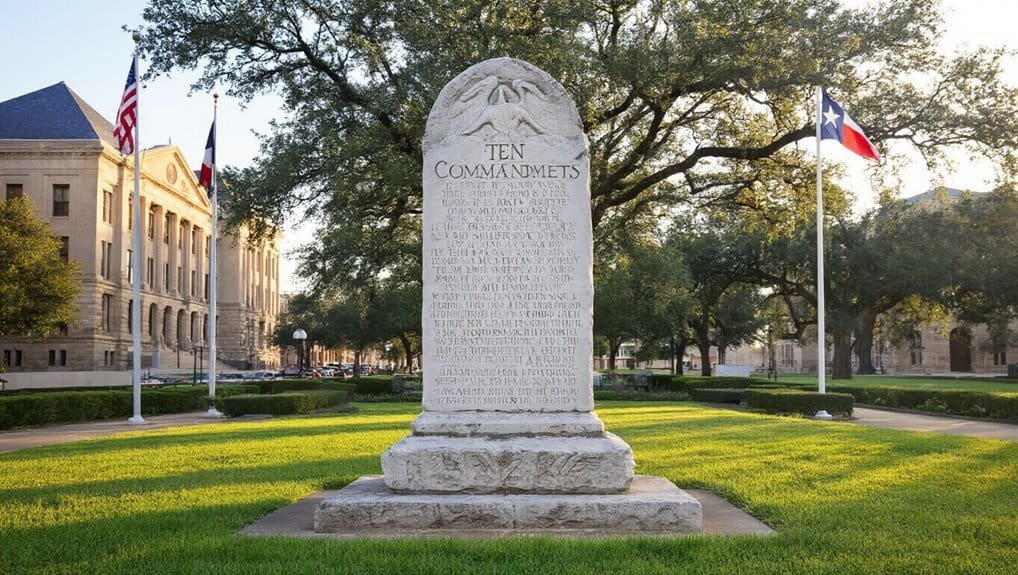
Because Texas courts have long grappled with the intersection of free speech, religious liberty, and the Establishment Clause, you’ll find the state’s approach to religious displays shaped by both federal precedent and local tradition. You’re confronted with a landscape where courthouse lawns and public squares frequently host religious monuments funded through private donations. These placements create legal tension between protecting religious expression and maintaining constitutional neutrality.
You’ll encounter cases where Texas courts examine whether displays constitute government endorsement of religion. Religious processions historically permitted on public streets reveal how municipalities balance community tradition against constitutional constraints. When you analyze Texas jurisprudence, you’ll notice courts emphasize the distinction between government speech and private speech displayed on public property.
Private donations funding monuments complicate this analysis further. You must recognize that Texas courts increasingly scrutinize whether accepting privately-funded religious displays creates unconstitutional entanglement. This nuanced approach reflects your state’s effort to accommodate religious expression while respecting constitutional boundaries.
The Texas State Capitol Monument: Origins and Significance
The Ten Commandments monument standing on the Texas State Capitol grounds represents one of the most litigated religious displays in American constitutional law. You’ll find this six-foot granite structure, erected in 1961 by the Fraternal Order of Eagles, positioned prominently on the capitol grounds—a location that amplifies its capitol symbolism and cultural reach.
The monument’s significance extends beyond its physical presence. You understand that it functions as a statement about public memory, asserting particular values within a government space. The Eagles’ placement strategy deliberately chose the capitol grounds to embed religious messaging within civic architecture and official memory.
Courts have grappled with whether this monument constitutes impermissible establishment of religion or protected historical expression. You recognize that the monument’s longevity and prominence created precedent-setting complications for subsequent Establishment Clause analyses, ultimately reaching the Supreme Court in Van Orden v. Perry (2005).

Constitutional Framework: The Establishment Clause and Free Speech Tensions
When the Eagles erected their granite monument on the Capitol grounds, they didn’t simply place a religious artifact in a civic space—they created a constitutional flashpoint that would force courts to reconcile two competing First Amendment protections.
You’re navigating the tension between the Establishment Clause and Free Speech protections. The church-state separation doctrine prohibits government endorsement of religion, yet Free Speech protections shield private religious expression. This speech overlap generates genuine constitutional difficulty.
Courts must distinguish between government speech endorsing religion (unconstitutional) and private speech the government merely tolerates (protected). You’ll find the controlling precedent requires examining whether reasonable observers perceive government endorsement. The Commandments monument presented this dilemma acutely: private donors funded it, yet the state controlled the Capitol grounds where it stood.
This framework shapes how Texas courts evaluate religious monuments, determining whether context—not content alone—determines constitutional permissibility.
Landmark Supreme Court Decisions Affecting Texas
These landmark rulings don’t provide you with absolute answers. Instead, they require contextual analysis examining purpose, effect, and setting—forcing Texas courts to navigate nuanced constitutional territory where religious expression meets governmental neutrality obligations.
County Courthouse Displays and Legal Challenges
Because courthouses serve as physical embodiments of governmental authority, they’ve become focal points in litigation over Ten Commandments displays—forcing Texas jurisdictions to confront whether posting religious texts violates the Establishment Clause.
Courthouses embody governmental authority, making Ten Commandments displays focal points in Establishment Clause litigation across Texas jurisdictions.
You’ll find that courts distinguish between displays serving secular historical purposes versus those promoting religious doctrine. The context matters considerably: placement, accompanying materials, and church aesthetics significantly influence judicial determinations.
When you examine courthouse displays, you’re essentially analyzing visitor behavior patterns. Do observers perceive the monument as endorsing religion or acknowledging historical heritage? Texas counties have strategically positioned displays alongside other historical documents, arguing educational intent. However, plaintiffs consistently challenge these arrangements, contending that surrounding context can’t sanitize inherently religious content.
You must recognize that each display presents unique factual circumstances. Courts scrutinize whether governmental actors selected the Commandments for secular reasons or religious motivation. These nuanced determinations require careful precedent application, making county-level decisions legally precarious without clear Supreme Court guidance on religious monument displays.
The Evolution of Texas Court Interpretations
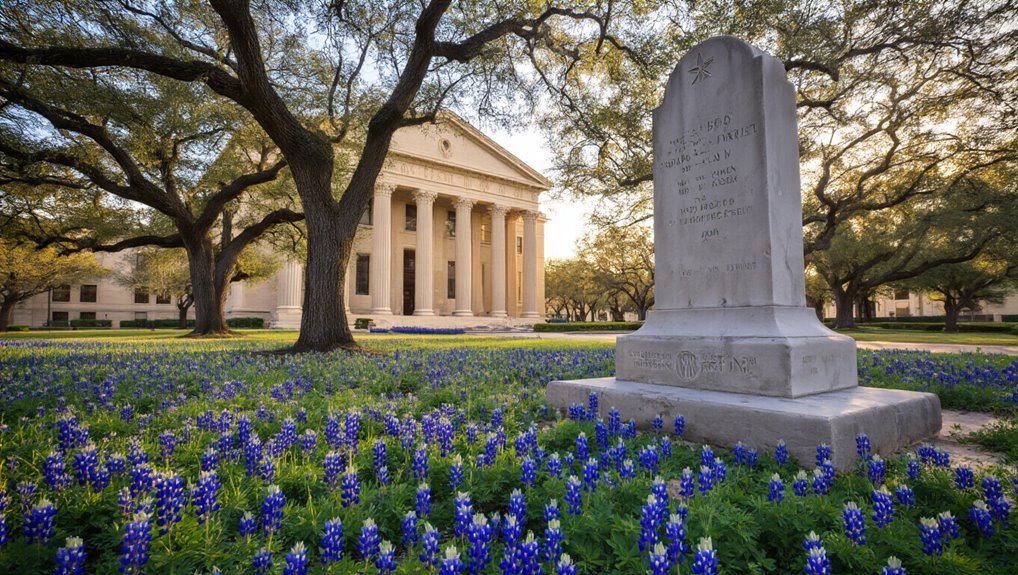
Texas appellate courts haven’t consistently interpreted the Establishment Clause‘s application to religious monuments, creating a doctrinal landscape that reflects broader national uncertainties.
You’ll find that judicial reasoning in these cases often hinges on distinguishing between monuments with historical significance and those primarily serving religious purposes.
Courts employ varying statutory interpretation approaches when examining display contexts and legislative intent.
You can observe how judges weigh secular justifications against religious symbolism, applying different analytical frameworks across decisions.
Some courts emphasize the monument’s age and cultural standing, while others focus on predominant effect and viewer perception.
This inconsistency means you’re navigating unpredictable precedent.
Texas courts haven’t settled whether Ten Commandments monuments represent historical documents, religious expression, or both.
Your understanding of applicable law depends heavily on which court decides your case and its particular judicial philosophy regarding Establishment Clause protections.
Religious Liberty Arguments and Opposition Perspectives
You’ll encounter proponents who invoke the Free Exercise Clause to defend Ten Commandments displays as religious expression deserving constitutional protection.
Opponents counter by emphasizing the Establishment Clause, arguing that such displays fail the Lemon test’s secular purpose prong and impermissibly advance religious doctrine.
This tension between free exercise rights and establishment concerns frames the central constitutional dispute you must navigate when evaluating Texas’s judicial approach to religious monument legislation.
Free Exercise Protection Claims
When proponents of the Ten Commandments monument advance religious liberty arguments, they typically invoke the Free Exercise Clause of the First Amendment, contending that displaying religious symbols doesn’t violate the Establishment Clause but rather reflects protected religious expression.
You’ll find supporters distinguish between religious exemptions granted to individuals and broader public acknowledgment of religious heritage. They argue that permitting the monument constitutes ritual accommodations recognizing Texas’s historical and cultural foundations.
However, opponents counter that public monuments differ fundamentally from individual exemptions. You must understand that courts have consistently held that Free Exercise protections don’t authorize government endorsement of specific religious doctrines.
The distinction between protecting individual religious practice and sponsoring religious displays remains analytically critical to evaluating these competing constitutional claims.
Secular Purpose and Establishment Concerns
Because the Establishment Clause analysis hinges on governmental purpose and effect, courts’ve scrutinized whether the Ten Commandments monument serves a genuinely secular intent or primarily advances religious doctrine.
You’ll find that opponents argue displaying the monument on public property violates the neutrality requirement by endorsing religious teachings. They contend that while government can acknowledge religion’s historical significance, the Commandments’ primary function remains spiritual instruction rather than secular education.
Courts’ve examined whether Texas officials selected this particular monument for its religious message or its purported historical value.
Your understanding of this tension proves crucial: establishing secular intent requires demonstrating the government chose the monument based on neutral, non-religious criteria rather than promoting faith-based content to citizens.
Government Policy Responses and Monument Management
The Texas Legislature’s approach to the Ten Commandments monument represents a deliberate shift in how states can navigate the intersection of religious expression and public property. You’ll find that Texas implemented specific policies governing monument placement, park signage, and maintenance funding to address legal vulnerabilities identified in preceding litigation.
Under these frameworks, you must understand that officials established clear protocols distinguishing religious monuments from government speech. The state designated funding mechanisms separate from general park operations, effectively creating a defensible position that you can trace through subsequent court filings.
By establishing transparent management procedures and standardized park signage protocols, Texas created documentation demonstrating governmental neutrality.
You should recognize that these policies attempted to preempt establishment clause challenges by demonstrating that monument maintenance funding derived from neutral sources rather than preferential religious allocations. This administrative approach reflects how government entities have adapted post-litigation, establishing precedent-based guidelines you’ll encounter in comparable state contexts.
Comparative Analysis: How Other States Handle Similar Displays
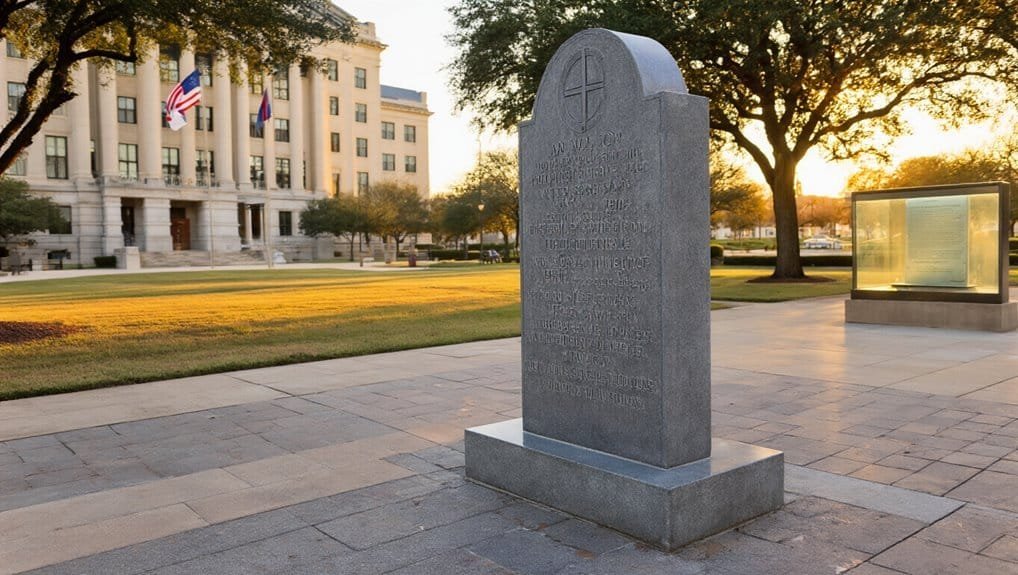
Beyond Texas’s framework, you’ll find that other states’ve adopted markedly different approaches to Ten Commandments displays, reflecting their distinct interpretations of establishment clause jurisprudence. Some jurisdictions strictly prohibit religious monuments on public property, while others permit them under narrow circumstances.
Several states’ve conducted community surveys to gauge public sentiment before authorizing displays. These findings often reveal significant regional variation in constitutional tolerance. Montana and Oklahoma, for instance,’ve successfully maintained monuments through careful neutrality provisions and historical contextualization.
When considering public funded art initiatives, states increasingly face scrutiny regarding religious content. Courts scrutinize whether displays serve secular purposes or primarily advance religious messages. Kentucky’s approach differs substantially from California’s, with Kentucky permitting displays while California enforces stricter separation.
You’ll notice that successful implementations typically combine historical significance with explicit secular justifications, avoiding purely devotional framings that courts consistently strike down.
Current Legal Status and Future Implications for Texas
As Texas courts continue navigating establishment clause challenges, you’ll find the state’s legal landscape remains unsettled regarding Ten Commandments displays on public property. The Supreme Court’s 2005 decision in Van Orden v. Perry upheld Texas’s monument, yet subsequent cases haven’t definitively resolved the church-state separation doctrine’s application to similar displays.
You’re witnessing evolving judicial standards that depend heavily on context, history, and legislative intent. Texas legislators face mounting pressure to clarify displaypolicy, knowing that ambiguous standards invite costly litigation.
The political implications prove substantial. Conservative lawmakers champion religious expression protections, while civil liberties advocates warn against preferential treatment. You’ll observe this tension intensifying as municipalities propose new monuments or courthouse displays.
Texas must anticipate the Supreme Court potentially revisiting establishment clause jurisprudence. You should recognize that your state’s approach will likely influence national church-state debates and potentially set precedent for religiously-themed public installations nationwide.
Frequently Asked Questions
What Specific Costs Have Texas Counties Incurred Defending Ten Commandments Monument Lawsuits?
You’ll find that specific cost breakdowns for Texas counties’ Ten Commandments monument litigation aren’t comprehensively documented in public records.
Counties’ve typically incurred legal fees, settlement payments, and expert witness expenses through separate budget allocations. Court appeals have multiplied these expenditures substantially.
While individual cases like Van Orden v. Perry involved significant resources, you’d need to request financial disclosures directly from county commissioners’ offices, as aggregate statewide figures remain fragmented across multiple jurisdictions without centralized reporting.
How Do Texas Voters Personally Feel About Religious Displays in Government Buildings?
You’ll find Texas voters deeply divided on religious displays in government buildings.
Public opinion surveys reveal that while many Texans support Ten Commandments monuments on courthouse grounds, citing historical and cultural significance, others oppose them on First Amendment grounds.
Community surveys consistently show this split reflects broader tensions between religious expression rights and secular governance principles, with support varying significantly by region and demographic factors.
What Alternative Designs Could Satisfy Both Religious and Secular Community Members Equally?
You’d find interfaith design solutions most promising. Consider monument plaques featuring multiple religious traditions alongside secular symbolism—perhaps incorporating historical documents emphasizing shared values like justice and equality.
You could display the Commandments within broader religious context exhibits. Precedent suggests courts favor displays emphasizing educational, historical significance rather than religious endorsement.
You’d need demonstrating genuine community input, ensuring secular perspectives receive equal visual prominence, avoiding any appearance of preferential treatment toward particular faiths.
Which Texas Politicians Have Publicly Stated Positions on the Ten Commandments Monuments?
You’ll find that Governor Greg Abbott and Attorney General Ken Paxton have publicly advocated for Ten Commandments monuments in Texas.
Abbott’s administration’s positions align with religious display protections, while Paxton’s office has defended such monuments through legal arguments emphasizing historical and cultural significance.
Both politicians’ stances reflect broader Republican support for religious expression in public spaces, though they’ve faced opposing arguments regarding First Amendment establishment clause concerns from various stakeholders.
How Have Ten Commandments Displays Affected School Prayer Policies in Texas Districts?
Ten Commandments displays haven’t directly altered Texas school prayer policies, though you’ll find they’ve influenced debates around student rights and curriculum changes.
Courts’ve consistently ruled that public school endorsement of religious displays violates the Establishment Clause.
You’re seeing districts navigate these precedents carefully, ensuring they’re not using such monuments to promote prayer.
Litigation’s shaped how you implement policies, requiring schools to distinguish between permissible student-initiated prayer and impermissible institutional religious expression.
Conclusion
You’ll find that Texas courts must balance the Establishment Clause against free speech protections when evaluating Ten Commandments displays. You’re working within precedent established by *Van Orden v. Perry*, which upheld the Capitol monument’s constitutionality based on historical context and secular purposes. You’ll need to assess each display individually—considering its placement, presentation, and accompanying monuments. You’re ultimately navigating evolving jurisprudence that favors narrow, fact-specific rulings over blanket prohibitions on religious monuments.


No Comments