

02 Dec Bible Story Gideon The Shocking Test That Changed Israel’s Fate – You Won’t Believe How God Chose Him
You’ll discover Gideon ben Joash threshing wheat inside a winepress (gat, גַּת) while hiding from Midianite raiders who’d devastated Israel for seven years. When Yahweh’s angel called this terrified farmer “mighty warrior” (gibbor chayil, גִּבּוֹר חַיִל), Gideon demanded proof through audacious fleece tests—twice reversing dew patterns overnight. God then reduced his army from 32,000 to just 300 warriors who lapped water like dogs, orchestrating victory through psychological warfare that turned 135,000 enemies against themselves.
Table of Contents
Key Takeaways
- God chose Gideon while he was hiding in a winepress, calling the fearful farmer a “mighty warrior” despite his weakness.
- Gideon demanded two miraculous fleece tests from God before accepting his divine commission to lead Israel against the Midianites.
- God reduced Gideon’s army from 32,000 to just 300 warriors using a strange water-drinking test at the spring.
- The 300 defeated 135,000 Midianites using only trumpets, torches, and clay jars in a midnight psychological warfare attack.
- Despite rejecting kingship verbally, Gideon created a golden ephod that led Israel into idolatry and acted like a king.
The Midianite Terror That Drove Israel Underground
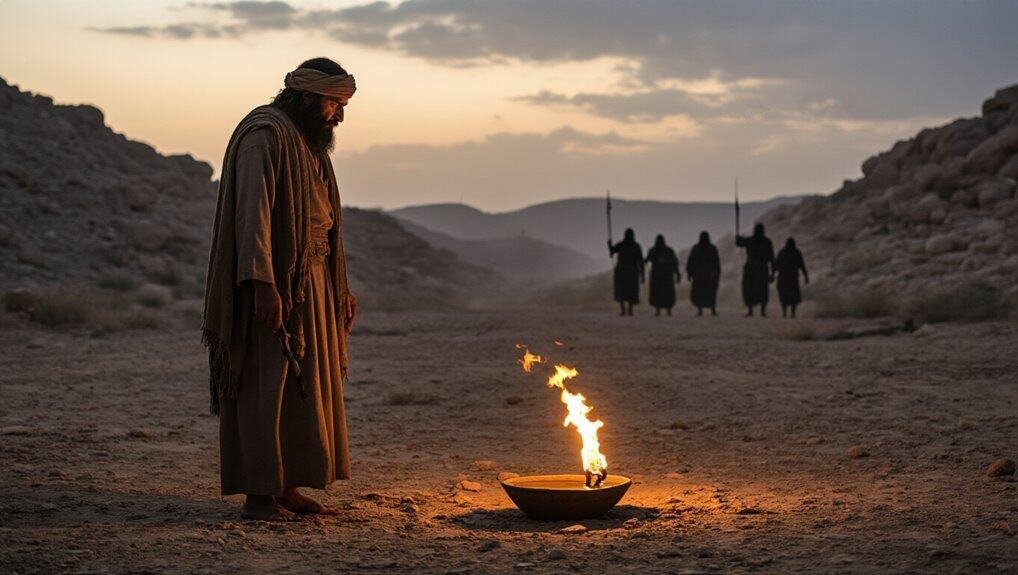
When the Israelites abandoned their covenant with Yahweh and embraced the worship of Baal and Asherah, divine judgment came swiftly through the marauding Midianites who swept across the Jordan Valley like locusts.
You’d witness these seasonal raids during harvest time when Midianite forces, allied with Amalekites and eastern peoples, descended upon Israel’s agricultural settlements. They’d systematically destroy crops, slaughter livestock, and plunder resources, employing a scorched-earth strategy that left nothing for survival.
Midianite raiders employed scorched-earth tactics during harvest season, systematically destroying Israel’s crops and livestock until nothing remained.
This seven-year oppression forced migration patterns you wouldn’t expect from God’s chosen people. Israelites abandoned their ancestral lands, fleeing to mountain caves, dens, and strongholds described as “me’arot” (מְעָרוֹת) in Hebrew texts.
They’d cultivate hidden fields in remote valleys, posting sentries to warn of approaching raiders. The economic devastation was complete—Israel couldn’t maintain basic subsistence farming. This crushing poverty and constant terror prepared the stage for divine intervention through an unlikely deliverer hiding in a winepress.
Meeting Gideon: The Fearful Farmer Hiding in a Winepress
As the angel of Yahweh approached the oak at Ophrah, you’d find Gideon ben Joash engaged in an act that revealed both ingenuity and fear—threshing wheat inside a winepress (gat, גַּת).
Normally, you’d thresh grain on elevated, open threshing floors where wind could separate chaff from kernels.
But Gideon couldn’t risk detection by Midianite raiders.
The winepress symbolism here isn’t accidental.
Wine production requires crushing grapes until they’re transformed—a metaphor for what God would do with Gideon’s personal doubt.
You’re witnessing a man whose very name means “hacker” or “hewer” (גִּדְעוֹן), yet he’s cowering in a pit meant for treading grapes.
When the angel called him a “mighty warrior” (gibbor chayil, גִּבּוֹר חַיִל), you can imagine Gideon’s bewilderment.
He wasn’t leading armies; he was hiding grain.
His immediate response—questioning God’s presence amid Israel’s suffering—reveals the depth of his skepticism.
You’re meeting Israel’s future deliverer at his lowest point.
When an Angel Called a Coward “Mighty Warrior”
The divine greeting “The LORD is with you, mighty warrior” (Judges 6:12) struck at the heart of Gideon’s identity crisis.
You’d find this angelic affirmation jarring—here’s a man threshing wheat in a winepress, literally hiding from Midianite raiders, being called “gibbor chayil” (mighty warrior).
God calls you mighty warrior while you’re hiding in fear—speaking to your destiny, not your current reality.
The Hebrew term denotes military prowess and valor, qualities Gideon clearly didn’t possess.
This identity reversal wasn’t mockery but prophetic declaration.
When God’s messenger addresses you, He doesn’t see your present weakness but your divinely ordained potential.
The angel spoke to Gideon’s future, not his current state cowering in fear.
You’re witnessing a theological pattern throughout Scripture where God names people according to their destiny: Abram becomes Abraham, Jacob becomes Israel.
The angel’s greeting challenged Gideon’s self-perception rooted in his clan’s insignificance within Manasseh’s tribe.
Yet God’s evaluation superseded societal hierarchies, transforming a frightened farmer into Israel’s deliverer through divine commissioning.
The Audacious Fleece Tests That Demanded Proof From God
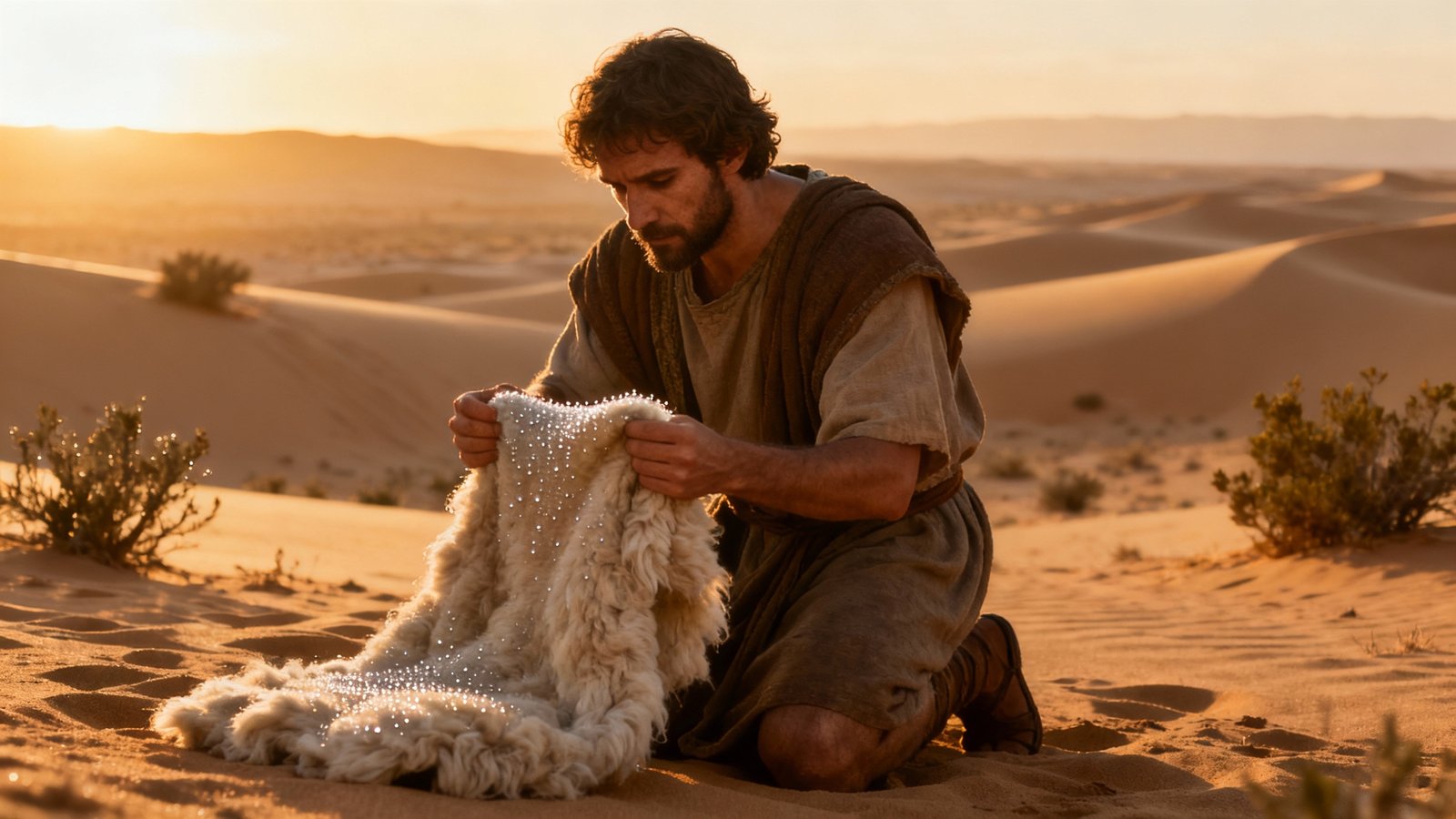
Why would someone who’d witnessed supernatural fire consume a sacrifice dare test God twice more? You’ll find Gideon’s fleece tests in Judges 6:36-40 reveal profound religious skepticism despite divine confirmation. The Hebrew word “gizzah” (fleece) becomes his chosen instrument for demanding tangible proof from Yahweh.
You’re witnessing unprecedented audacity when Gideon places wool on the threshing floor, requesting dew only on the fleece while keeping ground dry. Ancient Near Eastern divination practices typically involved single signs, yet he reverses his test the following night—demanding dry fleece amid dew-soaked ground. This double testing raises ethical implications about faith versus empiricism in ancient Israelite theology.
Scholar Robert Boling notes you’re observing a man wrestling with commission anxiety, not faithlessness. Gideon’s methodical approach reflects wisdom literature’s emphasis on verification (Proverbs 14:15). His tests weren’t rejecting divine authority but seeking absolute certainty before leading 32,000 men against Midian’s coalition forces.
From 32,000 Warriors to 300: The Military Strategy That Defied Logic
You’ve witnessed Gideon’s bold requests for divine signs, but now you’ll encounter YHWH’s counterintuitive military reduction that transformed Israel’s army from a formidable force of 32,000 to a mere 300 warriors.
Through two deliberate culling processes—first dismissing the fearful (Deuteronomy 20:8) and then observing how soldiers drank water at the spring of Harod—God systematically stripped away conventional military advantage.
This divine selection process, recorded in Judges 7:2-7, wasn’t about identifying the strongest fighters but ensuring Israel couldn’t attribute victory to their own strength, reflecting the ancient Near Eastern understanding that battles belonged to the gods, not human prowess.
The Fear Test
When Gideon’s army assembled at the spring of Harod (עין חרד, “spring of trembling”), the divine reduction strategy that followed would become one of Scripture’s most paradoxical military narratives. You’d witness God commanding Gideon to proclaim: “Whoever’s fearful may depart” (Judges 7:3).
Twenty-two thousand men left immediately—a devastating two-thirds reduction revealing fear contagion’s power within military ranks.
This wasn’t arbitrary cruelty. You’re observing divine wisdom addressing Israel’s cultural trauma from forty years of Midianite oppression. The Hebrew verb חָרֵד (hared, “to tremble”) connects etymologically to Harod’s name, suggesting providence in location selection. Fear-paralyzed soldiers couldn’t execute the upcoming psychological warfare strategy. By releasing the terrified majority, you’d prevent panic’s spread during combat, ensuring the remaining forces possessed the mental fortitude required for God’s unconventional battle plan.
The Water Test
The remaining ten thousand soldiers faced an unexpected second elimination at the water’s edge, where God instructed Gideon to observe their drinking method (Judges 7:4-5).
You’ll notice the Hebrew verb “tsaraph” (refine) describes this process, indicating divine selection through symbolic purification. Those who lapped water like dogs while remaining vigilant numbered only three hundred, while nine thousand seven hundred knelt to drink.
This test’s narrative function extends beyond military reduction—it reveals spiritual readiness. You’re witnessing a deliberate inversion of conventional warfare wisdom, where numerical superiority meant victory.
The drinking posture distinguished alert warriors from those prioritizing comfort, establishing a remnant theology that permeates Hebrew scripture. God’s selection criteria emphasized faith over force, transforming military engagement into theological demonstration.
God’s Selection Process
Although military commanders throughout ancient Near Eastern history measured strength by troop numbers, God’s reduction of Gideon’s army from 32,000 to 300 warriors represents a calculated theological statement rather than tactical incompetence. You’ll notice the Hebrew text emphasizes Divine Sovereignty through the phrase “פֶּן-יִתְפָּאֵר” (pen-yitpa’er) – “lest Israel boast.” God’s Calling Criteria wasn’t based on conventional military metrics but on preventing Israel’s self-glorification.
The selection process mirrors Deuteronomy 20:8‘s dismissal protocols, where fear disqualified soldiers. Yet God’s second criterion – how men drank water – seems arbitrary until you consider ancient warfare practices.
Those who lapped like dogs maintained battlefield alertness, demonstrating the vigilance required for divine service. This winnowing process ensured victory would unmistakably belong to Yahweh, not human strength or strategy.
The Strange Selection Process: Why Drinking Water Mattered
How could the manner in which soldiers drank water determine their fitness for battle? You’ll find the answer reveals God’s profound wisdom in military selection. When God instructed Gideon to observe how his men drank from the water (Judges 7:4-7), He wasn’t conducting an arbitrary test.
Those who lapped water like dogs while remaining upright demonstrated tactical alertness—they could maintain visual surveillance while drinking. The Hebrew term “yalaq” (לָקַק) specifically denotes this lapping action, distinguishing these 300 warriors from the 9,700 who knelt vulnerably.
Beyond ritual symbolism, this selection addressed practical logistics. You’re seeing divine strategy eliminate soldiers who’d prioritize personal comfort over battlefield readiness.
In ancient Near Eastern warfare, ambushes at water sources were common military tactics. The kneeling soldiers exposed themselves to attack, while the lappers maintained defensive posture. This wasn’t about righteousness but operational readiness—God selected warriors whose instinctive behavior matched the guerrilla warfare tactics necessary for defeating Midian’s vast army.
Trumpets, Torches, and Empty Jars: History’s Most Unusual Battle Plan
You’re about to witness the shofar’s blast and torch-lit chaos that would send the Midianite camp into complete disarray at the third watch of the night.
Against overwhelming odds—with your three hundred men facing an enemy force described as numerous as locusts—you’ll orchestrate a sophisticated psychological operation that exploits the darkness and the Midianites’ own superstitions about divine judgment.
The Hebrew term “teruah” (battle cry) combined with shattering pottery and sudden illumination would create such pandemonium that the enemy would turn their swords against each other in blind panic.
The Midnight Ambush Strategy
When Gideon received divine instructions for attacking the Midianite camp, the battle strategy defied every conventional military principle known to ancient Near Eastern warfare. You’d expect traditional formations, but God commanded a midnight assault using psychological warfare instead. The Hebrew term “laylah” (night) appears strategically throughout Judges 7, emphasizing darkness as divine cover.
You’ll notice Gideon’s troops relied on silent communication through careful observation rather than verbal commands. They’d rehearsed their synchronized movements, ensuring perfect timing when surrounding the valley’s perimeter. Moonlight navigation proved essential—the quarter moon provided just enough illumination to traverse the terrain while maintaining concealment. At precisely midnight’s third watch change, when Midianite sentries were most vulnerable, you’d witness 300 Israelites executing history’s most audacious ambush, transforming military disadvantage into theological triumph.
Three Hundred Against Thousands
Three distinct elements comprised Gideon’s arsenal against the Midianite coalition: the shofar (ram’s horn trumpet), clay vessels called “kadim” in Hebrew, and concealed torches.
You’d recognize this weaponry as psychological warfare rather than conventional armament. The statistical probability of three hundred men defeating an army described as “like locusts” (Judges 7:12) approached zero through traditional combat metrics.
Yet Gideon’s nocturnal strategy exploited Midianite superstitions. When you examine ancient Near Eastern military practices, night attacks weren’t standard protocol.
The simultaneous shattering of pottery, blazing torches, and shofar blasts created sensory overload, triggering panic-induced fratricide among the coalition forces. This battle’s cultural impact resonated throughout Israelite history—the phrase “sword of the Lord and Gideon” became synonymous with divine deliverance against overwhelming odds.
Psychological Warfare Tactics
Although military deceptions appear throughout ancient warfare, Gideon’s tactics represented an unprecedented manipulation of enemy psychology through calculated sensory assault.
You’d recognize these propaganda techniques in the Hebrew term “teruah” (battle cry), which Gideon weaponized alongside visual chaos.
His warriors didn’t spread misinformation campaigns through words but through orchestrated confusion—surrounding the Midianite camp with concealed torches suddenly revealed, accompanied by trumpet blasts and shattering pottery.
You’re witnessing psychological operations that predate modern warfare theory by millennia.
The simultaneous sensory overload—light piercing darkness, cacophonous noise, and shouting “For YHWH and Gideon”—created an illusion of overwhelming force.
This calculated deception triggered panic-induced fratricide among the enemy ranks, achieving what conventional assault couldn’t accomplish with Israel’s limited resources.
The Night Attack That Turned Enemies Against Each Other
As the second watch of the night began—approximately 10 PM in ancient Near Eastern reckoning—Gideon positioned his three hundred men around the Midianite encampment in the Valley of Jezreel. You’d witness military genius unfold through divine strategy. Each soldier carried a shofar, torch, and clay pitcher—unconventional weapons that’d exploit the darkness.
When Gideon‘s signal pierced the night, you’d hear three hundred shofars blast simultaneously while torches suddenly blazed as pitchers shattered. The Hebrew term “teruah” (תְּרוּעָה) describes this war cry that triggered moonlit miscommunication throughout the camp.
Startled Midianites couldn’t distinguish friend from foe in the chaos. Their rumor tactics backfired spectacularly—whispers of “Herev l’YHWH ul’Gideon” (A sword for the LORD and for Gideon) spread panic like wildfire.
You’d watch 135,000 warriors turn their swords against each other in blind terror. The psychological masterstroke exploited their own fears, transforming allies into enemies within minutes.
Gideon’s Victory and the Dangerous Aftermath of Success
Even though Gideon’s miraculous victory decimated the Midianite forces, you’ll notice the narrative takes an ominous turn as tribal politics and personal ambition corrupt this divine triumph.
The Israelites’ request that Gideon establish a dynasty reveals their misunderstanding of theocratic leadership. While he verbally rejects kingship, declaring “YHWH shall rule over you” (Judges 8:23), his subsequent actions betray leader hubris.
Gideon verbally rejects kingship while his actions betray monarchical ambitions and leader hubris.
You’ll observe Gideon’s creation of an ephod from plundered gold—seventeen hundred shekels—establishing what becomes a cult formation in Ophrah. The Hebrew term “zanah” (to prostitute) describes Israel’s worship of this object, demonstrating how victory’s spoils became spiritual snares.
His acquisition of multiple wives and seventy sons mirrors monarchical behavior he supposedly rejected. The text’s ironic naming of his concubine’s son Abimelech (“my father is king”) exposes Gideon’s true aspirations. You’re witnessing how divine deliverance deteriorates into idolatry when human pride supersedes covenant faithfulness.
Frequently Asked Questions
What Happened to Gideon’s Family After He Destroyed Baal’s Altar?
You’d witness severe Tribe Repercussions when Gideon’s townspeople discovered he’d destroyed Baal’s altar and Asherah pole.
The men of Ophrah demanded Joash surrender his son for execution, exemplifying intense Neighbor Retaliation.
However, Joash defended Gideon, arguing if Baal were truly divine, he’d defend himself.
This bold stance, recorded in Shoftim (Judges) 6:28-32, shifted public opinion.
Gideon’s new name “Jerubbaal” (let Baal contend) marked this pivotal familial crisis.
How Long Did Israel Have Peace After Gideon’s Victory?
You’ll find the peace duration lasted forty years according to Judges 8:28, where the Hebrew term “vayishqot” denotes complete rest. This regional stability represented one of Israel’s longest periods of tranquility during the judges’ era.
You’re observing a significant theological pattern here—the land’s rest paralleled Gideon’s lifetime, demonstrating divine covenant faithfulness. The Midianites didn’t resurface as threats, establishing unprecedented security across Israelite territories until Gideon’s death triggered renewed apostasy.
What Was the Ephod Gideon Made and Why Did It Become Problematic?
You’d recognize Gideon’s ephod as a golden priestly garment weighing 1,700 shekels, crafted from Midianite plunder.
While ephods (Hebrew: אֵפוֹד) traditionally served legitimate cultic purposes, Gideon’s became problematic through unauthorized worship.
You’ll find its Political Symbolism established Ophrah as a rival sanctuary to Shiloh, undermining centralized worship. The Ephod Idolatry emerged when Israelites “prostituted themselves” (Judges 8:27) before it, transforming a victory memorial into a snare that trapped Gideon’s household in apostasy.
Did Gideon Have Multiple Wives and How Many Children?
Yes, you’ll find Gideon’s marital status involved multiple wives, including a concubine in Shechem. Judges 8:30 states he’d seventy sons from his “many wives” (nashim rabot in Hebrew), reflecting ancient Near Eastern polygamous practices among wealthy leaders.
His offspring count reached seventy-one sons when including Abimelech, born to his Shechemite concubine. This extensive progeny demonstrates Gideon’s elevated social position following his military victories, though it ultimately created succession conflicts.
What Were the Names of the Midianite Kings Gideon Defeated?
You’ll find the Midianite kings Gideon defeated were Zebah and Zalmunna, whose names appear in Judges 8:5-21. Zebah’s identity derives from the Hebrew “zebach” meaning “sacrifice,” while Zalmunna’s origins stem from “tselem” (image) and “mana” (withheld).
These monarchs represented Midian’s oppressive power structure that’d subjugated Israel for seven years. The text also mentions princes Oreb and Zeeb, killed earlier by Ephraimites, completing the dismantling of Midian’s leadership hierarchy.
Conclusion
You’ve witnessed how Yahweh transformed a fearful farmer into a gibor chayil—a mighty warrior—through divine encounter and impossible odds. Gideon’s narrative demonstrates the Hebrew concept of bitachon, absolute trust despite human weakness. You’re reminded that ancient Near Eastern warfare typically favored numerical superiority, yet God’s reduction from 32,000 to 300 warriors defied conventional military strategy. This account challenges you to consider how divine sovereignty operates through human frailty, turning cultural expectations of power upside down.









No Comments