


24 Jan Palm Sunday Meaning: Why Branches Changed World History
When you examine Palm Sunday, you’re observing the moment Jesus fulfilled Daniel’s 483-year prophecy while strategically challenging Jerusalem’s power structures through deliberate messianic theater. The crowds’ proclamation threatened both Roman political authority and Jewish religious establishment, creating existential crisis among Pharisees and Sadducees. This calculated prophetic fulfillment catalyzed Christianity’s expansion across three continents within fifty years, fundamentally reshaping concepts of divine versus earthly authority that still influence Western constitutional law and human rights frameworks today.
Table of Contents
Key Takeaways
- Palm branches symbolized Jesus fulfilling ancient messianic prophecies, validating his divine kingship over earthly political powers.
- The celebration threatened Jerusalem’s religious and political authorities, challenging both Pharisees’ theology and Roman imperial stability.
- Within fifty years, Christianity expanded from local Jewish movement to multi-ethnic faith across three continents.
- Divine authority concepts from Palm Sunday influenced Western legal philosophy, natural law, and modern human rights declarations.
- The event redefined power relations by establishing transcendent authority over governmental decree, shaping constitutional protections today.
What Made Palm Sunday Fulfill Ancient Biblical Prophecy?
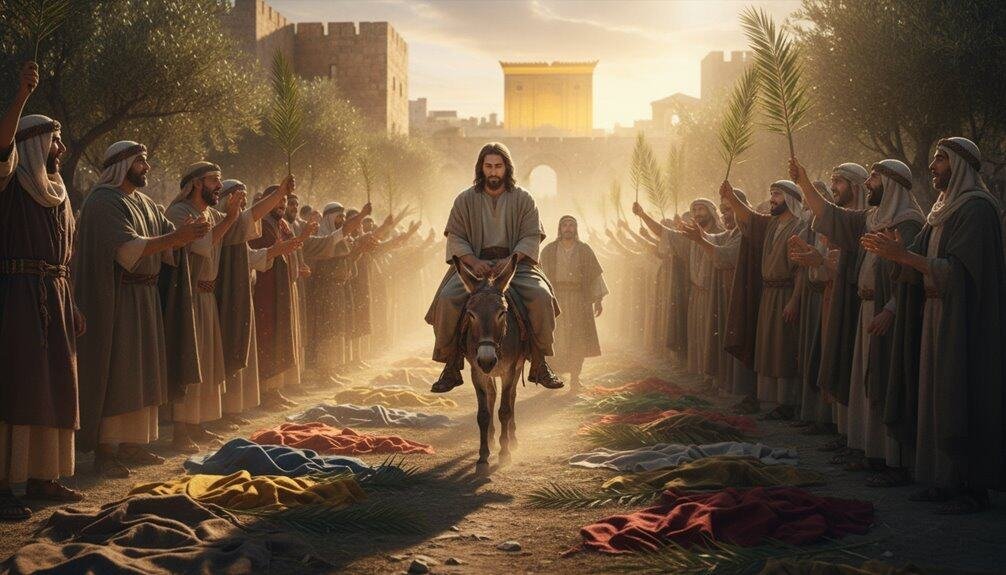
This wasn’t coincidental pageantry. You’re witnessing calculated prophetic fulfillment that validated Jesus’s messianic identity. The timing, manner, and public reception all converged to demonstrate that centuries of anticipation culminated in this moment. Ancient prophecy became historical reality through deliberate divine orchestration.
Why Palm Sunday Divided Jerusalem’s Religious and Political Leaders?
While crowds celebrated Jesus’s prophetic arrival, Jerusalem’s power structures recognized an existential threat to their authority. You’ll understand the crisis by examining how Jesus’s triumphal entry created irreconcilable tensions between competing powers.
Jerusalem’s established powers immediately grasped that Jesus’s triumphant arrival posed an unprecedented challenge to their fundamental authority and control.
The Pharisees faced theological devastation as crowds proclaimed Jesus as Messiah, undermining their interpretive monopoly over Scripture. Their demand that Jesus silence his disciples revealed their desperation to contain this prophetic challenge to their religious authority.

Roman authorities experienced mounting political pressure as messianic fervor threatened imperial stability. Pontius Pilate couldn’t ignore crowds hailing a “king” during Passover, when Jewish nationalism peaked and revolutionary sentiment simmered.
The Sadducees confronted economic catastrophe, as Jesus’s anticipated temple cleansing would disrupt their lucrative religious commerce. Palm Sunday was dividing loyalties throughout Jerusalem’s power hierarchy, forcing each group to choose between preserving their positions and acknowledging Jesus’s legitimate claims. This convergence of threatened interests would soon orchestrate his crucifixion.
How Christianity Spread From Palm Sunday’s Aftermath Across Three Continents?
Within fifty years of Palm Sunday’s dramatic confrontation, Christianity exploded across the Roman Empire’s vast network, transforming from a localized Jewish movement into a multi-ethnic faith spanning Europe, Asia, and Africa. You’ll find that Paul’s missionary journeys catalyzed this expansion, establishing churches from Antioch to Rome.
The movement’s growth stemmed from Palm Sunday’s theological foundation—Jesus’s royal entry established Christianity’s central claim of divine kingship over earthly powers.
Christian rituals emerged that transcended cultural boundaries, creating unified practices across diverse populations. Intercultural exchange flourished as Greek philosophy merged with Jewish theology, producing sophisticated doctrinal frameworks. Religious symbolism from Palm Sunday—particularly the triumph narrative—resonated with oppressed peoples throughout the empire. Local leaders recognized Christianity’s potential for political legitimacy, especially after Constantine’s conversion. By 325 CE, Christianity had penetrated Germanic tribes, North African provinces, and Asian territories, fundamentally altering three continents’ religious landscape through institutional structures that outlasted Rome itself.

Palm Sunday’s Influence on Western Law and Human Rights Today
The revolutionary principle Jesus embodied during his Palm Sunday entry—that divine authority supersedes human power structures—fundamentally reshaped Western legal philosophy and continues defining modern human rights frameworks. You’ll find this theological foundation embedded in competing legal traditions from Roman civil law to Anglo-Saxon common law systems.
Medieval canonists developed natural law theory directly from Jesus’s challenge to temporal authority, establishing that certain rights transcend governmental decree. This principle undergirds every major human rights declaration since 1789, from the French Declaration of Rights to the Universal Declaration of Human Rights.
When you examine modern constitutional protections—religious freedom, due process, equal dignity—you’re witnessing Palm Sunday’s enduring legal legacy. The concept that legitimate authority serves rather than dominates citizens stems from Jesus’s kingship model that day. Contemporary humanitarian ethics, international law, and civil rights movements all trace their philosophical DNA to this moment when branches welcomed a king who redefined power itself.
Frequently Asked Questions
What Type of Palm Branches Were Actually Used During Jesus’s Entry Into Jerusalem?
You’ll find that date palm fronds (Phoenix dactylifera) were likely used, though botanical identification remains debated among scholars.
The Gospels mention both palm branches and general foliage, suggesting mixed vegetation.
Date palms carried significant palm symbolism in ancient Judaism, representing victory, peace, and messianic triumph.
You’re encountering a deliberate theological narrative where the crowd’s choice of branches wasn’t random but symbolically proclaimed Jesus’s royal and redemptive identity through recognized cultural imagery.
How Do Different Christian Denominations Celebrate Palm Sunday Today?
You’ll find Catholic and Orthodox churches distribute blessed palms during processional liturgies, while Protestant denominations often incorporate palm fronds into divine worship through congregational processions.
Anglican traditions emphasize liturgical symbolism with elaborate ceremonial entries, whereas Lutheran and Methodist churches focus on scriptural readings about Christ’s triumphal entry.
Eastern Orthodox communities use willow branches in northern climates, maintaining ancient practices that connect contemporary believers to Jerusalem’s original Hosanna proclamations through sacramental participation.
What Is the Connection Between Palm Sunday and Easter Week Traditions?
You’ll discover the connection between Palm Sunday and Easter Week establishes Christianity’s foundational narrative arc. Palm Sunday’s triumphal entry inaugurates Holy Week, creating liturgical momentum toward crucifixion and resurrection. The palm sunday symbolism in liturgy represents Christ’s kingship while foreshadowing sacrificial death. You’re witnessing how branches that welcomed Jesus become instruments pointing toward Easter’s climactic events, forming Christianity’s central theological framework through connected worship traditions.
Why Do Some Churches Use Olive Branches Instead of Palm Branches?
You’ll find churches using olive branches because they carry profound liturgical symbolism rooted in biblical tradition.
When palms aren’t available in certain climates, you’re witnessing churches draw from Scripture’s rich imagery where olive branches represent peace, anointing, and God’s covenant.
You’re experiencing how liturgical practice adapts geographically while maintaining theological integrity—olive branches connect Christ’s triumphant entry to His role as the Prince of Peace.
What Happened to the Disciples Immediately After the Palm Sunday Procession?
You’ll find the disciples scattered after Palm Sunday’s triumph quickly dissolved into confusion and fear. Within days, they’d witness Jesus’s arrest, trial, and crucifixion. They abandoned him—one disgraced disciple betrayed Christ for silver. After his death, they hid behind locked doors, terrified of authorities. When women brought the post resurrection rumor Sunday morning, initial disbelief gave way to transformed courage that would reshape history.
Conclusion
You’ve witnessed how Christ’s triumphal entry fulfilled Zechariah’s prophecy while challenging Rome’s imperial claims and Jerusalem’s religious establishment. You can’t separate Palm Sunday from Christianity’s explosive growth—it catalyzed the apostolic mission that transformed three continents within centuries. Today, you’re still experiencing its revolutionary impact: Western jurisprudence’s emphasis on human dignity, individual rights, and social justice directly stems from this pivotal moment when branches proclaimed a kingdom that’d reshape civilization forever.









No Comments