

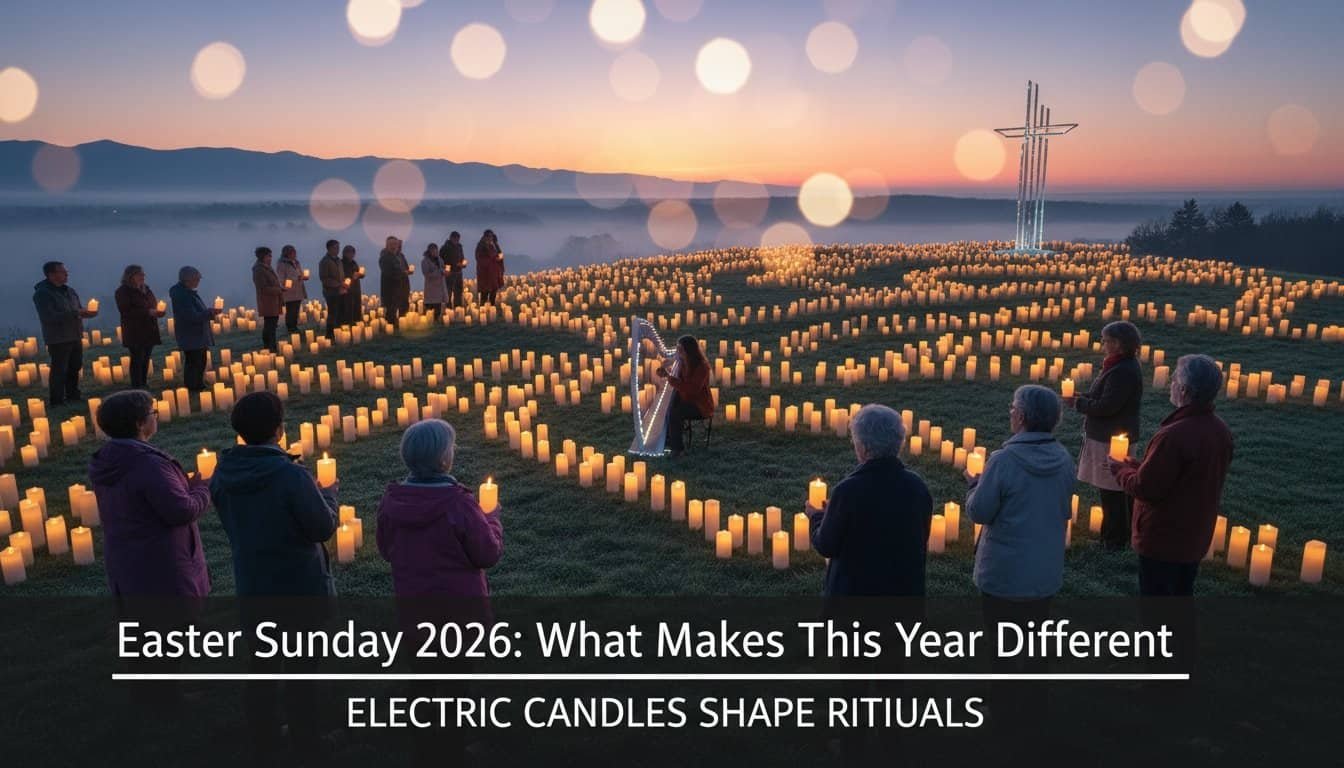
20 Jan Easter Sunday 2026: What Makes This Year Different
You’ll witness a remarkable Easter Sunday in 2026 as multiple extraordinary factors converge. The celebration occurs on March 29, one of the earliest possible dates in decades, following ancient ecclesiastical calculations. A rare solar eclipse will sweep across Europe on Good Friday, creating profound liturgical symbolism. Churches worldwide will offer immersive virtual reality services, while the Vatican achieves its first carbon-neutral Easter celebration through renewable energy initiatives. These astronomical, technological, and environmental elements transform this year’s observance into an unprecedented convergence of tradition and innovation.
Table of Contents
Key Takeaways
- Easter 2026 falls on March 29, one of the earliest possible dates in decades due to astronomical alignment.
- A rare solar eclipse occurs on Good Friday 2026, visible across major European cities from London to Rome.
- Virtual reality technology transforms Easter services, enabling global congregations to worship together in shared digital sanctuaries.
- The Vatican achieves its first carbon-neutral Easter celebration using renewable energy and carbon offset programs.
- Ancient ecclesiastical calculations, celestial events, and modern technology converge to create an unprecedented Easter experience.
Why Easter 2026 Falls So Early And What It Means

When will Easter arrive in 2026, and why does its timing carry such significance? You’ll witness Easter falling on March 29, 2026—one of the earliest possible dates in decades. This early springdates occurrence stems from the complex ecclesiastical calculations established at the Council of Nicaea in 325 CE, which determined Easter as the first Sunday following the first full moon after the spring equinox.
The lunar phase timing creates this remarkably early celebration because the paschal moon occurs shortly after March 21st. You’re experiencing a rare convergence where astronomical and liturgical calendars align to produce such timing. This early date affects global Christian communities’ preparations, seasonal celebrations, and cultural practices. The phenomenon demonstrates how ancient mathematical formulations continue governing modern religious observances, connecting contemporary believers to centuries-old traditions.
The Good Friday Solar Eclipse Visible Across Europe
How does celestial mechanics intersect with sacred chronology to create one of history’s most extraordinary coincidences? You’ll witness an unprecedented alignment on Good Friday 2026, when a solar eclipse sweeps across Europe during Christianity’s most solemn day. This celestial event carries profound historical resonance, echoing medieval chroniclers who interpreted eclipses as divine portents. The eclipse’s visibility across major European cities—from London to Rome—creates a shared experiential moment for millions observing both astronomical wonder and religious reflection simultaneously. You’re observing a convergence that hasn’t occurred in this geographic region during Holy Week for centuries. The eclipse’s timing amplifies Easter 2026‘s distinctiveness, transforming Good Friday from purely liturgical observance into a moment where scientific marvel intersects with spiritual contemplation across an entire continent.
Virtual Reality Easter Services Connecting Global Congregations
Why hasn’t technological innovation transformed religious observance until now? You’re witnessing a pivotal moment in ecclesiastical history as virtual reality fundamentally reshapes Easter services in 2026. This technological breakthrough emerges from decades of gradual digital integration within religious communities, accelerated by pandemic-era adaptations that normalized remote worship experiences.
You’ll find congregations from Jerusalem to São Paulo participating simultaneously in shared virtual sanctuaries, transcending geographical limitations that have historically fragmented Christian communities. These immersive Easter services enable unprecedented global communion, allowing believers to experience identical liturgical environments regardless of physical location.
The historical significance parallels the printing press’s impact on Christianity—democratizing access while preserving sacred traditions. You’re observing how virtual reality creates authentic spiritual experiences that maintain theological integrity while expanding participation beyond traditional denominational boundaries, fundamentally altering contemporary religious practice.
Vatican’s First Carbon-Neutral Easter Celebration
Where once the Vatican’s Easter celebrations consumed massive amounts of energy through traditional lighting and heating systems, 2026 marks the Holy See’s unprecedented achievement of complete carbon neutrality during its most significant liturgical observance. You’ll witness how Pope Francis’s environmental encyclical “Laudato Si'” has evolved from theological doctrine into concrete action. The Vatican’s climate policy now mandates renewable energy sources throughout St. Peter’s Basilica and Square during Easter Week. Solar panels installed across Vatican City’s rooftops power LED lighting systems, while geothermal heating maintains optimal temperatures. Private sponsorship from Catholic environmental organizations funded carbon offset programs, neutralizing emissions from international pilgrim travel. This historic milestone demonstrates institutional commitment to environmental stewardship, establishing precedent for global religious communities confronting climate change through liturgical practice.
Frequently Asked Questions
What Are the Traditional Easter Foods and Recipes for 2026?
You’ll find traditional desserts like hot cross buns and simnel cake remain central to Easter 2026 celebrations. Regional dishes continue reflecting local customs, while spring beverages such as elderflower cordials gain prominence. You’re seeing increased emphasis on vegetarian mains including herb-crusted lamb alternatives. Kid-friendly snacks like chocolate eggs persist alongside novelty crafts incorporating edible elements. These culinary traditions maintain historical significance while adapting to contemporary dietary preferences and cultural shifts.
How Do I Plan an Easter Egg Hunt for Children?
You’ll establish your Easter egg hunt by planning a scavenger hunt with age-appropriate clues that historically mirror medieval treasure quests. Contemporary scholarship suggests hosting a craft station ideas alongside traditional hiding spots, enabling children to create decorative containers. When planning a scavenger hunt, you’re perpetuating ancient spring fertility rituals. Academic research demonstrates that hosting a craft station ideas enhances cognitive development while maintaining cultural continuity with historical Easter celebrations.
What Stores Will Be Open on Easter Sunday 2026?
You’ll find most major retailers closed on Easter Sunday 2026, following historical precedent established since mid-twentieth century retail practices. Pharmacies, convenience stores, and gas stations typically maintain limited store hours for essential needs.
Traditional holiday shopping patterns indicate grocery chains often close entirely, while some restaurants operate reduced schedules. This commercial cessation reflects Easter’s significance in American retail calendar, where businesses historically observe Christian holidays despite increasing secularization trends.
When Do Easter School Holidays Begin and End in 2026?
You’ll find Easter school holidays in 2026 typically span two weeks, beginning around March 30th and concluding April 13th, though dates vary by educational district.
Historically, these breaks have facilitated family Easter travel patterns, with railways reporting peak usage during opening days.
Academic institutions have long recognized this period’s cultural significance, while retailers strategically launch spring fashion collections to capitalize on increased consumer mobility and seasonal purchasing behaviors during these extended holiday periods.
What Are Popular Easter Gift Ideas for Family Members?
You’ll find traditional Easter gift ideas center on chocolate eggs, stuffed animals, and religious items, reflecting centuries-old customs rooted in spring renewal symbolism. Contemporary families often incorporate books, games, and craft supplies that facilitate family activities during the holiday period. Historical evidence suggests these practices evolved from ancient fertility rituals, where eggs represented new life. You’re participating in traditions that blend Christian theology with pre-Christian seasonal celebrations, creating meaningful intergenerational experiences.
Conclusion
You’ll witness Easter 2026 as a convergence of celestial mechanics, technological innovation, and ecclesiastical reform. The early calendar date demonstrates Christianity’s continued adherence to ancient lunar calculations, while the solar eclipse reinforces humanity’s enduring fascination with cosmic phenomena during religious observances. You’re observing how digital worship platforms fundamentally reshape congregational participation, and the Vatican’s environmental initiatives reflect Christianity’s evolving relationship with creation stewardship in contemporary theological discourse.












No Comments