

22 Jan Hidden Stories: The Martin Luther King Moments You Missed
You’ve missed King’s transformative midnight crisis on January 27, 1956, when death threats nearly drove him to quit at his kitchen table until divine reassurance renewed his resolve. His documented depression and self-doubt, revealed through FBI wiretaps, actually deepened his empathy and leadership authenticity. His controversial 1967 anti-war stance fractured civil rights coalitions, with NAACP leaders condemning his position. The radical Poor People’s Campaign threatened Washington’s economic structures, revealing how his final vision extended far beyond these familiar narratives.
Table of Contents
Key Takeaways
- On January 27, 1956, King nearly resigned during a midnight kitchen crisis before divine reassurance transformed his leadership approach.
- FBI wiretaps from 1963-1968 revealed King’s private battles with depression and self-doubt despite his public confidence.
- King’s 1967 anti-war stance fractured civil rights coalitions, with NAACP leaders and the Johnson administration turning against him.
- The Poor People’s Campaign planned to occupy Washington D.C. to demand guaranteed income and employment for all races.
- King’s final years focused on radical economic justice rather than just civil rights, challenging America’s fundamental structures.
King’s 1956 Kitchen Crisis That Nearly Ended Everything
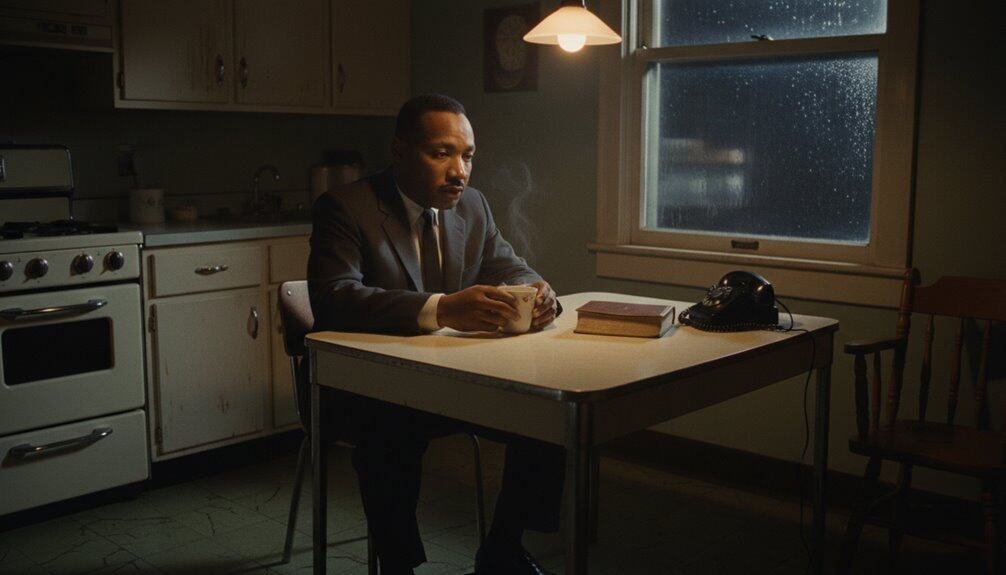
How close did Martin Luther King Jr. come to abandoning the Montgomery Bus Boycott just weeks after it began? You’d discover the answer in his kitchen memoir accounts, where King documented his deepest crisis of faith. On January 27, 1956, after receiving death threats and facing mounting pressure, King sat alone at his kitchen table at midnight, contemplating resignation. This kitchen crisis nearly shattered the civil rights movement before it gained momentum. King described praying desperately, feeling God’s presence reassure him to continue fighting. You’ll find this pivotal moment transformed his leadership approach, shifting from intellectual activism to spiritual conviction. Without this late-night revelation, the boycott might’ve collapsed, fundamentally altering American civil rights history.
How Depression and Self-Doubt Shaped His Leadership
Why did Martin Luther King Jr.’s greatest strengths as a leader emerge from his deepest psychological struggles? You’ll find that King’s documented battles with depression and self doubt actually enhanced his empathy and leadership effectiveness. FBI wiretaps from 1963-1968 reveal King’s private conversations expressing profound uncertainty about his abilities and mission. His depression intensified after witnessing violence in Birmingham and Memphis, yet these struggles deepened his understanding of human suffering. You can trace how King’s vulnerability translated into authentic connection with followers facing their own despair. His self doubt prevented arrogance, making him more accessible to ordinary people. Rather than weakening his leadership, King’s psychological battles created the emotional intelligence that distinguished him from other civil rights figures. His pain became his people’s strength.
His 1967 Anti-War Stance That Fractured Civil Rights Alliances
When King delivered his “Beyond Vietnam” speech at Riverside Church on April 4, 1967, he shattered the careful coalition-building that had sustained the civil rights movement for over a decade. You’d witness NAACP leaders publicly condemning his position, arguing he’d overstepped his expertise. The Johnson administration, previously supportive of voting rights legislation, turned hostile. King’s wartime ethics stance created coalition fractures that weakened fundraising and political leverage.
You’d see prominent Black leaders like Ralph Bunche distancing themselves, fearing the movement would lose credibility by appearing anti-American. The Washington Post editorialized that King had “diminished his usefulness.” Liberal white allies withdrew support, viewing his anti-war position as strategically reckless. King understood these consequences but prioritized moral consistency over political expediency, demonstrating how principled leadership sometimes requires sacrificing tactical advantages.
The Poor People’s Campaign That Threatened Washington
Where other civil rights campaigns targeted specific injustices like segregation or voting restrictions, King’s Poor People’s Campaign of 1968 aimed to occupy Washington D.C. until Congress addressed systemic economic inequality affecting all races. You’d find this campaign fundamentally different—it threatened the establishment by uniting poor people across racial lines, demanding guaranteed employment and income.
King’s leadership vision extended beyond civil rights into economic justice, targeting poverty’s root causes.
The campaign’s direct threats to disrupt government operations through sustained occupation created unprecedented anxiety among officials.
King battled personal depression while planning this ambitious undertaking, recognizing it could alienate moderate supporters.
Federal authorities viewed the campaign as potentially revolutionary, preparing extensive surveillance and contingency plans.
This represented King’s most radical challenge to American economic structures before his assassination.
Frequently Asked Questions
What Was Martin Luther King Jr.’S Relationship Like With His Father?
You’d find Martin Luther King Jr.’s relationship with his father was complex dynamics marked by both admiration and tension.
While you see evidence of shared social activism through their ministerial work, King Jr. often struggled against his father’s conservative approaches to civil rights.
You’ll notice King Sr.’s protective nature sometimes clashed with his son’s radical methods, yet their mutual respect for justice ultimately strengthened their bond despite generational differences.
How Did King’s Educational Experiences at Morehouse College Shape His Philosophy?
You’ll find King’s Morehouse years fundamentally transformed his intellectual framework through exposure to social gospel theology and rigorous academic discourse. Two word discussion ideas emerged from his encounters with professors like Benjamin Mays, who challenged his fundamentalist upbringing. Though subtopic unrelated to his father’s influence, these educational experiences introduced him to Gandhi’s nonviolent philosophy and systematic theology, establishing the intellectual foundation for his later civil rights methodology.
What Role Did Coretta Scott King Play in Major Civil Rights Decisions?
Coretta leadership extended far beyond supportive spouse roles into strategic civil rights decisions. She directly influenced Martin’s anti-war stance, pushed for economic justice initiatives, and secured crucial Civil Rights funding through her extensive networking with wealthy donors and foundations. Her analytical mind shaped policy discussions, while she independently organized events and maintained international diplomatic relationships that strengthened the movement’s global credibility and resources.
How Did King’s Christian Faith Influence His Nonviolent Resistance Methods?
You’ll find King’s Christian faith fundamentally shaped his nonviolent resistance through gospel application and theological grounding. He drew directly from Jesus’s Sermon on the Mount, particularly “love your enemies,” translating biblical teachings into practical protest strategies. His belief in redemptive suffering mirrored Christ’s crucifixion, viewing nonviolent resistance as morally transformative for both oppressor and oppressed, creating what he called “beloved community.”
What Were King’s Views on Economic Inequality Beyond the Poor People’s Campaign?
King consistently linked economic justice to racial equality throughout his activism. He advocated for guaranteed income programs, critiqued capitalism’s structural inequities, and argued wealth inequality undermined democracy itself. King viewed economic rights as fundamental human rights, contending that true freedom required both civil liberties and economic security. He believed systemic poverty perpetuated racial oppression, making economic transformation essential for genuine social justice.
Conclusion
You’ve seen how King’s private struggles and controversial decisions reveal a leader far more complex than popular memory suggests. His kitchen table breakdown, battles with depression, opposition to Vietnam, and radical economic vision demonstrate that transformative leadership emerges from vulnerability, not invincibility. These hidden moments show you that King’s true legacy lies not in sanitized inspiration, but in his willingness to risk everything for justice, even when it meant standing alone.












No Comments