

02 Feb Our Father Prayer: The Biblical Version You’ve Never Seen
You’ve likely memorized a version of the Our Father that combines elements from multiple biblical sources and centuries of liturgical tradition. Matthew’s fifty-seven-word version differs substantially from Luke’s thirty-eight-word account, with phrases like “Our Father in heaven” and “deliver us from evil” appearing only in Matthew. Jesus spoke Aramaic, using “Abba,” while manuscript variations and translation philosophies further shaped modern renderings. The familiar doxology ending doesn’t appear in the oldest biblical texts but entered through early church liturgy. Understanding these textual complexities reveals fascinating insights about Christianity’s most foundational prayer.
Table of Contents
Key Takeaways
- Luke’s version omits “in heaven,” “Your will be done,” and “deliver us from evil” found in Matthew’s familiar text.
- Jesus originally spoke the prayer in Aramaic using “Abba,” a more intimate term than formal translations convey.
- The famous ending doxology appears in no original manuscripts and was added later through liturgical use.
- Matthew places the prayer in the Sermon on the Mount while Luke sets it during Jesus’ journey to Jerusalem.
- The Greek word “epiousion” for bread appears nowhere else in literature, making its translation uncertain.
What Jesus Actually Taught: The Original Our Father Prayer
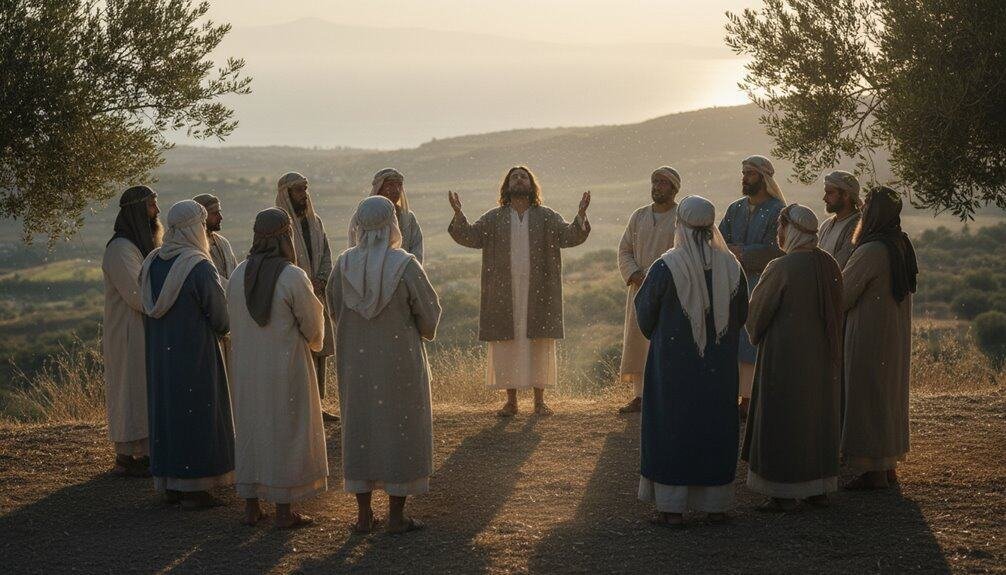
When you examine the Gospel accounts of Jesus teaching the Lord’s Prayer, you’ll discover striking differences that reveal the complexity of transmitting his original words. Matthew’s version contains fifty-seven words while Luke’s abbreviated form uses thirty-eight, creating two word discussion ideas among biblical scholars about which reflects Jesus’ actual teaching.
The translation nuances become even more significant when you consider Jesus spoke Aramaic, not Greek. The intimate term “Abba” that Jesus used carries emotional weight absent in formal translations. Luke’s “Father” versus Matthew’s “Our Father which art in heaven” demonstrates how early communities adapted the prayer for liturgical purposes.
Most striking is Matthew’s inclusion of debt forgiveness language—”forgive us our debts, as we forgive our debtors”—while Luke uses “sins” and “everyone indebted to us.” These variations suggest Jesus taught this prayer multiple times with contextual modifications rather than as a fixed formula. The familiar doxology ending that concludes many recitations was actually added by early Christians and does not appear in the original New Testament manuscripts.

Why Matthew and Luke Record Different Versions
Why do Matthew and Luke present such markedly different versions of the same prayer? You’re witnessing the result of Jesus teaching this prayer in different settings throughout his ministry. Matthew places it within the Sermon on the Mount as part of systematic instruction, while Luke positions it during Jesus’ journey to Jerusalem when disciples specifically request prayer guidance after comparing Jesus to John the Baptist.
Jesus taught the Lord’s Prayer in multiple settings throughout his ministry, adapting his instruction for different audiences and circumstances.
These different settings explain the textual variations you’ll encounter. Matthew’s longer version includes “Our Father in heaven,” “Your will be done,” and “deliver us from evil”—elements absent in Luke’s concise rendering.
Luke’s “each day’s bread” differs from Matthew’s “daily bread,” while Luke’s simple “Father” contrasts with Matthew’s communal “Our Father.”
Manuscript variations further complicate the picture. Early manuscripts show Luke omitting Matthew’s ornate elements, suggesting Jesus adapted his teaching for specific audiences and circumstances rather than providing identical rote instruction.
How English Translations Shaped Modern Versions
These manuscript differences take on new significance when you examine how English translations transformed the prayer’s modern form. The King James Version’s 1611 rendering established enduring patterns by combining Byzantine texts with Jerome’s Latin Vulgate, creating “Our Father which art in heaven, hallowed be thy name.” This formal approach influenced centuries of liturgical language.

Tyndale’s 1534 foundational work sparked two word discussion ideas that continue today: should translators prioritize literal accuracy or contemporary accessibility? Jerome’s inconsistent handling of “epiousion”—rendering it “supersubstantialem” in Matthew but “cotidianum” in Luke—exemplifies this tension.
Modern translation philosophies diverge sharply. The ESV maintains formal equivalence with “Your kingdom come,” while dynamic translations like the NLT simplify to “may your name be kept holy.” Contemporary versions also address theological confusion, rendering “lead us not into temptation” as “save us from the time of trial,” clarifying God’s non-involvement in temptation.
Understanding the Doxology Debate
How did a phrase absent from Christianity’s earliest manuscripts become one of its most recognizable conclusions? The doxology controversy reveals manuscript dynamics that fundamentally altered biblical text through liturgical influence.
You’ll find the “For thine is the kingdom, and the the power, and the glory, forever” absent from Christianity’s oldest and most reliable Matthew manuscripts. The Latin Vulgate doesn’t include it, nor do modern translations based on textual evidence. Yet it appears in the Didache and possibly Tatian’s Diatessaran, suggesting early liturgical usage rather than original scriptural text.
Scribes familiar with congregational responses gradually inserted this doxology into later Greek manuscripts. The 1611 King James Bible adopted it from these corrupted sources, cementing its place in Protestant tradition. Meanwhile, manuscript evidence consistently points to liturgical addition rather than apostolic origin. This demonstrates how worship practices can inadvertently reshape sacred texts through repeated scribal exposure to familiar prayers.
Choosing the Right Our Father Prayer for You
Which version of Christianity’s central prayer should guide your spiritual practice when multiple biblical texts, centuries of liturgical development, and modern translation efforts offer competing forms? Your choice depends on understanding cultural context and linguistic nuance across historical periods.
If you’re drawn to historical authenticity, Matthew’s longer version preserves Jesus’s original teaching within the Sermon on the Mount’s comprehensive framework. Luke’s shorter text offers directness but lacks theological completeness. Traditional forms like the 1662 Book of Common Prayer maintain centuries of devotional continuity, while contemporary translations such as the English Standard Version provide clearer modern understanding.
Consider your worship community’s practices. Anglican churches authorize both traditional and contemporary versions, allowing flexibility. Catholic and Protestant traditions typically employ the traditional ecumenical form with doxology. The linguistic nuance matters: “trespasses” versus “debts” versus “sins” reflects different theological emphases. Your selection should align with your spiritual needs while respecting your faith community’s established practices.
Frequently Asked Questions
Did Jesus Pray the Our Father Prayer Himself During His Ministry?
The gospels don’t record that Jesus prayed the Our Father himself during ministry. You’ll find he taught it to disciples, but textual evidence suggests he used different prayer patterns personally.
Ancient manuscripts show he prayed with spontaneous, contextual language rather than fixed formulas.
Modern vs ancient phrases indicate this prayer served as instructional template for followers, not his personal devotional practice during active ministry.
Why Do Some Churches Say “Trespasses” While Others Say “Debts” or “Sins”?
You’re encountering translation differences rooted in biblical manuscripts and liturgical evolution. Matthew’s Greek uses “opheilēmata” (debts), while Tyndale’s 1522 translation introduced “trespasses” from post-prayer verses. This creates tension between forgiveness vs conduct interpretations—debt imagery emphasizes obligation to God, while trespasses suggest moral boundary-crossing. Different denominations preserve either ritual vs meaning preferences, reflecting whether they prioritize manuscript fidelity or pastoral comprehension in worship traditions.
What Does “Hallowed” Actually Mean in Modern English?
In modern English, “hallowed” means sacred or revered, though you’ll encounter it primarily in formal or religious contexts. This hallowed meaning discussion reveals how the term has evolved from active consecration to describing already-sacred spaces or traditions. You see it applied to everything from “hallowed halls” of institutions to battlegrounds like Gettysburg, where reverence stems from historical significance rather than religious ritual.
Is It Wrong to Use Different Versions of the Prayer?
No, it’s not wrong to use different versions of the prayer. You’re engaging with legitimate biblical texts since Matthew and Luke record distinct forms. Translation debates over phrases like “lead us not into temptation” versus “save us from the time of trial” reflect scholarly attempts to capture original Greek meaning. Different versions enhance understanding across cultures and languages while preserving the prayer’s essential theological intent and spiritual function.
How Often Should Christians Recite the Our Father Prayer?
Scripture doesn’t prescribe specific recitation frequency for the Lord’s Prayer, leaving this to personal devotion and church tradition. You’ll find daily practice dating from the first century, with many churches incorporating weekly communal recitation. What matters isn’t frequency but authenticity—whether you pray it daily, weekly, or occasionally, you must engage your heart and mind, avoiding the “vain repetition” Jesus warned against.
Conclusion
You’ve examined the textual variants between Matthew 6:9-13 and Luke 11:2-4, analyzed how translation choices shaped liturgical traditions, and explored manuscript evidence surrounding the doxology’s authenticity. You now understand that there isn’t one “correct” version—rather, you’re encountering different transmission streams of Jesus’s teaching. Your choice of which version to pray should reflect your theological priorities: whether you prefer Matthew’s liturgical fullness, Luke’s stark simplicity, or modern translations’ interpretive bridges between ancient manuscripts.









No Comments