

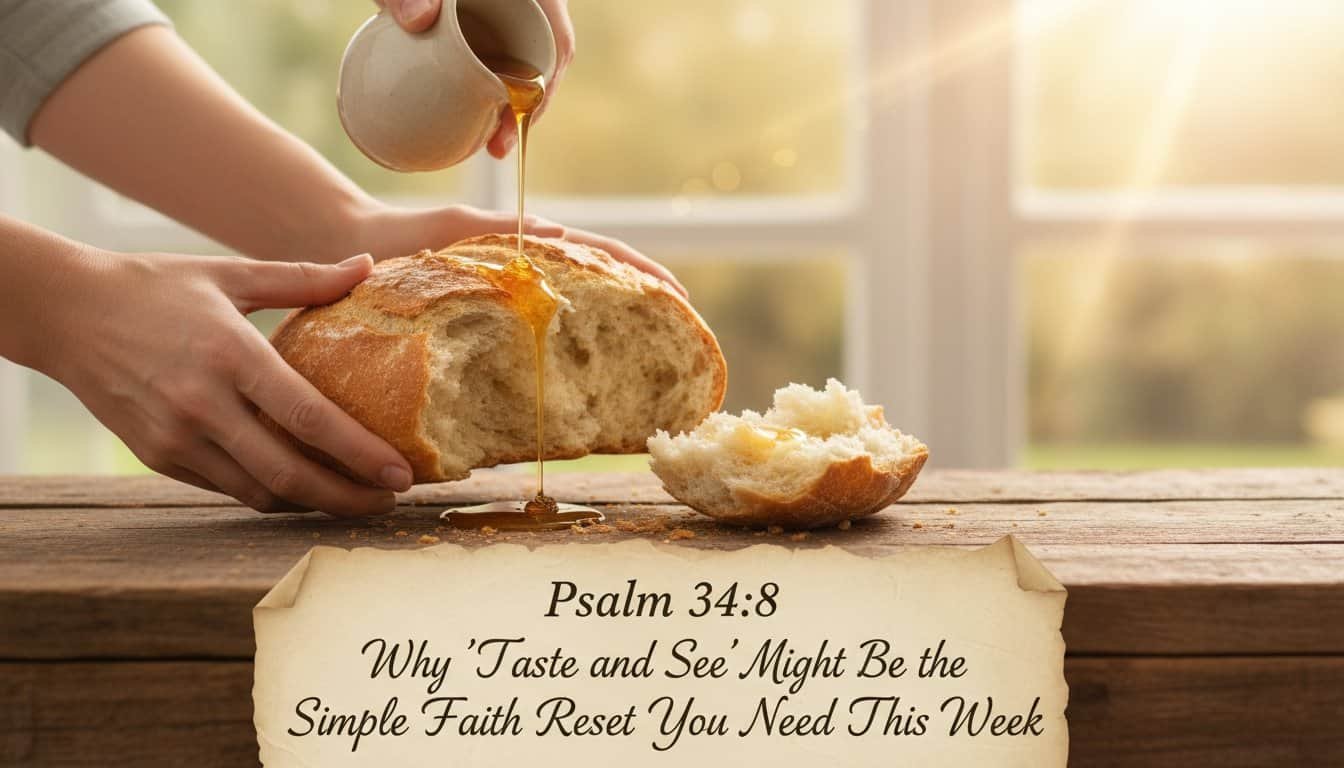
07 Jan Why Psalm 34:8 Taste and See Might Be the Simple Faith Reset You Need This Week
You’ve been overthinking your faith when God’s been inviting you to experience Him. Psalm 34:8 calls you to “taste and see that the Lord is good”—a sensory, relational encounter rather than intellectual analysis. Your five senses can become instruments of worship as you discover God’s goodness in ordinary moments like morning coffee, gentle breezes, or quiet prayers. Release the pressure to perform perfectly and return to childlike wonder. Below, you’ll discover simple practices that transform everyday experiences into sacred encounters.
Key Takeaways
- Faith thrives through personal encounters with God, not endless theological analysis or mental gymnastics about doctrine.
- Engaging your senses in worship—lighting candles, savoring communion, observing creation—transforms faith from concept to experience.
- God’s goodness appears in ordinary moments when you practice mindful gratitude instead of focusing on lack.
- Releasing pressure to perform perfectly in faith allows childlike trust to replace analysis paralysis and spiritual striving.
- Simple daily practices like whispered prayers, Scripture memorization, and naming God’s presence reset overwhelmed faith.
When Analysis Paralysis Blocks Your Spiritual Growth

Overcoming overthinking begins when you recognize that faith isn’t primarily intellectual—it’s relational. Jesus didn’t call the disciples to endless debate; He said, “Come and follow me” (Matthew 4:19). Your spiritual growth stagnates when you substitute thinking about God for actually encountering Him.
Cultivating mindfulness in your faith means stepping away from the mental gymnastics and into His presence. Like David, who experienced God’s goodness firsthand before writing Psalm 34, you need experiential knowledge. Stop analyzing the bread of life and simply taste it. God’s goodness isn’t proven through arguments—it’s discovered through authentic, personal encounter with His love and faithfulness.
The Power of Experiencing God Through Your Senses
Something profound happens when you engage with God through all five senses rather than limiting your faith to mental exercises alone. David understood this when he wrote “taste and see that the Lord is good” – he wasn’t speaking metaphorically about intellectual comprehension, but about genuine sensory worship practices that awaken your soul.
Consider how Scripture consistently invites embodied faith experiences: listening to creation’s symphony (Psalm 19:1), feeling the wind of God’s Spirit (John 3:8), or witnessing His glory in a sunset. When you light a candle during prayer, savor communion bread, or feel soil between your fingers while gardening, you’re practicing biblical spirituality.
Your body isn’t separate from your faith – it’s an instrument of worship. God designed you as a sensory being because He wants relationship, not just intellectual agreement. This week, step beyond analytical thinking and invite your whole self into His presence.
Finding Divine Goodness in Ordinary Daily Moments
While you’re rushing through your morning routine, God’s goodness quietly unfolds in the steam rising from your coffee cup, the gentle weight of your pet against your leg, and the way sunlight filters through your kitchen window. These aren’t coincidences—they’re invitations to “taste and see that the Lord is good” (Psalm 34:8).
Mindful observations transform mundane moments into sacred encounters. When you pause to notice your child’s laughter echoing through the hallway or feel gratitude for a friend’s unexpected text, you’re practicing what the psalmist knew: God’s goodness permeates ordinary life.
Intentional gratitude shifts your perspective from what’s missing to what’s abundant. Like the Israelites gathering manna daily, you’re called to collect these small mercies—proof of God’s faithful provision. Your morning coffee becomes communion, your evening walk becomes prayer, and your daily breath becomes worship. God’s goodness isn’t waiting somewhere else; it’s woven into this very moment.
Breaking Free From Overthinking Your Faith Journey
Jesus calls you to become like a child (Matthew 18:3), not a theological scholar analyzing every spiritual breath. Children don’t overthink; they trust and receive. Your uncluttered prayer life begins when you release the pressure to perform perfectly.
David’s psalm offers refreshing simplicity: just taste. Stop dissecting God’s goodness and start experiencing it. Those sacred silence experiences you’ve been avoiding? They’re not empty spaces—they’re opportunities to encounter God without agenda.
Faith isn’t a complex equation requiring constant solving. It’s a relationship built on trust, not understanding. When doubt spirals into analysis paralysis, return to the basics: breathe, be still, and simply taste His faithfulness today.
Practical Ways to “Taste” God’s Presence This Week
So how do you actually put this “tasting” into practice? Start by prioritizing spiritual disciplines this week—but keep them simple. Set aside ten minutes each morning to read Scripture, asking God to reveal one thing about His character. Take communion with fresh eyes, savoring each element as tangible proof of Christ’s love.
Throughout your day, practice rediscovering childlike wonder in God’s creation. Notice the intricate design of a leaf, feel grateful for your morning coffee, or pause to watch clouds drift across the sky. These aren’t trivial moments—they’re invitations to taste God’s goodness.
When anxiety creeps in, whisper a prayer instead of spiraling into worry. Choose one verse to memorize and repeat it during stressful moments. End each day by naming three specific ways you experienced God’s presence. Remember, “taste and see that the Lord is good” (Psalm 34:8) isn’t complicated—it’s beautifully simple.
Frequently Asked Questions
What Does the Hebrew Word “Taste” Literally Mean in Psalm 34:8?
The Hebrew word “ta’am” means to literally taste food with your mouth, experiencing its flavor and texture. You’re invited to engage God through both physical and spiritual perception. Just as you’d savor delicious food, David encourages you to experientially know God’s goodness.
This isn’t mere intellectual understanding—it’s intimate, personal encounter. You’ll discover His faithfulness through direct experience, not just theological knowledge.
How Does This Verse Relate to Communion or the Lord’s Supper?
When you partake in communion, you’re literally experiencing “taste and see” as Jesus becomes your spiritual nourishment. This Eucharistic metaphor connects David’s invitation with Christ’s words: “Take and eat, this is my body” (Matthew 26:26). You’re not just observing God’s goodness—you’re consuming it.
Each time you taste the bread and wine, you’re invited to experientially know Christ’s love, making communion a tangible expression of Psalm 34:8.
Are There Other Bible Verses That Connect Physical Senses With Spiritual Experience?
Yes, Scripture’s rich with sensory imagery connecting physical senses to spiritual truths. You’ll find experiential spirituality examples throughout: “Be still and know” (Psalm 46:10) engages touch and awareness, while “Listen, my son” (Proverbs 1:8) connects hearing with wisdom.
Jesus touched the blind man’s eyes (Mark 8:23), and Paul writes about the “sweet aroma of Christ” (2 Corinthians 2:15). God designed your senses to deepen faith.
What Was David’s Specific Situation When He Wrote Psalm 34?
David penned Psalm 34 while fleeing from Saul’s murderous pursuit, desperately seeking refuge with Abimelech (the Philistine king). You’d think he’d write about fear and desperation, but instead he declares God’s goodness!
Even when you’re running for your life, God’s faithfulness remains constant. David’s crisis became his testimony – proving that when you taste God’s protection in your darkest moments, you’ll never forget His sweetness.
How Do Different Bible Translations Render “Taste and See” Differently?
Most alternative translations maintain the vivid “taste and see” phrasing, though some render it as “experience and learn” or “come and discover.”
You’ll find these contextual interpretations preserve the original Hebrew’s experiential emphasis – God’s goodness isn’t just intellectual knowledge but something you personally encounter.
Whether reading ESV, NIV, or NASB, the invitation remains: step forward and experience God’s faithful character for yourself through active trust.
Conclusion
You don’t need to figure everything out before you experience God’s goodness. This week, step away from endless analysis and simply taste what He’s offering. Notice His presence in your morning coffee, feel His peace during a quiet walk, or sense His love in a friend’s laughter. Trust that experiencing God’s faithfulness will strengthen your faith more than any theological debate ever could. He’s inviting you to come and see.












No Comments