

27 Jan This New Animated Bible Movie Just Broke Every Rule Since Prince of Egypt
You’re witnessing Angel Studios’ David fundamentally disrupt animated biblical filmmaking through its $49.7 million crowdfunding achievement and $22 million opening weekend—the first serious challenge to Prince of Egypt’s two-decade dominance. Unlike traditional studio models, David leverages community-driven equity financing, music-forward narrative structure, and contemporary Christian star power from Phil Wickham and Lauren Daigle. This dual-release strategy positions biblical animation within blockbuster territory, establishing new benchmarks for faith-based content’s theatrical viability and market penetration dynamics.
Table of Contents
Key Takeaways
- David’s $49.7 million crowdfunding achievement marks the first audience-funded biblical animation, disrupting traditional Hollywood studio financing models.
- Music-forward narrative makes songs primary story-driving mechanisms rather than inserted numbers, restructuring how biblical stories are animated.
- Angel Studios’ guild system enables 300,000+ members to vote on projects using community-driven content creation instead of executive decisions.
- $22 million opening weekend ranks second only to Avatar: Fire & Ash, establishing animated biblical narratives as legitimate blockbuster contenders.
- Dual-release strategy places two Angel films in top 15 animated domestics, creating competition-driven theatrical-first approaches over streaming.
David’s $22 Million Opening Proves Animated Bible Films Can Compete With Major Studios

The film’s second-place finish behind *Avatar: Fire & Ash* validates animated biblical narratives as legitimate box office contenders.
You can analyze this performance against *Prince of Egypt’s* historical dominance, recognizing that *David’s* opening establishes contemporary relevance for scripture-based animation.
The 28% opening-to-total ratio indicates strong front-loaded performance, suggesting effective pre-release audience cultivation.

This achievement recalibrates industry expectations, proving faith-based animated content can achieve mainstream theatrical success through strategic positioning and targeted marketing execution. With Angel Studios backing the project, David becomes the second-highest-grossing release for the independent distributor.
Why 2025 Became the Breakthrough Year for Biblical Animation Success
You’re witnessing a convergence of technological advancement, market validation, and distribution innovation that transformed 2025 into biblical animation’s watershed moment.
The crowdfunding mechanisms that enabled projects like *Light of the World* to secure $20 million budgets demonstrated audience demand metrics that major studios couldn’t ignore, triggering competitive market entry across multiple production houses. The deliberate choice of traditional 2D animation over computer-generated imagery represented a bold creative decision that emphasized timeless storytelling over technological spectacle.
Box office performance data from *King of Kings* and subsequent releases established new revenue benchmarks that fundamentally shifted industry perception of faith-based animation from niche content to commercially viable entertainment.
Record-Breaking Box Office Numbers
Box office analysts hadn’t witnessed such seismic shifts in faith-based animation since DreamWorks’ Prince of Egypt dominated theaters in 1998, yet 2025’s unprecedented dual-release strategy fundamentally restructured industry expectations. David’s $81 million trajectory established new benchmarks, capturing global signatures while demonstrating measurable social impact through sustained audience engagement. You’re observing Angel Studios simultaneously position two releases within 2025’s top 15 animated domestics—David at sixth place and King of Kings securing thirteenth position globally. David’s $22 million opening weekend exceeded King of Kings’ $19.4 million debut, yet both surpassed Prince of Egypt’s animated biblical records. These metrics validate faith-based animation’s commercial viability, with David approaching Elio’s $73 million threshold while maintaining superior per-theater averages across three consecutive weekends. The King of Kings features an all-star voice cast including Pierce Brosnan, Forest Whitaker, Uma Thurman, Oscar Isaac, Kenneth Branagh, and Mark Hamill in this computer-animated retelling of Jesus’ life.

Crowdfunding Revolution Takes Hold
Multiple investment rounds transformed David’s $49.7 million crowdfunding achievement into animation’s most significant audience-backed milestone, eclipsing The Chosen’s $11 million Season 1 benchmark by 351% while establishing new paradigms for faith-based content financing.
You’re witnessing Angel Studios’ systematic disruption of traditional Hollywood funding mechanisms through Regulation A securities offerings. The platform’s investor-driven model pre-validates audience demand, eliminating studios’ irrelevant focus on demographic projections. Unlike conventional distribution strategies that pursue unrelated angle marketing approaches, David’s crowdfunding methodology generates organic evangelism through stakeholder investment.
This participatory financing structure transforms passive viewers into active promoters, creating viral distribution networks that bypass traditional marketing expenditures. The $60.9 million total budget positions biblical animation within blockbuster territory while maintaining grassroots authenticity—a combination previously deemed impossible within faith-based entertainment verticals.
Multiple Studios Enter Market
While Angel Studios dominated headlines with David’s unprecedented crowdfunding success, 2025’s biblical animation explosion originated from systematic market validation that attracted competing studios into previously untested theatrical territory.
5&2 Studios’ entry with The Chosen: Last Supper ($35 million box office) and The Wonder Project’s strategic positioning alongside Angel’s dual releases (David and The King of Kings) created industry’s first competitive biblical animation marketplace since DreamWorks’ Prince of Egypt established the category 27 years prior.
You’re witnessing production studios leverage advanced animation techniques from Disney veterans who worked on Beauty and The Beast, The Lion King, and Mulan.
This technical expertise enables sophisticated world building that balances biblical authenticity with mainstream appeal.
Competition drove theatrical-first strategies over streaming, validating faith-based animation as sustainable commercial entertainment rather than niche religious content.
How Angel Studios’ Crowdfunding Model Transformed Religious Film Production

You’re witnessing a fundamental disruption of traditional studio gatekeeping through Angel Studios’ equity crowdfunding framework, which bypasses Hollywood executives by empowering audiences to directly finance and greenlight religious content.
Their Guild system transforms passive viewers into active stakeholders—over 300,000 members vote on projects using “Torches” while contributing monthly subscriptions that validate market demand before production begins.
This community-driven approach has generated unprecedented results, with 6 out of 7 films grossing over $10 million compared to Lionsgate’s 45% success rate, proving that audience-validated content outperforms executive-driven selections.
Crowdfunding Breaks Studio Barriers
How does a Utah-based studio consistently outperform industry giants like Lionsgate and A24 without traditional Hollywood backing? Angel Studios’ equity crowdfunding model systematically dismantles conventional production barriers through direct audience investment. While Lionsgate achieves 45% profitability on independent releases and A24 reaches 18%, Angel Studios delivers 86% success rates with six of seven films grossing over $10 million.
Their dual-tier approach addresses crowdfunding ethics through transparent risk disclosure: equity investors face monetary exposure with $5,000-$10,000 legal costs, while Pay It Forward contributors receive perks without investor risk. This framework bypasses studio gatekeepers entirely, enabling projects like DAVID’s $49.7 million raise—the largest audience-funded production. You’re witnessing democratized content selection where Guild members’ votes, not executive decisions, determine theatrical viability.
Community-Driven Content Creation
When traditional gatekeepers determine content viability through executive boardrooms, Angel Studios inverts this hierarchy by positioning audience members as primary decision-makers in project development. You’ll find their community driven approach fundamentally restructures content creation through the Angel Guild voting mechanism, where members select projects rather than studio executives. This audience participation model transforms passive consumers into active stakeholders who influence narrative direction and funding allocation.
Unlike conventional distribution channels, you’re witnessing a democratized ecosystem where crowdfunding success directly correlates with community engagement metrics. The Testament series exemplifies this paradigm shift, securing over $800,000 through collective audience investment. Through Pay It Forward mechanisms and equity offerings, you’re observing how community-driven financing eliminates traditional studio dependencies while empowering diverse storytelling perspectives previously marginalized by mainstream gatekeepers.
What Made David’s Musical Approach Different From Traditional Bible Movies
Traditional Bible adaptations typically treat musical numbers as supplementary elements that pause narrative momentum, but David fundamentally restructures this paradigm by positioning songs as primary story-driving mechanisms. You’ll notice this musical narrative approach differs markedly from previous biblical films like Prince of Egypt, where songs often felt inserted rather than integral. David’s scriptural blend seamlessly weaves Psalms 8, 23, 27, 121, and 139 into contemporary animated musical format without sacrificing theological authenticity.
The production quality reaches Pixar-level standards, avoiding the cheesiness that plagued earlier biblical musicals. You’re experiencing songs that advance plot through character motivation rather than random emotional outbursts. “Shalom” calms Saul during David’s audition, while “Tapestry” establishes God’s sovereignty as the central metaphor. This music-forward narrative structure creates the first animated musical specifically focused on David’s Samuel narrative, delivering streamable quality comparable to modern contemporary Christian music while maintaining epic cinematic scope.
Phil Wickham and Lauren Daigle: The Star Power Behind David’s Success
Why does casting contemporary Christian music’s biggest names transform an animated biblical film from niche project into mainstream phenomenon? Phil Wickham’s role as adult David represents strategic demographic targeting through authentic musical integration. You’ll notice his multiple auditions emphasized acting-singing synthesis rather than celebrity endorsement, validating artistic merit over marketability.
Lauren Daigle’s participation, though limited to Rebecca’s minor role and selective duets, leverages her Grammy-winning credentials and chart-topping recognition to expand audience reach.
The casting announcements demonstrate calculated rollout timing—Phil Wickham’s October 2025 reveal positioned alongside established voice actors creates anticipatory momentum. You’re witnessing unprecedented presale success: $10 million represents Angel Studios’ highest animated musical performance, directly correlating with recognizable vocal talent. Their contributions transcend typical celebrity cameos through substantial musical involvement—Phil Wickham performs original compositions with orchestral accompaniment, while Lauren Daigle’s duet work integrates thematically with the film’s sonic architecture, establishing crossover appeal between faith-based and mainstream markets.
One Million Free Tickets: How Pay-It-Forward Campaigns Expand Biblical Film Reach
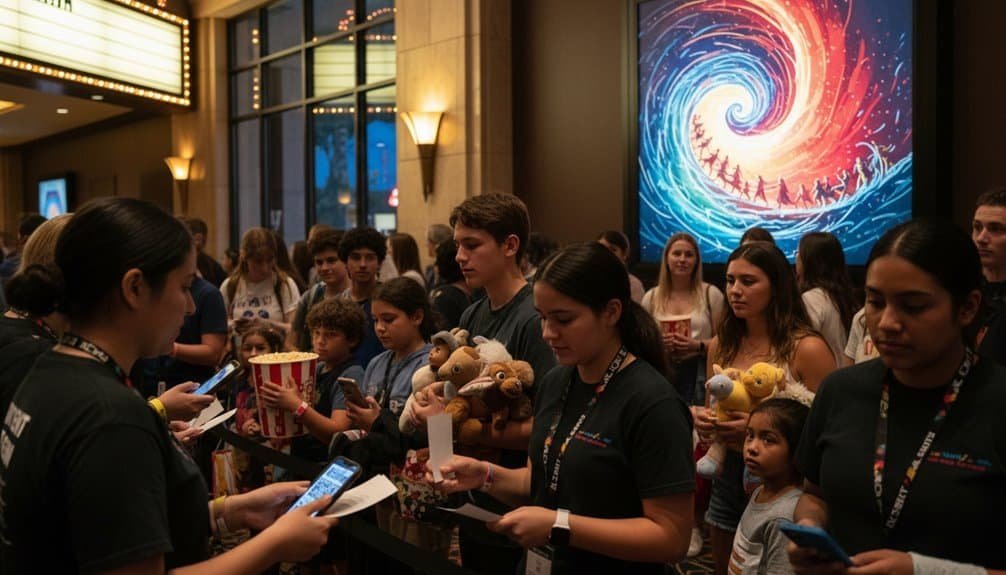
How does distributing one million free tickets through crowdfunded generosity transform a niche animated biblical film into a mainstream theatrical contender? You’re witnessing a paradigm shift where traditional distribution models yield to community-driven market penetration strategies.
The Pay-It-Forward mechanism leverages outreach ethics by removing financial barriers that exclude underserved demographics from theatrical experiences. When supporters purchase tickets for families who can’t afford them, you’re creating measurable demand signals that exhibitors require for screen allocation decisions.
This crowd dynamics approach generates what researchers term “generosity cascade effects”—initial donations inspire subsequent contributions, amplifying reach exponentially. Unlike conventional marketing spends, this model converts charitable impulses into tangible box office metrics.
The digital integration component strengthens engagement through tiered incentives. You’re not just donating tickets; you’re unlocking exclusive Young DAVID episodes, creating multi-platform value propositions that extend beyond singular theatrical experiences.
Real-time transparency through contribution tracking maintains donor confidence while demonstrating market viability against December 2025’s Avatar: Fire and Ash competition.
Frequently Asked Questions
Will David Be Available on Streaming Platforms After Its Theatrical Run?
You’ll access David streaming through VOD and digital platforms starting February 3, 2026, following its theatrical exclusivity window.
The distribution strategy mirrors industry-standard release patterns, though no major streaming service commitments exist beyond digital rental/purchase options.
David streaming availability reflects Angel Studios’ direct-to-consumer approach, prioritizing theatrical revenue maximization.
The animation quality’s technical specifications suggest optimization for both theatrical projection and home streaming compression standards.
How Does David’s Animation Quality Compare to Disney and Pixar Films?
You’ll find David’s animation rivals Disney-Pixar standards through its industry-veteran talent pipeline. The production team’s Pixar, Disney, and Star Wars credentials ensure Pixar-like quality in technical execution. David’s animation leverages groundbreaking 3D-modeling technology and immersive digital innovations that actually surpass live-action limitations for historical accuracy. With its $150M budget and expert consultation approach, you’re seeing production values that match major studio animated features in visual grandeur and technical sophistication.
Are There Plans for Sequels Featuring Other Biblical Characters?
You won’t find explicit plans for sequels featuring other biblical characters from DAVID’s production team.
Instead, you’re witnessing a decentralized approach where separate studios are developing standalone biblical narratives.
Angel Studios focuses on DAVID as an isolated project, while concurrent releases like Light of the World and DANIEL emerge from different production houses, creating parallel biblical content rather than interconnected franchise architecture.
What Age Group Is the Target Audience for These Biblical Animations?
You’ll find these biblical animations primarily target children aged 8-14, utilizing the protagonist perspective of young John (13-14) as their demographic anchor. The 2D animation style deliberately emulates children’s storybook aesthetics, contrasting with Prince of Egypt’s sophisticated CGI approach. Unlike VeggieTales’ comedic framework, these productions employ coming-of-age narratives that simultaneously engage adults through nostalgic childhood viewing experiences, creating cross-generational market penetration.
How Accurate Are the Biblical Stories Compared to Original Scripture?
You’ll find biblical animations demonstrate varying fidelity matrices when compared to original scriptures. Prince of Egypt maintains narrative integrity while incorporating visual embellishments, whereas Noah introduces fantastical elements that significantly deviate from source material.
King of Kings omits theological assertions and employs cultural misrepresentations. These adaptations prioritize cinematic engagement over textual precision, creating interpretative frameworks that necessitate supplementary scriptural consultation for doctrinal accuracy assessment.
Conclusion
You’re witnessing a paradigm shift in faith-based entertainment distribution. David’s crowdfunded model circumvents traditional studio gatekeepers, while its contemporary musical framework differentiates it from conventional biblical narratives. The pay-it-forward mechanism exponentially amplifies audience reach beyond standard theatrical release strategies. This convergence of alternative financing, genre hybridization, and grassroots marketing establishes a replicable template that’ll likely influence future religious content production cycles and distribution methodologies across the entertainment industry.









No Comments