24 Apr Acts 2: The Holy Spirit’s Pentecost Descent Explained
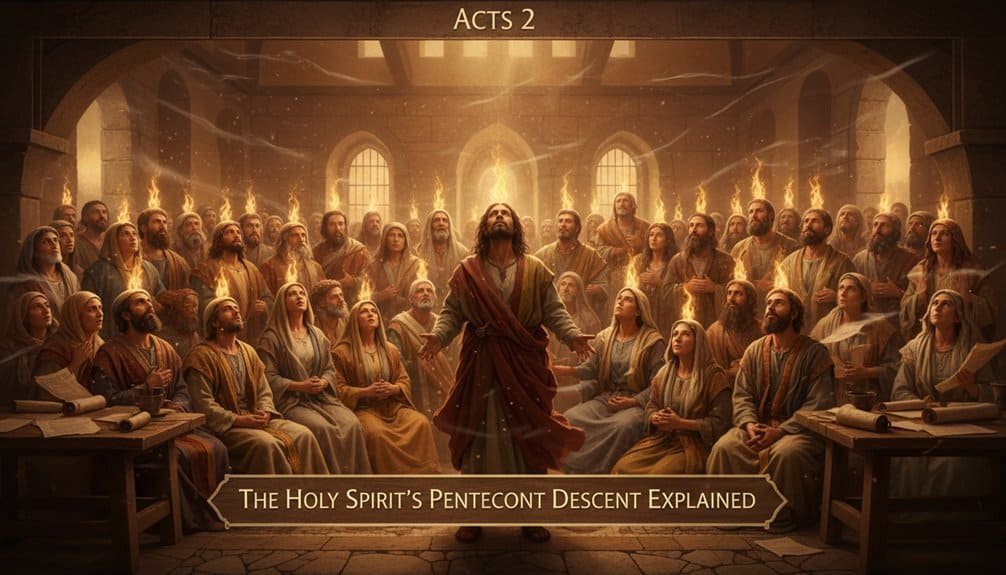
On Pentecost, you’re witnessing Christianity’s launch moment—when God’s Spirit descended upon believers in Jerusalem and transformed a regional Jewish festival into the birthplace of the global church. The Spirit arrived as rushing wind and flames, empowering disciples to speak in foreign languages they’d never learned. This multilingual miracle reversed Babel’s scattering, enabling three thousand converts from fifteen regions to hear the Gospel in their native tongues. You’ll discover how this event strategically positioned believers to carry Christ’s message across the known world.
Table of Contents
Pentecost: The Feast That Changed Everything
What if the most significant spiritual event in Christian history didn’t happen randomly, but unfolded according to God’s carefully orchestrated plan? You’re witnessing exactly that in Acts 2—the convergence of centuries-old Jewish tradition with divine purpose.
Pentecost wasn’t arbitrary. For generations, Jews celebrated this harvest festival fifty days after Passover, commemorating both the wheat harvest and God’s giving of the Torah at Mount Sinai. Thousands of devout pilgrims from across the Diaspora—Parthia, Media, Egypt, Rome, Asia—gathered in Jerusalem, creating an unprecedented multilingual audience. This gathering fulfilled Jesus’s promise that followers would be clothed with power from on high, equipping them to carry God’s presence beyond Jerusalem’s walls.
You see God’s design in every detail. The very feast commanding Jews to remember God’s covenant became the stage for unveiling a new one. Where Mount Sinai displayed God’s presence through external thunder and fire, Pentecost would manifest His Spirit internally, transforming believers into living temples. The agricultural firstfruits harvest would become a spiritual reality—three thousand souls gathered as God’s kingdom harvest.
The Wind and Fire: Decoding the Spirit’s Arrival
You’ve witnessed the dramatic arrival of wind and fire at Pentecost, but you might wonder whether these were literal phenomena or symbolic language communicating God’s presence. The wind and flames weren’t random special effects; they carried deep theological meaning rooted in Scripture’s own imagery of divine power and transformation. Understanding what these symbols meant to first-century believers helps you grasp why the Spirit’s arrival mattered so profoundly to the early church. These portents foreshadow Moses on Mount Sinai imagery, connecting the Spirit’s descent to God’s covenant-making power revealed in Exodus 19:16-19.
Symbolic Language of Wind
Why does the Bible consistently reach for wind imagery when describing the Holy Spirit’s arrival? The answer lies in wind’s multifaceted symbolic power. Wind represents divine life-giving force—the very breath God breathed into creation. When you encounter “pneuma” in Greek texts, you’re encountering a word that simultaneously means wind, breath, and spirit, binding these concepts into one unified reality.
You’ll notice wind symbolizes freedom and sovereignty. Jesus taught that the Spirit “blows where it listeth,” operating beyond human control or institutional constraints. This autonomy mirrors the Spirit’s refusal to be confined or regulated.
Moreover, wind embodies transformative power. It swept across the Mediterranean like spring wind melting glacial ice, fundamentally reshaping entire civilizations. The rushing mighty wind at Pentecost wasn’t merely atmospheric—it announced supernatural presence and impelled believers toward their divine purpose with unstoppable momentum.
Flames: Vision and Significance
How did the disciples recognize God’s presence in the upper room? You witnessed divided flames resting individually on each believer—a visual manifestation that accompanied the rushing wind’s audible sound. These tongue-shaped fires weren’t ordinary flames; they produced no heat or burning sensations. Instead, they symbolized God’s Spirit distributed equally among all present.
This fire differed from Old Testament appearances. Rather than centralizing in one location like the burning bush or pillar of fire, these separated tongues came to rest on each person individually. The specific form communicated the Spirit’s primary purpose: empowering you and your fellow believers for proclamation ministry.
The flames recalled John the Baptist’s prophecy about baptism with Holy Spirit and fire, signifying both cleansing and divine authority. This supernatural communication enabled you to declare God’s mighty works in listeners’ native languages.
Speaking in Tongues: How the Spirit Empowered Multilingual Witness
When you encounter the disciples speaking in recognizable foreign languages rather than ecstatic utterances, you’re witnessing God’s deliberate reversal of Babel’s language division—a strategic undoing of humanity’s scattered communication that now becomes your vehicle for unified gospel proclamation.
You’ll notice how this multilingual capacity wasn’t random chaos but rather a calculated network that reached pilgrims from fifteen to seventeen nations simultaneously, transforming Jerusalem into a convergence point where each listener heard the mighty works of God in their native dialect.
Recognizable Languages, Not Ecstasy
What if the disciples’ experience at Pentecost wasn’t mystical utterance but rather a Spirit-empowered capacity to speak genuine foreign languages? The Greek term “glōssai” denotes recognizable human languages, not ecstatic sounds. Early manuscripts consistently support this interpretation across Codex Vaticanus, Codex Sinaiticus, and P45. The word “dialektos” emphasizes native speech patterns tied to regional identity. When Acts 2:6 describes the crowd being “bewildered” because “each one heard them speaking his own language,” you’re reading an account of intelligible communication. The crowd’s astonishment stemmed from rational recognition—Galilean speakers suddenly conversing in foreign dialects. This wasn’t mystical interpretation but genuine linguistic comprehension, demonstrated by their declaration of hearing “the wonders of God” in their own tongues.
Reversing Babel’s Language Division
The Spirit’s descent at Pentecost fundamentally reversed the linguistic fragmentation God imposed at Babel. Where God once scattered nations through language confusion as judgment against human pride, He now descended through the Holy Spirit to unite diverse peoples for gospel witness. You witness this theological reversal through Luke’s deliberate parallels: both events involve God’s descent, both feature assembled crowds, and both reference the nations listed in Genesis 10. However, the purpose transforms entirely. At Babel, division prevented unified rebellion. At Pentecost, supernatural multilingual communication enabled Galilean disciples to proclaim God’s wonders in recognizable foreign languages. The Spirit empowered what human effort couldn’t achieve—transcending linguistic boundaries to accomplish Christ’s redemptive mission across all peoples and cultures.
Strategic Gospel Dissemination Networks
God’s reversal of Babel’s linguistic curse didn’t stop at symbolism—it activated a revolutionary communication strategy. You’re witnessing the Spirit’s deliberate deployment of multilingual proclamation across strategic networks. Jerusalem’s Pentecost gathering included devout Jews from Parthia, Media, Mesopotamia, Egypt, Libya, Rome, Crete, and Arabia—representatives spanning three continents. When disciples spoke native dialects they’d never learned, they bridged every linguistic barrier simultaneously. This wasn’t random glossolalia; it was precision-engineered gospel distribution. Each listener heard God’s mighty works in their mother tongue, eliminating translation delays and cultural friction. The Spirit didn’t merely overcome language divisions—He weaponized them for maximum evangelistic penetration. Three thousand conversions demonstrated the strategy’s immediate effectiveness, launching a network of believers equipped to carry the gospel across every linguistic boundary their societies maintained.
The Crowd: Fifteen Regions, One Gospel Message
How’d Jerusalem fill with such a diverse crowd on Pentecost? Devout Jews and proselytes traveled from fifteen distinct regions across the Roman Empire—Parthia, Media, Elam, Mesopotamia, Judea, Cappadocia, Pontus, Asia, Phrygia, Pamphylia, Egypt, Libya, Rome, Crete, and Arabia. This geographic span stretched from east to west, representing widespread diaspora communities throughout the Mediterranean world.
Yet here’s what makes this moment extraordinary: despite speaking seventeen different languages and dialects, you’d hear the apostles’ message clearly in your native tongue. These Galilean speakers, typically uneducated in multiple languages, suddenly proclaimed God’s mighty works with fluency. The linguistic miracle centered on the apostles’ ability to speak, not on altering your hearing.
This diversity wasn’t coincidental. Each regional community became positioned to carry the Gospel back home, creating a network effect that maximized the resurrection testimony’s reach across the known world.
Peter’s Resurrection Argument: Why Jesus’ Empty Tomb Mattered
Why’d Peter ground his resurrection argument in Jerusalem’s physical landscape? You’d find the answer in forensic necessity. The empty tomb wasn’t abstract theology—it was tangible evidence in the city where skepticism ran deepest.
Peter wielded three categorical terms—Miracles, Wonders, Signs—positioning Jesus’ works as undeniable public phenomena. He shifted the burden of proof onto opponents who’d orchestrated the crucifixion itself. That’s brilliant legal strategy: the very authorities who arranged Jesus’ death now faced an “Impossible Verdict” challenging death’s power.
But here’s what clinched it: David’s tomb remained occupied and visible. This contrast strengthened Peter’s argument dramatically. Jewish resurrection understanding required bodily raising, making the empty grave an implicit assumption. Peter invoked Psalm 16 and Psalm 110, demonstrating the resurrection wasn’t tragic accident but sovereign fulfillment. Physical landmarks functioned as forensic exhibits, and Spirit-empowered proclamation validated Christ’s kingship through verifiable facts.
Three Thousand Baptized in One Day
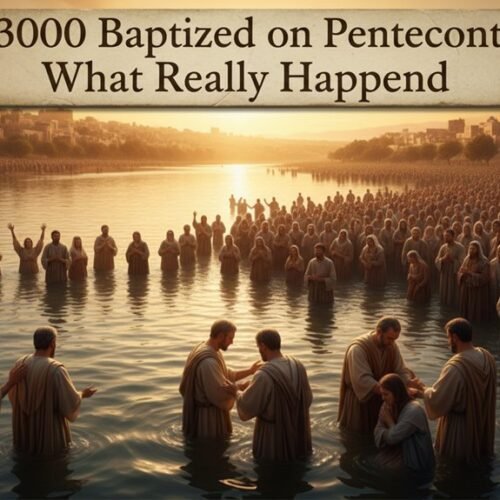
A mass movement swept through Jerusalem that morning—not a riot or political uprising, but a spiritual awakening that’d transform the city’s religious landscape within hours. You’d witness three thousand people responding to Peter’s proclamation by seeking baptism immediately.
The conviction ran deep. These pilgrims felt “cut to the heart,” pierced by the reality of Jesus’ resurrection and their complicity in His death. They didn’t hesitate with theological questions; instead, they asked urgently: “What shall we do?”
The logistics worked seamlessly. Excavated mikvaot south of the Temple possessed capacity for thousands of baptisms within hours. You’d observe no lengthy catechesis delaying the process—those who gladly received the word moved directly into water immersion.
This reversal carried profound significance: where three thousand died under the Law for idolatry, three thousand now lived through the Spirit’s grace. The specificity of the number suggests divine intentionality, not exaggeration.
How the Early Church Actually Lived: Daily Practices and Radical Sharing
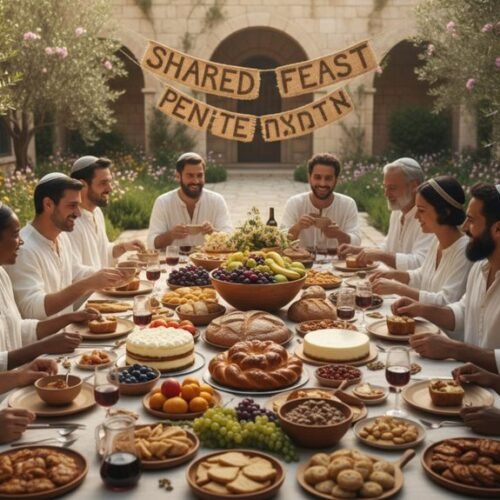
Those three thousand converts didn’t simply vanish into Jerusalem’s streets with newfound faith and nothing else. Instead, you’d have witnessed something radical: believers pooling resources and distributing goods according to individual need. This wasn’t socialism—it was voluntary, Spirit-empowered generosity flowing from genuine conversion.
They gathered daily for apostolic teaching, koinonia fellowship, and breaking bread together. You’d see property sales happening consistently, with proceeds going to a common fund. Administrators distributed funds daily to whoever needed assistance, making sure no one lacked essentials.
This practice demonstrated something essential: you couldn’t separate authentic conversion from radical sharing. Archaeological evidence confirms pooled resources existed in first-century Jerusalem Christian communities. When Ananias and Sapphira tested these boundaries by lying about their donation, God’s judgment clarified that sharing remained voluntary—though the community’s expectation was clear. Your transformed heart naturally produced transformed economics.
From Babel to Pentecost: Why Language Became the Gospel’s Universal Bridge
What if God’s most devastating judgment in Scripture—the scattering of humanity through language confusion at Babel—actually set the stage for His greatest redemptive miracle?
At Babel, God divided languages to restrain unified rebellion. At Pentecost, He reversed that division entirely. When the Holy Spirit descended on Jerusalem during Shavuot, you witnessed something unprecedented: diverse pilgrims from across the Mediterranean suddenly understood the apostles’ proclamation in their native tongues. This wasn’t enforced uniformity—it was authentic multicultural unity.
The contrast cuts deep. Babel’s scattering divided to judge; Pentecost’s reversal united to redeem. You see God moving from restraint to restoration, from fragmentation to reconciliation. Language became the Gospel’s bridge precisely because it’d been humanity’s greatest barrier. The Spirit didn’t erase linguistic distinctiveness; He transcended it, proving redemption works across all boundaries. Pentecost announces that God’s kingdom embraces every tongue without erasing any identity.
Frequently Asked Questions
Did the Apostles Understand They Were Fulfilling Joel’s Prophecy When Speaking in Tongues?
You need to understand that the apostles didn’t view themselves as fulfilling Joel’s complete prophecy. They recognized the Spirit’s outpouring as similar to Joel’s vision, not identical. Peter used “this is what was spoken” to indicate connection, not total fulfillment. You’d find they understood Pentecost as a foretaste—an inauguration of spiritual blessing—while Joel’s cosmic events and Israel’s national salvation remained future-dependent occurrences tied to Christ’s return.
How Did the 3,000 New Believers Find Housing and Sustenance in Jerusalem Immediately After?
You’d find the newly baptized believers relying on voluntary communal sharing. Local Christians incrementally sold possessions and property to address housing shortages. They lodged in upper rooms and private homes while sharing meals together daily. The apostles distributed proceeds directly to those experiencing need. You’d witness temporary arrangements combining shared communal dining with temple attendance, sustaining the growing community through collective resources rather than individual economic activity.
Were Non-Jewish Proselytes Treated Equally in the Early Church’s Communal Sharing System?
You’ll find that non-Jewish proselytes received equal treatment in the early church’s communal sharing system. Acts 4:32-35 describes believers sharing possessions without categorical distinctions, and distribution occurred “to each one, as they’d need.”
While Acts 6:1 documents tension between Hellenists and Hebrews, scholars attribute this to cultural-linguistic factors rather than proselyte status. You won’t discover textual evidence indicating differential treatment based on convert background.
What Happened to Believers Who Returned Home and Faced Skepticism About Their Experiences?
When you returned home after Pentecost, you faced skepticism from family and neighbors who hadn’t witnessed the supernatural events. You relied on oral testimony and personal experiences to convince them.
Without written Gospels or Paul’s letters yet available, you formed house churches for mutual support.
You endured social ostracism and family rejection while continuing to experience healings and visions, which served as ongoing evidence strengthening your faith claims among isolated believing communities.
How Long Did the Apostles Remain in Jerusalem After Pentecost Before Dispersing?
You’ll find that the apostles remained in Jerusalem for approximately fourteen years following Pentecost in 33 A.D. During this period, you’d witness them devoted to teaching, fellowship, and prayer while performing miracles and facing persecution. You’d see them arrested and beaten yet continuing their ministry.
However, you’d notice significant dispersal accelerating after the Jerusalem Council around 48-49 A.D., when missionaries departed to various regions, though some apostles had begun expanding into Syria and Cyprus during the early 40s.
Conclusion
You’ve witnessed how Pentecost transformed everything. The Spirit’s arrival wasn’t just a spiritual experience—it was the launch of God’s inclusive kingdom. You’ve seen how speaking in tongues reversed Babel’s confusion, how Peter’s boldness sparked three thousand conversions, and how the early church’s radical sharing modeled authentic community. Now you understand: Pentecost didn’t just happen in Jerusalem. It continues wherever you’re willing to surrender to the Spirit’s power and share Christ’s resurrection message boldly.


No Comments