

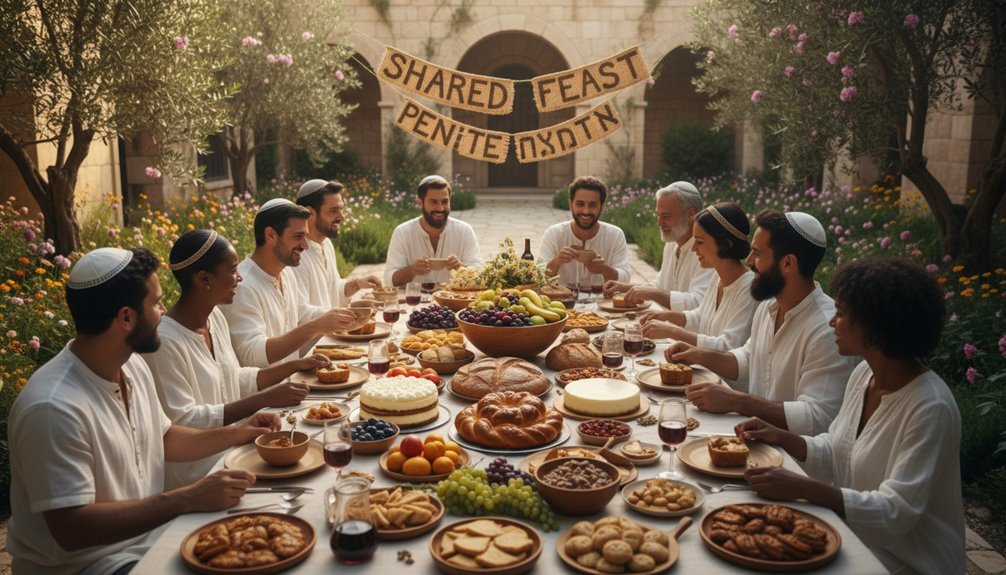
14 Apr 3 Best Connections Between Shavuot And Pentecost
You’ll see that Shavuot’s living Torah and Pentecost’s falling Spirit both turn revelation into daily practice, urging you to study, act, and share. First, the Word becomes a breathing covenant that guides your decisions, while the Spirit drops like a sudden wind, reshaping priorities and sparking bold proclamation. Second, both festivals push you from passive belief to active compassion and justice. Third, they together inspire community‑wide rituals, interfaith dialogue, and social‑justice work, showing how ancient covenant fuels modern purpose. Keep going and discover how these links deepen your faith journey.
Shavuot’s Promise: The Torah as Living Word
Why does Shavuot feel like a promise fulfilled? You stand beneath the canopy of summer, remembering the moment when the Torah descended as a living, breathing covenant.
The festival marks the birth of divine law, not as stone tablets but as a dynamic guide that shapes daily life. You feel the text pulse through rituals, study sessions, and ethical choices, turning ancient verses into present‑day decisions.
This living word invites you to engage, question, and apply its teachings, making each encounter a fresh revelation. As you read, the Torah’s voice resonates with your own hopes, urging you to act with compassion and justice.
The promise you experience is that the covenant never stagnates; it evolves with you, offering direction and comfort. In this way, Shavuot becomes more than a historical commemoration—it’s a continual, personal affirmation that the divine narrative lives within you.
Pentecost’s “Falling of the Spirit” Explained
From the living Torah that guides your daily choices, Pentecost shifts the focus to the sudden, overwhelming outpouring of the Holy Spirit. You experience the “falling” as a divine wind that descends without warning, touching each believer with equal intensity.
Unlike a gradual awakening, this event crashes like a storm, shattering ordinary perception and igniting bold speech in foreign tongues. The Spirit’s arrival isn’t a calm whisper; it’s an electric shock that reorders priorities, urging you to act, proclaim, and share the covenant instantly.
As the wind sweeps across the crowd, you sense a shared momentum that unites disparate hearts under one purpose. This dramatic inflection point transforms passive observance into active participation, reminding you that faith can erupt spontaneously, demanding response and reshaping community dynamics in a single, unforgettable moment.
Why Shavuot and Pentecost Matter for Modern Faith Communities
Shavuot and Pentecost both ignite a fresh sense of purpose in modern faith communities, reminding you that divine revelation isn’t confined to ancient texts but lives in today’s shared experiences. You see these festivals as bridges between tradition and contemporary life, urging you to embody the law and the Spirit in everyday actions. When you celebrate Shavuot, you honor the moment the Torah entered the world, prompting you to study, teach, and apply ethical teachings in schools, workplaces, and families.
Pentecost, on the other hand, marks the outpouring of the Holy Spirit, inviting you to cultivate community, compassion, and bold witness. Together, they inspire you to create inclusive rituals, interfaith dialogues, and social‑justice initiatives that reflect ancient wisdom in modern contexts. By linking study with spirit, you empower your congregation to grow intellectually and emotionally, fostering resilience, hope, and a shared mission that transcends generations.
Frequently Asked Questions
What Historical Events Link Shavuot and Pentecost?
You’ll see that both Shavuot and Pentecost commemorate the giving of divine law and the outpouring of the Spirit. In the Hebrew Bible, Shavuot marks Moses receiving the Torah at Sinai, while Pentecost (the Feast of Weeks) celebrates the first fruits of the harvest. The New Testament links Pentecost to the Holy Spirit descending on the apostles, echoing the covenant established at Shavuot.
Both festivals thus connect law, revelation, and spiritual empowerment.
Do Both Holidays Share Similar Liturgical Music?
You’ll notice they both feature rich, celebratory music, but the styles differ. Shavuot uses traditional Hebrew chants, often centered on the Hallel and “Lecha Dodi” melodies, while Pentecost incorporates early Christian hymns like “Veni Creator Spiritus” and modern worship songs.
Both aim to lift the spirit, yet Shavuot’s liturgy stays rooted in Jewish cantillation, whereas Pentecost embraces a broader, ecumenical repertoire.
How Do the Dates of Shavuot and Pentecost Align Each Year?
You’ll find that Shavuot falls on the 6th day of the Hebrew month of Sivan, while Pentecost—called Shavuot in the Christian calendar—occurs 50 days after Easter. Since Easter’s date moves each year (based on the first full moon after the vernal equinox), Shavuot’s Gregorian date shifts, too.
Typically, the two holidays line up within a few weeks, but they don’t always coincide exactly; the Jewish Shavuot can be earlier or later than the Christian Pentecost depending on that year’s lunar calculations.
Are There Traditional Foods Common to Both Celebrations?
You’ll find that both holidays share dairy dishes, especially cheese‑laden foods. In many communities you’ll serve blintzes, cheese pancakes, and sweetened cheese spreads alongside fresh fruits.
Some families also bake cheese‑filled pastries like bourekas or cheese‑stuffed pastries. The emphasis on dairy stems from the Torah’s command to eat dairy on Shavuot, and the early Christian tradition of sharing cheese at Pentecost carries a similar celebratory spirit.
Can the Themes of Shavuot and Pentecost Be Combined in Worship?
You can blend the two themes by focusing on revelation and empowerment. Highlight how Shavuot celebrates the giving of the Torah, then transition to Pentecost’s outpouring of the Holy Spirit, emphasizing that both moments invite divine insight and bold action. Use songs that speak of law and fire, invite testimonies of transformation, and design prayers that ask for wisdom and spiritual gifts together, creating a unified worship experience.
Conclusion
You’ve seen how Shavuot’s promise of the Torah as a living word and Pentecost’s falling of the Spirit both invite you into deeper, communal encounter with divine truth. By embracing their shared themes—revelation, empowerment, and the call to live out faith—you can energize your congregation, nurture personal transformation, and keep ancient promises vibrant in today’s world.







No Comments