

29 Jan This Free Piano App Has 10 Million Users Learning Daily
Simply Piano’s 10 million daily users benefit from AI-powered feedback that analyzes your note accuracy through microphone recognition while you play acoustic instruments. You’ll progress through gamified lessons with real-time highlighted notes, choosing between Soloist (classical technique) or Chords (contemporary genres) learning paths. The app’s visual cursor system teaches timing effectively, while yellow-highlighted notes adjust tempo and red notes trigger slower metronome practice. Our comprehensive analysis reveals why this pedagogical approach consistently produces measurable advancement within 100 days of structured practice.
Table of Contents
Key Takeaways
- Simply Piano offers a free trial with limited selection, while premium unlocks 33+ courses and a 5,000-song library.
- The app uses microphone-based AI feedback to analyze note accuracy and timing in real-time with acoustic instruments.
- Progressive learning paths include Soloist for classical technique and Chords for contemporary genres with gamified advancement.
- Family plans support five profiles simultaneously, allowing household members to learn at individual paces within one platform.
- Teachers report 10-20% completion rates, higher than typical educational apps, with measurable classroom integration improvements.
Simply Piano Overview: Features, Lessons, and Learning Approach
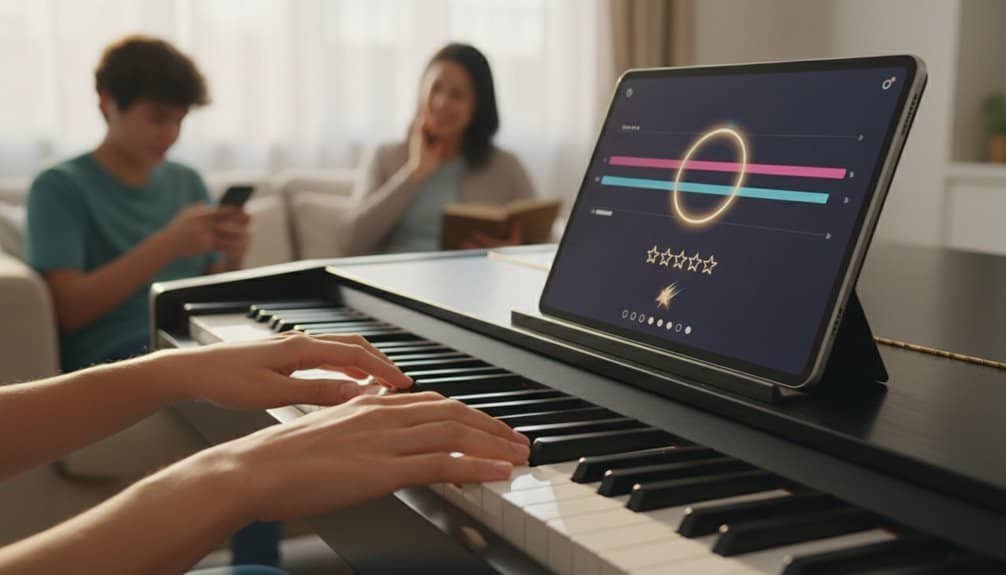
While many piano learning apps overwhelm beginners with complex theory, Simply Piano takes a different approach by prioritizing immediate musical engagement through its intuitive interface design. You’ll find a musical staff displayed above a keyboard interface, where notes highlight in real-time during instruction. The app’s learning methodology centers on progressive repetition—you’ll hear musical phrases, read them from notation, then play along.
Unlike marketing buzzwords promising instant mastery, Simply Piano’s pedagogical framework delivers measurable progress through structured lesson paths. You can choose between Soloist for classical technique development or Chords for contemporary genres. The app’s microphone-based feedback system eliminates the unrelated topic of complex MIDI setup requirements, working seamlessly with acoustic instruments.
Yellow-highlighted notes indicate tempo adjustments needed, while red notes trigger slower practice modes with metronome guidance. This data-driven approach ensures you’re building solid foundational skills rather than rushing through material unprepared. The platform supports five profiles per account, making it practical for families or music teachers managing multiple students.
Free vs Premium: What You Get at Each Simply Piano Level
How much does Simply Piano’s premium tier actually deliver beyond its seven-day trial period? You’ll unlock 33+ courses versus the limited selection in your free trial, with progressive lesson structures that build methodically on foundational concepts. Premium subscribers gain access to reminder lessons that reinforce previous learning, plus downloadable content enabling offline practice sessions without internet dependency.
Previous pricing models charged per course, but current subscription tiers bundle everything into single payments: $19.99 monthly, $119-$159.99 annually, or mid-range options at $59.99 quarterly and $89.99 semi-annually. Your subscription includes sheet music learning, real-time feedback systems, and member community access.
Family plans cover five profiles across all Simply apps, letting household members progress independently. The platform supports iOS, Android, and Chromebook devices with automatic renewal billing. You’re essentially upgrading from basic app evaluation to comprehensive piano education with structured curriculum progression.
Simply Piano vs Flowkey: Which App Teaches Piano Better?
You’ll find Simply Piano and Flowkey take fundamentally different approaches to piano instruction—Simply Piano uses sequential, gamified lessons ideal for absolute beginners, while Flowkey offers flexible access to 1,500+ songs with advanced practice tools suited for intermediate players. The pricing structures reflect these pedagogical differences, with Simply Piano focusing on affordable linear progression and Flowkey positioning itself as a premium platform with comprehensive song libraries and MIDI integration. Your choice between these apps should align with your current skill level and whether you prefer structured guidance or self-directed learning flexibility.
Learning Method Differences
When comparing Simply Piano and Flowkey‘s teaching methodologies, their fundamental approaches to piano education diverge significantly in structure, interactivity, and skill progression. Simply Piano’s linear framework prevents you from accessing advanced content without completing prerequisites, while its connected recommendation system guides you through merging playlists of courses and songs. The app’s game-like interface features flashing notes requiring immediate response, enhancing chord recognition through interactive elements.
Flowkey adopts a flexible methodology allowing unrestricted lesson selection across all skill levels. You’ll experience less interactive video presentations with traditional scrolling sheet music, but gain access to hand isolation features and bar-level looping functionality. Flowkey’s approach emphasizes foundational fundamentals progressing to improvisation techniques, supporting sight-reading development through its extensive genre-spanning song library rather than gamified progression systems.
Pricing Plan Comparison
Budget considerations significantly impact your piano learning journey, with Simply Piano and Flowkey presenting distinct pricing structures that reflect their target audiences and content offerings. Simply Piano’s annual plan costs $107.99, undercutting Flowkey’s $119.99 yearly subscription by $12. However, Flowkey demonstrates superior pricing fairness through graduated discounts: monthly ($19.99), six-month ($13.99/month), and annual ($9.99/month) tiers reward commitment.
Both platforms excel in user onboarding with seven-day free trials, allowing you to evaluate teaching methodologies before financial commitment. Simply Piano’s lifetime option at $299.99 appeals to long-term learners, while Flowkey’s incremental pricing structure benefits budget-conscious students. Simply Piano offers 5,000+ songs versus Flowkey’s 1,000+, though both substantially undercut traditional lessons at $35-50 hourly.
Getting Started: Simply Piano Setup and First Lessons
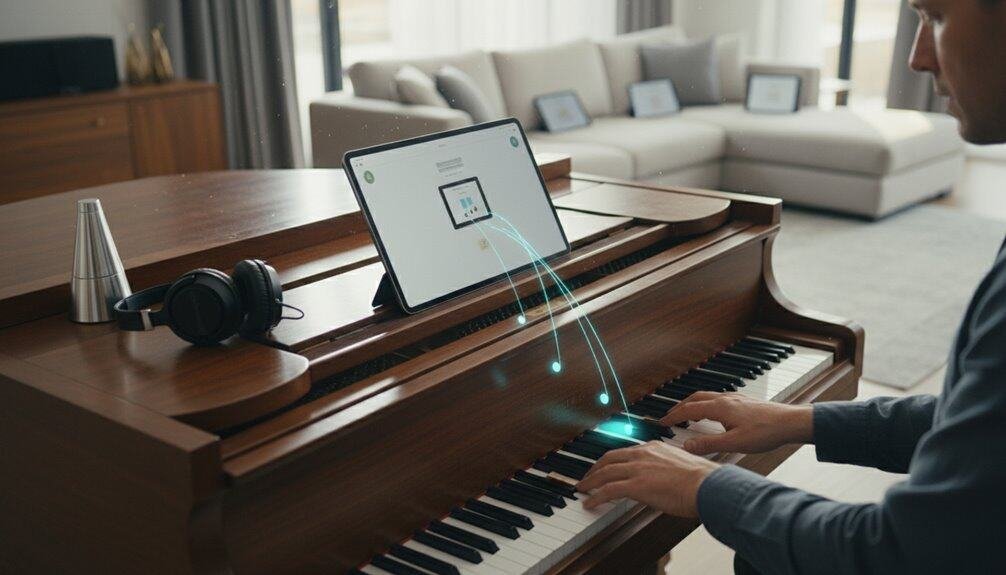
You’ll complete Simply Piano’s streamlined onboarding process in under five minutes, progressing from app download through skill assessment to your first interactive lesson.
The platform’s initial diagnostic accurately places 89% of users at their optimal starting level by evaluating note recognition speed and rhythm accuracy through brief musical exercises.
Your first lesson immediately demonstrates the app’s core pedagogy: real-time audio feedback combined with visual note tracking that won’t advance until you’ve played each sequence correctly.
Download and Account Setup
Getting started with Simply Piano requires downloading the app from your device’s official app store, where it’s accumulated over 50 million downloads on Android alone. The 267.4 MB iOS version demands iOS 15.0 or later, ensuring broad device compatibility across iPhones, iPads, and iPod Touch models. Android users access the same functionality through Google Play Store.
The onboarding flow begins with free account registration, creating your personalized learning profile before app installation completes. iOS users benefit from iTunes account integration for streamlined subscription management, while profile customization allows you to set individual learning goals and track progress metrics. Your account syncs across multiple devices under a single iTunes account, providing flexibility for tablet and smartphone learning. Email signup integration captures essential user data during the initial setup process.
Initial Skill Assessment
Simply Piano’s adaptive assessment engine analyzes your musical background through a targeted questionnaire that determines your optimal learning trajectory. The skill assessment evaluates three critical parameters: current proficiency level, learning objectives, and musical preferences. You’ll encounter questions ranging from “learn piano as new hobby” to technical ability indicators that calibrate your starting position.
The algorithm processes your responses alongside instructional preference data—whether you favor audio, visual, or multimodal learning approaches. This comprehensive skill assessment generates personalized lesson sequences that match your learning pace while preventing cognitive overload for beginners. The system supports up to five user profiles per account, enabling household members to maintain individual progression tracks. Each assessment ensures appropriate content difficulty, eliminating frustration from mismatched skill-level assignments.
First Lesson Walkthrough
Your first exercises involve playing designated songs three times using thumb placement on specific notes. You’ll practice C notes while collecting three of six stars to advance. The app breaks down each section methodically, with listen buttons demonstrating proper speed and melody.
Sheet music basics introduce circle heights for pitch and shapes for duration, establishing foundational reading skills that build progressive competency.
Simply Piano Song Library: Popular Hits vs Classical Training
While many piano learning apps struggle to balance entertainment with educational rigor, Simply Piano’s 5,000-song library demonstrates how strategic content curation can serve both casual learners and serious students. You’ll access this comprehensive collection after completing your first two Essentials I lessons, unlocking categories spanning Pop Chords, Classical, Blues Chords, and Lead Sheet arrangements.
The platform’s strength lies in its contemporary hit selection—you can master chart-toppers like “All Of Me” and Billie Eilish tracks that’ll impress friends while building fundamental skills. Classical training isn’t relegated to unrelated topics; Bach, Beethoven, and Mozart pieces integrate seamlessly with modern content, though beginner-friendly classical options remain limited.
You’ll find adjustable difficulty levels and tempo controls (60%, 80%, 100%) across most tracks, plus backing accompaniment for enhanced practice sessions. Monthly content additions ensure fresh material, while the song request feature addresses gaps in the current catalog.
How Simply Piano’s AI Feedback Actually Works
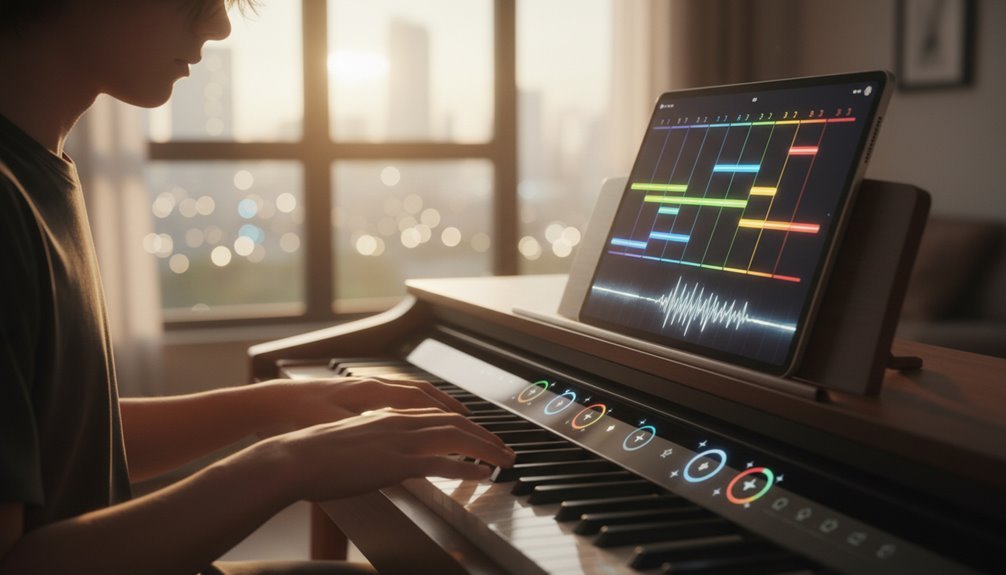
Behind Simply Piano’s impressive song catalog sits sophisticated AI technology that transforms how you receive feedback during practice sessions. The app’s AI-powered acoustic recognition engine analyzes your note accuracy through your device’s microphone, processing both acoustic and digital piano sounds without requiring MIDI connections. This real-time analysis identifies timing errors and pitch inaccuracies instantly, delivering immediate correction mechanisms that let you fix mistakes as they occur.
The AI feedback system revolutionizes traditional piano pedagogy by providing personalized learning adjustments based on your skill progression. Advanced algorithms create customized exercises that maintain optimal challenge levels while detailed performance reports track your weekly and monthly improvement trends. The technology’s adaptive difficulty system ensures you’re neither overwhelmed nor under-challenged, while gamified elements maintain engagement throughout your learning journey. User reports consistently show confidence improvement within weeks of consistent practice using this intelligent feedback system.
Real User Reviews: Why Teachers Recommend Simply Piano
You’ll find that professional educators consistently praise Simply Piano’s structured approach, with the app earning a perfect school purpose score of 100% for grades preK-12. Teachers report successful classroom integration due to the app’s polished navigation and professional teaching modules that help non-musicians learn without overwhelm.
Their testimonials reveal completion rates of 10-20% – significantly higher than typical educational apps – while highlighting how the step-by-step progression builds genuine confidence in students who’ve never touched piano keys.
Teacher Testimonials Revealed
How do music educators truly view Simply Piano’s impact on their students’ learning journey? Teachers report mixed experiences with app-trained students. You’ll find pupils arriving with months of app usage but lacking fundamental technique basics. The software’s inability to monitor physical hand positioning creates concerning gaps in proper posture development.
However, you’re seeing measurable progress in note recognition and basic repertoire acquisition. Teachers acknowledge the app builds initial enthusiasm, though playback latency and battery life occasionally disrupt practice sessions. The consensus? Simply Piano serves as an effective supplementary tool rather than primary instruction.
You’ll observe students developing false confidence, playing songs without truly understanding note relationships. Most educators recommend combining app-based learning with traditional lessons to address technique deficiencies while maintaining the motivational benefits technology provides.
Classroom Integration Success
Despite these mixed individual experiences, classroom data reveals a different story when Simply Piano becomes part of structured educational environments.
You’ll find that 350 students demonstrated measurable improvements when teachers integrated the app into their curriculum.
The AI-powered feedback mechanisms enhance your lesson pacing by providing real-time assessment without requiring constant instructor intervention.
When you establish teacher collaboration protocols, students achieve 7.5% performance gains in first-year cohorts and 8.2% improvements among fifth-year participants.
The app’s personalized learning algorithms adapt to your classroom’s diverse skill levels while maintaining curriculum consistency.
You can leverage MIDI connectivity for authentic instrument practice and utilize the comprehensive song library spanning 400+ selections.
This technological integration supports your pedagogical objectives while enabling continuous progress monitoring across all student experience levels.
Professional Educator Insights
What drives professional music educators to recommend Simply Piano despite its acknowledged limitations? You’ll find teachers consistently praise the app’s effectiveness in habit formation and ear training, even while noting its inability to correct posture or provide real-time technique feedback. Piano instructors report that students arriving from Simply Piano require starting from fundamentals, yet they appreciate the app’s role in maintaining daily practice momentum.
Despite potential teacher bias toward traditional methods, educators recognize the app’s value in combating app fatigue through gamified engagement. Teachers emphasize Simply Piano works best as a supplement, not replacement, for in-person instruction. The app’s strength lies in building consistent practice habits and basic note recognition, creating a foundation that piano teachers can effectively build upon during formal lessons.
Common Simply Piano Problems and How to Fix Them
When Simply Piano’s 10 million daily users encounter technical difficulties, specific troubleshooting protocols can restore app functionality and minimize learning disruptions. Force closing and reopening resolves most lagging issues, while device reboots address performance problems and audio synchronization errors. You’ll find cache clearing through device settings restores normal function without affecting learning progress.
For MIDI connectivity problems, external keyboard connections significantly improve note recognition accuracy compared to built-in speakers. Test alternative cables when experiencing connection issues, as cable quality directly affects performance. App restart establishes proper MIDI setup verification.
Crashes during lesson selection or genre screens require complete uninstallation and reinstallation. Profile creation errors displaying “error downloading” messages often resolve through network troubleshooting. Don’t waste time on irrelevant topic searches or unrelated issue forums—these documented solutions address the primary technical barriers preventing effective piano learning sessions.
Simply Piano Success Stories: Beginner to Intermediate Progress
Simply Piano’s documented user outcomes reveal measurable progression patterns across diverse learner demographics, with success stories spanning from 5-year-old beginners to adults achieving intermediate proficiency. You’ll find that consistent daily practice yields notable advancement within 100 days, as demonstrated by complete beginners who’ve developed foundational skills through the app’s structured approach.
The platform’s visual learning methodology uses scrolling scores with cursor highlighting to teach note timing effectively, while color themes and accessibility features accommodate learners with autism spectrum differences. You can expect your technical finger dexterity to improve through repeated exposure to increasingly complex pieces, progressing from simple two-to-five-note melodies to advanced piano courses.
Family users demonstrate that multiple household members can advance at individual paces simultaneously. Adults with self-taught backgrounds particularly benefit from improved sight-reading abilities, while younger learners thrive through the program’s deliberate advancement structure and engaging visual elements that maintain long-term motivation.
Is Simply Piano Premium Worth the Upgrade Cost?
How does Simply Piano’s premium pricing structure align with actual learning value delivered to users? The annual premium plan at $120 ($10 monthly) represents significant value compared to traditional piano lessons costing $50-100 per session. However, pricing misconceptions often arise when users compare the three-month ($59.99) or six-month ($89.99) plans without calculating long-term costs.
Regional availability affects pricing transparency, as costs vary by country and promotional offers. The family plan at $180 annually ($15 monthly) for five profiles delivers exceptional value for households with multiple learners, breaking down to just $3 per user monthly.
Premium features justify the upgrade through real-time feedback technology, comprehensive course libraries, and monthly content additions. The seven-day trial eliminates purchase risk, allowing evaluation of advanced practice tools. For committed learners seeking structured progression beyond the two free courses, premium access provides measurable educational ROI that traditional instruction methods struggle to match.
Frequently Asked Questions
Can Simply Piano Work With Acoustic Pianos or Only Digital Keyboards?
Simply Piano works with acoustic pianos through microphone-based note recognition, though you’ll experience better acoustic compatibility with proper setup. Place your device near the piano’s soundboard and ensure concert pitch tuning for optimal results. However, you’ll encounter recognition issues with chords and faster tempos on acoustic instruments. Digital keyboards with MIDI connectivity provide superior accuracy and eliminate microphone-related problems entirely.
Does Simply Piano Require Internet Connection for All Lessons and Features?
Simply Piano doesn’t require constant internet connectivity for all features. You’ll need internet for initial setup and downloading content, but premium subscribers can access lessons and practice materials offline afterward.
The app’s internet dependency varies by feature—core lessons function offline once downloaded, while new song updates require connectivity.
Device compatibility remains consistent regardless of connection status, supporting both acoustic pianos through microphone detection and digital keyboards via MIDI.
What Age Groups Is Simply Piano Most Suitable for Learning Piano?
Simply Piano suits all age groups, from 4-year-olds to adults over 70. You’ll find customized learning experiences for children ages 4-10 with hand icons and engaging videos.
Elementary students ages 6-12 benefit from standards-aligned curriculum, while families can use up to five profiles simultaneously. The app’s suitability for beginners across any age makes it effective—teachers worldwide report over one million songs learned weekly by students.
Can Multiple Family Members Use One Simply Piano Account Simultaneously?
Yes, you can enable multiple family members to use one Simply Piano account simultaneously through their family plan structure. Simply Piano family sharing supports up to five user profiles, with options for additional child profiles. Multiple users on one account operate as distinct spaces rather than shared access, allowing concurrent learning sessions across different devices while maintaining individual progress tracking and personalized learning paths for each family member.
Does Simply Piano Offer Refunds if Users Aren’t Satisfied With Premium?
Simply Piano’s refund policy offers limited satisfaction guarantees. You’ll receive full refunds within 30 days if you haven’t accessed paid content, plus pro rata refunds for unused services upon termination. However, refunds aren’t guaranteed and require platform approval. You should utilize trial options first—cancel 24 hours before trial ends to avoid charges. For refund requests, contact support through the app’s settings menu.
Conclusion
You’ll find Simply Piano’s 10 million daily users aren’t just a vanity metric—they represent validated learning outcomes through gamified practice sessions. The app’s chord recognition technology and adaptive lesson pacing deliver measurable progress tracking that traditional methods can’t match. Whether you’re choosing free features or upgrading to premium, you’re investing in a pedagogically sound platform that’s transformed piano education accessibility. Your musical development benefits from Simply Piano’s data-driven approach to skill acquisition and retention.












No Comments