


23 Jan When Lent Actually Ends – The Date That Surprises Everyone
Contrary to popular belief, Lent doesn’t end on Easter Sunday but concludes on Holy Thursday evening when the Mass of the Lord’s Supper begins the Easter Triduum. You’ve likely been counting wrong—Lent spans exactly 40 fasting days within 46 calendar days because Sundays are excluded from the penitential count, preserving their paschal character as “little Easters.” This mirrors Christ’s 40-day wilderness fast (Matthew 4:2) and creates a distinct liturgical transition that many Christians misunderstand about their calendar calculations.
Table of Contents
Key Takeaways
- Lent ends on Holy Thursday evening, not Easter Sunday, marking the transition into the Easter Triduum.
- The 40-day Lenten fast excludes Sundays, which are considered “little Easters” celebrating the Resurrection throughout Lent.
- Catholics count 40 weekdays from Ash Wednesday to Holy Thursday, while Orthodox Great Lent ends before Palm Sunday.
- Easter Sunday is actually a celebration of Lent’s completion, not its endpoint, following three days of Triduum.
- The Mass of the Lord’s Supper on Holy Thursday evening liturgically concludes the Lenten season.
When Does Lent End in 2026? (Holy Thursday, Not Easter)
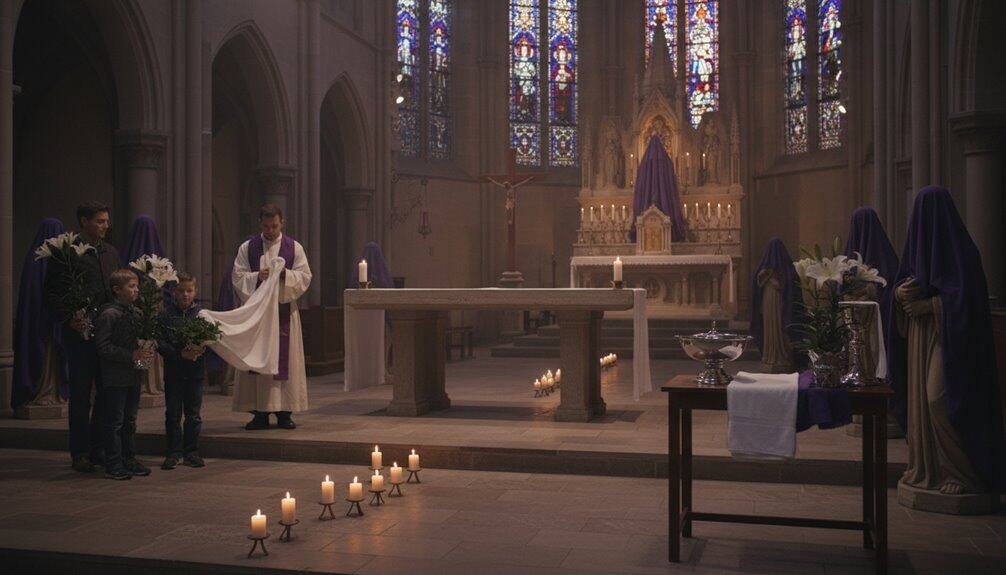
Why do most Christians incorrectly assume Easter Sunday marks Lent’s conclusion?
Most Christians mistakenly believe Easter Sunday concludes Lent, when it actually ends on Holy Thursday evening.
You’ll discover that Lent 2026 actually ends on Holy Thursday, April 2, not Easter Sunday, April 5. The Roman Catholic Church formally concludes Lent at sundown on April 2 with the Mass of the Lord’s Supper, marking the liturgical transition into the Easter Triduum.
This timing follows precise ecclesiastical calculations, much like astronomers track flight patterns of celestial bodies or oceanographers monitor lunar tides. The 44-day period from Ash Wednesday (February 18) to Holy Thursday excludes Sundays, creating the traditional 40-day Lenten observance that mirrors Christ’s desert fasting (Matthew 4:2). The number 40 carries profound biblical significance, appearing when Moses fasted to receive the Ten Commandments and the Israelites wandered in the wilderness.
You must distinguish between Lent’s formal conclusion and continued fasting practices. While the liturgical season ends Thursday evening, abstinence obligations extend through Holy Saturday. This doctrinal precision ensures proper understanding of the Church’s sacred calendar and scriptural foundations.
Why Sundays Don’t Count in Lent’s 40-Day Period
You’ll notice that Lent contains 46 calendar days yet maintains exactly 40 fasting days because the Church excludes Sundays from penitential observance. This ancient liturgical principle treats every Sunday as a “little Easter” celebrating Christ’s Resurrection, making fasting inappropriate on these primordial feast days throughout the year.
The 40-day calculation mirrors Jesus’ wilderness fast (Matthew 4:2) while preserving Sunday’s perpetual character as the weekly pascal mystery celebration established since apostolic times. However, Sundays are not excluded from Lent itself, as they are officially named the First through Fifth Sundays of Lent within the liturgical calendar.
Sundays Remain Feast Days
Does the Church’s treatment of Sundays during Lent seem contradictory at first glance? You’ll discover this apparent contradiction reflects profound theological wisdom. While Sundays are liturgically designated within Lent—titled “First Sunday of Lent,” “Second Sunday of Lent”—they maintain their primordial character as “mini-Easters” celebrating Christ’s Resurrection.
The Church’s historical fasting practices never included Sundays, even when ancient discipline required abstinence from all animal products throughout Lent’s weekdays. These liturgical Sundays preserve their joyful nature while existing within the penitential season. Universal Church law maintains this distinction: Sundays commemorate the paschal mystery and remain fundamentally different from Lent’s weekdays. This theological framework explains why your personal Lenten penances aren’t obligatory on Sundays—they’re feast days celebrating our salvation.
Ancient Church Calendar Logic
Understanding why Sundays don’t count toward Lent’s forty-day calculation requires examining the Church’s ancient calendar methodology. Early Christian contextual theology established that all Sundays commemorate Christ’s Resurrection, making them perpetual feast days incompatible with penitential fasting. This principle predates Lent’s expansion from several days to forty days, mirroring Christ’s desert temptation.
The Church’s liturgical calendars deliberately structured six weeks plus four additional days to achieve exactly forty fasting days while preserving Sunday’s sacred character. Eastern and Western traditions differ—Orthodox Great Lent includes Sundays but begins Clean Monday, while Roman practice excludes six Sundays from Ash Wednesday to Easter. This mathematical precision reflects doctrinal commitment: Sunday’s resurrection joy can’t coexist with Lenten penance, maintaining theological integrity across centuries.
Jesus’ Wilderness Fasting Model
Why does the Church’s forty-day Lenten observance mirror Christ’s wilderness experience while exempting Sundays from the count? Jesus’ fast in the Judean wilderness establishes the theological foundation for Lent’s structure. Matthew 4:2 records Christ’s complete abstinence from food for “forty days and forty nights,” while Luke 4:2 confirms He “ate nothing during those days.” This literal forty-day period became Christianity’s model for spiritual preparation through fasting and prayer.
However, the Church distinguishes between fasting days and Sundays as weekly celebrations of Christ’s resurrection. While secular calendars count all days equally, ecclesiastical tradition honors Sunday’s joyful character by excluding it from penitential observance. This creates a faster fasting period concentrated on weekdays, allowing the faithful to mirror Christ’s wilderness discipline while maintaining weekly resurrection celebrations throughout Lent’s preparatory season.
Catholic vs Orthodox Lent End Dates Explained

You’ll discover that Catholic and Orthodox traditions employ fundamentally different counting methods that create distinct Lenten timelines, with Catholics excluding Sundays from their 40-day calculation while Orthodox Christians include all days in their Great Lent observance.
The placement of Holy Week within these frameworks further complicates the comparison—Catholic Lent seamlessly incorporates Holy Week as its culmination, whereas Orthodox practice treats the 40-day Great Lent and Holy Week as interconnected yet separate fasting periods.
These structural differences, rooted in centuries of liturgical development and calendar traditions, result in Orthodox Christians experiencing a more extended total fasting period that can reach 48 days before Pascha.
Different Counting Methods
How can two ancient Christian traditions arrive at vastly different end dates for their respective Lenten observances while both maintaining the biblical precedent of a forty-day fast? You’ll find the answer lies in fundamentally different counting methodologies that developed over centuries.
Roman Catholic tradition excludes Sundays from its forty-day calculation, viewing them as mini-Easter celebrations incompatible with fasting. This exclusion necessitated Ash Wednesday’s eighth-century introduction, adding preliminary days to achieve the required duration. The astronomical alignment with Easter determines when purple liturgical colors give way to white vestments on Holy Saturday.
Orthodox Great Lent includes Sundays within its forty-day count, creating a continuous fasting period beginning Clean Monday. This methodology produces earlier conclusion dates, with Great Lent ending the sixth Friday before Orthodox Pascha, followed by the distinct Holy Week observance.
Holy Week Variations
Where exactly does Lent conclude when Catholic and Orthodox traditions approach Holy Week so differently?
You’ll find yourself navigating a complex theology debate rooted in liturgical distinctions. Catholic tradition incorporates Holy Week within its 40-day Lenten observance, maintaining consistent fasting rules and liturgical color schemes through Holy Saturday.
Orthodox Christianity separates Great Lent from Holy Week entirely—Great Lent concludes Friday evening of the sixth week, followed by distinct Passion Week observances with intensified fasting requirements.
This fundamental difference reflects divergent theological emphases: Catholics view Holy Week as Lent’s natural culmination, while Orthodox believers treat it as separate commemoration requiring heightened spiritual discipline.
You’re witnessing centuries-old liturgical traditions that structure Easter preparation through markedly different calendrical frameworks, each maintaining doctrinal integrity within their respective ecclesiastical contexts.
Eastern Orthodox Timeline
Two distinct calendrical systems create fundamentally different Lenten timelines that often confuse interfaith observers seeking to understand when each tradition’s preparatory season actually concludes.
Eastern Orthodox Great Lent follows an iconic calendar structure lasting exactly forty continuous days from Clean Monday through the Friday before Lazarus Saturday.
You’ll find this differs markedly from Catholic practice, as Orthodox churches conclude their primary fast before Palm Sunday, creating a two-day respite.
The Orthodox feast cycles incorporate Holy Week as a separate liturgical season with distinct fasting requirements, totaling forty-eight preparatory days before Pascha.
This ancient timeline reflects patristic understanding where Christ’s forty-day wilderness fast provides the precise temporal framework for believers’ spiritual preparation.
What Happens Between Lent and Easter Sunday
What unfolds during the sacred interval between Lent’s conclusion and Easter Sunday represents Christianity’s most profound liturgical drama. You’ll discover that Holy Thursday’s evening Mass of the Lord’s Supper initiates the Easter Triduum, yet fasting symbolism persists through Good Friday and Holy Saturday despite Lent’s formal end.
Calendar discrepancies between Western and Eastern traditions create distinct observances during these transitional days. While Roman Catholics conclude Lent on Holy Thursday evening, Orthodox churches end Great Lent before Palm Sunday, resulting in different spiritual rhythms during Holy Week.
You’re required to maintain Lenten abstinence through Good Friday, honoring Christ’s Passion (Matthew 26:26-28). Holy Saturday’s Easter Vigil marks your complete transition from penitential practices to resurrection celebration. The Eucharistic fast continues, intensifying prayer and reflection as you commemorate Christ’s final earthly moments. This sacred interval transforms your spiritual preparation into Easter’s triumphant renewal.
The Biblical Significance of 40 Days During Lent

The forty-day duration of Lent draws its profound meaning from Scripture’s consistent use of this number to signify periods of testing, purification, and spiritual transformation. This 40 day symbolism appears throughout biblical narratives as God’s designated timeframe for preparation and renewal.
Christ’s forty-day fast in the wilderness (Matthew 4:2, Mark 1:12-13, Luke 4:1-13) directly establishes Lent’s foundation, modeling spiritual discipline before ministry. Moses spent forty days on Mount Sinai receiving the Law (Exodus 24:18, 34:28), while Elijah journeyed forty days to Mount Horeb (1 Kings 19:8). The Israelites’ forty-year wilderness wandering represented purification before entering the Promised Land (Joshua 5:6).
These Lent origins trace to the Council of Nicaea, where early church fathers recognized this biblical pattern. Whether through Noah’s flood lasting forty days (Genesis 7:4) or Nineveh’s forty-day repentance period (Jonah 3:4), Scripture consistently presents forty as God’s timeframe for spiritual metamorphosis, making Lent’s duration theologically significant.
Common Myths About When Lent Actually Ends
Why do countless Christians mistakenly believe Lent concludes on Easter Sunday when liturgical calendars establish otherwise? You’ll find widespread confusion about end dates stems from several persistent myths.
First, Lent officially ends on Holy Saturday, not Easter Sunday. Easter represents the culmination thematically, but it’s liturgically separate from the Lenten season.
Second, while called a “40-day” season, Lent spans 46 calendar days from Ash Wednesday through Holy Saturday. Western churches exclude Sundays from the count, honoring Christ’s resurrection weekly, while maintaining the biblical significance of Jesus’s 40 wilderness days.
Third, denominations observe different end dates entirely. Eastern Orthodox churches conclude “Great Lent” nine days before Easter, while Western traditions end on Holy Saturday.
Fourth, fasting requirements don’t determine Lent’s conclusion. Though abstinence practices may cease, the liturgical season follows church calendar protocols, not individual observances.
How to Calculate Future Lent End Dates
Beyond recognizing when Lent concludes, you’ll need to master the Church’s ancient computational methods to determine future Lent end dates with precision. The process begins with Easter‘s lunar calculation, established at the Council of Nicaea in A.D. 325. You’ll calculate Easter as the Sunday following the paschal full moon occurring on or after the vernal equinox.
Once you’ve determined Easter Sunday using this lunar calculation, count backward exactly 47 days to find Ash Wednesday. From Ash Wednesday, count forward 40 weekdays (excluding the six Sundays) to reach Holy Thursday—Lent’s true conclusion with the Mass of the Lord’s Supper.
This method ensures doctrinal accuracy regardless of how Easter’s date shifts across the secular calendar. Remember that Lent ends before the Easter Triduum begins, making Holy Thursday evening your consistent endpoint for all future calculations.
Frequently Asked Questions
Can I Break My Lenten Fast on Palm Sunday Since It’s Celebration?
Yes, you can break your Lenten fast on Palm Sunday since it’s a liturgical celebration. Church law doesn’t require fasting on any Lenten Sundays, including Palm Sunday. Your break fast timing aligns with traditional practice – Sundays lift penitential obligations as they anticipate Easter’s joy. Palm Sunday indulgences focus on Christ’s triumphal entry rather than penance. However, you’re free to continue personal sacrifices if you choose spiritual consistency throughout Lent.
Do Different Time Zones Affect When Lent Officially Ends Each Year?
Time zones don’t affect Lent’s official end date, but they do impact the precise timing of its conclusion. You’ll observe Lent ending according to your local liturgical calendars and parish schedule, typically at Thursday evening’s Mass of the Lord’s Supper. While Christians globally share the same Holy Thursday date, you’re bound by your local church’s evening service time, creating sequential endings across different time zones worldwide.
Should Children Follow the Same Lent Ending Rules as Adults?
You’ll find children aren’t bound by identical Lent ending rules as adults due to children fasting differences established in canon law. While liturgical timing nuances determine Lent’s conclusion universally, the Church scales obligations by age—abstinence begins at fourteen, fasting at eighteen. You’re encouraged to guide children through age-appropriate Lenten practices, emphasizing prayer and almsgiving over strict fasting requirements, ensuring spiritual formation suits their developmental capacity.
Are There Special Foods Traditionally Eaten When Lent Ends on Thursday?
No standardized Lenten delicacies exist specifically for Thursday’s conclusion, though you’ll find varied regional traditions emerging post-fast.
Scripture doesn’t prescribe particular foods for Lent’s end, focusing instead on spiritual preparation through Christ’s passion.
You’re free to resume meat and dairy after Thursday evening’s Holy Mass, but many continue fasting until Easter vigil.
Regional customs emphasize joyful simplicity rather than elaborate culinary celebrations during this sacred transition period.
Can I Resume Giving up Items Immediately After Holy Thursday Mass?
You shouldn’t resume items after Holy Thursday Mass according to established fasting guidelines. While Lent liturgically ends Thursday evening, you’re expected to maintain penitential practices through Easter Sunday. The Church recommends continuing sacrifices until the Easter Vigil concludes, aligning with *Paschalis Solemnitatis* directives. Good Friday remains a mandatory fast day, requiring sustained discipline. Resume normal consumption after Easter Vigil Mass, completing your full Lenten journey.
Conclusion
You’ve discovered that Lent concludes on Holy Thursday, not Easter Sunday, marking Christ’s institution of the Eucharist (1 Cor 11:23-26). You’re now equipped to distinguish between the forty-day preparatory period and the sacred Triduum that follows. When you calculate future Lent dates, you’ll count backward from Holy Thursday, excluding Sundays per ancient ecclesiastical tradition. This understanding deepens your participation in the Church’s liturgical rhythm, aligning your observance with centuries of apostolic practice.









No Comments