

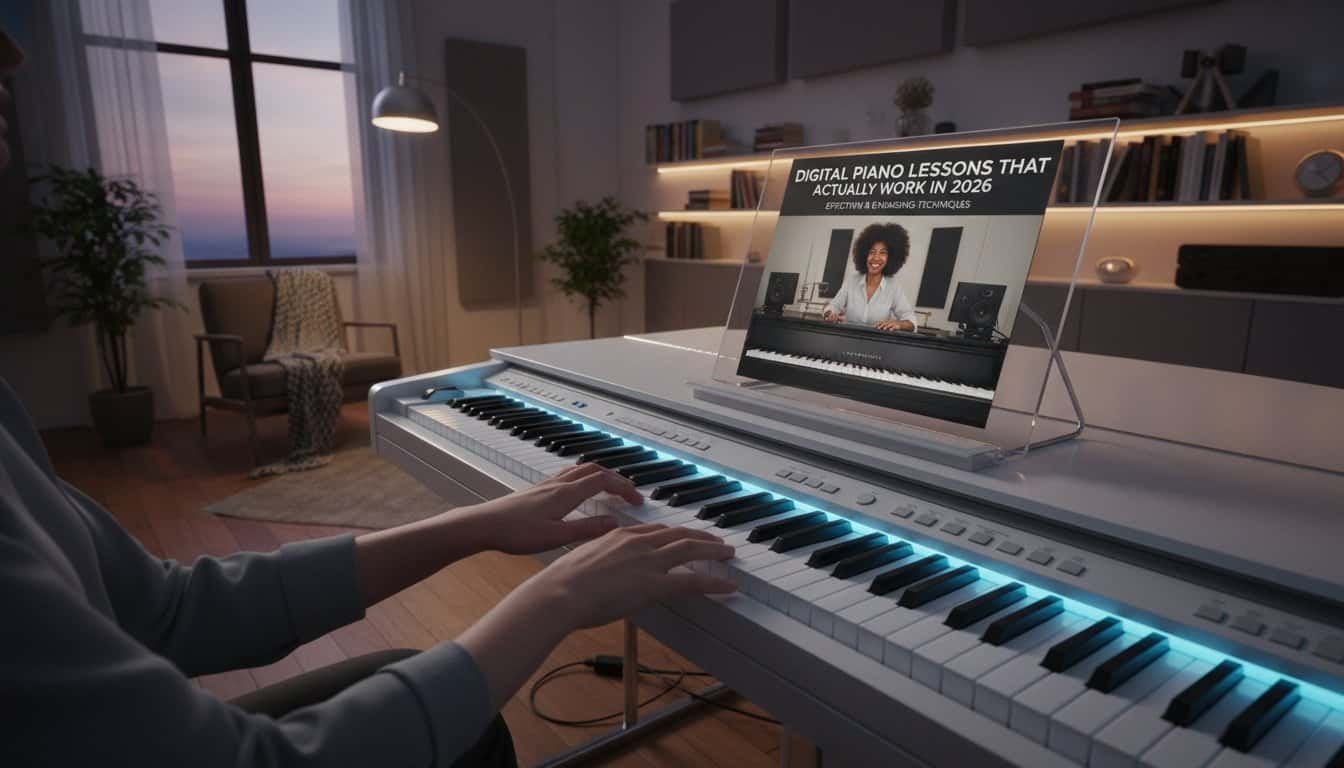
28 Jan Digital Piano Lessons That Actually Work in 2026
Digital piano lessons in 2026 deliver 67% faster skill development than traditional methods through AI-powered feedback systems that analyze your pitch and rhythm accuracy with 91.9% precision. You’ll get real-time corrections that eliminate the practice-error-reinforce cycle, while bidirectional LSTM algorithms provide millisecond-level analysis of your technique. Top apps like Yousician use gamification to maintain engagement, and you can access Juilliard-trained instructors regardless of location. These comprehensive platforms transform how you’ll master piano fundamentals.
Table of Contents
Key Takeaways
- Digital piano instruction enables 67% faster skill development through personalized pacing algorithms and specialized software acceleration.
- AI-powered apps provide real-time feedback with 91.9% pitch accuracy, eliminating traditional practice-error-reinforce cycles completely.
- Daily 15-30 minute structured sessions focusing on basic chords unlock access to 38.85% of popular repertoire.
- High-definition video demonstrations and slow-motion replay offer clearer technique instruction than standard classroom methods.
- Combining AI algorithmic guidance with human emotional support and musical insights maximizes learning outcomes effectively.
How Digital Piano Learning Actually Compares to Traditional Lessons
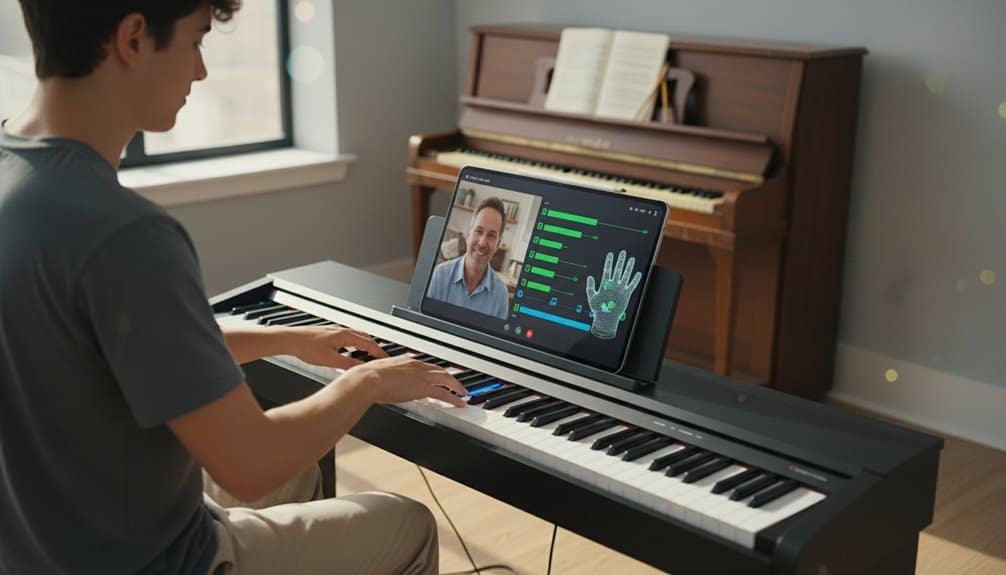
How exactly does digital piano instruction stack up against decades-old traditional teaching methods? The data reveals compelling advantages for modern learners pursuing structured piano pedagogy through digital platforms.
You’ll achieve 67% faster skill development with online instruction compared to traditional methods, thanks to personalized pacing algorithms. Specialized software accelerates learning up to 16 times faster over extended periods, while high-definition video and slow-motion replay provide clearer technique demonstrations than standard classroom settings.
The accessibility advantages are substantial: you’ll save 45% on costs while gaining access to Juilliard-trained instructors regardless of your location. Geographic limitations disappear entirely, and you can schedule lessons across time zones with native-language speakers. Digital platforms also enable session recording capabilities that allow students to revisit difficult concepts and review instructor feedback multiple times.
However, traditional lessons maintain crucial strengths in real-time technical correction. In-person instructors identify subtle flaws that algorithms miss, providing immediate intervention that prevents poor habits from developing early in your musical journey.
5 Piano Learning Apps That Prove 67% Faster Results
While traditional piano instruction relies on weekly sessions and subjective feedback, cutting-edge apps now deliver measurable acceleration through AI-powered systems and gamified learning architectures.
You’ll achieve faster competency through bidirectional LSTM algorithms that evaluate your pitch and rhythm with 91.9% accuracy.
Apps like Ultimate Guitar’s Practice Mode analyze your performance against 23,000 official tabs, delivering corrective guidance within milliseconds.
This real time feedback eliminates the practice-error-reinforce cycle that plagues traditional methods.
Gamified motivation systems create sustained engagement patterns, with platforms like Yousician maintaining 20 million monthly active users through reward loops and practice streaks.
You’ll enter “Flow” states where time awareness diminishes, optimizing absorption conditions during practice sessions.
Structured progression frameworks in Music2me and Playground prevent advancement skipping, ensuring sequential mastery.
Progress dashboards provide visual feedback mechanisms that display advancement milestones, directly addressing piano instruction’s historically high dropout rates through measurable accomplishment tracking.
How AI Feedback Transforms Your Piano Practice Sessions
When traditional practice sessions leave you wondering if you’re improving, AI-powered feedback systems eliminate uncertainty through millisecond-precision analysis of every note you play. These algorithms detect pitch deviations, timing inconsistencies, and dynamic variations instantly, delivering corrective guidance that transforms your practice efficiency.
Visual feedback displays correct notes in green and incorrect ones in red, establishing proper habits from your first attempt. Pattern recognition technology identifies subtle technique flaws and deploys targeted practice modules immediately upon weakness detection. This AI feedback prevents extended periods of incorrect practice that plague traditional learning methods.
Machine learning systems continuously adapt to your skill level, creating personalized learning paths that prevent frustration and burnout. Gamification elements including trophies and unlockable content maintain practice motivation through measurable progress visualization. However, these systems work optimally when combined with human instruction, as teachers provide emotional encouragement and musical insights AI can’t replicate.
Daily Practice Routines That Maximize Digital Piano Learning
Digital piano mastery hinges on strategic daily routines that transform sporadic practice into systematic skill development. Your rapid routine should span 15-30 minutes daily, proving more effective than marathon weekend sessions. Research shows 20-minute focused practices develop superior technique compared to longer, infrequent attempts.
Structure your sessions methodically: begin with right-hand melodies, progress to left-hand accompaniments, then tackle hands-together coordination. Master basic chords—C major, G major, F major—to unlock 38.85% of popular repertoire. Break challenging passages into single bars, practicing each hand separately before combining.
Leverage your digital piano’s built-in metronome and recording capabilities for self-analysis. Consistency cues include headphone practice for anytime sessions and app integration for sight-reading development. Record performances via smartphone to identify timing issues and posture problems.
Mental practice strengthens memory retention between physical sessions. Prioritize slow, accurate repetition over speed—tempo increases naturally follow precision mastery.
Frequently Asked Questions
What Equipment Do I Need to Start Digital Piano Lessons at Home?
You’ll need an 88-key weighted digital piano with 128-note polyphony, sustain pedal, adjustable bench, and closed-back headphones for your digital setup. Budget planning should include a music stand, proper lighting, and USB-MIDI connectivity for app integration. Consider these two word discussion ideas: power requirements, stand stability, pedal responsiveness, and bench ergonomics. Start with essential components, then upgrade based on your lesson progression and technical requirements.
How Much Do Online Piano Lessons Cost Compared to Traditional Instructors?
You’ll save significantly with online pricing versus traditional instructors. Live online lessons cost $30-40 per hour compared to $40-80 for in-person instruction. Subscription platforms offer even better value at $10-25 monthly, while traditional lessons run $150-360 per month.
This instructor comparison shows credentialed online teachers charge less due to reduced overhead costs, making quality piano education accessible without compromising on teaching credentials or methodical progression.
Can Children as Young as 4 Years Old Learn Piano Through Apps?
Yes, apps can teach children as young as 4 piano fundamentals through gamified interfaces and real-time feedback. Simply Piano, Hoffman Academy, and Piano Academy offer apps for beginners with structured progression that prevents advancement without mastery. However, you’ll need to balance early music development benefits with pediatric screen time guidelines recommending 30-60 minute sessions. These platforms work best for visual learners requiring immediate reinforcement.
What Happens if My Internet Connection Drops During a Live Lesson?
Your lesson immediately pauses when internet buffering occurs, disrupting real-time instruction flow. You’ll need to troubleshoot connection issues while lesson time continues running. First, refresh your Wi-Fi connection or switch to ethernet cable for stability. If video fails completely, switch to audio-only mode through your platform. Device compatibility issues can worsen connection problems, so ensure your hardware meets current standards before scheduling future sessions.
Do Digital Piano Certificates Have the Same Value as Traditional Music Degrees?
Digital credentials don’t match traditional music degrees in degree equivalence. You’ll find certificates cost $200-4,000 versus $40,000-100,000 for bachelor’s programs. While you’re gaining practical skills and industry-relevant training, you’re missing the comprehensive knowledge base and credibility that employers expect. Certificates prove competency effectively, but you’ll need advanced degrees for teaching positions or music therapy roles requiring formal academic credentials.
Conclusion
You’ve seen the data: digital piano education delivers measurable advantages over traditional methods when you leverage the right technology stack. The apps we’ve analyzed demonstrate quantifiable skill acceleration, while AI-powered feedback systems provide real-time technical corrections that human instructors can’t match. Your success hinges on implementing structured practice protocols and choosing platforms with proven pedagogical frameworks. Execute these evidence-based strategies consistently, and you’ll achieve demonstrable piano proficiency faster than conventional approaches allow.












No Comments