


15 Nov What Is the Meaning and Origin of John?
You’re encountering a name that’s traveled from ancient Hebrew Yochanan through Greek Iōannēs to Latin Iohannes, meaning “Yahweh is gracious.” It’s shaped Western civilization through biblical figures like John the Baptist and John the Apostle, twenty-three popes, and countless monarchs from England’s King John to Portugal’s six King Joãos. From medieval manuscripts to modern birth certificates, John’s produced variants like Jean, Juan, Giovanni, and Ivan while maintaining its sacred significance across three millennia of continuous use.
Table of Contents
Key Takeaways
- John means “God is gracious” or “Yahweh has been gracious,” combining the Hebrew elements “Yo” (Yahweh) and “chanan” (to be gracious).
- The name originated in ancient Hebrew as Yochanan, widely used during the First Temple period among Levitical and priestly families.
- It entered Greek as Iōannēs through the Septuagint translation, then Latin as Iohannes, becoming standardized in Western Christianity through Jerome’s Vulgate.
- John gained religious prominence through biblical figures John the Baptist and John the Apostle, with 23 popes and over 70 saints bearing the name.
- The name evolved into numerous variants worldwide: Jean (French), Juan (Spanish), Giovanni (Italian), Johann (German), Ivan (Slavic), and Seán (Irish).
The Hebrew Roots and Original Meaning of Yochanan
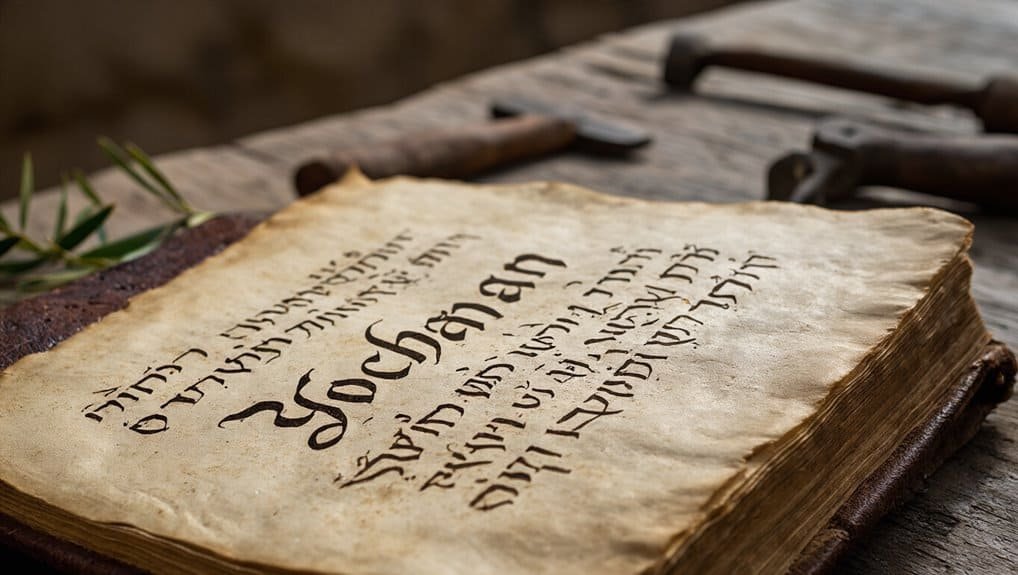
The name Yochanan emerged in ancient Hebrew as a theophoric compound, combining “Yo” (a shortened form of Yahweh) with “chanan” (meaning “to be gracious” or “to show favor”). You’ll find this construction follows established onomastic patterns in ancient Semitic naming traditions, where divine elements frequently preceded verbal roots to create personal names expressing religious devotion.
Ancient inscriptions from the First Temple period confirm Yochanan’s widespread use among Israelite communities. Archaeological evidence reveals the name on ostraca, seals, and bullae, demonstrating its popularity across various tribal name associations, particularly among Levitical families. Biblical phonology shows the name’s pronunciation evolved from the original Hebrew /joːħaːˈnaːn/ through Aramaic influences during the Second Temple period.
You can trace the name’s theological significance through its appearances in biblical texts, where it often marked individuals serving priestly or prophetic roles. This pattern reflects the ancient Near Eastern belief that names embodied divine destiny and parental aspirations for their children’s spiritual character.
The Journey Through Greek and Latin Translations
You’ll find that Yochanan transformed into Iōánnēs when Hebrew scribes and Greek translators rendered the name for Hellenistic audiences during the Septuagint’s creation.
The Romans subsequently adapted this Greek form into Iohannes, establishing the Latin foundation that would dominate Western Christianity for over a millennium.
These sequential translations didn’t merely alter pronunciation—they fundamentally shaped how billions of Christians would encounter this name through Jerome’s Vulgate and subsequent biblical texts.
Greek Form Ioannes
Greek scribes translating Hebrew texts in the Hellenistic period rendered Yochanan as Ἰωάννης (Iōannēs), adapting the name’s phonetic structure to conform with Greek linguistic patterns. You’ll notice the transformation preserved the original’s essential sounds while accommodating ancient Greek pronunciation rules that couldn’t replicate certain Hebrew consonants.
During Hellenistic usage, Iōannēs became the standard form across the Mediterranean world. You can trace this consistency through Byzantine manuscript traditions, where scribes meticulously copied the name in religious texts. The translation process created subtle religious semantic shifts—while Yochanan emphasized Yahweh’s direct grace, Iōannēs acquired broader theological associations within Greek-speaking Christian communities.
You’re seeing how linguistic adaptation wasn’t merely phonetic but carried cultural implications that would influence the name’s meaning for centuries.
Latin Iohannes Development
Roman scribes encountering Iōannēs in Greek Christian texts adapted it to Iohannes, maintaining the transliteration’s core structure while conforming to Latin orthographic conventions. You’ll notice they preserved the initial “I” and terminal syllables while adjusting the internal vowel sequence to match Latinized phonology. This Iohannes evolution occurred primarily during the second and third centuries as Christian manuscripts circulated throughout the Roman Empire.
When you examine early Latin biblical manuscripts, you’ll find Iohannes became the standard rendering in Jerome’s Vulgate (382-405 CE). The form demonstrates systematic phonological adaptation: Greek omega became Latin “o,” and the double “n” remained intact. Latin’s lack of the Greek eta sound necessitated its replacement with “a.” This transliteration pattern established precedents for converting other Hebrew-origin names through Greek into Latin ecclesiastical usage.
Biblical Translation Impact
Translation shaped John’s linguistic destiny as the name traversed from Hebrew through Greek Septuagint renderings into Latin biblical texts. You’ll find that early translation choices fundamentally altered how Western cultures received this name.
When Greek translators rendered Yohanan as Ioannes, they weren’t just transliterating—they were adapting Hebrew phonetics to Greek linguistic patterns.
These interpretive shifts continued in Jerome’s Vulgate, where Iohannes became Christianity’s standard form. You can trace how each translation layer added subtle modifications that distanced the name from its Semitic roots.
The Greek omega transformed into Latin’s distinctive “o” sound, while the Hebrew guttural elements disappeared entirely. Through these biblical translations, you’re witnessing more than linguistic evolution—you’re observing how sacred texts standardized naming conventions that would influence two millennia of Christian nomenclature.
Biblical Significance and Religious Importance
Reverence for the name John stems from its profound biblical heritage, particularly through two pivotal New Testament figures who shaped early Christianity. You’ll find John the Baptist‘s role as Christ’s herald embedded in theological interpretations across denominations, while John the Apostle‘s Gospel writings established foundational Christian doctrine.
The name’s biblical symbolism extends beyond individual figures. You’re encountering divine favor whenever John appears in scripture—God’s grace manifested through human vessels. This spiritual significance transformed John into Christianity’s most enduring name choice.
Liturgical usage reinforces John’s sacred status. You’ll hear it invoked during baptismal ceremonies, feast days, and religious celebrations worldwide. Saintly veneration amplified its importance through centuries of Christian tradition. Over seventy saints bear this name, including twenty-three popes who adopted it upon ascending to the papacy. You’re witnessing how religious authority perpetuated John’s prominence, making it inseparable from Western Christianity’s spiritual and cultural identity.
Variations of John Across Different Languages and Cultures
You’ll find John’s name transformed across linguistic boundaries through centuries of cultural exchange and phonetic adaptation.
European languages render it as Jean (French), Juan (Spanish), Giovanni (Italian), and Johann (German), while Asian cultures have produced versions like Yohanes (Indonesian) and Yohan (Korean).
These variations reflect not only pronunciation differences but also orthographic conventions, with spellings ranging from Ioan in Romanian to Seán in Irish Gaelic.
European Language Forms
Across Europe’s linguistic landscape, the name John has undergone remarkable transformations while maintaining its essential character and meaning. You’ll find Giovanni in Italy, Juan in Spain, João in Portugal, and Jean in France—each reflecting regional phonology that evolved over centuries. In Germanic territories, you’ll encounter Johann and Hans, while Slavic regions present Ivan and Jan.
Church records from medieval monasteries document how Latin’s Johannes adapted to local pronunciations as Christianity spread northward. You’ll notice that Nordic countries developed Jón and Johan, while Celtic regions retained Seán and Iain. These variations aren’t arbitrary; they’re systematic sound changes following each language’s phonological rules. When you examine these forms, you’re witnessing how one biblical name became culturally embedded across an entire continent, creating distinct yet recognizable versions.
Asian Name Adaptations
Translation and transliteration have shaped John’s journey into Asian languages, producing forms that balance phonetic adaptation with cultural meaning.
You’ll find Japan’s “Yon” (ヨン) demonstrates strict transliteration preferences, while Chinese “Yuēhàn” (约翰) reflects Mandarin’s phonetic shifts from the original Hebrew.
Korea’s “Yohan” (요한) shows how cultural integration modifies consonant clusters absent in Korean phonology.
You should note that naming laws in countries like China and Vietnam have influenced John’s adoption patterns.
Vietnamese “Gioan” emerged through Catholic missionary influence, adapting to tonal requirements.
In India, you’ll encounter “Yohanan” in Christian communities, preserving Semitic roots while conforming to local scripts.
These adaptations aren’t mere linguistic exercises—they’re negotiations between maintaining biblical authenticity and meeting governmental regulations that often restrict foreign names.
Regional Spelling Differences
Throughout European linguistic territories, John’s orthographic variations reflect centuries of phonological evolution and scribal traditions that you can trace through medieval manuscripts.
You’ll find Giovanni in Italian texts, Jean in French documents, and Johann in Germanic regions, each representing distinct pronunciation shifts from the original Yohanan.
Spain’s Juan emerged through Arabic influence during Moorish occupation, while Portugal’s João developed independently through Latin intermediaries.
Regional spellings like Ireland’s Seán and Scotland’s Ian demonstrate Celtic linguistic adaptations.
You’re observing how consonant mutations and vowel transformations created Poland’s Jan, Russia’s Ivan, and Greece’s Ioannes.
These variations aren’t merely superficial; they’ve encoded phonetic rules specific to each language’s sound system.
When you examine historical records, you’ll discover that scribes often transliterated names according to local orthographic conventions, establishing spelling patterns that’ve persisted for centuries.
Historical Figures Named John Throughout the Ages
The name John has adorned countless influential figures who’ve shaped Western civilization’s trajectory. You’ll find Johns dominating medieval throne rooms, from England’s King John who signed the Magna Carta to Portugal’s John I who established the Aviz dynasty.
Religious history reveals Pope John XXIII‘s revolutionary Vatican II reforms and John Calvin‘s Protestant theological framework that you’ve likely encountered in Western Christianity’s development.
In America’s founding, you’d recognize John Adams and John Hancock’s signatures on pivotal documents. The arts showcase Painter John Constable’s romantic landscapes and John Milton‘s Paradise Lost. Even maritime folklore presents John Canoes festivals, celebrating Caribbean cultural resistance through this namesake figure.
Scientific advancement owes debts to John Dalton’s atomic theory and John Locke’s empirical philosophy. You’re witnessing how Johns have persistently emerged at history’s crucial junctures, from John F. Kennedy‘s space race leadership to John Lennon’s cultural revolution. This name’s bearers haven’t merely witnessed history—they’ve actively constructed it.
The Rise of John in Medieval and Renaissance Europe
You’ll find that John became Europe’s premier royal name when England’s King John ascended in 1199, followed by twenty-three French kings and countless German princes who bore the name.
The Church’s veneration of John the Baptist and John the Evangelist drove the name’s adoption across all social classes, as parents sought divine protection through their children’s baptismal names.
Royal Name Adoption
Kings and nobles took up the name John with remarkable enthusiasm following its biblical associations and the canonization of several saints bearing the name. You’ll find that royal patronage elevated John’s status throughout European courts, transforming it from a religious designation into a symbol of dynastic prestige. England’s King John (1199-1216) marked the name’s sovereign adoption, despite his troubled reign. Portugal’s João I through VI and France’s Jean II demonstrated the name’s endurance among crown names across centuries.
You can trace how monarchs strategically selected John for heirs, believing it conveyed divine favor and legitimacy. This aristocratic preference filtered downward through society—when royalty embraced a name, lesser nobility followed, then merchants, and finally commoners adopted it for their sons.
Religious Influence Spreads
As monastic orders expanded across medieval Europe, they carried John’s name through their evangelical missions, establishing churches and abbeys that reinforced its sacred significance.
You’ll find that Benedictines, Franciscans, and Dominicans particularly promoted the name through their missionary expansion into Germanic and Slavic territories. They’ve translated biblical texts containing John’s gospel and epistles, ensuring the name’s penetration into vernacular languages.
During the Reformation, you’d witness denominational debates intensifying John’s prominence. Protestant reformers invoked John’s theological authority against Catholic doctrine, while Counter-Reformation leaders emphasized John the Baptist’s ascetic virtues.
You’ll notice how both sides claimed John’s legacy, paradoxically spreading the name further across confessional boundaries. By 1600, John had become Christianity’s most universal name, transcending sectarian divisions.
John as a Royal and Noble Name Through History
Throughout medieval and early modern Europe, the name John dominated royal nomenclature with remarkable consistency. You’ll find Johns ruling England, France, Portugal, Poland, and numerous duchies across the continent. England’s King John signed the Magna Carta in 1215, while John II of France navigated the Hundred Years’ War. Portugal’s João I established the Aviz dynasty, and Poland’s Jan III Sobieski defeated the Ottomans at Vienna in 1683.
This prevalence reflects deliberate dynastic patronage—royal families repeatedly chose John to honor predecessors and saints, particularly John the Baptist. You can trace how successive generations reinforced the name’s prestige through strategic naming patterns. Heraldic symbolism often incorporated Baptist imagery, with royal Johns adopting lamb motifs and baptismal crosses in their personal arms. The name’s versatility across linguistic boundaries—Jean, Juan, Giovanni, Johann—enabled its transmission through intermarriage and diplomatic networks. By selecting John, you weren’t just choosing a name; you were claiming membership in Christianity’s most exclusive political circles.
Cultural Impact and Literary References
The name John’s aristocratic cachet translated directly into Western literature’s foundational texts, where you’ll encounter Johns wielding narrative authority from Chaucer to Shakespeare.
You’ll find John represents literary archetypes of everyman figures and noble heroes alike—from John the Baptist‘s prophetic voice to King John’s tragic sovereignty.
Shakespeare’s deployment of the name across fourteen characters demonstrates its versatility in conveying both virtue and villainy.
The name’s cultural symbolism extends beyond literature into linguistic frameworks.
You’re using “John” whenever you reference anonymous figures: “John Doe,” “John Q. Public,” or Britain’s “John Bull.”
These constructions reinforce specific gender perceptions, establishing masculine defaults in legal and social contexts.
Modern portrayals have complicated this tradition—you’ll notice contemporary Johns ranging from action heroes to antiheroes, reflecting shifting cultural values.
The name’s ubiquity has paradoxically rendered it both universal and particular, serving as a blank canvas for character development while carrying centuries of accumulated meaning.
Modern Popularity and Usage Statistics Worldwide

Currently, you’ll find John maintaining remarkable statistical resilience across English-speaking nations despite declining from its twentieth-century dominance.
In the United States, John’s dropped from first place (1900-1923) to 27th position in 2023, yet it’s still given to approximately 8,000 newborns annually. You’re witnessing modern trends where parents increasingly favor unique names over traditional choices, though John persists as a middle name selection.
Regional differences emerge strikingly across continents. You’ll observe John ranking within the top 100 in Ireland, Scotland, and Northern Ireland, while it’s fallen below 200th place in England and Wales. In non-Anglophone countries, you’re seeing localized variants outperform the English form: Giovanni in Italy, Jean in France, and João in Brazil demonstrate stronger contemporary usage.
Australia’s statistics mirror American patterns, with John sitting at 89th place. These variations reflect broader cultural shifts where you’re watching classical names yield to international influences and creative spellings.
Common Nicknames and Derivative Names From John
Beyond statistical patterns and regional preferences, John’s linguistic versatility manifests through an extensive network of diminutives and related forms that you’ll encounter across cultures and centuries.
John’s linguistic versatility spans cultures through countless diminutives and related forms across centuries of adaptation.
You’ll recognize the most common English diminutive forms as Jack, Johnny, and Johnnie, each representing distinct stages of nickname evolution from medieval times to present day. Jack emerged in medieval England through the Anglo-Norman chain Johan-Jankin-Jackin-Jack, while Johnny developed as an affectionate pet name during the 18th century.
You’ll find cultural nicknames vary significantly across linguistic boundaries. Spanish speakers use Juan, Juanito, and Juancho; Russians employ Ivan, Vanya, and Vanka; while Irish Gaelic produces Seán and Seánie. These variations aren’t mere translations but represent independent phonological developments within each language’s morphological framework.
You’ll notice that diminutive forms often follow predictable patterns: adding suffixes like -ny, -ie, or -kin in English, or -ito in Spanish, demonstrating how cultures adapt biblical names to their indigenous naming conventions.
Frequently Asked Questions
Is John Considered a Lucky or Unlucky Name in Different Cultures?
You’ll find John carries positive cultural luck across most Western traditions, with name superstitions favoring its biblical heritage.
In numerology meanings, John’s vibration typically equals 2 or 20, suggesting cooperation and diplomacy.
European folklore associations link it to prosperity through Saint John’s feast days, while Anglo-Saxon traditions consider it protective.
You won’t encounter negative connotations except in isolated regional beliefs where foreign names faced historical prejudice during wartime periods.
What Are the Best Middle Names That Pair Well With John?
You’ll find that classical pairings like James Patrick and Oliver Thomas complement John’s biblical gravitas exceptionally well.
Historical records demonstrate that monosyllabic surnames benefit from these longer middle appellations, creating phonetic equilibrium.
You’re observing centuries of naming conventions when selecting Michael, Alexander, or William—each carrying substantial etymological weight.
Contemporary scholars note that John’s versatility permits both traditional Anglo-Saxon choices and modern variants, though you’ll achieve optimal resonance with time-honored combinations rooted in Western nomenclature.
How Do You Pronounce John Correctly in American Versus British English?
You’ll pronounce John as /dʒɑn/ in American pronunciation, with a broad “ah” vowel sound that’s characteristic of American phonology.
In British pronunciation, you’d articulate it as /dʒɒn/, employing a shorter, rounder “o” sound.
Both dialects maintain the initial affricate /dʒ/ and final nasal /n/, but the vowel distinction represents a fundamental difference between transatlantic English varieties.
This phonetic variation reflects historical linguistic divergence between the two standard forms.
What Personality Traits Are Commonly Associated With People Named John?
You’ll find Johns historically characterized as dependable, traditional, and trustworthy individuals.
Research into nominative determinism suggests they’re often perceived as a friendly leader within social hierarchies, embodying masculine strength and reliability.
Johns typically project a steady presence in professional settings, reflecting the name’s biblical gravitas.
Psychological studies indicate they’re viewed as conventional, honest, and approachable—traits reinforced through centuries of the name’s prominence in Western Christian societies and leadership positions.
Is John an Appropriate Name for Girls or Strictly Masculine?
You’ll find John remains strictly masculine in traditional usage, though gender neutral trends have emerged in modern naming practices.
Historical feminization created distinct variants like Joan, Jane, and Joanna rather than adapting John directly for female use.
While you’re witnessing contemporary parents choosing traditionally masculine names for daughters, John hasn’t gained traction in this movement.
You’d typically encounter feminine derivatives rather than John itself when seeking this name’s essence for girls.
Conclusion
You’ve discovered that John’s journey from the Hebrew Yochanan through Greek Ioannes to Latin Johannes represents more than linguistic evolution—it’s a testament to cultural transmission across millennia. You’ll find John’s meaning, “God is gracious,” has remained constant while spawning countless variations worldwide. Whether you’re encountering Juan, Jean, or Ivan, you’re witnessing the same ancient name’s endurance. John’s prominence in religious texts, royal lineages, and literature confirms its position as history’s most influential given name.












No Comments