

19 May Elijah Fasting Scripture — 40 Days to Mount Horeb (1 Kings 19)
Disclosure: Some of the links on this website are affiliate links. If you click a link and make a purchase, the Website Operator may earn a small commission at no extra cost to you.
Table of Contents
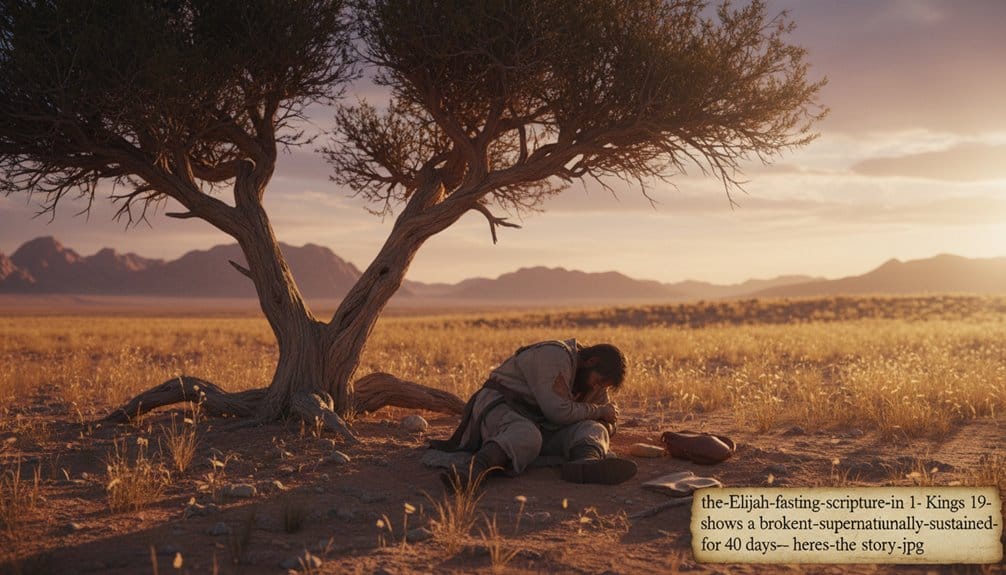
In 1 Kings 19, you’ll find Elijah — fresh off calling fire down from heaven on Mount Carmel — collapsed under a broom tree in the wilderness, begging God to let him die. One death threat from Jezebel shattered him completely. Yet God didn’t scold him. Instead, an angel fed him twice, and that supernatural provision carried him through a 40-day journey to Horeb. There’s far more to this story than you’d expect.
Key Takeaways
- After Jezebel’s death threat, Elijah fled into the wilderness, collapsed under a broom tree, and begged God to let him die.
- An angel twice provided bread and water, physically sustaining Elijah before his long journey began.
- Strengthened by supernatural food, Elijah traveled forty days and nights to Horeb, the mountain of God.
- The forty-day fast mirrors Moses at Sinai, connecting Elijah’s wilderness experience to Israel’s foundational covenant history.
- Despite his total emotional collapse after Carmel’s victory, God met Elijah’s physical need before addressing his spiritual despair.
Who Was Elijah Before the Wilderness Began
Elijah wasn’t a newcomer when he stepped into the wilderness of 1 Kings 19. He’d already served as the LORD’s prophet in the northern kingdom of Israel, identified as “the Tishbite” from Gilead. His ministry centered on confronting Israel’s covenant unfaithfulness, particularly the Baal worship Ahab and Jezebel actively promoted.
Before the wilderness, you can trace a consistent pattern in Elijah‘s life: bold obedience, divine provision, and direct confrontation with royal power. He announced drought to Ahab’s face, survived by ravens at Cherith, and depended on a widow’s household during famine. He wasn’t guessing whether God would provide — he’d already seen it repeatedly.

That’s what makes the collapse in chapter 19 so striking. The man fleeing under a broom tree, begging to die, is the same seasoned prophet who’d just called down fire on Carmel. His fall wasn’t shallow. It was total. Jezebel’s death threat, delivered with the chilling promise that his life would be taken by this time tomorrow, was the breaking point that sent him running into the wilderness alone.
What Happened on Mount Carmel Right Before He Fled
What unfolded on Mount Carmel wasn’t a quiet spiritual moment — it was a full-scale, nationally witnessed confrontation between the LORD and Baal. Elijah summoned Ahab, gathered all Israel, and brought 450 prophets of Baal to a single location to settle the question tearing the nation apart: who was actually God?
Baal’s prophets went first. They cried out for hours, cut themselves, and performed every ritual they knew. Nothing answered. Elijah mocked them openly while the crowd watched.
Then Elijah repaired the LORD’s altar with twelve stones, soaked the sacrifice with water until it filled the surrounding trench, and prayed a single, focused prayer. Fire fell and consumed everything — offering, wood, stones, dust, and water. The people fell facedown and declared, “The LORD — he’s God.”
Then rain broke the three-year drought, and Elijah ran ahead of Ahab’s chariot to Jezreel.

Why Jezebel’s Threat Broke a Prophet Who Just Called Down Fire
You watch Elijah go from commanding fire out of heaven to running for his life in a single chapter, and the whiplash is jarring. One messenger from Jezebel accomplished what hundreds of Baal’s prophets couldn’t—it broke him completely. Victory didn’t insulate him from fear; it left him more exposed than ever.
Victory Followed By Fear
How does a prophet who just called down fire from heaven end up hiding in the wilderness, begging God to let him die? The answer sits in 1 Kings 19, and it’s more human than you’d expect.
Elijah had just won. Fire fell, Baal’s prophets died, and Israel confessed. Then Jezebel sent one message, and everything collapsed. She vowed to kill him within twenty-four hours, matching the deaths of her prophets with his own. No public arrest. No army. Just a calculated threat designed to break him psychologically.
It worked. Elijah fled from Jezreel to Beersheba, then deeper into the wilderness alone. He sat under a tree and asked God to take his life. Victory had cracked open into despair almost overnight.
One Threat, Total Collapse
Jezebel never mobilized an army. She sent a messenger with words, and that was enough. The threat arrived with oath language, a deadline, and the full weight of royal authority behind it.
After the Carmel confrontation, Elijah had publicly humiliated the crown’s religious establishment. Jezebel‘s response reframed the entire episode as a personal vendetta, shifting the conflict from theological victory to survival crisis.
You have to understand what Elijah carried into that moment. He’d just executed 450 prophets, endured sustained public pressure, and operated at maximum intensity with no recovery period.
When the threat landed, it landed on a man already running on empty. One message, precisely timed, targeting honor and survival simultaneously, collapsed a prophet who’d just called down fire from heaven.
Why Elijah Left His Servant Behind in Beersheba
When Elijah reached Beersheba, he left his servant there and pressed on alone into the wilderness. The text gives no explicit reason, but the narrative context makes the picture clear—he wasn’t strategizing, he was collapsing.
| Factor | Detail | Implication |
|---|---|---|
| Geography | Beersheba bordered Judah’s southern edge | Beyond it lay harsh, uninhabited terrain |
| Safety | Outside Jezebel’s northern jurisdiction | Servant faced less risk staying put |
| Psychology | Elijah claimed he alone remained | Isolation reflected emotional breakdown |
You can see how these three realities converged at once. Beersheba was the last recognizable landmark before the desert swallowed everything. The servant’s presence would’ve been impractical beyond that point, and Elijah’s state of mind wasn’t built for company anyway. His later cry—”I alone am left”—confirms that this separation wasn’t tactical. It was a broken man withdrawing from everything familiar.
The Broom Tree: Where a Prophet Hit Rock Bottom
After watching fire fall from heaven and defeating the prophets of Baal, Elijah runs for his life when Jezebel threatens him, and the stark contrast between that triumph and this terror sets the stage for what comes next.
He pushes into the wilderness alone, collapses under a desert broom tree, and lets his exhaustion speak its worst: “I’ve had enough, LORD—take my life.”
You’re looking at a man who didn’t gradually fade but broke sharply, hitting rock bottom in a barren stretch of land where the only shade came from a scraggly shrub.
Fleeing After Victory
The story shifts without warning in 1 Kings 19: one moment Elijah’s outrunning Ahab’s chariot in the rain after a crushing victory on Mount Carmel, and the next he’s running again—this time for his life.
Jezebel’s death threat arrives immediately after Ahab reports the Carmel events. The shift is jarring. You’re watching someone go from national prophet to frightened fugitive within a single verse. Notice what drives the collapse:
- Fear replaces faith — 1 Kings 19:3 says plainly he “was afraid”
- Distance replaces presence — he flees south to Beersheba, beyond Jezebel’s reach
- Isolation replaces companionship — he leaves his servant behind before continuing alone
The victory didn’t protect him from breaking. Sometimes the hardest moments follow the highest ones.
Wilderness Despair Sets In
Elijah doesn’t stop at Beersheba. He leaves his servant behind and pushes a full day’s journey deeper into the wilderness alone.
When he finally stops, it’s under a broom tree—a scraggly desert shrub offering almost no shade. That detail matters. You’re not looking at a man who found shelter. You’re looking at a man who collapsed.
His words confirm it: *”It is enough!”* That’s not strategy talking. That’s burnout. That’s a prophet who’d just called down fire on Mount Carmel now sitting in the dirt, asking God to let him die.
The broom tree doesn’t represent rest. It represents rock bottom—the place where strength runs out and only God’s intervention remains.
A Death Wish Spoken
A day’s journey into the wilderness alone, and he’s done. Elijah collapses under a broom tree — a sparse desert shrub offering almost no real shade — and prays to die.
His words cut deep:
- “It is enough now, LORD” — the cry of a man completely emptied
- “Take my life” — surrender framed as a request to God, not self-destruction
- “I am no better than my fathers” — failure measured against those who came before him
You’re looking at a prophet who just called down fire from heaven now sitting exposed in harsh wilderness, spiritually depleted and emotionally broken. The broom tree isn’t a refuge. It’s a collapse point. But the text doesn’t condemn him. It records it honestly, setting up everything that follows.
Elijah Asked God to Let Him Die
After his stunning victory on Mount Carmel, Elijah’s courage collapsed the moment Jezebel threatened his life. He fled into the wilderness, left his servant behind at Beersheba, and walked a full day alone before sitting under a broom tree in exhaustion and despair.
There, he prayed directly to God—not a private thought, but a spoken request. He said, “It is enough; now, O LORD, take away my life.” He compared himself unfavorably with his ancestors, declaring he was no better than they were.
You can see in this moment that his desire wasn’t simply to escape danger. He wanted to die. The collapse came after prolonged stress, isolation, and fear, not during failure but after a public triumph.
Yet God’s first response wasn’t rebuke. An angel arrived with food and water, meeting Elijah’s physical need before addressing anything else.
What “I Have Had Enough” Reveals About Burnout and Faith
Three words carry enormous weight in 1 Kings 19:4: “I have had enough.” They don’t signal a moment of mild disappointment or temporary frustration—they mark a full collapse of emotional and spiritual reserves.
What’s striking is that Elijah wasn’t rebelling—he’d just been faithful. Burnout doesn’t wait for disobedience. It shows up after prolonged stress, fear, and overextension, even following major victories. James 5:17 reminds you that Elijah was “as human as we are,” and that humanity has real limits.
The phrase reveals three overlapping realities of burnout:
- Emotional depletion — the shift from problem-solving to escape-seeking
- Distorted perception — tunnel vision that makes circumstances feel larger than they are
- Loss of purpose — ministry that suddenly feels unsustainable
You can be spiritually effective and still hit a wall. Elijah did, and Scripture doesn’t treat that as a scandal.
God Did Not Rebuke Elijah : He Fed Him Instead
When Elijah collapsed under the juniper tree and asked to die, you might expect Scripture to record a divine rebuke—but it doesn’t. God’s first move is provision, not correction.
| What God Could Have Done | What God Actually Did |
|---|---|
| Issued a rebuke | Sent an angel with food |
| Demanded explanation | Let Elijah sleep first |
| Withdrawn his presence | Repeated the provision |
| Focused on failure | Spoke of the journey ahead |
| Enforced discipline | Sustained him supernaturally |
That contrast defines the passage. An angel touches Elijah twice, offering baked bread and water before any conversation begins. No interrogation precedes the meal. No condition qualifies it.
When God finally speaks at Horeb, He asks a question—”What are you doing here?”—not an accusation. The tone stays pastoral throughout. You’re reading a rescue account, not a courtroom scene.
The Angel’s First Visit: Touch, Wake, Eat
What Elijah finds when he wakes isn’t a task—it’s provision already waiting:
- Bread baked over hot coals, placed right by his head
- A jar of water, ready without him searching for it
- Both prepared before he even asked for anything
You don’t see Elijah gathering resources or pulling himself together. You see him looking around, noticing what’s there, and eating. The sequence matters—touch first, then command, then nourishment. After eating, he lies back down. One meal restores enough strength for temporary recovery, but his exhaustion runs too deep for a single visit to fully resolve. The second visit is still coming.
What Was the Bread and Water God Provided in the Wilderness
Both items Elijah finds beside him are strikingly ordinary—bread baked over hot coals and a jar of water. No recipe. No baker. No source named for the water. Yet both appear exactly when he needs them most.
The miracle isn’t in the ingredients. It’s in the timing, the placement, and what they accomplish—forty days of strength from a single meal.
| Element | What the Text Says | Why It Matters |
|---|---|---|
| Bread | Baked over hot coals | Real, cooked food—not symbolic |
| Water | Jar placed beside him | Essential desert survival need |
| Source | Neither source identified | Emphasizes divine origin |
| Purpose | Fuel for the journey ahead | One meal, supernatural endurance |
You’ll notice 1 Kings 19 follows a pattern already established in Elijah’s story. Ravens, a widow’s flour, a brook—God consistently sustains him through ordinary provision made extraordinary by divine intervention.
Why God Fed Elijah Before Telling Him What to Do
God feeds Elijah before saying a single word to him—and that sequence isn’t accidental. The first divine command isn’t “go” or “speak.” It’s “arise and eat.” That order reveals something important about how God treats exhausted servants.
You’ll notice the pattern across the passage:
- Physical weakness receives practical care before prophetic direction
- Restored strength makes obedience to future tasks possible
- Provision functions as preparation for revelation, not merely survival
Elijah travels forty days to Horeb “in the strength of that food.” The meal doesn’t just keep him alive—it carries him through a wilderness journey ordinary strength couldn’t sustain. God’s commission, including anointing Hazael, Jehu, and Elisha, comes only after rest, nourishment, and travel.
The sequence tells you something real: burnout doesn’t disqualify you, but it does require honest care. God addresses your weakness before he renews your assignment.
The Angel Returned a Second Time With More Food
Before Elijah could rise and travel, the angel returned a second time. He touched Elijah again and repeated the same command: “Arise and eat.” The reason this time was explicit — the journey ahead was too great for him.
You’ll notice the text doesn’t describe a different meal. The provision mirrored what came before: bread and water, simple but sufficient. What mattered wasn’t variety but adequacy. The second feeding wasn’t a bonus — it was necessary preparation for what Elijah couldn’t yet see coming.
After that second meal, Elijah rose, ate, and drank. Then he traveled forty days and forty nights on the strength of that food, eventually reaching Horeb, the mount of God. The angel didn’t over-explain or over-provide. He gave Elijah exactly what the journey required — and that was enough to carry him all the way there.
What “The Journey Is Too Great for You” Actually Means
After Elijah ate and rose, the angel’s parting words carried more weight than a simple travel advisory: “The journey is too great for you.” That phrase — pulled from 1 Kings 19:7 — is easy to read past, but it’s worth slowing down on.
The Hebrew meaning centers on the road exceeding available human strength. It’s a divine assessment, not a rebuke. God isn’t criticizing Elijah’s weakness — he’s naming it honestly.
Notice what the phrase rules out:
- It’s not a declaration that Elijah is finished or rejected
- It’s not a command to push harder through sheer willpower
- It’s not limited to physical fatigue — emotional and spiritual depletion are equally in view
What God acknowledges here is that calling can outstrip human stamina. The road ahead may exceed your natural strength, but that’s precisely where divine supply takes over and carries you forward.
Elijah Rose and Ate in the Strength of That Food
What happens next in 1 Kings 19:8 is deceptively simple: Elijah rose, ate, and traveled — and the text ties his endurance directly to that meal. The phrase “in the strength of that food” isn’t decorative language. It’s the narrative’s explanation for how a depleted, suicidal prophet walked forty days to Horeb without another recorded meal.
Notice what the text doesn’t say. It doesn’t describe repeated provisions, miraculous energy surges, or visible signs of restoration. It simply shows Elijah obeying, eating, and moving — and the food doing exactly what God intended it to do.
That sequence matters. You see a man who asked to die now rising and walking. The reversal isn’t dramatic. It’s quiet, practical, and grounded in something as ordinary as bread and water. Yet that ordinary provision carried extraordinary staying power — enough to sustain a prophet through an entire wilderness crossing.
Did Elijah Fast for Forty Days or Travel Through Them?
Compare Elijah’s account with two clearer examples:
- Moses at Sinai neither ate bread nor drank water for forty days — Exodus 34:28 states it directly.
- Jesus in the wilderness fasted forty days — Matthew 4:2 uses that exact word.
- Elijah’s narrative emphasizes supernatural provision *before* the journey, then describes travel, not deprivation.
What 1 Kings 19:8 Actually Says About the Forty Days
When you read 1 Kings 19:8 carefully, you’ll find it says Elijah “arose, and did eat and drink, and went in the strength of that meat forty days and forty nights unto Horeb the mount of God.”
The verse ties his movement directly to the food he consumed, not to an absence of food, which means the forty days describe a journey sustained by divine provision rather than a fast.
You’re reading a text about travel powered by miraculous nourishment, not a record of Elijah deliberately refusing to eat.
The Verse’s Exact Wording
Looking closely at 1 Kings 19:8, you’ll find that the verse lays out a simple, direct sequence: Elijah arose, ate, drank, and then traveled. Every major English translation preserves this structure with remarkable consistency. Here’s what stays fixed across versions:
- The journey lasted forty days and forty nights
- The destination was Horeb, the mount of God
- The travel was sustained by the strength of that food
Whether you’re reading the KJV’s “strength of that meat” or the NIV’s “strengthened by that food,” the core meaning doesn’t shift. The forty-day duration directly modifies the journey, not a fast. The verse moves Elijah from angelic provision straight to Horeb, with no stops mentioned and no ambiguity about how long he traveled.
Strength From Divine Food
Once you’ve locked in what the verse actually says, the next question is what it means that Elijah traveled on divine strength rather than his own. The text doesn’t credit Elijah’s willpower or physical conditioning. It credits the food God provided.
That distinction matters. The phrase “went in the strength of that food” places divine provision at the center of his survival, not human endurance. God supplied bread and water through an angel, and those ordinary means carried Elijah through forty days and nights to Horeb.
Commentaries consistently read this as God sustaining a servant beyond natural limits. The meal wasn’t incidental. It was grace made edible, care for his body, mind, and vocation, and the reason he arrived at the mount of God at all.
Travel Not Total Fasting
Before drawing conclusions about Elijah’s forty-day fast, you need to read what 1 Kings 19:8 actually says. The verse states Elijah “went in the strength of that food forty days and forty nights” until he reached Horeb. That’s a travel statement, not a fasting declaration.
Three things the text actually emphasizes:
- Duration of movement — forty days describes how long Elijah traveled, not how long he abstained
- Divine sustenance — the phrase “in the strength of that food” points backward to God’s provision, not forward to deprivation
- A destination — Horeb was the goal, framing this as a purposeful journey
Calling this a strict fast requires inference. The verse’s exact wording doesn’t support that conclusion without reading something into the text.
Why the Text Never Uses the Word “Fast” in 1 Kings 19
What you won’t find anywhere in 1 Kings 19:8 is the Hebrew verb for fasting. The text simply doesn’t use it. Instead, the verse says Elijah “went in the strength of that food forty days and forty nights.” That’s a statement about nourishment-enabled travel, not abstinence.
Scripture doesn’t shy away from fasting language when fasting is actually happening. Moses, Esther, and Daniel all appear in passages that explicitly identify fasting. The Hebrew and Greek terms for abstaining from food show up clearly when the narrative intends them. In 1 Kings 19, those terms are absent.
The forty-day period belongs grammatically and thematically to the journey, not to a declared fast. The angel’s instructions center on eating and drinking. The episode is built around divine provision. If you call this a fast, you’re making an interpretive claim, not quoting the text.
Fasting vs. Supernatural Sustenance: A Critical Distinction
When you read 1 Kings 19 carefully, you’ll notice the text focuses on what Elijah *received*, not what he *refused*. The angel supplies bread and water twice, and verse 8 credits that provision as the source of Elijah’s strength for the forty-day journey. That’s a fundamentally different category than fasting, which requires deliberate self-denial rather than divinely given nourishment.
What The Text Says
How you read 1 Kings 19:7–8 matters more than you might think. The text never uses the word “fast.” Instead, it records something specific and worth noting carefully:
- The angel tells Elijah twice to arise and eat
- Elijah travels forty days and nights in the strength of that food
- The passage frames the journey as supernaturally enabled movement, not deliberate abstinence
That distinction changes everything. The text isn’t describing a formal fasting practice. It’s describing a broken man, supernaturally fed, then sustained through an extended journey on a single divine meal. The grammar connects the forty days to travel, not to going without food. What you’re reading is miraculous provision for a mission, not a biblical template for voluntary fasting.
Provision Over Abstinence
Before you label 1 Kings 19 a fasting account, it’s worth asking whether the text actually supports that category. Fasting means voluntary abstention from food for spiritual purposes. That’s not what the narrative describes. Elijah doesn’t choose deprivation—he collapses, and God feeds him.
The angel’s instruction centers entirely on eating for the journey ahead, not on spiritual discipline through hunger. The meal restores strength for movement toward Horeb. That’s provision language, not fasting language.
The distinction matters doctrinally. A fast presumes deliberate self-denial. Elijah’s experience emphasizes mercy, emergency care, and divine supply for a specific mission. If you want precision, “supernatural sustenance” fits the text far better than “fasting.” The story isn’t about what Elijah gave up—it’s about what God gave him.
The Most Common Misreading of the Elijah Fasting Scripture
Most readers assume that because Elijah traveled forty days and forty nights, he must have fasted for all forty of those days. That reading imports a meaning the text doesn’t actually support.
Here’s what that misreading typically looks like:
- Treating the forty-day period as an uninterrupted fast following the first meal
- Assuming “went in the strength of that food” means Elijah needed nothing else for the entire journey
- Harmonizing Elijah’s story with Moses’ and Jesus’ forty-day fasts, as if identical duration means identical practice
The text never says Elijah ate nothing for forty days. It says he was supernaturally sustained fora forty-day journey after eating. That’s a meaningful distinction.
Narrative compression makes the journey feel like a spiritual discipline, but the text’s emphasis isn’t on ascetic deprivation. It’s on a broken prophet receiving enough strength to reach his destination.
What Forty Days on One Meal Reveals About Supernatural Strength
What makes this passage remarkable isn’t the length of the journey but what sustained it. One meal. Bread and water. Nothing elaborate, nothing excessive — just enough, granted by God, carrying Elijah forty days to Horeb.
That detail matters. The text doesn’t say Elijah rationed carefully or pushed through on willpower. It says he traveled “in the strength of that food.” The sustaining power wasn’t his. It came from outside him, through a simple provision he didn’t earn or manufacture.
This tells you something about how divine strength often works. It arrives practically, matches the specific assignment, and outlasts what ordinary resources could support. The journey was described as “too great” for Elijah without that provision — and it likely would’ve been.
You’re not reading about spectacle here. You’re reading about God making small provision sufficient for an impossible task, quietly, through a broken prophet who needed to reach a mountain.
Forty Days and Forty Nights as a Recurring Biblical Pattern
Elijah’s forty-day journey to Horeb doesn’t stand alone — it lands inside a recurring biblical pattern you’ll recognize once you start tracing it.
Scripture uses forty days and forty nights as a deliberate marker for seasons of testing, transition, and divine purpose:
- Noah’s flood lasted forty days, moving creation from judgment into renewal
- Jesus fasted forty days in the wilderness before his public ministry launched
- Jonah warned Nineveh with a forty-day window for repentance and restoration
Each instance signals the same underlying rhythm — God uses extended, defined seasons to refine, prepare, or redirect his people before something significant begins.
Elijah fits directly into that pattern. His forty-day journey isn’t random suffering or meaningless wandering. It’s a structured threshold — the kind Scripture consistently places before a prophet, a mission, or a covenant moment that changes everything.
Moses on Sinai: The Forty-Day Fast That Mirrors Elijah’s Journey
The clearest Old Testament mirror for Elijah’s journey is Moses on Sinai. Exodus records two separate forty-day fasts, both involving complete abstention from food and water under divine encounter. You’re not reading poetic exaggeration—Deuteronomy 9:9 confirms it explicitly.
| Moses’ Experience | Elijah’s Experience |
|---|---|
| Mount Sinai setting | Mount Horeb (Sinai) setting |
| Supernaturally sustained without food or water | Angel-provided food before the journey |
| Receives covenant revelation | Receives renewed prophetic commission |
| National crisis: golden calf idolatry | National crisis: Baal worship under Jezebel |
| Mediates between God and Israel | Intercedes before God for Israel |
Both accounts follow an identical framework: national spiritual failure, a chosen servant’s extreme exhaustion, divine intervention, and restored mission. Moses’ survival wasn’t biological endurance—it was miraculous preservation. Elijah’s forty days echo that same pattern, signaling that God was repeating something deliberate and theologically significant.
Jesus in the Wilderness: The Third Forty-Day Parallel
Moses fasted forty days on Sinai, Elijah traveled forty days to Horeb, and then centuries later, Jesus spent forty days fasting in the wilderness—and you can’t dismiss that pattern as coincidence.
Matthew 4:2 confirms Jesus ate nothing during those forty days. The Spirit drove Him there deliberately, framing the entire event as divinely appointed preparation before public ministry.
What separates Jesus from Moses and Elijah matters:
- Elijah fled in fear; Jesus entered under the Spirit’s direction
- Elijah received a miracle meal beforehand; Jesus abstained completely
- Elijah needed restoration from collapse; Jesus maintained obedience under direct satanic pressure
Where Elijah represents weakness rescued by grace, Jesus represents righteousness sustained under assault. The wilderness fast wasn’t accidental preparation—it was formation. Each temptation tested dependence on God rather than self-sufficiency, the same dependence Elijah demonstrated when he could only collapse and ask God to act.
Why Forty Days Follows Every Major Biblical Breaking Point
When you trace the major crises in Scripture, you’ll notice that forty almost never arrives first — collapse, rebellion, or exhaustion comes before it.
The flood, the wilderness wandering, Elijah’s flight from Jezebel, and Jesus’s temptation all begin with a breaking point that forty then follows and reframes.
Recognizing this pattern helps you see forty not as a random duration but as God’s consistent signal that a reset is underway.
Breaking Points Precede Forty
Rarely does a forty-day period appear in Scripture without a breaking point preceding it. The pattern is consistent and intentional:
- Moses fasts forty days after Israel’s golden calf crisis, receiving renewed covenant tablets (Exodus 34:1-28).
- Jesus endures forty days of wilderness testing after his baptism, then launches public ministry (Matthew 4:1-17).
- Elijah collapses under a broom tree, prays for death, and then travels forty days to Horeb supernaturally sustained (1 Kings 19:4-8).
You’ll notice the breaking point isn’t incidental — it’s structural. God doesn’t initiate forty-day seasons during comfortable stretches. He initiates them after collapse, crisis, or judgment. The brokenness clears the ground. The forty days rebuild what comes next.
Forty Marks Divine Reset
Forty doesn’t show up randomly in Scripture — it shows up on cue. Every time it appears, something old is ending and something new is beginning. The flood wiped out a corrupted world and reset creation. Israel’s forty years separated slavery from inheritance. Moses’ forty days on Sinai produced covenant law. Jesus’ forty days in the wilderness launched his public ministry.
You’ll notice the pattern: brokenness comes first, then forty, then commissioning. Elijah’s collapse under the juniper tree fits perfectly inside that framework. God doesn’t ignore the breaking point — he uses it. The forty days aren’t punishment. They’re preparation. They signal that God is recalibrating something. When you see forty in Scripture, a divine reset is already underway.
Horeb as the Mountain of God and Why Elijah Went There
After traveling through the wilderness for forty days and forty nights, Elijah arrives at Horeb, identified in 1 Kings 19:8 as “the mountain of God.” Scholars widely treat Horeb and Sinai as the same sacred mountain—the site where God revealed the covenant law to Moses and Israel in Exodus and Deuteronomy.
This destination wasn’t accidental. Elijah’s route from Beersheba to Horeb—roughly 300 miles—points to a deliberate theological choice. He’s returning to the foundational place of Israel’s covenant identity during a moment of national and prophetic crisis.
Horeb carries deep significance for three reasons:
- It’s where God first disclosed himself to Moses and Israel
- It frames Elijah’s journey as movement toward encounter, not merely escape
- It connects his story to the older wilderness and covenant tradition
You’re watching a broken prophet being brought back to the place where everything began.
Moses and Elijah Both Collapsed Before God Met Them at Horeb
When you read Moses and Elijah side by side, you notice that both men hit a wall before God met them at Horeb. Moses carried Israel’s complaints, interceded under crushing pressure, and fell facedown more than once in the wilderness. Elijah ran from Jezebel, asked God to let him die, and collapsed under a broom tree before he ever reached the mountain.
Both Men Fell
Before God met either man at Horeb, both had already fallen.
Moses arrived at Sinai after Israel’s golden calf rebellion shattered the covenant. Elijah arrived after fleeing Jezebel, begging God to let him die under a broom tree. Neither came in strength. Both came broken.
Their collapses looked different, but shared the same shape:
- Moses faced covenant failure, leading a rebellious people through exhausting wilderness years
- Elijah faced mission failure, watching Israel refuse to repent even after Baal’s prophets fell
- Both entered Horeb depleted, discouraged, and hiding
That’s where God met them. Not at their peak, but at their lowest. Horeb wasn’t a reward for faithfulness. It was a refuge for the finished.
God Met Weakness
There’s a pattern worth noticing: God met both Moses and Elijah not at their strongest, but at their most depleted. Moses arrived at Horeb as a fugitive shepherd, decades removed from Egypt, carrying the weight of failure. Elijah arrived exhausted, afraid, and convinced he was the last faithful person standing. Neither man walked up that mountain in triumph.
Yet God showed up in both cases. He didn’t wait for them to recover first. He initiated the encounter, addressed the confusion, and redirected their mission. At Horeb, God’s presence didn’t celebrate their performance—it reoriented their purpose.
That tells you something important: divine calling doesn’t require your best condition. It only requires God’s initiative, and at Horeb, He brought it both times.
Horeb Awaited Them
Both Moses and Elijah collapsed before God ever spoke to them at Horeb. That pattern isn’t accidental. The mountain didn’t receive triumphant servants. It received broken ones.
Consider what each man carried into that wilderness:
- Moses approached Horeb amid covenant breakdown and Israel’s golden calf rebellion
- Elijah arrived after fleeing Jezebel, emotionally shattered and asking to die
- Both men needed divine intervention just to reach the mountain at all
Horeb wasn’t a reward for strength. It was a destination God prepared for exhausted people who’d nothing left to offer. You can’t miss the deliberate echo the text creates between these two figures. God met Moses there during national crisis. Then centuries later, He pulled Elijah to that same ground for the same reason.
What Elijah Expected to Find When He Arrived at the Mountain
When Elijah finally reached Horeb, he likely wasn’t arriving empty-handed spiritually. He carried expectations shaped by everything the mountain represented.
This was Sinai, where Moses encountered God in fire, cloud, and glory. Elijah had reason to expect something similarly dramatic.
The narrative even signals it. God announces He’s “about to pass by,” which is covenant language loaded with weight. After Carmel’s public confrontation and Jezebel’s death threat, Elijah probably hoped for vindication, direction, or a visible display of divine power that matched the crisis he’d survived.
But the text deliberately frustrates those expectations. Wind tears the mountain apart. Earthquake shakes the ground. Fire blazes through. And in each one, God simply isn’t there.
The climax arrives not in spectacle but in sheer silence. What Elijah expected and what he actually encountered weren’t the same thing, and that contrast is the entire point.
The Cave at Horeb: Hiding From God or Running Toward Him?
When Elijah reaches Horeb, he takes shelter in a cave, and that’s where God meets him with a pointed question: “What are you doing here, Elijah?”
The question isn’t about geography—it’s a direct probe into Elijah’s spiritual and emotional state.
You can see in this moment that God isn’t punishing Elijah for hiding; He’s drawing him out.
Elijah Finds the Cave
After forty days of walking, Elijah arrives at Horeb — the mount of God — and takes shelter in a cave. This isn’t random geography. Horeb is where Moses met God, where covenants were sealed, where revelation broke through.
Elijah’s arrival here carries weight because of what this mountain means to Israel’s story. The cave gives him:
- Immediate shelter from a wilderness that’s already nearly killed him
- A pause point before God steps back into his life
- A connection to covenant history, framing his crisis within something larger than himself
He’s not wandering aimlessly. He’s landed at the one place where broken people have encountered a faithful God before. The cave isn’t his ending — it’s his threshold.
God’s Probing Question
It’s not an informational question. It’s a spiritual probe.
| What the Question Isn’t | What the Question Is |
|---|---|
| A request for data | A call to self-examination |
| Immediate correction | Pastoral confrontation |
| Random dialogue | Purposeful revelation |
| A rebuke of location | A challenge to posture |
| Informational inquiry | Invitation to confession |
God asks the same question twice — before and after the wind, earthquake, and fire. The repetition isn’t accidental. You can’t move toward recommissioning without first confronting why you withdrew.
“What Are You Doing Here, Elijah” : God’s Question Unpacked
Few questions in Scripture carry the weight of what God asks Elijah in 1 Kings 19:9: “What are you doing here, Elijah?” On the surface, it sounds like a simple geographic inquiry, but it’s anything but that.
God isn’t asking for directions. He’s exposing what’s happening inside Elijah. The cave on Mount Horeb becomes more than a physical shelter — it’s a picture of where Elijah’s heart has gone.
The question functions as a spiritual diagnostic, probing three things at once:
- Motive — Why did you run?
- Calling — Are you still who I commissioned you to be?
- Obedience — Does fear now lead you instead of faith?
God repeats the question in verse 13, signaling it’s not rhetorical. He wants you to notice that Elijah’s despair persists even after a supernatural encounter — and that God still doesn’t walk away.
The Wind, Earthquake, and Fire That Did Not Contain God
When God tells Elijah to stand on the mountain, what follows looks exactly like a theophany should — wind strong enough to tear rock apart, an earthquake, then fire. You’d expect God to show up inside one of those. That’s the Sinai pattern. That’s how theophanies work.
But the text keeps interrupting itself. The LORD wasn’t in the wind. The LORD wasn’t in the earthquake. The LORD wasn’t in the fire.
That repetition isn’t accidental. It’s dismantling a reflex — the assumption that God only speaks through catastrophe and overwhelming force.
What arrives instead is a still small voice, a sound of sheer silence.
The point isn’t that quietness is holier than power. God controls everything you just witnessed. The point is that God chooses how he reveals himself, and he won’t be reduced to a pattern you already know how to read.
The Still Small Voice: What Elijah Heard After the Silence
After the fire clears, what Elijah hears isn’t another spectacle — it’s a *qol demamah daqqah*, a phrase so compressed and strange that translators have been wrestling with it ever since.
Translators have rendered it three distinct ways:
- “A still small voice” — emphasizing gentle sound
- “A gentle whisper” — stressing intimacy and softness
- “Sound of sheer silence” — leaning into its paradox
That last option captures something important. The phrase pairs *qol* (“sound”) with words rooted in stillness and silence — a deliberate contradiction. You’re not hearing thunder. You’re hearing the absence of noise become somehow audible.
Elijah responds by covering his face and moving to the cave entrance. He doesn’t rush toward it; he approaches with reverence. That’s the point the text is making: God reaches a burnt-out, isolated prophet not through spectacle, but through something barely perceptible — and it’s enough to reorient him completely.
What God Told Elijah to Do Next After Horeb
After Horeb, God didn’t let Elijah stay in hiding — He sent him back into the world with a clear, three-part mission.
You’ll see that God told Elijah to anoint Hazael as king over Aram, Jehu as king over Israel, and Elisha as the prophet who’d carry on his work.
These aren’t random assignments; they’re God’s coordinated plan to bring judgment, correction, and continuity to a nation that had strayed from the covenant.
God’s New Mission
What happens when a burned-out prophet reaches the end of his rope? God gives him a new assignment.
After Horeb, God didn’t dismiss Elijah. He recommissioned him. The encounter shifted focus away from Elijah’s complaints and back toward active, public ministry. The northern kingdom still needed confronting, and Elijah’s work wasn’t finished.
God handed Elijah three specific tasks:
- Anoint Hazael as king over Aram
- Anoint Jehu as king over Israel
- Continue prophetic action against Ahab’s covenant-breaking dynasty
These weren’t vague directions. They were precise moves in a larger strategy to judge Israel’s idolatry through political transformation.
You see that God’s answer to burnout wasn’t retirement — it was redirection. Elijah moved from private despair back into public obedience, carrying fresh authority and a clear mission.
Elisha’s Divine Appointment
Among the three tasks God handed Elijah at Horeb, one stood out as uniquely personal: anoint Elisha son of Shaphat as prophet in his place. That wording mattered. It signaled succession, not mentorship.
Elijah found Elisha plowing a field in Abel-meholah, working alongside twelve yoke of oxen. No sanctuary, no royal court—just ordinary labor. Elijah threw his mantle over him, a brief but decisive act that transferred prophetic authority visibly and unmistakably.
Elisha recognized the weight of it immediately. He ran after Elijah, requested a farewell with his parents, then slaughtered his oxen and burned his plowing equipment. There was no going back. The meal he shared publicly marked his formal break from his former life and his entry into prophetic calling.
Return to the Work
Horeb wasn’t the finish line—it was a reset point. God didn’t leave Elijah on the mountain. He sent him back with a direct commission that covered political upheaval and prophetic succession.
Three specific assignments awaited him:
- Anoint Hazael as king over Aram
- Anoint Jehu son of Nimshi as king over Israel
- Anoint Elisha son of Shaphat as his prophetic successor
These weren’t suggestions. Each appointment would become an instrument of judgment against Baal-aligned leadership.
God also reminded Elijah that 7,000 in Israel hadn’t bowed to Baal. The mission wasn’t pointless—a remnant already existed. You see the pattern clearly: exhaustion gets met with rest, rest gets followed by purpose, and purpose always moves forward.
Why God Highlights Elijah’s Collapse Rather Than His Carmel Victory
Why does 1 Kings 19 dwell on Elijah’s collapse rather than his Carmel triumph? Because collapse teaches what victory can’t.
Carmel proved God’s power. Horeb revealed prophetic fragility. The narrative deliberately centers on breakdown because it exposes something more enduring: chosen servants stay dependent, not self-sustaining.
| Carmel Victory | Horeb Collapse |
|---|---|
| Fire from heaven | Fear from one threat |
| Public confrontation | Private despair |
| Defeat of Baal’s prophets | Death wish spoken aloud |
| Spectacle and power | Silence and care |
You’ll notice God doesn’t open with rebuke. He responds with sleep, food, and water. That sequence matters. Fatigue magnified Elijah’s emotional breakdown, and God addressed the body before the mission.
The collapse also corrects false expectations. Elijah likely anticipated visible repentance after Carmel. None came. That disappointment, combined with exhaustion, shattered him. God used that shattering to teach dependence, realism, and compassion.
Why God Sent Elijah Back to Work Before Resolving His Despair
When God sends Elijah back to work in 1 Kings 19, He doesn’t wait for Elijah’s despair to fully lift before issuing new assignments.
You’ll notice that the commands to anoint Hazael, Jehu, and Elisha arrive while Elijah is still emotionally raw, still hiding in a cave, still convinced he’s the last faithful man standing.
God’s approach suggests that mission itself becomes part of the cure, pulling Elijah’s focus outward before his inner crisis is fully resolved.
Mission Before Healing
Before God addressed Elijah’s despair directly, He sent him back on the road. The angel didn’t offer counseling at the broom tree. Instead, the message was practical and forward-moving: eat, rest, travel.
This pattern reveals something important about how God handles broken servants:
- Provision precedes clarity. Elijah traveled “in the strength of that food,” meaning bodily renewal came before spiritual resolution.
- Movement creates the conditions for encounter. The theophany at Horeb only happened after the 40-day journey, not before it.
- Purpose interrupts paralysis. Redirecting Elijah toward Horeb pulled him out of hiding and into a space where God could recommission him.
God didn’t ignore Elijah’s pain. He just refused to let it become a permanent destination.
Work Restores Purpose
At Horeb, God’s appearance wasn’t designed to produce extended self-examination. It was designed to return Elijah to the social arena—back to anointing kings, back to commissioning prophets, back to purposeful movement. Enduring Word notes that without an assignment, excessive introspection would’ve deepened Elijah’s despair rather than lifted it.
You don’t always need resolution before you return to work. Sometimes the work itself is what restores your sense of purpose.
What the Elijah Fasting Scripture Teaches About God’s Priorities
Most people assume God’s priority is getting things done—but 1 Kings 19 tells a different story. Before reassigning Elijah, God feeds him, rests him, and strengthens him for forty days. That sequence reveals what God actually values.
Here’s what the text shows you about His priorities:
- Restoration before reassignment — God addresses Elijah’s inner collapse before handing him a new mission.
- Encounter before output — The destination is Horeb, a covenant site, where intimacy with God outranks ministry performance.
- Sustained readiness over brief momentum — The angelic meal doesn’t just get Elijah moving; it carries him through forty days of preparation.
You don’t see God rushing Elijah back into productivity. Instead, He builds something durable—realigned faith, renewed strength, and covenant clarity. The story reorders your assumptions: God’s first concern isn’t your usefulness. It’s your wholeness before Him.
Why God Ordered Elijah to Sleep Before He Ordered Him to Move
God’s first move toward Elijah wasn’t a new assignment—it was sleep. Before any mission resumed, God let Elijah rest, eat, and sleep again. That sequence wasn’t accidental.
| What God Did First | What God Did Second |
|---|---|
| Let Elijah sleep | Woke him to eat |
| Fed him beside the broom tree | Sent him back to sleep |
| Touched him a second time | Told him the journey was hard |
| Strengthened him through food | Released him toward Horeb |
| Met his body’s need | Then addressed his purpose |
You can’t sustain a 40-day desert journey on an empty, exhausted frame. God knew that. The angel didn’t rebuke Elijah’s collapse—he touched him gently and fed him. Rest came before direction because restoration had to come before movement. God restored first, then redirected.
The Transfiguration Scene and Why Elijah Stood Beside Jesus
When Elijah collapsed under a broom tree in the wilderness, he looked finished. But centuries later, he stood on a mountain beside Jesus during the Transfiguration, very much present and very much relevant.
Matthew, Mark, and Luke all record the scene. Jesus’ face shone, his clothes turned dazzling white, and Moses and Elijah appeared with him. That pairing wasn’t random. Together, they represented the Law and the Prophets — the entire Hebrew Scriptures — converging on one person.
Elijah’s presence there carried specific weight:
- He confirmed Jesus as the fulfillment of Israel’s prophetic expectations.
- His appearance demonstrated continuity, not rivalry, between the Old Testament and Jesus‘ mission.
- His role connected directly to John the Baptist, whom Jesus identified as the Elijah Malachi predicted.
Then the divine voice said, “Listen to him,” elevating Jesus above both figures. The broken prophet under a broom tree had pointed toward this moment all along.
What 1 Kings 19 Says to Anyone Running on Empty
The Transfiguration showed Elijah fully restored — standing, present, and participating in the most significant moment in redemptive history. That’s where his story eventually leads. But 1 Kings 19 meets you somewhere earlier — in the wilderness, under a broom tree, asking God to let you die.
If you’re running on empty, this chapter speaks directly to your condition. Burnout doesn’t disqualify you. It can hit hardest after your greatest efforts, when the threat finally lands and your body has nothing left to resist it.
Notice what God doesn’t do first. He doesn’t correct Elijah or demand an explanation. He provides food, water, and rest — twice. He treats the physical collapse as real and worth addressing before anything else.
Fear and fatigue distort everything. They shrink hope and make despair feel permanent. But 1 Kings 19 refuses to let exhaustion be the final word. God still meets you there.
God Did Not Retire Elijah After the Wilderness
Whatever you expect to happen after a collapse like Elijah’s, dismissal isn’t what God does. After the wilderness, God restores Elijah and sends him straight back into active service. There’s no demotion, no rebuke, no forced retirement.
At Horeb, God asks Elijah a question, listens to his complaint, and then gives him three specific assignments:
- Anoint Hazael as king over Aram
- Anoint Jehu son of Nimshi as king over Israel
- Appoint Elisha son of Shaphat as his prophetic successor
These aren’t exit instructions. They’re a renewed commission. Elijah goes on to confront Ahab over Naboth’s vineyard in 1 Kings 21 and later delivers judgment against Ahaziah’s messengers in 2 Kings 1. His public ministry continues well after the wilderness episode. The breakdown didn’t define him, and God never treated it as a reason to sideline him.
Every Element of 1 Kings 19 Is Designed to Show God Meeting Human Limits
Every element of 1 Kings 19 is structured around a single sustained pattern: God meeting Elijah exactly where his human limits break down. When Elijah’s body collapses, God provides sleep and food. When the journey ahead exceeds his capacity, God provides strength through a single meal that sustains forty days. When Elijah’s mind locks into isolation and despair, God opens a conversation rather than issuing a rebuke. When Elijah expects thunder and fire, God arrives in silence.
Nothing in the chapter is accidental. The wilderness setting, the angel’s touch, the repeated provision, the long journey, the question at Horeb, the theophany’s quiet climax—each element maps directly onto a specific human limitation. Physical exhaustion, emotional collapse, distorted thinking, spiritual expectation—God addresses all of it.
If you read 1 Kings 19 carefully, you’re not reading a crisis account. You’re reading a precise, layered demonstration of how God engages the full range of human weakness without bypassing any of it.
Frequently Asked Questions
Did Elijah Ever Return to Active Ministry After His Wilderness Experience?
Yes, Elijah absolutely returned to active ministry after his wilderness experience. You’ll see God commission him to anoint Hazael, Jehu, and Elisha immediately after Horeb. He didn’t retire — he mentored Elisha, confronted King Ahaziah, called down fire on soldiers, and performed miracles. His post-wilderness life wasn’t marked by withdrawal but by renewed purpose, ending dramatically when God took him up in a whirlwind.
How Did Elijah’s Successor Elisha Fit Into God’s Plan at Horeb?
At Horeb, God didn’t just recommission Elijah — He also named Elisha as the next prophet. You can see this as proof that God’s mission never depended on one person’s emotional strength. When Elijah felt completely alone and defeated, God was already preparing his successor. Elisha’s calling wasn’t an afterthought; it was part of Horeb’s full message: judgment, mercy, and continuity in God’s covenant work across generations.
Were Other Biblical Prophets Sustained Supernaturally During Long Journeys?
Few prophets match Elijah’s forty-day supernaturally sustained journey, but you’ll find related patterns throughout Scripture. Moses fasted forty days and forty nights on Sinai without food or water, showing God-enabled endurance in His presence. Elijah himself experienced supernatural speed when God’s hand propelled him to Jezreel in 1 Kings 18:46.
Scripture more often emphasizes God providing food, water, and guidance during hardship than describing miraculous travel endurance over long distances.
How Did Ancient Israelites Understand the Significance of Horeb Geographically?
You’d understand Horeb as more than a single peak — it was a whole mountain region anchoring Israel’s sacred geography. It marked where God revealed Himself, where covenants were made, and where journeys began.
Deuteronomy’s “eleven days” route measurement shows you’d treat it as a real, navigable landmark. It connected Midian, Seir, and Kadesh-barnea into a meaningful wilderness corridor — simultaneously a travel reference point and a theological center.
Did Elijah Experience Any Similar Emotional Collapses Elsewhere in Scripture?
No, Elijah doesn’t experience a comparable emotional collapse anywhere else in Scripture. You’ll find him boldly confronting prophets on Mount Carmel, delivering firm judgment against Ahab, standing fearlessly before Ahaziah’s messengers, and walking confidently with Elisha in his final days. His death wish, exhaustion, and complete breakdown are unique to 1 Kings 19. The New Testament even highlights his faith and prayer life, not recurring despair.
Conclusion
You’ve just walked through one of Scripture’s rawest portraits of human exhaustion. Elijah didn’t fake his collapse, and God didn’t condemn him for it. He met him under a broom tree, fed him, and sent him forward. If you’re running empty right now, that’s your story too. God isn’t finished with you any more than He was finished with Elijah. Get up. The journey isn’t over.









No Comments